Originally published on 10 August 2021 on Hey SoCal
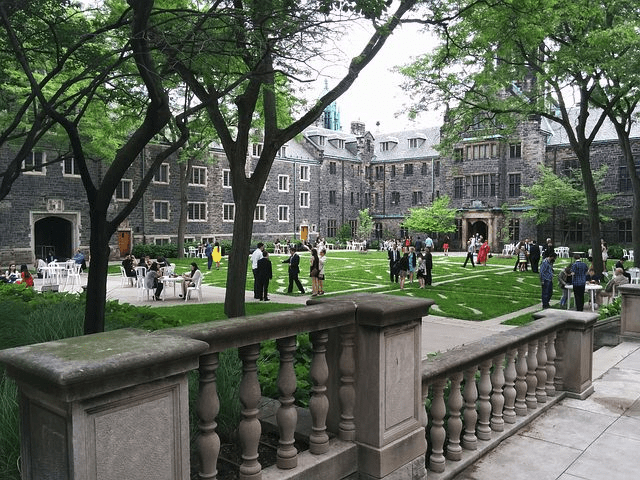
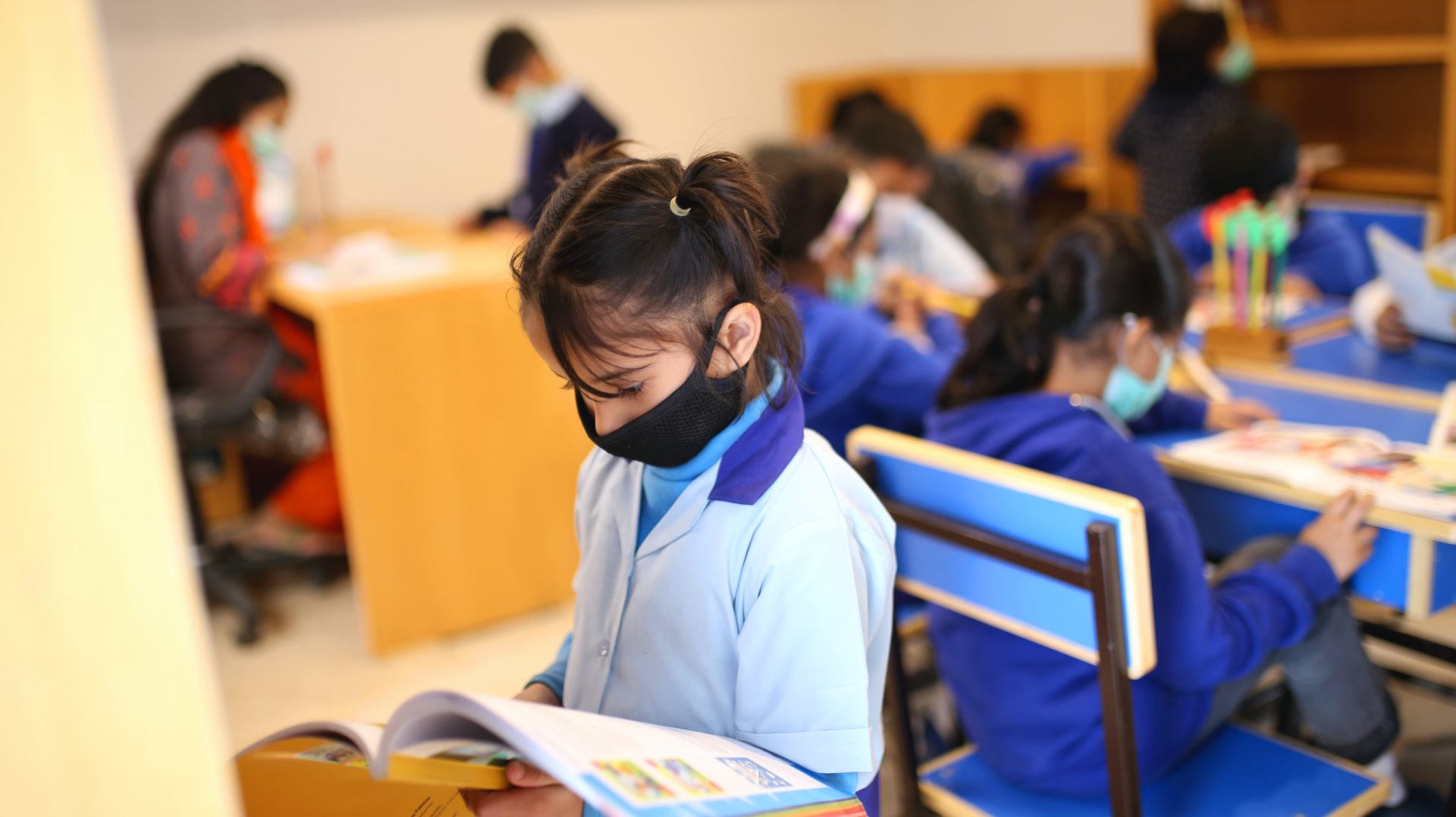
Photo by Muneer Ahmed OK on Unsplash
Schools are gearing up for reopening full time after more than a year of remote and hybrid learning. Such happy news should be a source of relief for parents who believe that virtual classes don’t adequately provide the environment and tools conducive to learning. However, the seemingly uncontrollable coronavirus infection rates from the Delta variant are causing trepidation, even fear, among these same parents.
Some people have gone so far as saying that it’s irresponsible for schools to reopen and have students come on campus under these circumstances. While the cost of learning loss should not be taken lightly, the threat to students’ and teachers’ safety and health should not be discounted in any way either. It is essential that we bring students back in the classrooms; it is necessary to keep students and teachers safe. Both are moral imperatives – one need doesn’t outweigh the other.
To find out how school districts and administrators are handling this sensitive issue, we reached out to the Arcadia, Monrovia, and Pasadena school districts and heads of independent schools to share their plans with us and our readers.
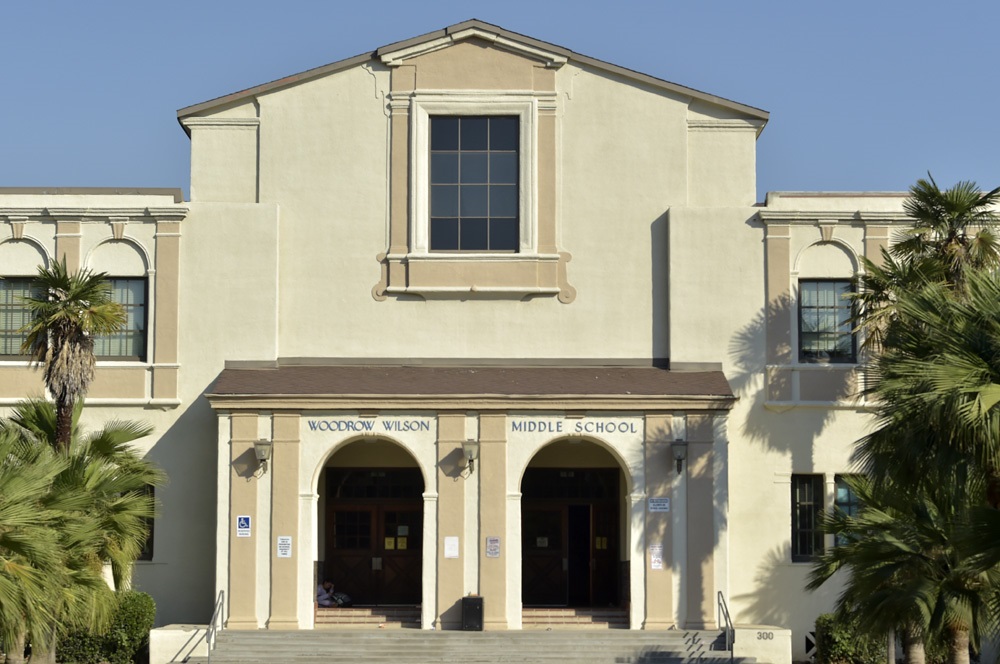
Wilson Middle School | Photo by Terry Miller / Hey SoCal
The Pasadena Unified School District serves approximately 17,000 students from kindergarten through 12th grade who live in Pasadena, Altadena, and Sierra Madre. Operating four high schools, five middle schools, three K-eighth, and 15 K-fifth elementary schools, it is the largest in the western San Gabriel Valley. Through Hilda Ramirez-Horvath, PUSD communications manager, Superintendent Brian McDonald discloses:
“School begins in PUSD on Thursday, Aug. 12. Classes will be full-time and in-person, five days a week. Learning will take place on campus an independent study will be available as an option for parents who are hesitant about sending their children back on campus. According to the California Department of Public Health (CDPH), in-person instruction can occur safely when prevention strategies are implemented. Since the pandemic began, PUSD has implemented multiple layers of robust set of safety measures. We will comply with the State’s public health requirements for schools and continue to work closely with the Pasadena Public Health Department (PPHD).
“We’re following the guidance of Pasadena Public Health and the California Public Health Department. We’re urging everyone who is eligible to get the vaccine, we have a robust COVID testing program, and masks are required for everyone. Ventilation is also in place with commercial-grade air purifiers in classrooms and common areas.
“As to whether PUSD will be requiring students to show proof that they’re fully inoculated, mandatory vaccinations for children are set by the state public health department. We will comply with state guidance.”
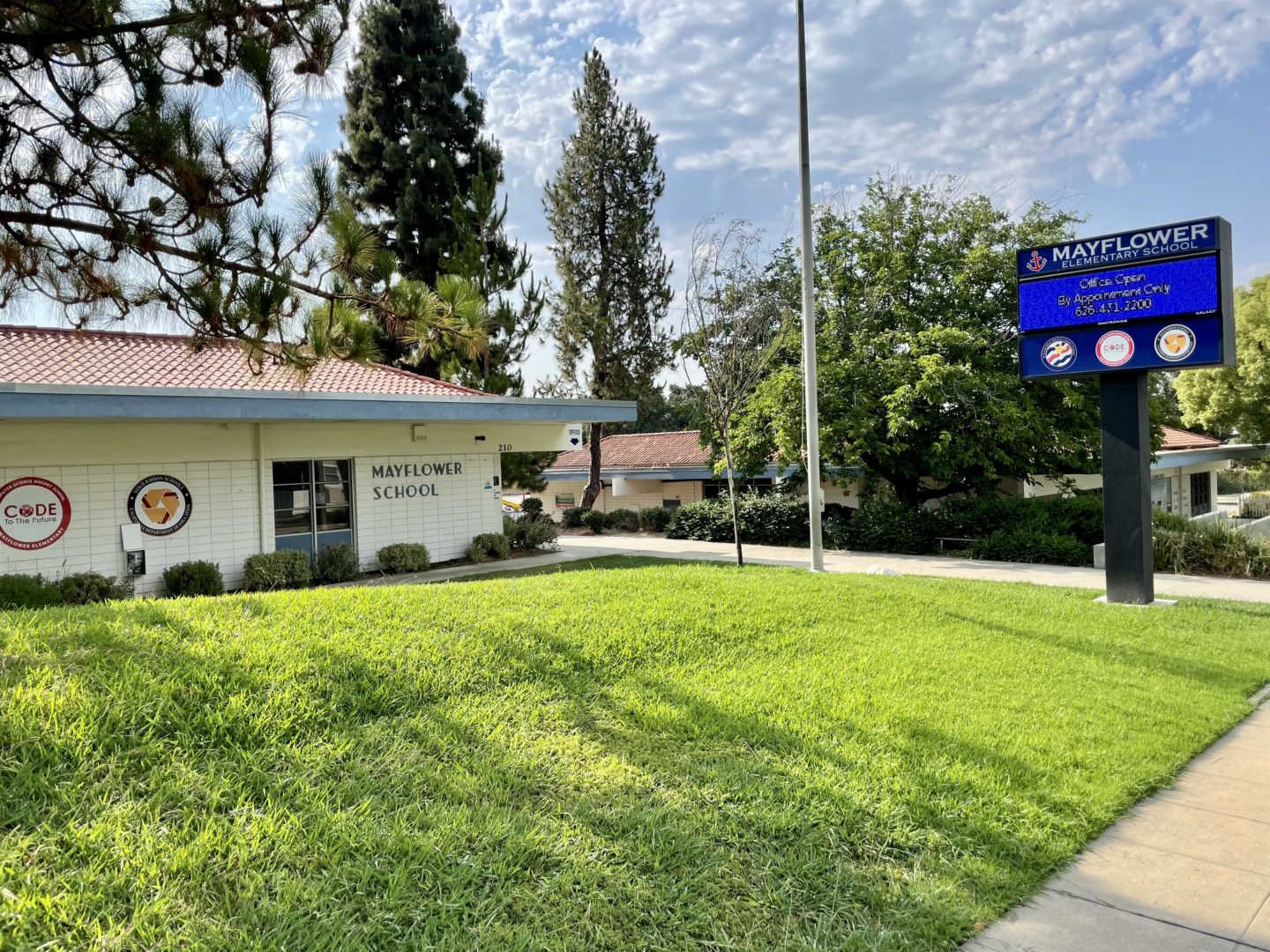
Mayflower Elementary School | Photo courtesy of Monrovia Unified School District
The Monrovia Unified School District encompasses five elementary schools, two middle schools, and one comprehensive high school. Superintendent Ryan Smith says:
“Our school year will begin on Wednesday, Aug. 18. We are very excited to welcome students back to campuses for traditional in-person instruction. We do have an independent study program at Mountain Park School that is a viable alternative for any family that prefers that their student continue to learn online on either a short or long-term basis.
“As always, we will be adhering to all requirements for schools that are laid out in both state and county public health guidelines. This includes the wearing of masks indoors for all students and staff; outdoors, masks are optional. Distancing is no longer a requirement in these guidelines; however, when feasible, we will do what we can to space students as needed or appropriate. We will not be requiring students to show proof of vaccination as that is not a requirement in health guidelines; students younger than 12 cannot be vaccinated anyway at this time. We have protocols in place to routinely clean our classroom, ensure proper ventilation, and access to PPE, again, all in accordance with public health requirements.
“We continue to emphasize that students who are ill or exhibiting symptoms stay home, handwashing, wearing masks, and that people get vaccinated if they are able.
“We are very excited about the start of the school year! Among our immediate priorities as we return are the following: identifying gaps in learning for each individual student and acting to address them; ensuring access to resources and support to address the social-emotional learning needs of all students; and utilizing technology to continue to personalize and accelerate student achievement.”
The Arcadia Unified School District is made up of 11 schools and serves about 9,500 students. It’s consistently named as one of the top school districts in the country by various ranking organizations; Arcadia High School is a U.S. News & World Report Gold Medal School.
We didn’t get a response from the school district’s information office but we learned that Arcadia High School will be opening on Aug. 11. Last Friday, Aug. 6, we observed the campus abuzz with activity – students were registering for classes, the band was practicing at the Performing Arts Center, and sports teams were meeting at the stadium. We saw safety protocols posted everywhere, the masking mandate strictly enforced, and bottles of hand sanitizers perched on tables at the reception lobby and at entrances. There was a definite air of eager anticipation for the school year to begin.
Most independent schools will start their 2021-2022 school year on the last week of August and, understandably, don’t have their plans etched in stone at this time. Among the handful of heads of school we requested information from, two agreed to tell us their procedures while emphasizing that they are in flux.
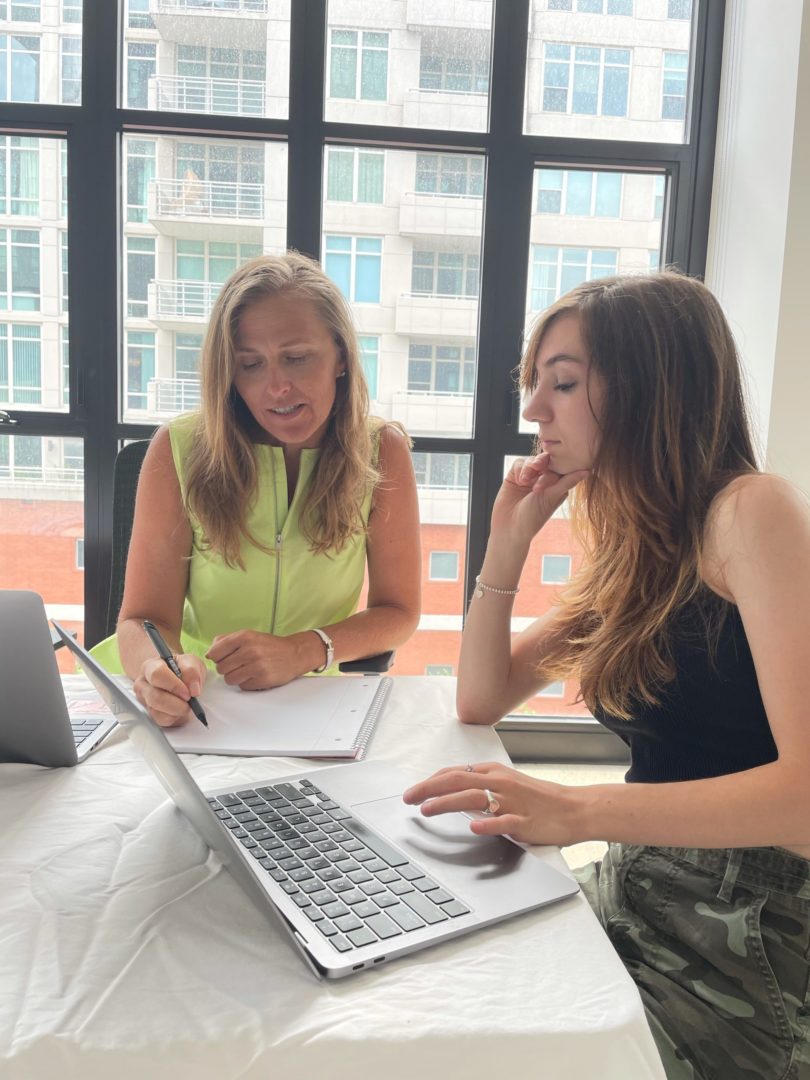
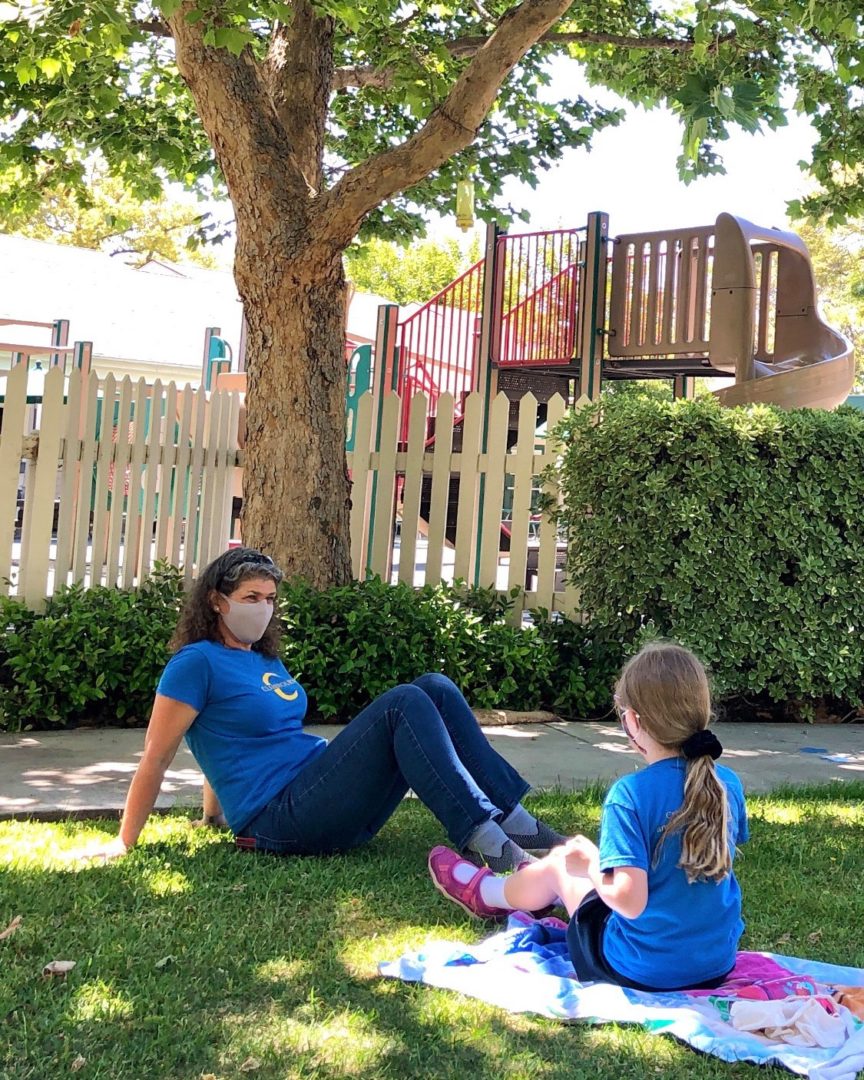
Head of school Amy Patzlaff relaxes with a student | Photo courtesy of Clairbourn School
Clairbourn School in San Gabriel, which has served the Pasadena area continuously since 1926, is a day school with a small enrollment of 200 students from pre-K to eight grade. Head of school Amy Patzlaff, states:
“Our opening day is Aug. 26, and we currently plan to offer only in-person instruction, but there may be situations that we will handle on a case-by-case basis. That said, we are prepared to go fully remote in any class or grade should that become necessary due to health department orders, exposures, or any other reason.
“Besides cleaning procedures in place, we have hand sanitizers at every building entrance, desks are spaced out in classrooms to a minimum of three feet and more where possible, ventilation has been increased, and we are mandating universal masking on campus. We have visual cues to help with spacing – dots on benches and paw prints on the sidewalks. We do daily health screening for symptoms prior to arrival on campus. We will be doing regular COVID testing as long as it is recommended, including upon return to campus after holidays. In addition, we follow all of the protocols recommended by the health departments of isolating any symptomatic students or adults, sending them home, and requiring testing before return to campus. We will collect vaccination information and store it, according to privacy laws, along with all other health records.
“The spring was a good test of protocols while fewer students were on campus. We found the students compliant and the teachers vigilant. With the layers of protection in place, we are confident that we have mitigated the risk enough to have a successful year. A group of school nurses in our area have been working closely together to share strategies and procedures. This brain trust has helped each school to build on the collective work to launch successfully. I am grateful for the partnerships. In addition we have been working very closely, since March, with Pasadena Public Health, Los Angeles Public Health, cohorts of local schools, and Joffe Emergency Services. All of these agencies and groups have been generous with their time and knowledge. They all have provided expert advice that we can use immediately.”
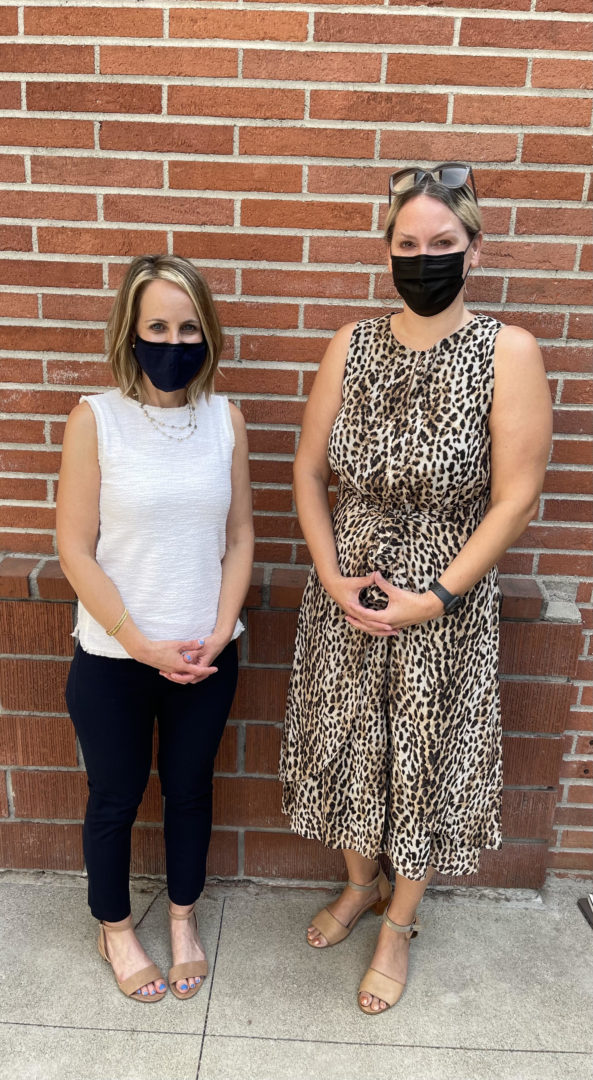
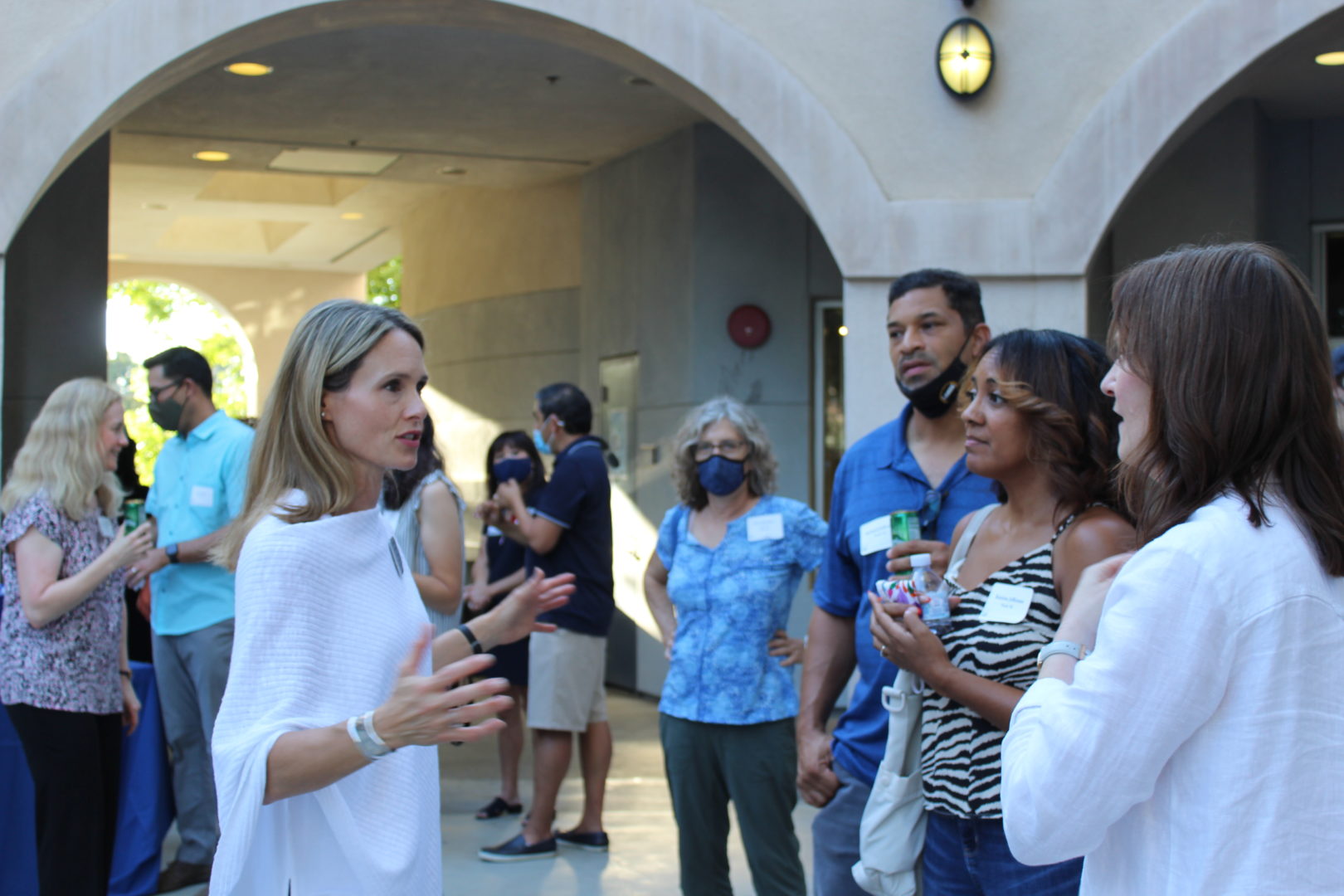
Vanessa Walker-Oaks (in white blouse on the left) chats with parents during a “Meet and Greet” event | Photo courtesy of Flintridge Preparatory School
A nationally recognized coed learning institution, Flintridge Preparatory School in La Cañada Flintridge, educates students from seventh to 12th grade. Through their director of communications, Nicole Haims Trevor, head of School Vanessa Walker-Oakes, shares their opening plans.
“Our school year will begin on Aug. 26 for in-person classes only. We will follow all guidance from the State of California and Los Angeles County, including (but not limited to) masking indoors and outside as appropriate, enhanced cleaning protocols, improved ventilation, frequent handwashing, and daily symptom assessments. We are prepared to be responsive as conditions and guidance change.
“We expect all eligible community members to be vaccinated and to voluntarily share their students’ vaccination status. However, we anticipate our policy to change when the FDA fully approves the vaccination, removing the emergency use authorization.
“While we are mindful of the Delta variant, we here at Flintridge Prep are enthusiastic and excited to reopen this fall, and we look forward to revitalizing our relationships and reconnecting with our families on campus. Flintridge Prep values our community’s health, safety, and wellness, and we will use a variety of tactics to reduce risk for our students, their families, and our faculty and staff.”
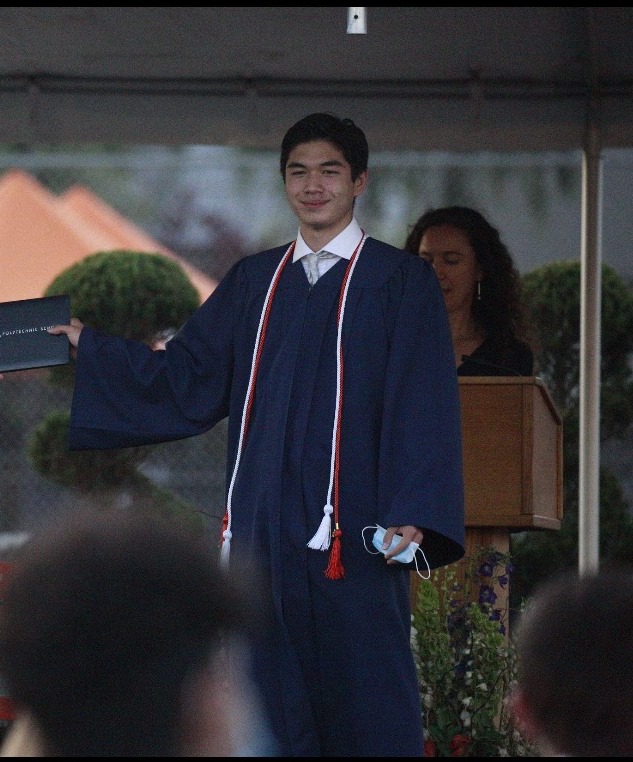
It’s graduation season for seniors – an event that is usually greeted with gleeful anticipation by students and their families. These students, who spent the majority of their last year in high school distance learning, are leaving after what would have arguably been one of the most memorable periods of their life. But it’s memorable in the worst possible sense because a great number of them feel it has been a lost year.
The college application process, a rite-of-passage for teenagers all over the country, wrought a great deal of anxiety and disappointment this year. Already a nerve-wracking time for students and parents, the pandemic has not only intensified their apprehension but has also exposed a trend in college admissions. According to a New York Times education briefing, selective schools – including California’s UC system and Penn State – saw double-digit surges in applications due to standardized test scores being waived this admissions cycle. Harvard University had a record-setting 42% increase and the entire Ivy League had to extend its notification by a week to give admissions officers time to read and process applications. It marked the lowest college acceptance rates in a decade for these schools.
On the other hand, many state schools and small private colleges suffered double-digit drops in applications and enrollments. Many institutions outside the top-tier have been struggling for years and the pandemic just made it worse. The N.Y. Times report further said American colleges and universities have endured losses of more than $120 billion and a few have shut down permanently. The institutions still operating often have to make up the difference by cutting services and programs that provide the tools, resources, and support which many low-income and first-generation students need to complete their degrees.
A survey released a few weeks ago by Intelligent.com, a resource for pre, current, and post college students to use when making choices for their education, provides additional evidence of pandemic’s negative effect. It found that one in four students who left college during the pandemic isn’t returning – at a time when getting into a university was tougher than ever.
Intelligent.com’s key findings are as follows:
21% of students from households that earn less than $25,000 annually left school during the pandemic.
38% of students of color who left school during the pandemic did so because they could not afford tuition.
19% of undergraduate students say they won’t graduate on time because of pandemic-related disruptions.
One-third of college students would attend classes exclusively online in exchange for a 10% tuition decrease.
Beata Williams, a college admissions expert and a consultant at Intelligent.com, pronounces, “For many students who have comfortable spaces to study in, privacy, and online connectivity capabilities, the shift to online classes did increase their productivity. However, for students who live in smaller spaces with shared rooms, less privacy, and may have caretaking responsibilities, the shift to online learning during the pandemic decreased their productivity.”
Beata Williams | Courtesy Photo
By email, Williams answers Beacon Media News’ questions:
When was Intelligent.com established? What is its mission? Where is it headquartered? Who are the people behind the organization?
Intelligent.com was founded in 2017 by a group of digital marketers based in Seattle, Wash. The founding members can be found here: https://www.intelligent.com/about-us/ and the managing editor is Kristen Scatton. Our mission is to help students make smarter choices through our research and the information we publish.
Please describe your background, including number of years in education and capacity.
I have worked with students in an academic setting since my early twenties when I began my career in the Office of the Vice Chancellor for Student Affairs at the University of Illinois at Chicago. I authentically enjoy and have passion for coaching students to achieve their academic and professional goals. I also fell in love with the potential to make an impact within an academic environment. I completed my B.S. in marketing and my M.S. in public administration at UIC.
After completing my graduate studies, I moved to New York City and worked at Columbia University in the Executive MBA and Executive Education Program offices with executive level students as a finance and admissions officer. I later transitioned to New York University Leonard B. Stern School of Business where I worked in student engagement, executive education, MBA international programs, global programs and academic affairs. I thoroughly understand the admissions process and have extensive experience working with domestic and international students.
For the past nine years, I have been focused on coaching students through the undergraduate and graduate admissions process. A few schools my students have been offered admission to include: Carnegie Mellon, Columbia, Cornell, Hong Kong University of Science and Technology, London School of Economics, MIT, NYU, Oxford, UCLA, UPENN, USC, and Yale. Ninety-nine percent of my students have been admitted to at least one of their top choices. The feedback I overwhelmingly receive is that not only have I helped students reach their dream programs, I alleviate the stress by breaking down the application process into manageable steps leading them towards consistent progress towards their goals.
What was the purpose of the survey?
We designed the survey targeting enrolled college students with the purpose of determining how they felt about the current state of their education given that it is forcing them to learn in different settings and formats. We wanted to know how the quality of their education and their outcomes have changed during the pandemic and if that has changed their education plans for the future.
When was the survey done and who conducted it? How many students participated and how did you find them? Of the students you asked, how many declined to answer? What methodology was used?
The survey was administered by online survey platform Pollfish on April 6, 2021. We surveyed 1,250 American college students, including undergraduate, graduate, and doctoral students aged 18 and older about the impact of the pandemic on their education, and their preferences for school attendance once the pandemic is over. Of the 1,250 polled, none of them declined to answer. The data show 8/600 people were from the LA area (Los Angeles & Long Beach).
Does Intelligent.com offer services or products geared for college students?
Intelligent.com offers resources and guides for prospective college students and current college students to help students succeed in the classroom by bringing together the latest research with tips and techniques championed by today’s leading experts.
Please tell me anything else I need to know about you and Intelligent.com that I didn’t ask.
The internet is filled with information (some garbage). Yet where do we go when we need answers? As a group of digital marketers who have a deep understanding of the internet we wanted to do something about it. We deployed our team of experts and research to scour through all the nooks and crannies of the internet to find the buried treasure, analyzing mountains of data, in order to create content that helps students gain a competitive advantage in their pursuit of higher education and future endeavors. And to make this possible, we’re committed to finding a business model that best serves our users and doesn’t corrupt the integrity of our content. So you won’t find programmatic ad blocks on our site, nor will you find affiliate disclosures. Oh, and you definitely won’t see any ‘native ads’.
All is not lost, though. Williams assures, “While the pandemic has exacerbated the divide between advantaged and disadvantaged students, it has created an opportunity to re-envision and shift to a more equitable learning environment through hybrid learning opportunities at lower costs available to everyone. Community colleges serve a large percentage (approximately 50%) of students lacking in college prep skills and those from lower incomes; President Biden’s proposal to make community colleges tuition free, has the potential to significantly change the access to education for many students. And I still see a need for education in the future.”
Originally published on 8 October 2020 in the Pasadena Independent, Arcadia Weekly, and Monrovia Weekly
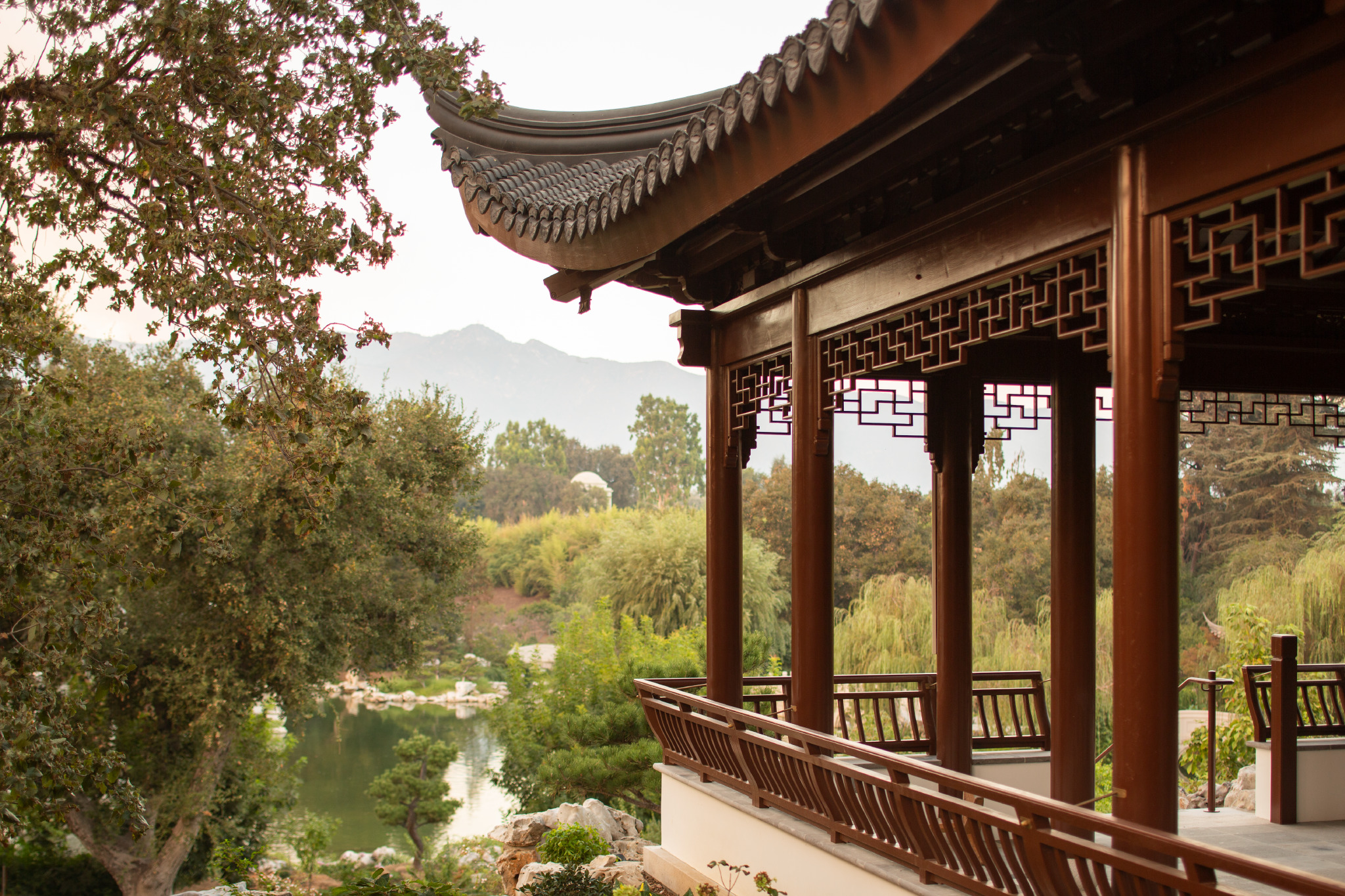
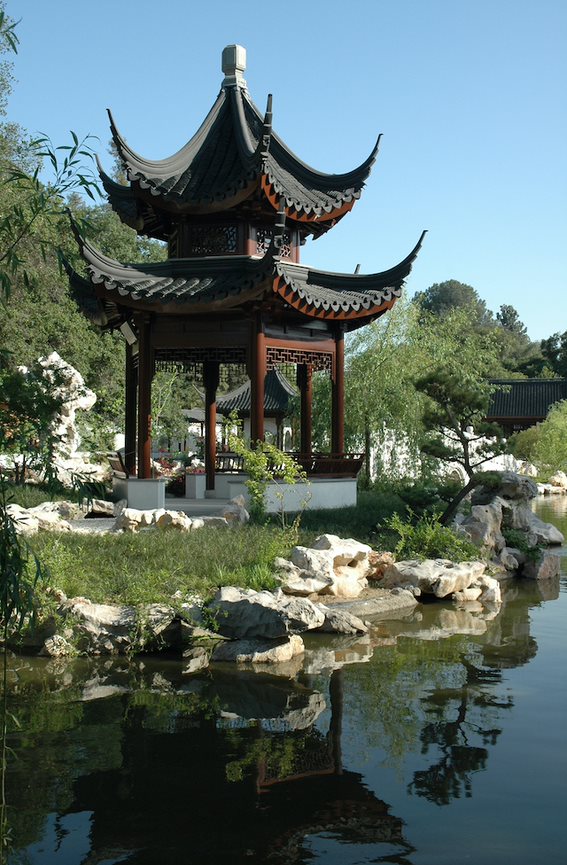
The Stargazing Tower, one of the new pavilions in the expanded section of the Chinese Garden. The Stargazing Tower offers sweeping views of the lake and garden below and of the ‘borrowed landscape’ beyond, including the San Gabriel Mountains and Mount Wilson Observatory, which inspired the pavilion’s name. | Photo by Beth Coller / The Huntington Library, Art Museum, and Botanical Gardens.
To say that it took a village and a few decades to create the Huntington Library, Art Museum and Botanical Garden’s Liu Fang Yuan (the Garden of Flowing Fragrance) wouldn’t be an exaggeration. And we’ll have the opportunity to see the completed project and revel in all the pleasures within when the expanded Chinese Garden opens on Oct. 9, 2020. And what a treat it will be!
Enjoy the arrival of fall meandering along lush landscapes, magnificent pavilions, and new attractions. Spread on 15 acres of land, 12 acres of which comprise a central garden, it features a bamboo grove on its western edge and a conifer forest to the north, making it one of the largest classical-style Chinese gardens in the world.
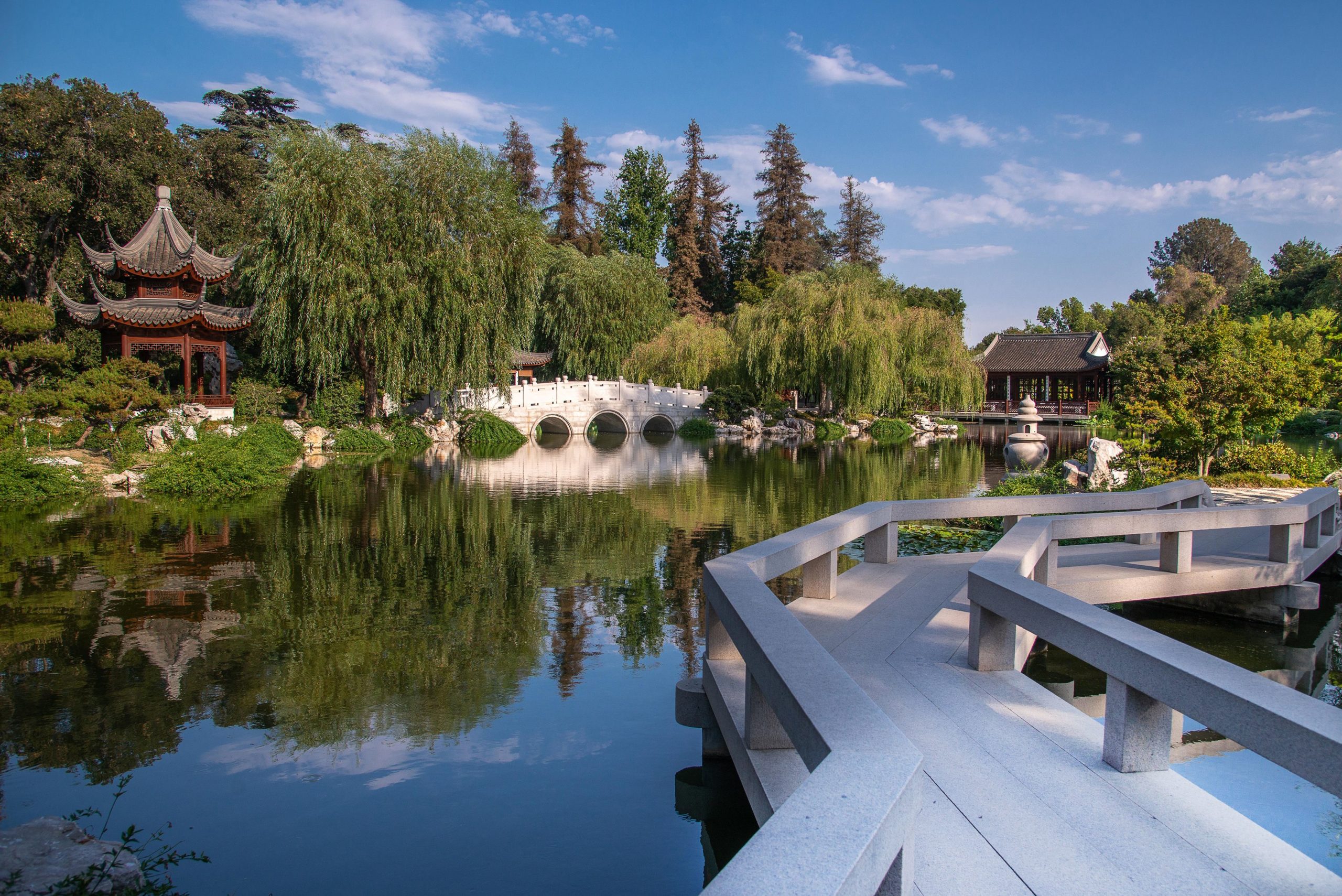
The Stargazing Tower is the perfect vantage point from which to view the gorgeous landscape below and the beautiful San Gabriel Mountains in the distance. This 527-square-foot pavilion is situated on the highest point in the garden at the southern end of the lake and evokes the Mount Wilson Observatory, which is visible from the tower, and the work of astronomer Edwin Hubble, whose papers are part of the Library’s holdings in the history of science.
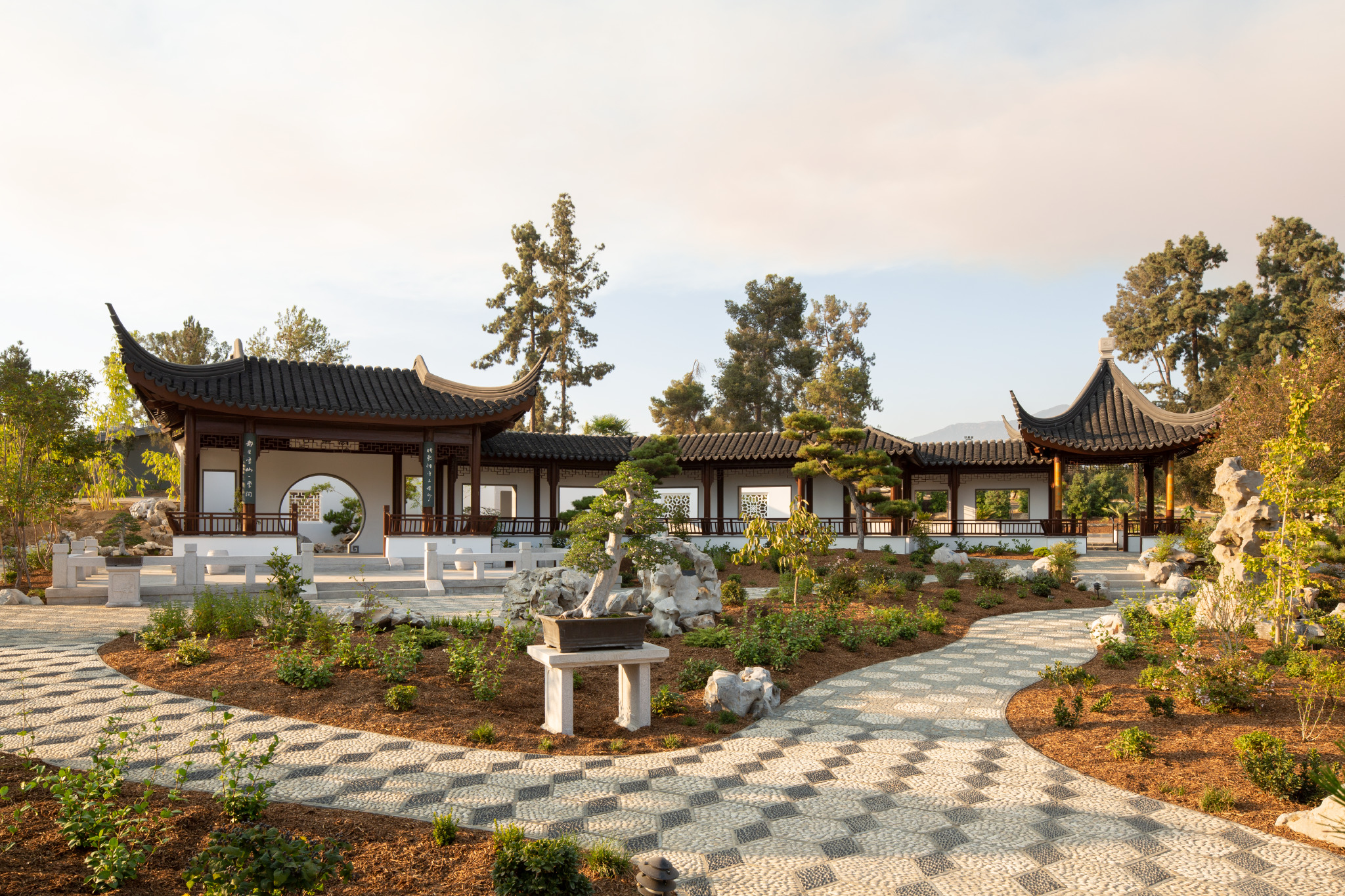
Visit The Verdant Microcosm, the 17,900-square-foot area on the western slope of the garden designed for the study, creation, and display of penjing (miniature potted landscapes, similar to Japanese bonsai).
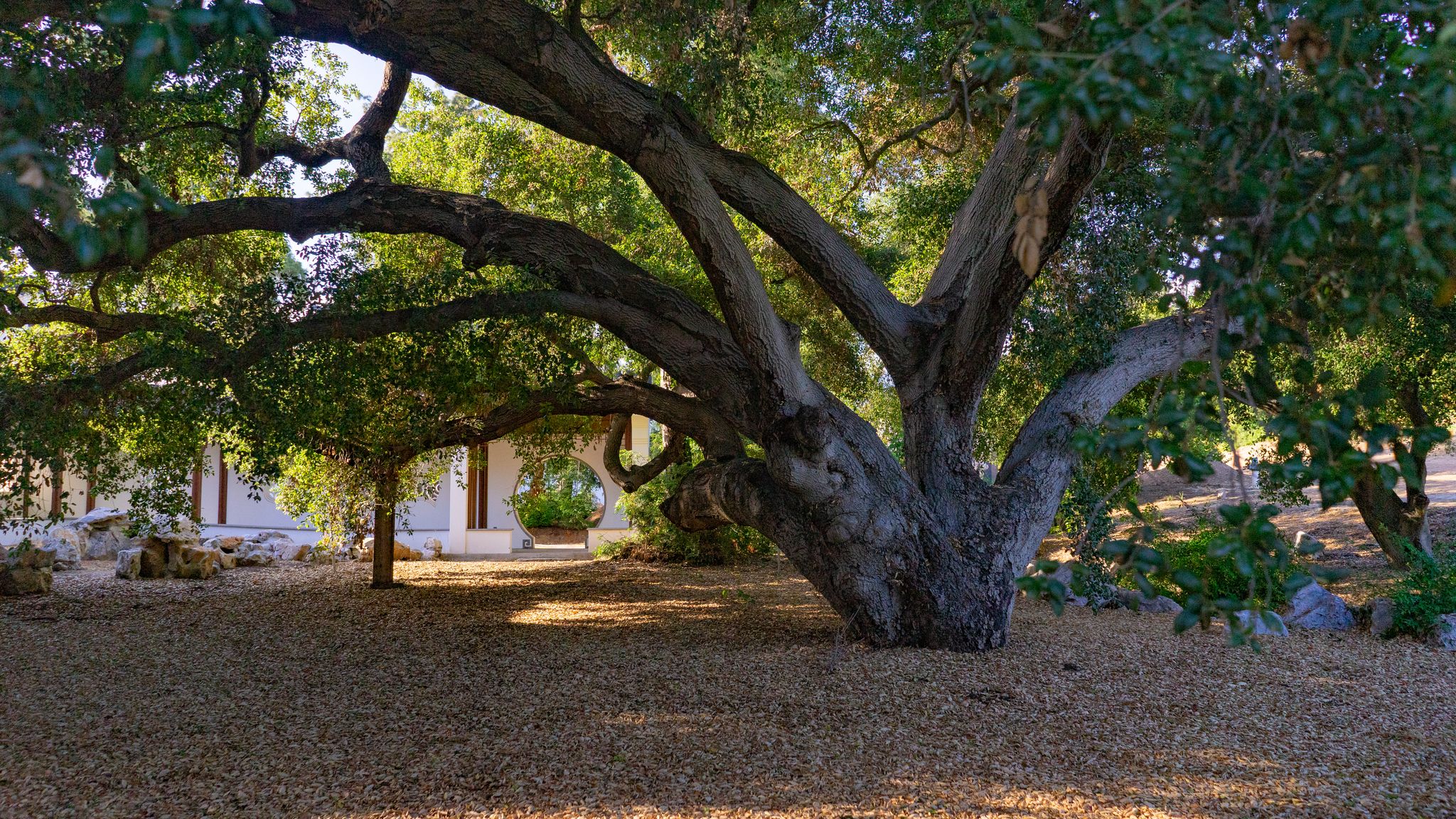
Take a breather at the aptly called Reflections in the Stream and Fragrance of Orchids Pavilion, which is shaded by mature California oaks near a gently flowing stream. The name of this 308-square-foot pavilion brings to mind the legendary gathering of poets at the Orchid Pavilion in Shaoxing in 353, immortalized by the great calligrapher Wang Xizhi, who wrote the preface to the collected poems.
Wander into the Courtyard of Assembled Worthies, a large patio paved with intricate pebble mosaics which links the existing Clear and Transcendent pavilion on the north side of the lake – the frequent site of concerts and performances – with the new exhibition complex.
Mature oaks frame a view of the Courtyard of Assembled Worthies and the Flowery Brush Library, two of the new features in the expanded Chinese Garden. | Photo by Aric Allen / The Huntington Library, Art Museum, and Botanical Gardens
As you would correctly surmise, all these wonders are the culmination of the yearslong work of countless experts and contributions from numerous individuals. In a pretaped interview, Phillip E. Bloom, June and Simon K.C. Li curator of the Chinese Garden and director of the Center for East Asian Studies, expands on what went into the garden’s creation.
Bloom reveals, “The idea for the Chinese Garden came about more than 20 years ago when Jim Folsom, the Telleen/Jorgensen director of the Botanical Gardens, began conceiving of a garden where he would showcase common American garden plants that are actually Chinese in origin. But as he learned about what a Chinese garden is and how it typically incorporates architecture, calligraphy, poetry, sometimes even painting, he began to understand that having plants alone would never be sufficient.
“It was a cross-cultural effort which began with The Huntington collaborating with Chinese American designers in the San Gabriel Valley in the late 1990s. In the early 2000s, we began working with a design firm in China. Since 2004 we also worked with a construction company based in Suzhou, China to build the actual garden which was done in three phases – from 2004-2008; 2012-2014; 2018-2020. The completion of the project took over two decades, involved more than 2,200 donors, probably over 150 artisans from China, innumerable subcontractors and laborers from the U.S., as well as 150 docents, and two or three different curators.
“On the construction aspect, at any one time, there typically were three or more languages being spoken – English, Mexican Spanish, Mandarin, and the Suzhou dialect. The workers had to learn to collaborate with each other despite their linguistic differences so there tended to be a lot of sign language being used on site.”
Bloom discloses further, “The Chinese American community played a major role in its creation. Before there was even a design for the Liu Fang Yuan, Jim initially consulted with the Chinese American community to understand, first of all, what a Chinese garden is and, more importantly, how it can serve the area around it. In the 1980s, the population of San Marino changed quite dramatically; today 70 percent of its population is of Chinese American descent. So it became imperative for The Huntington to create a garden that would be meaningful to the people who live in the area.
“Subsequently, these residents have become supporters either as donors, docents, or members of The Huntington. Many of them come to the garden every single day for their morning walk. It has also become a vital educational space. Students from various school districts in the San Gabriel Valley frequently come to the garden to learn about Chinese culture and how it is being adapted in an American context, to see examples of Chinese art which we feature periodically in the garden.”
World in a Wine Pot, one of the architectural features within the Verdant Microcosm, the garden’s new penjing complex.The Chinese art of penjing is similar to Japanese bonsai. | Photo by Beth Coller / The Huntington Library, Art Museum, and Botanical Gardens
As to what sets the Liu Fang Yuan apart and makes it noteworthy, Bloom explains, “Physically, the garden is unique because of its site. Southern California has a relatively dry climate so they had to plant it quite differently from what is typically done in Suzhou. It has also been adapted to local building and audience requirements. The garden itself, although it looks traditional, was designed to be able respond to its environment – the buildings are earthquake-resistant – and the needs of an American public – they are wheelchair- and stroller-accessible.
“Additionally, we have chosen to include an art gallery and a reproduction of a Ming Dynasty scholar’s studio. Through these spaces, we’ll be able to engage in exciting cultural activities and public educational programs. Eventually, students can come in to the studio and pick up a calligraphy brush and experience pre-modern scholar lifestyle.
“Most importantly, through the Center for East Asian Garden Studies, we’re able to offer a monthly lecture series on East Asian garden history, mount exhibitions periodically that bring art into dialogue with the garden, stawge performances directly from China as well as other places in the United States occasionally to perform traditional music as well as modern adaptions of such. There is no garden – to my knowledge – anywhere in China that is supported with scholarly and public programming.”
Liu Fang Yuan plays a significant role in promoting understanding and appreciation of East Asian garden culture, according to Bloom. He elucidates, “Our programming allows Americans to better understand East Asian garden culture and Chinese Americans to have a different perspective to learn about their own culture from scholars. Every month we have a lecture on East Asian garden history. Periodically we hold concerts, we bring artists, through an artist residency program, we actually create artwork in the gardens.
“Our initial exhibition, called ‘A Garden of Words,’ displays the original works of calligraphy we used to create the name placards on the buildings and scenic features and poetic couplets throughout the garden. Before any of these Chinese inscriptions were written on wood, stone, or tile, they existed as works on paper created by about 35 different contemporary artists from around the world, including China, Taiwan, Hong Kong, the U.S., and the U.K.
“At the same time, the garden itself functions remarkably well as a place of cross-cultural understanding with the scholar’s studio – where people can sit and try to do calligraphy or play the guqin – and art gallery and where we’ll have exhibitions that will provide an artistic perspective on Chinese garden culture. In the western expansion we created a massive, new penjing court where people would be able to compare Chinese penjing and Japanese bonsai.
View of the Lake of Reflected Fragrance, showing some of the original features that opened in 2008 (l–r): the Pavilion of the Three Friends, the Jade Ribbon Bridge, and the Hall of the Jade Camellia. In the foreground is the Bridge of the Joy of Fish. | Photo by Martha Benedict / The Huntington Library, Art Museum, and Botanical Gardens
A press release issued by The Huntington’s Communications Office describes the indoor spaces, which Bloom mentions, to open later: The art gallery, Studio for Lodging the Mind, a 1,720-square-foot climate- and light-controlled building at the northern end of the garden that will showcase changing exhibitions of Chinese artworks, both contemporary and historical. The gallery’s inaugural exhibition will feature ‘A Garden of Words: The Calligraphy of Liu Fang Yuan,’ will open in May 2021.
There’s the Flowery Brush Library adjacent to the gallery, a hall designed in the style of a scholar’s studio –a garden retreat traditionally used to create paintings and calligraphy. Also in this north section is a new casual restaurant with outdoor seating, known as the Pavilion Encircled by Jade. And a large open space overlooking the lake, the Terrace of Shared Delights, will be used for banquets, festivals, and other gatherings.
Cultural programming slated to coincide with the opening will include a virtual screening of the video ‘Fragrant Rhythms: The Seasons of Liu Fan Yuan’ by artist Tang Qingnian, on Sunday, Oct. 11, at 4 p.m. The video was produced during Tang’s residency as the Cheng Family Visiting Artist in 2019. The screening will be followed by a conversation with the artist and soundtrack musicians Wu Man (who composed the score) on the pipa (lute) and Kojiro Umezaki on the shakuhachi (bamboo flute). Presented on the Zoom videoconferencing platform, the screening is free with reservations, available at huntington.org/calendar.
Online lectures related to the opening will include: ‘The Pleasures of Chinese Gardens’ by curator Phillip E. Bloom on Thursday, Oct. 8, at 4 p.m., and ‘The Past and Future of The Huntington’s Asian Gardens’ by James Folsom, on Thursday, Oct. 29, at 4 p.m.
In addition, a special display of orchids throughout the Chinese Garden will celebrate the debut of the expanded features. Many of the flowers will be drawn from The Huntington’s own extensive orchid collections, supplemented by blooms from local orchid societies and commercial exhibitors. The display is tentatively scheduled for Oct. 16–18.
After being confined indoors for seven months remote learning and working from home, we’re longing to finally see what’s out there. An outing to Liu Fang Yuan fits the bill perfectly!
Originally published on 18 September 2020 in the Pasadena Independent, Arcadia Weekly, and Monrovia Weekly
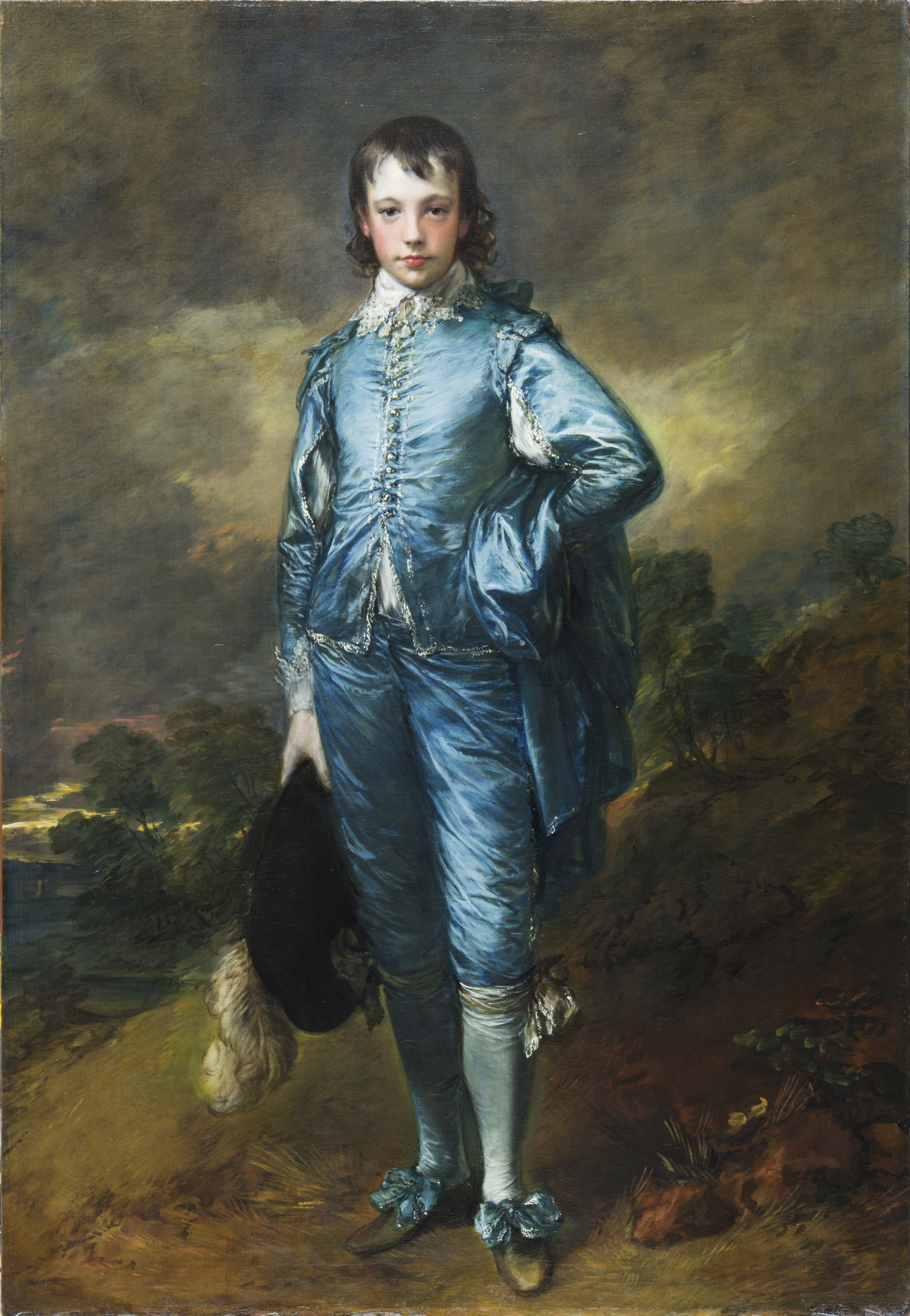
‘The Blue Boy’ by Thomas Gainsborough post conservation photo | Photo by Christina Milton O’Connell / The Huntington Library, Art Museum, and Botanical Gardens
Created by English landscape and portrait painter Thomas Gainsborough around 1770, ‘The Blue Boy’ occupies a place of honor at The Huntington Library, Art Museum, and Botanical Garden’s Thornton Portrait Gallery and is seen by about 800,000 people annually. After an 18-month restoration project, it has been rehung and will be available for viewing when it’s safe for the museum to reopen. And when we do get the chance to visit again, we’ll fully appreciate why the painting gained the moniker.
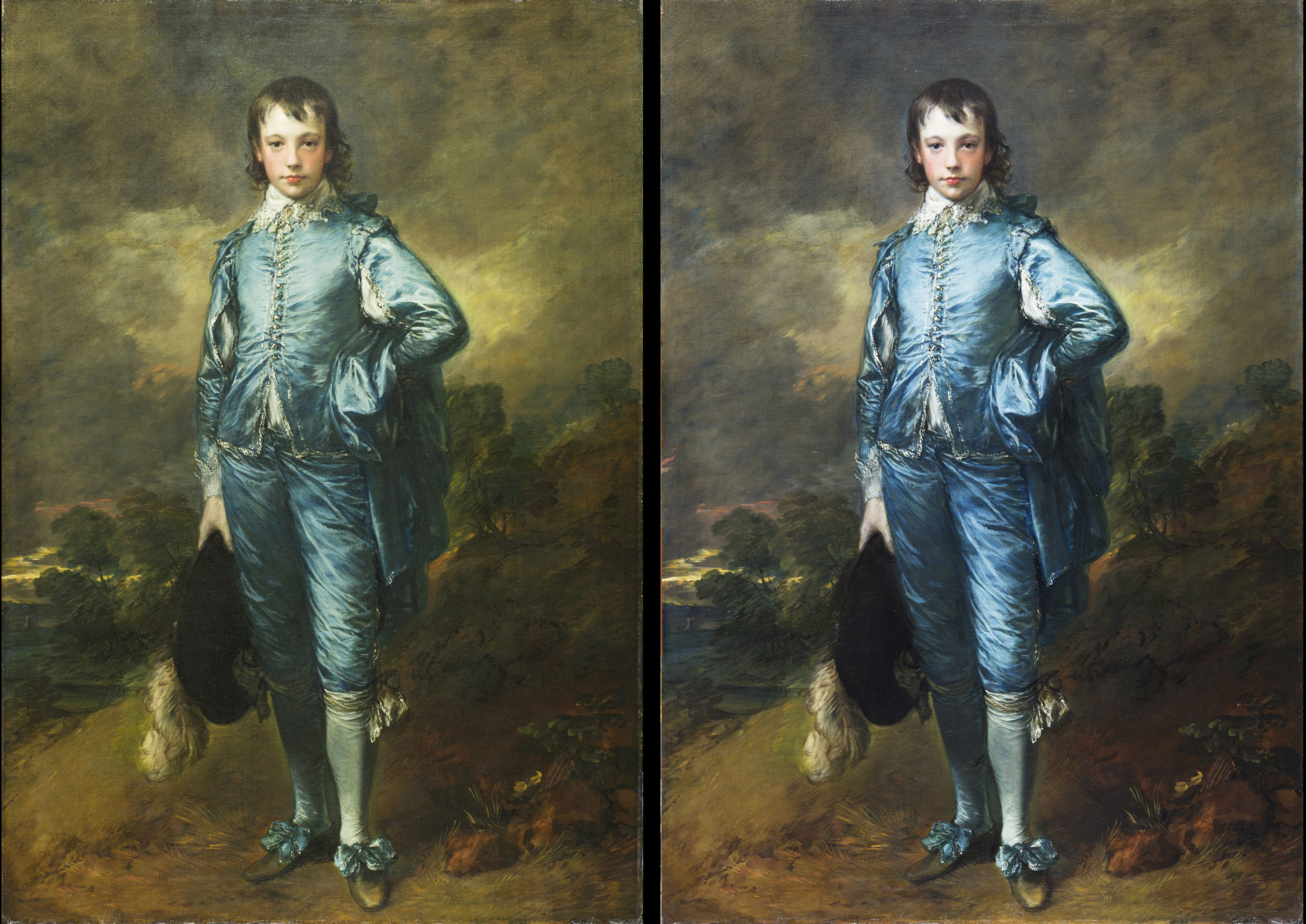
‘Project Blue Boy’ began in 2017 when conservators carried out a preliminary analysis of the painting. It was examined and documented using a range of imaging techniques that allowed Christina O’Connell, senior paintings conservator, and Dr. Melinda McCurdy, associate curator of British art, to see beyond the surface with wavelengths the human eye can’t see. Infrared reflectography rendered some paints transparent, making it possible to see preparatory lines or changes the artist made. Through ultraviolet illumination, they were able to examine and document the previous layers of varnish and old overpaints.
Their findings determined what needed to be done and how it was going to be accomplished – ‘The Blue Boy’ required conservation to address both structural and visual concerns. “Earlier conservation treatments mainly have involved adding new layers of varnish as temporary solutions to keep it on view as much as possible,” O’Connell declared at the start of the project. “The original colors now appear hazy and dull, and many of the details are obscured.”
According to O’Connell, there were also several areas where the paint was beginning to lift and flake, making the work vulnerable to paint loss and permanent damage; and the adhesion between the painting and its lining was separating, meaning it did not have adequate support for long-term display.
New images of the back of the painting were taken to document what appeared to be an original stretcher (the wooden support to which the canvas is fastened) as well as old labels and inscriptions that told more of the painting’s story. Furthermore, minute samples from the technical study and from previous analysis by experts were studied at high magnification (200-400x) with techniques including scanning electron microscopy with which conservators could scrutinize specific layers and pigments within the paint.
The undertaking uncovered new information of interest to art historians as well. During preliminary analysis, conservators found an L-shaped tear more than 11 inches in length which, data suggest, was made early in the painting’s history. The damage may have occurred during the 19th century when the painting was in the collection of the Duke of Westminster and exhibited frequently.
Side-by-side comparison of Thomas Gainsborough’s ‘The Blue Boy,’ Pre-conservation (left), post conservation (right) | Photo by Christina Milton O’Connell / The Huntington Library, Art Museum, and Botanical Gardens
It was decided early on that this conservation project was going to be different from what they had undertaken before – it would have an educational component and involve the community. The Huntington partnered with Bank of America’s Art Conservation Program to finance the massive undertaking.
For the first time in its history, The Huntington held a year-long exhibition from September 2018 to September 2019 showcasing the project in progress – the capstone of its centennial celebration. During the first three months, ‘The Blue Boy’ was on public view in a special satellite conservation studio set up in the west end of the Thornton Portrait Gallery, where O’Connell worked on the painting to continue examination and analysis, and began paint stabilization, surface cleaning, and removal of non-original varnish and overpaint.
It went off view from February through June when O’Connell performed structural work on the canvas and applied varnish with equipment that couldn’t be moved to the gallery space. ‘The Blue Boy’ then returned to the gallery where visitors witnessed the in-painting process until the close of the exhibition.
The final phase – held off view from October 2019 to March 2020 – involved in-painting, varnishing, supportive backing, and adjusting the framing.
A stabilized and restored painting was scheduled to be back at the Thornton Portrait Gallery in the spring, but the pandemic delayed the public unveiling until Thursday, Sept. 10. To help get the word out, The Huntington held a virtual press briefing. In conjunction with the event, Dr. McCurdy and O’Connell agree to be interviewed by email.
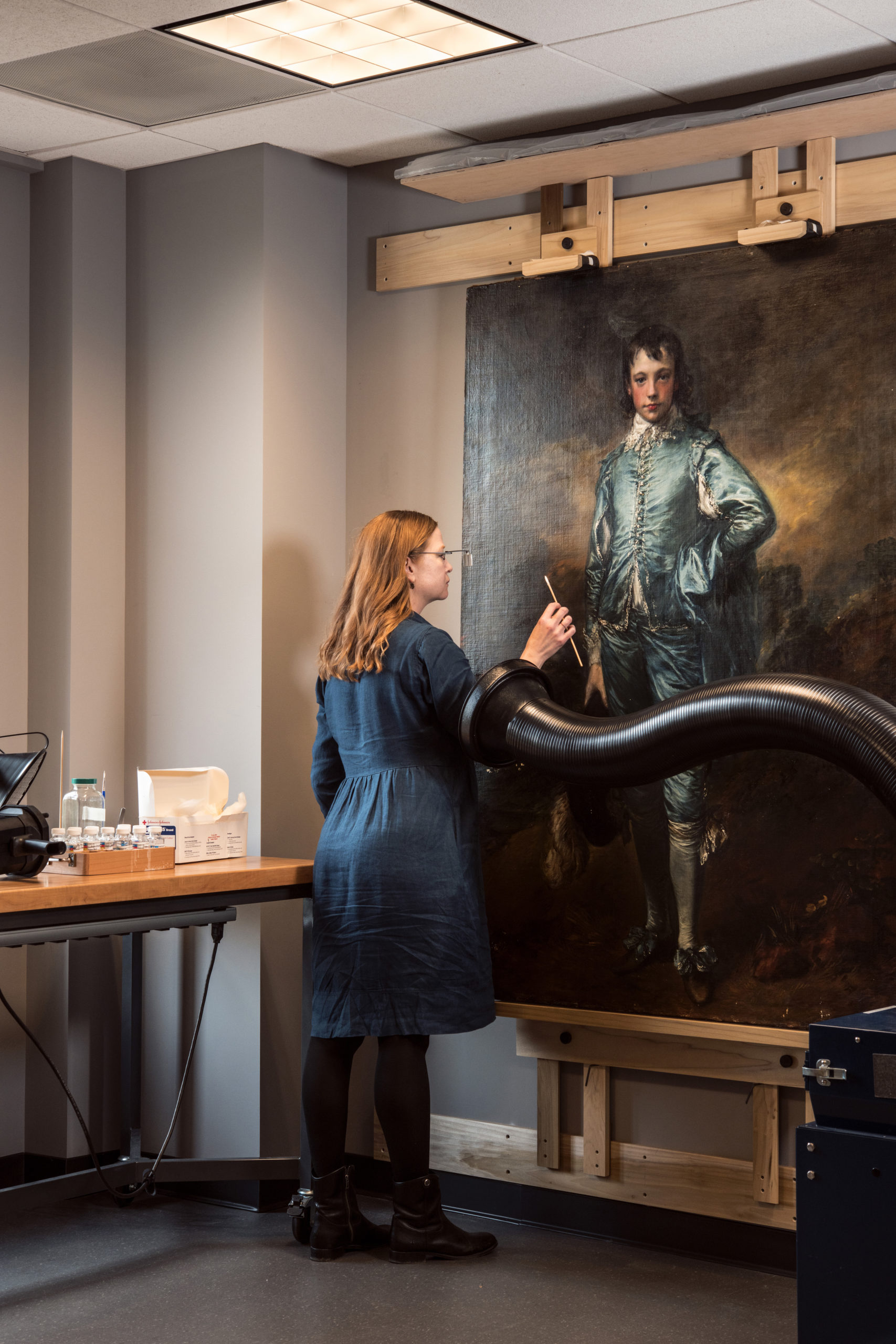
Christina Milton O’Connell, Mary Ann and John Sturgeon Senior Paintings Conservator, removed discolored varnish with small swabs | Courtesy Photo / The Huntington Library, Art Museum, and Botanical Gardens
I ask if they were able to find the answers to questions they had when they embarked on the project: What technical means did Gainsborough use to achieve his spectacular visual effects? Did he develop special pigments, create new materials, pioneer new techniques?
O’Connell replies, “We’re still waiting on some data from our samples and we hope to have more information soon. What we do know is that Gainsborough used a complex mixture of many different pigments together to make his colors. He also used many layers of opaque and transparent paint to create different visual effects. Now that the painting has been cleaned, we can see nuances of his brushstrokes that were obscured under the discolored/cloudy varnish. We can appreciate his technique from the fluid and fast strokes he applied to the sky and landscape to the more complex network of paint strokes that comprise the figure of the boy.
What might new technologies tell us about this earlier abandoned portrait? Where does this lost painting fit into his career? How does it compare with other earlier portraits by Gainsborough? Will there be other evidence that may become visible beneath the surface paint, and what it might indicate about Gainsborough’s painting practice?
“The digital x-ray gave us a clearer picture of the abandoned painting than we had previously,” answers Dr. McCurdy. “We were able to capture more of figure’s face, including his eyes, which we had never seen before. That was an exciting discovery. Unfortunately, there just wasn’t enough information for us to identify the sitter or to suggest a specific date range for the portrait.”
Adds O’Connell, “As Melinda indicated, we learned a lot from the x-rays. We also used infrared reflectography (IRR) to see through some of the layers of paint (X-rays go through all the layers). With IRR, we could confirm that Gainsborough didn’t take that previous portrait very far – he only captured the likeness of the sitter and painted very preliminary outlines for the figure’s shoulders. I’d like to point out that there isn’t one analytical technique that provides all the answers, we have to study the painting with many different forms of technology to get different pieces of information.
Did you discover other evidence beneath the surface paint and what did it indicate about the artist’s painting process?
“We used some techniques of analysis that hadn’t previously been used to study the painting,” says O’Connell. “One of those techniques is infrared reflectography (IRR). With this analysis, we can see what is beneath some of the paint layers and it’s a useful technique for examining the preparatory layers or sketches an artist applied under the paint. For Blue Boy, we can see preparatory lines that establish the bold pose of the figure from the very beginning stages.
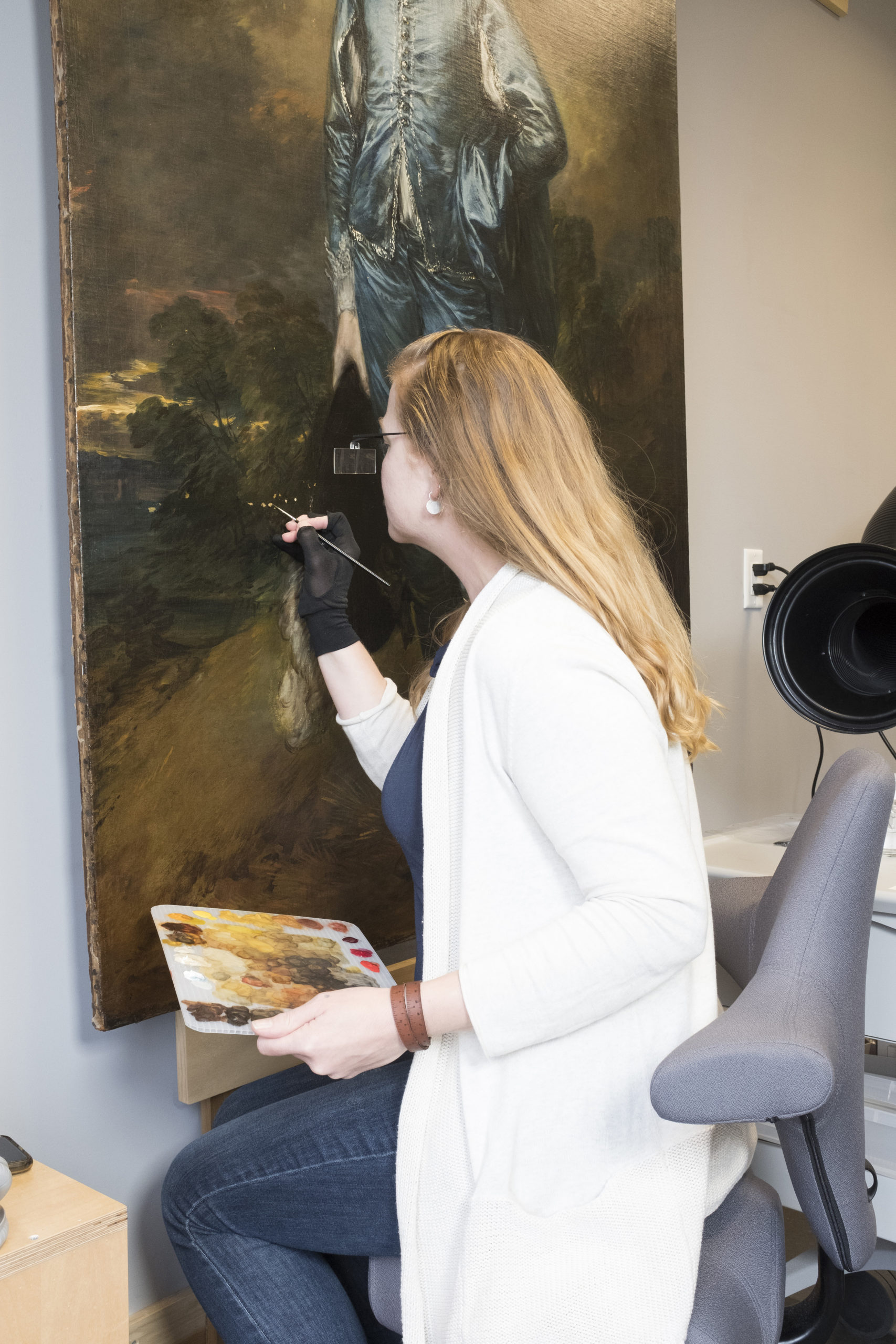
Christina Milton O’Connell uses tiny brushes to reconnect Gainsborough’s brushstrokes across the voids of past damages | Courtesy Photo / The Huntington Library, Art Museum, and Botanical Gardens
I ask if there were other revelations they hadn’t expected to unearth and Dr. McCurdy responds, “We hadn’t expected to find that the painting had suffered a major damage in the past. The canvas had been torn, but it had been repaired so well that it hadn’t shown up in previous x-rays.”
Continues O’Connell, “Discovering the tear helped us understand the reason why the painting was lined. There was a large damage that needed repair.”
“How does this restoration project compare with others you have done before?” I inquire.
“The condition issues for Blue Boy were not surprising for a painting from the 18th century,” O’Connell discloses. “Each treatment is slightly unique and a conservator has to take into account the original materials and how they’ve aged over time, but also the past treatments and restorations. Each project is a unique case study and that’s one of the things I love about the field.”
Painting restoration doesn’t sound like a thrilling project for the average person who isn’t knowledgeable about art, so I ask what we should find exciting to know. I tell them I was shocked to learn that Gainsborough had painted over something – it seems sacrilegious – but I imagine it was a common practice among artists.
Dr. McCurdy explains, “It is not that uncommon to find another painting beneath the surface composition. There are many reasons an artist might decide to paint over something else – maybe the composition didn’t work out the way s/he wanted? Maybe a client did not pay? Materials are expensive, so it could also happen for cost-saving reasons. In this case, we know that Gainsborough didn’t paint Blue Boy as a commissioned work, so he wasn’t being paid for it. It made financial sense to re-use a canvas he already had.”
“Sharing the treatment process with our visitors created another avenue for them to learn about and see Blue Boy in a new way,” O’Connell expounds. “Visitors were extremely fascinated to learn about all the layers that comprise the painting (there are 8-9 and you wouldn’t know that just from looking at the surface). Some visitors are drawn to learning more about Gainsborough’s technique and others were drawn to the process of conservation. Some were interested to see the forensic side of the technical investigation. The focus on research and education (part of The Huntington’s mission) really meant that this project had something for everyone.
Christina Milton O’Connell in-painting in the conservation lab | Courtesy Photo / The Huntington Library, Art Museum, and Botanical Gardens
“I have many memories from visitors coming to the gallery, but one that stands out was a day when I had a detailed discussion with an artist and a polymer chemist from JPL about varnishes. They both had a different reason for asking their questions and a different experience and understanding of varnish, but everyone was engaged.”
Please share your thoughts about what you, personally, learned as you did this project, I ask.
Dr. McCurdy states, “In watching Christina uncover Gainsborough’s original palette from beneath layers of dirt and discolored varnish and overpaint, it was remarkable to see this painting that everyone knows through cheap reproductions be revealed as a truly compelling work of art. Now, we get a better sense of the relationship between the figure and the landscape, we are better able to see the complexity of Gainsborough’s brushwork, and the true colors of the figure’s blue costume. Due to the discoloration, it had appeared slightly green-ish. That effect is now gone, and it is brilliant blue again. It must have been striking to audiences who first saw it in 1770.”
“Conservation is very much a process of discovery,” concurs O’Connell. “I spent a lot of time looking at the surface of Blue Boy while setting tiny flakes of paint back into place and during the cleaning process where, inch by inch, I saw the original surface emerge from underneath many layers of degraded and cloudy varnish. Each treatment has unique problems to solve and decision-making as part of the process, so there’s an opportunity for learning with each treatment.”
Lastly, I inquire if there’s something that they would like to add. And Dr. McCurdy divulges, “For me, the fact that The Huntington decided to do this conservation work on public view was important. Of course, this is a beloved painting to many of our visitors, and we knew we needed to keep it on display as much as possible, but the most exciting thing was the way the project engaged visitors with the role museums play in preserving cultural heritage. There were times when the crowd of visitors around the satellite conservation lab in the Thornton Portrait Gallery was several deep. People were excited to learn more about this painting and to see the conservation work unfold in front of them.”
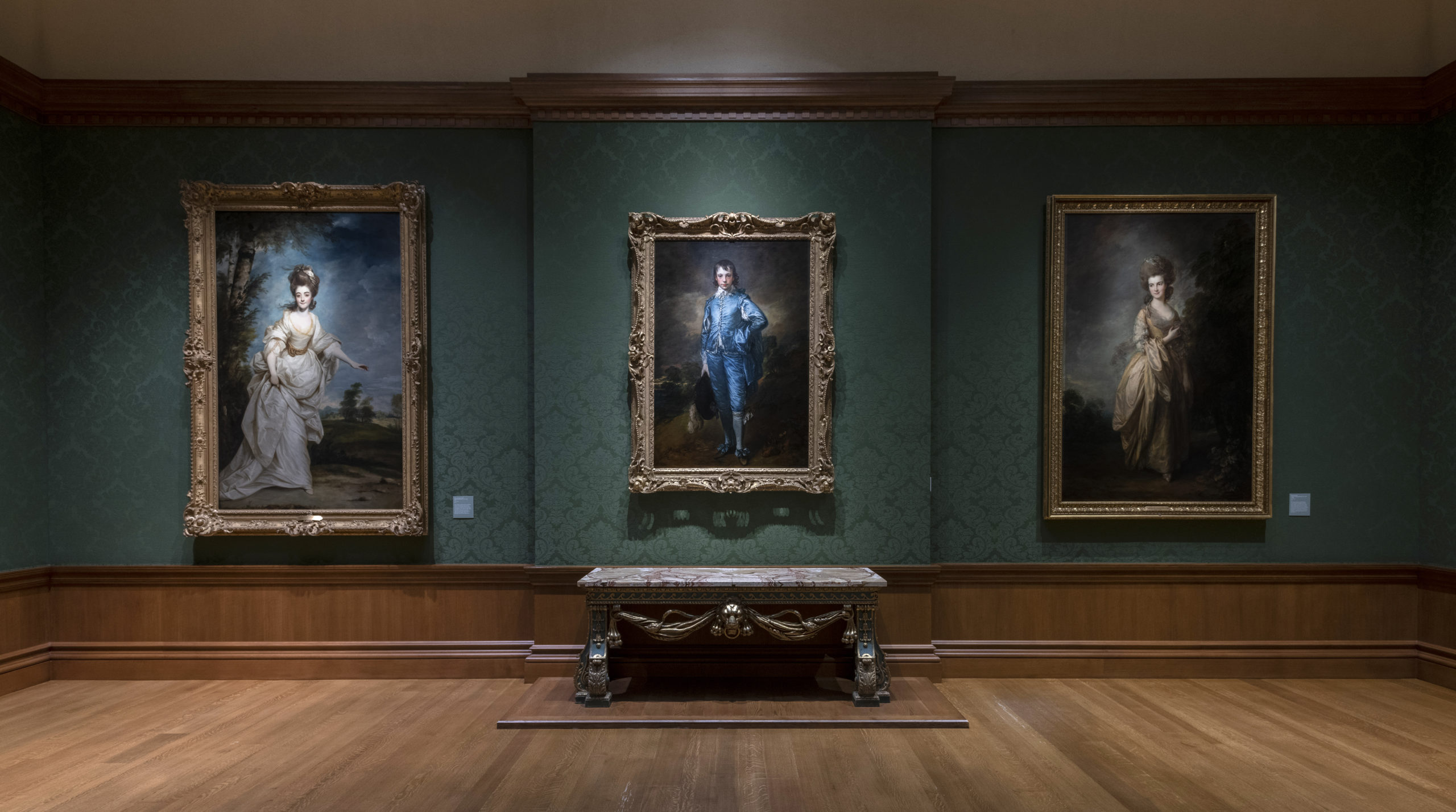
Installation view of ‘The Blue Boy’ in the Huntington Art Gallery | Photo by John Sullivan / The Huntington Library, Art Museum, and Botanical Gardens
‘The Blue Boy’ has a storied provenance. Thomas Gainsborough was among the most prominent artists of his day. Though he preferred to paint landscapes, he built a flourishing career as portraitist to the British aristocracy whom he depicted at their leisure. However, ‘The Blue Boy’ wasn’t a commissioned work but was done to show off his skill at the Royal Academy. Later circulated accounts that Gainsborough did it to disprove another painter’s belief about the use of the color blue were dispelled by The Huntington’s curators as apocryphal and were made after his death. The model was believed to be Jonathan Buttall (1752–1805), the son of a wealthy merchant and who was also the first owner of the painting, but his identity remains unconfirmed.
Anthony van Dyck, the 17th century Flemish painter, was a major influence in British art and Gainsborough’s Blue Boy’ appears to be an homage to him. Instead of dressing the figure in the elegant finery worn by most sitters at the time, Gainsborough chose knee breeches and a slashed doublet with a lace collar – inspired by van Dyck’s ‘Portrait of Charles, Lord Strange.’ It made its debut at the Royal Academy exhibition of 1770 as ‘A Portrait of a Young Gentleman,’ where it received high acclaim. By 1798 it was being called ‘The Blue Boy.’
When Henry and Arabella Huntington purchased ‘The Blue Boy’ in 1921, it was already being hailed as Gainsborough’s greatest work and a national treasure. His image was on print reproductions, even on chocolate tin containers. It was no surprise then that the sale of the painting to an American caused an enormous protest in its homeland. The National Gallery displayed it one last time before it left for California and reportedly drew 90,000 people.
But they needn’t have lamented – ‘The Blue Boy’ is as beloved and treasured at his home of 99 years. As Christina Nielsen, The Huntington’s Hannah and Russell Kully Director of the Art Collections, pronounced during the press briefing, “We hold him in trust not only for this generation but for future generations.”
The boy wearing a dazzling blue outfit and defiant demeanor once more stands confident at The Huntington’s Thornton Portrait Gallery where he will continue to beguile hundreds of thousands of admirers into the next century.
Originally published on 11 September 2020 in the Pasadena Independent, Arcadia Weekly, and Monrovia Weekly
Benjamin Franklin appointed the first postmaster general in 1775 but it wasn’t until the passage of the Postal Service Act in 1792 that the post office department was created. In 1970, it became what we now know as the United States Postal Service (USPS).
For all the noble purposes its creation was intended, the USPS has seen its share of negative press and not by its own doing. In 1986, a series of incidents involving postal workers killing managers, fellow workers, and police officers originated the derogatory expression ‘going postal.’ Since then, anyone having a meltdown is described as ‘going postal.’
President Trump recently threatened to block aid for the agency unless it quadruples its prices for package shipping. That could adversely affect the USPS’s partnership with Amazon to deliver the online giant’s packages at a discounted rate. Yet, its financial woes may have nothing to do with shipping prices but are due to a congressionally-mandated retirement health plan that no other agency is required to observe.
All these, however, are a cause for concern among USPS employees as they wonder if they will have jobs when the dust finally settles. I would like to advocate recognizing the invaluable service that these men and women provide and rescuing them from an uncertain future.
Our
mail carrier Rudy has been working in our neighborhood since my daughter
Brianna was four years old. She thought then that Rudy was a relative because
each time he delivered our mail, we would chat and ask about each other’s
family members as if we knew them personally.
Rudy
and I swapped accounts of the challenges in finding caregivers for parents with
dementia and the travails of the ‘sandwich’ generation – adults who have aged
parents and young children to look after. We commiserated with each other when
these parents we had been worrying about passed away.
It
was Rudy who chased after our hyperactive cocker spaniel Charlie when he bolted
out into the street as we were chatting by the front door one day. As fast as
Charlie ran, Rudy was faster and got our dog safely back in no time.
I don’t know everything that happens in our neighborhood, but Rudy sees them all and that’s how I find out. He is privy to a lot of joyful occasions as well as the heartbreaking events. He was the one who told me that the well-known interior designer who owned the gorgeous French Regency residence nearby was moving to South Pasadena to open a larger office. Four years ago, he excitedly informed me that the teenager who lived close to us had qualified to compete in swimming at the Summer Olympics – he was as proud of her as her parents were!
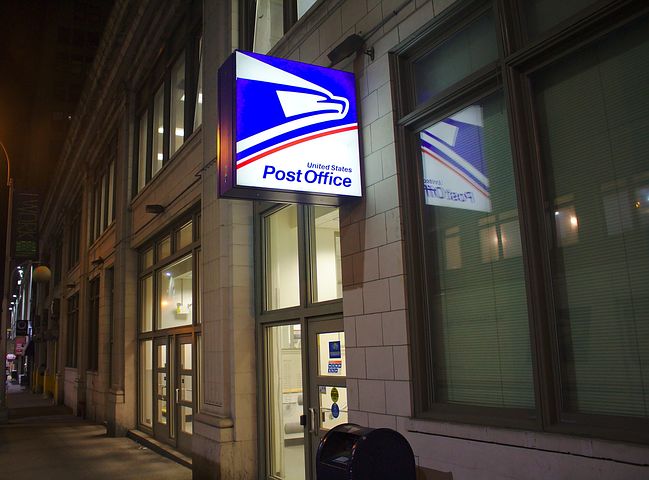
A USPS office | Courtesy photo
When an internationally famous pop star suddenly died about a decade ago, Rudy told me a neighbor of ours was bereft not only because she knew him personally – she was one of his back-up singers – but also because his worldwide tour was going to be her major break.
A sad occurrence Rudy relates concerns an older resident who lived on her own. He says, “I always made it a point to stop for a few minutes to look in on her and would run errands for her. One day, I found out that some of her relatives were trying to extort money. I took it upon myself to let her exploiting relatives know that I was aware of what was happening, and that I would report them to the proper authorities if they attempted it again. She has since passed away and her estranged daughter is now living in the house. I wish she had been there when her mom needed her.”
Perhaps the most heartrending event Rudy has witnessed unfolded only a few weeks ago. He recalls, “There was an electrical accident at the house that’s being built up on this street. I saw the man who was working inside come running out with his body on fire. People had gathered, telling him to roll around the grass but there really wasn’t much of that left, there was mostly debris from all the construction. The man’s clothes had burned and he was naked, so I asked someone to get me a towel to cover him with. The paramedics arrived rather quickly and rushed him to the hospital but, tragically, he passed away the following day.”
As
to the job itself, Rudy says, “It is generally a pleasant job. The mail
processing at the facility where I work is quite organized – the mail being
distributed to carriers is balanced out so that there aren’t days when we’re
delivering them until dark. That’s not to say that it isn’t stressful, though,”
he admits. “There’s always the pressure to work faster and more efficiently.”
It’s usually the mail carrier who is the first to see changes in the area and Rudy has observed a shift in demographics in the last decade. He reports, “There’s a lot of construction going on. Older residents are moving out and are being replaced by younger families. The pandemic caused an increase in online shopping which has meant more packages to deliver, but I already had more packages than other carriers’ even before the lockdown because there are more young people on my route and they tend to shop online.”
I ask what he likes about being a mail carrier, and Rudy replies, “The people are all very friendly, warm, and caring. There’s one elderly gentleman who keeps an ice chest with cold water and soda waiting for me on his porch. Another older lady calls me on my cell or home phone when she hasn’t see me for days, to make sure I’m okay. Everyone takes the time to chat or say ‘Hello.’ It’s the people that make it a gratifying job.”
Rudy
has been working for the post office for 31 years. He and his wife will be
celebrating their 39th anniversary next month, after having raised
four children ranging in age from 38 to 25. He’s eligible for retirement and is
looking at all his options. He loves the job and enjoys his daily rounds in the
neighborhood but he thinks it might be time to hang up his mail carrier hat. It
will be a gloomy day when he decides to – we can’t fathom having someone other
than Rudy deliver our mail.
| Courtesy photo
A
mail processing clerk who graciously agrees to answer my questions on condition
of anonymity because he is contractually prohibited from speaking with the
media on behalf of the post office without their prior approval, has been a
USPS employee for six years now.
When I inquire if he feels the agency gets undeserved bad publicity, he says, “I’m not sure that USPS gets all that much bad publicity. At the end of the day it is a service that customers pay for; and when a customer has a bad experience they will want to complain about it (sometimes rightfully so). Maybe some people wrongfully believe their tax dollars are being spent to support the Postal Service and would like to have more say in how it is handled. As a service it is not without its shortcomings, but postal workers fulfill a vital role in society. Everyone notices when the package or letter they’ve been expecting arrives late and a lot of people are working to make sure it won’t.”
I ask how the budget cuts affected employees, his workplace, and the performance of his duties, and he replies, “At my facility only overtime hours were cut; but in a facility with hundreds of employees, that equates to a lot of work time. The only changes I have experienced were cuts to overtime and operational hours, i.e., operations were to be shut down at prescribed times to facilitate a regimented flow of mail; but that meant unprocessed mail was held for the following day.”
“This led to delays in processing for delivery, which meant most days were heavy (for this time of year) and ultimately led to sending large amounts of mail to the carriers every day,” he continues. “That affects how long they are out on the road and, in turn, how quickly they can return with mail to be sent out processed. These policies would not have held up under the volume of the election mailings [opinion based on having worked during previous elections] – the amount of mail that would have been delayed would have been astronomical. During the 2016 election, mail-in-ballot volume increased processing time for outgoing mail by 1-2 hours a day for multiple weeks leading up to the election itself.”
As to accounts in the media about rotting food and dead animals at some postal offices, he clarifies, “The only parcels we work on are 1-day Express and those were unaffected. Live animals, perishables, organs, et. al. are only supposed to be sent 1-day Express. If those items were sent by another method it would be handled by another facility; and those stories do not surprise me with parcel volume as high as it is coupled with the cuts we had experienced.”
“The
atmosphere at work is fairly neutral, trending toward concern,” he adds. “There
was a lot of confusion and frustration with the policies enacted at the
beginning of August. There is some uncertainty with regard to funding and the
longevity of the Postal Service, should the recent strains put on it persist.
“It
is largely a good place to work, notwithstanding. Like many jobs there are
supervisors and managers you like and those you don’t; coworkers you like and
those you don’t. There is plenty of opportunity to advance or branch out into
different jobs other than what I do currently. More recently, it has been
stressful with wearing a mask all day at work and the political climate making
our future uncertain. But I have work that keeps me busy enough to not worry
too much.”
As he points out, the USPS is a good place to work at. It is also a compassionate agency. According to the USPS website, it has a long history of providing career opportunities to veterans, reservists, and their family members. It employs more than 97,000 veterans across the country. Former military members make up over 18 percent of its personnel, which means it employs veterans at three times their share of the national workforce.
Besides being a good employer, the USPS offers affordable postal and shipping rates and small business owners rely on it to get their products to customers. While the recent delays due to the budget cuts caused havoc on their shipping budget and even resulted in lost income for some, that is not the norm. The USPS has reliably delivered parcels and packages to their destination in a few days.
Compared with those of other countries, we enjoy the least expensive postal delivery system – a fact most of us don’t fully appreciate. Being an avid traveler with an annoying habit of sending postcards to friends and family from wherever I am, I have first-hand knowledge.
We spend 55 cents to send by first-class mail a one-ounce letter, and 15 cents for each additional ounce, $1 for a flat/large envelope, and 35 cents for postcards anywhere within the United States – that’s 3,797 million miles of land area. We pay $1.20 to send a letter or card to most countries in Asia and Western Europe.
The
Royal Mail, on the other hand, charges 76p for first-class (approximately $1.30)
and 65p (approximately 86 cents) for second class mail within the United
Kingdom. Tom, my son-in-law, is from England and his entire family lives there.
It costs his friends and family from ₤1.55 (about $2.06) to ₤1.66 (about $2.21)
to send him a one-ounce card during the holidays. And having been to the U.K. a
few times, I know that it costs at least ₤1(about $1.33) to send a postcard here.
My
sister, who lives in Switzerland with her husband and daughter, spends CHF 2.00
(about $2.12) to send a letter to me. I have to add that the Swiss postal
system hasn’t been as reliable as in the past – the last time I sent my niece a
birthday card, it took seven weeks to get to her, when it used to take only
five days.
I have relatives in the Philippines who have limited themselves to sending me e-cards during Christmas because the price of international postage stamps is prohibitive. To give you a clear picture of what I mean, the minimum wage there is 537 Philippine pesos (PHP) or $11.05 per day and sending a one- ounce letter (up to 28.35 grams) to L.A. county costs 140 PHP or $2.88. That’s over a quarter of what a Filipino minimum-wage worker makes in one entire day!
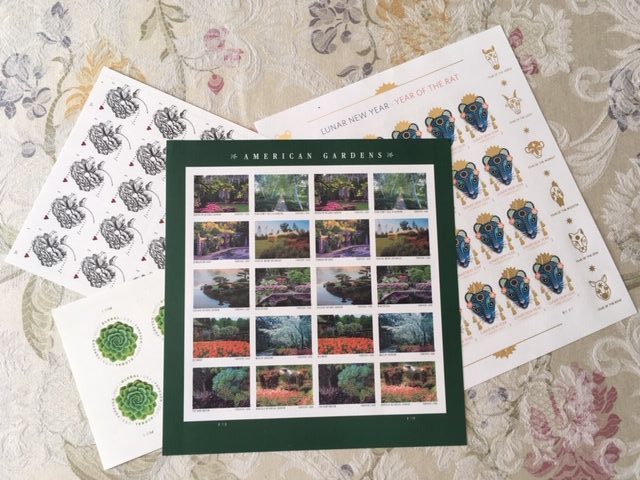
U.S. stamps | Photo by May S. Ruiz / Beacon Media News
Even
as we pay affordable rates for postage, we complain each time the price
increases. So the USPS created the ‘Forever’ stamp we can use even when the
rate goes up. I haven’t heard of any other country’s postal system that has
resorted to that.
Speaking of stamps, the United States has some of the prettiest stamps you can find. And I know what I’m talking about – I have quite an impressive stamp collection that spans 74 years and covers 65 countries. Okay, I’m old (because who else but an old person would have a stamp collection, right?) but not quite as old as the oldest stamps in my collection. It just so happens that my long-deceased grandfather worked for the Philippine post office and he bequeathed to me his commemorative first day cover of the July 4, 1946 Philippine Independence Day stamp (Philippine independence from American rule, which is different from when the United States liberated it from Spanish colonization in 1898). In fact, it was how my hobby started. But I digress.
Postal workers perform essential functions which cannot be replaced by a machine. The ZIP code, which was introduced and implemented in 1963, allowed for automated mail sorting. And since I’ve only ever received or sent out letters and cards with ZIP codes on them, I thought a letter would not get to its destination without it. Until I was proved wrong. Two weeks ago, Tom received a card from his childhood friend in England. Instead of putting the ZIP code, his friend inadvertently wrote Tom’s entire 10-digit cell phone number!
While a missing ZIP code isn’t exactly an adversity to overcome, America’s postal workers have battled natural calamities to get our mail delivered. The motto ‘Neither snow nor rain nor heat nor gloom of night stays these couriers from the swift completion of their appointed rounds’ aptly describes what they accomplish.
Our mail carriers are a part of our daily lives – they cheer with us when we celebrate milestones and grieve with us when we mourn our misfortunes. They are a thread in the fabric of our community.
Originally published on 11 February 2020 in the Pasadena Independent, Arcadia Weekly, and Monrovia Weekly
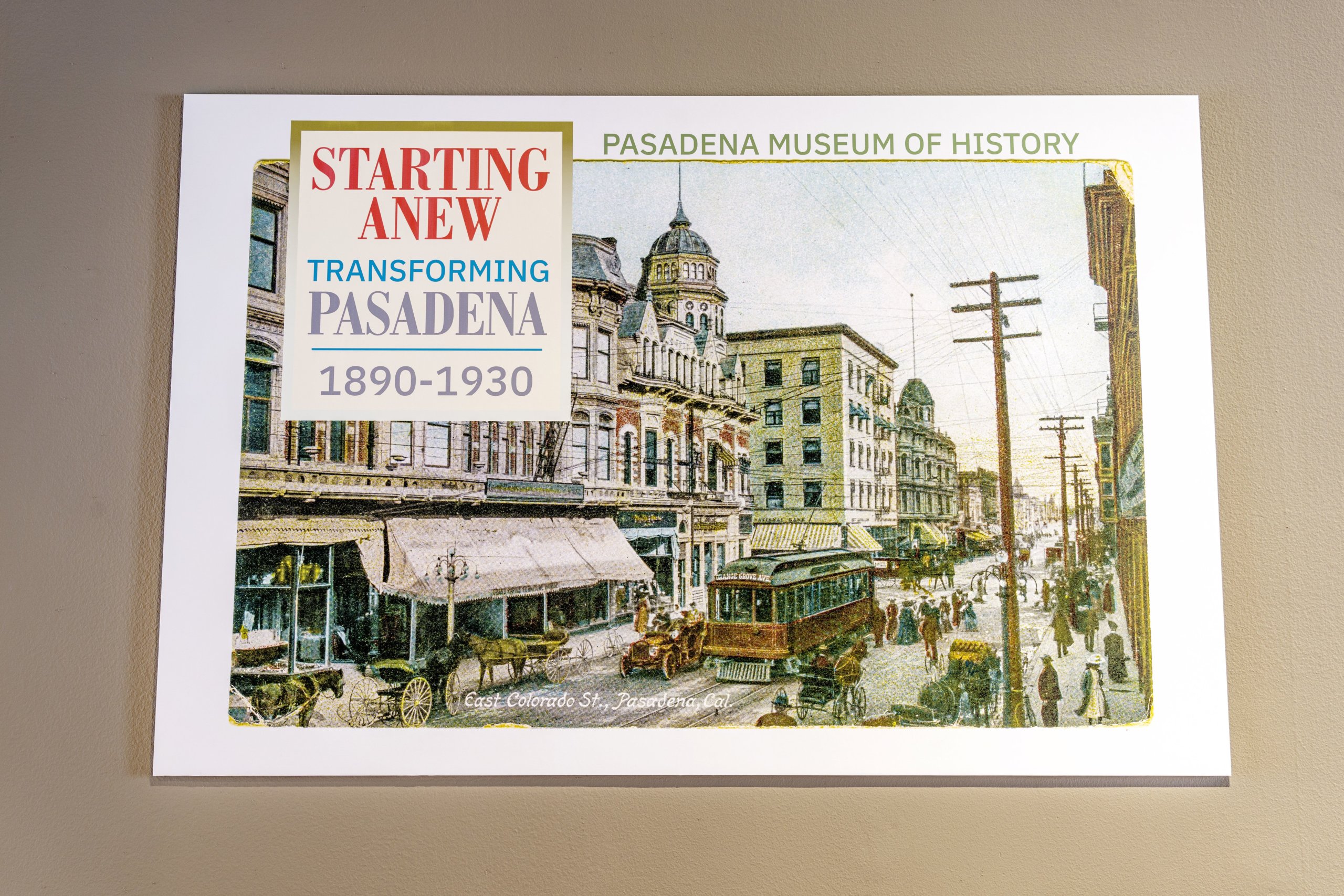
PMH’s ‘Starting Anew: Transforming Pasadena 1890-1930’ Exhibition Signage | Photo by Marlyn Woo/Joanne Wilborn / Pasadena Museum of History
Very few of us realize that the Pasadena we know and live in today was built in the early 20th century by dreamers with grand visions who settled here from the Midwest and the East Coast. The Pasadena Museum of History (PMH) offers a compelling look at the most flourishing period in Pasadena’s history with an exhibition called ‘Starting Anew: Transforming Pasadena 1890 – 1930,’ on view until July 3, 2020.
I consider Pasadena my hometown and have lived here for 37 years. And while I dearly love my adopted city, I don’t know as much about it as I probably should. PMH’s exhibition provides that stimulating learning experience and Brad Macneil, Education Program Coordinator, who curated this show, happily gives me a tour.
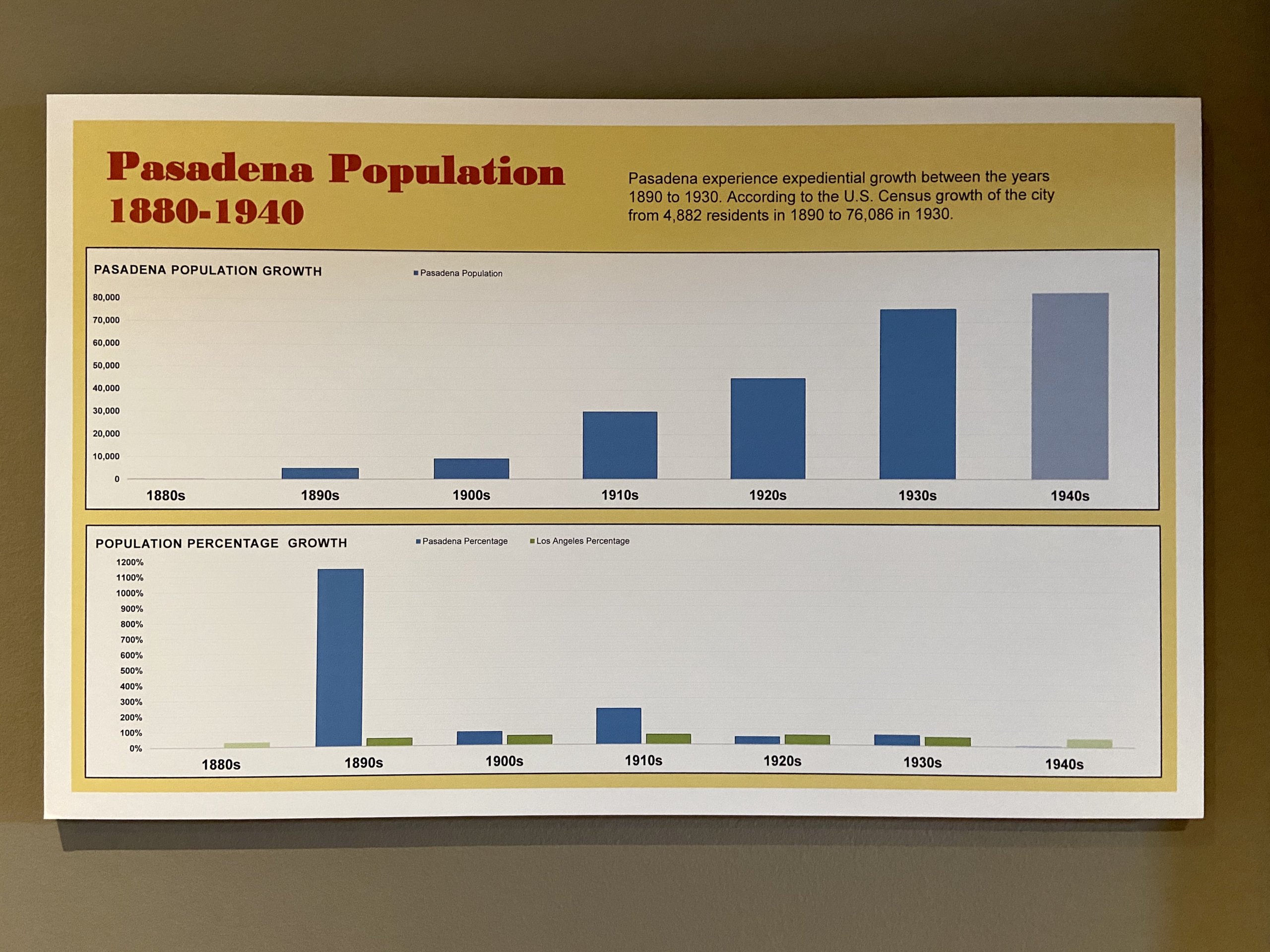
Our first stop is a chart which shows that population growth in Pasadena outpaced that of Los Angeles and then leveled off in 1930 when the depression hit. He discloses, “This was what sparked the idea for this exhibition. It was an amazing time in Pasadena’s history when the population went from below 5,000 to over 76,000 in just four decades. Today there are 150,000 – the population only doubled since. The city was transformed in so many different ways and our exhibit asks and answers a number of questions – why people came here, how they got here, where they lived, what they did, what kept them here.”
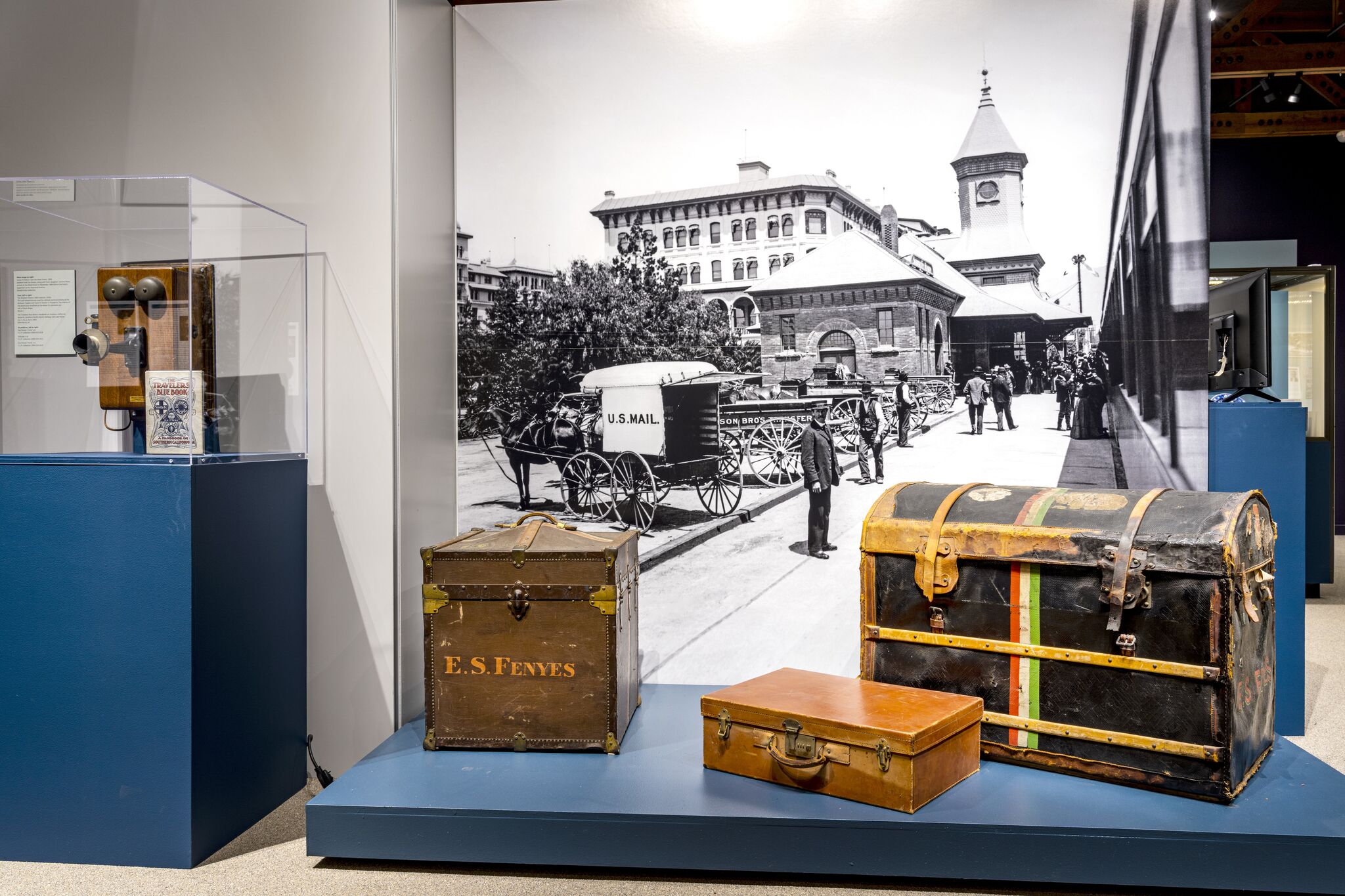
Macneil explains that the railway system started serving Pasadena in the mid-1880s, which caused the population to rise from 500 to 5,000 between 1880 and 1890. A photo of the Santa Fe Railway Depot and the Hotel Green greets us as we enter the first exhibition hall.
Population Chart | Photo by Marlyn Woo/Joanne Wilborn / Pasadena Museum of History
“Part of our exhibit tells the story of Dr. Adalbert and Eva Fenyes,” Macneil narrates. “The couple met in Cairo, Egypt and were married in Budapest. It was during their honeymoon around the world that they heard about Pasadena. They arrived at this train station in 1896 as newlyweds, and they had with them Leonora, Eva’s teen-age daughter from her first husband. They stayed at the Hotel Green for about three days and fell in love with Pasadena. They immediately leased a house on the Arroyo, which they later bought. Subsequently, they built two mansions here. One of the wonderful things about this exhibit is that we are able to display the museum’s collection. These are the Fenyeses luggage here and that telephone over there was inside the depot.”
Santa Fe train depot, the Fenyeses’ luggage, and depot telephone | Photo by Marlyn Woo/Joanne Wilborn / Pasadena Museum of History
“Besides word-of-mouth, a marketing campaign touting the city’s natural beauty and health benefits lured people to the area,” adds Macneil. “In the late 1880s big, fancy hotels were being constructed, the first of which was the Raymond Hotel. It was built by entrepreneur Walter Raymond, who had been working for a company back East that brought tourists here and thought Pasadena could use a grand hotel. Other hotels then were Hotel Green, the Pintoresca, the Maryland, the Huntington (which was originally the Wentworth and is now The Langham), and the Vista del Arroyo.
“Each year thousands came to Pasadena for the seasons – from November through March. The population would go up and down. The wealthy people came from the Midwest like Indiana and Chicago, and the Northeast – Boston, Philadelphia, and New York. Because of the winter resort business, the whole town grew. Visitors needed service, which opened up employment opportunities. That brought in working class people from other parts of the country to get jobs in the railways, hotels, and in agriculture. Professionals also arrived – doctors, lawyers, newspaper publishers. Pasadena grew into a diverse community – there was already a large Mexican American population, then the Armenians, the Chinese, and the Japanese arrived. They came to either find a job or start a business.”
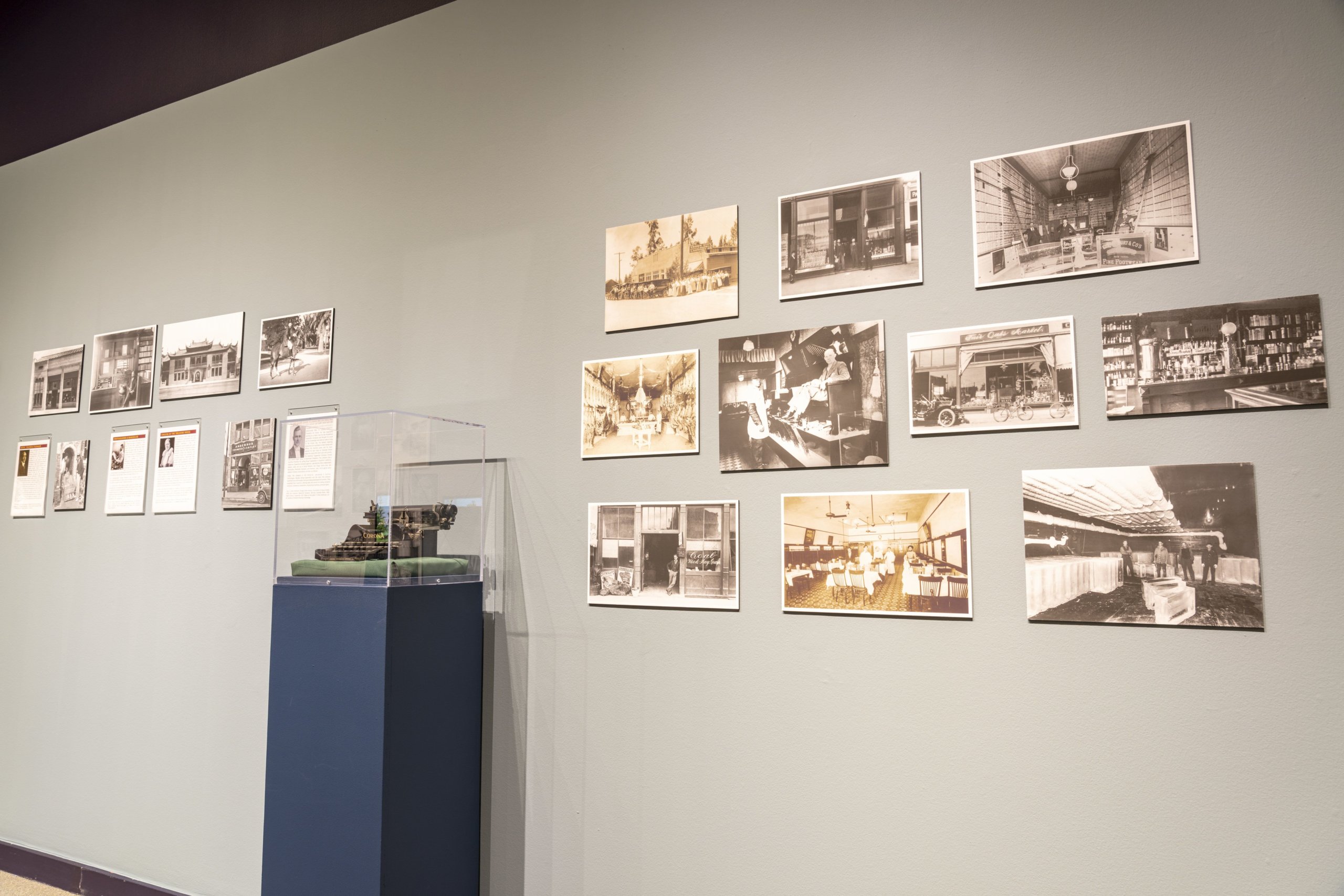
Pasadena was a great place to be an entrepreneur and PMH’s exhibition highlights four enterprising people who came here with very little yet built successful establishments. One of them was Elmer Anderson who arrived with nothing more than a typewriter repair kit and founded Anderson Typewriters. Known today as Anderson Business Technology, it has branches all over Southern California selling business equipment and is still being run by his descendants. The local store on Colorado Boulevard, near Arroyo Parkway, remains to this day.
Many of us will recognize the edifice resembling a Chinese Imperial Palace on Los Robles and Union Street as USC Pacific Asia Museum. Back in the 1920s it was Grace Nicholson’s Treasure House of Oriental Art. She came here with a small inheritance and opened a curio shop selling Native American arts and crafts. She developed great relationships with Native Americans in the Southwest and eventually started selling to the finest museums in the country, including the Smithsonian and Field Museum. She later switched to Asian artifacts and created her treasure house where she lived and worked.
Adam Clark Vroman, an avid book collector and photographer, moved to Pasadena from Illinois hoping the climate would help his wife recover from her illness. Unfortunately, she died two years later. Brokenhearted, he sold his book collection to raise the capital to open Vroman’s Bookstore. As he had no direct heir, he made arrangements for his employees to take over the store when he passed away. It was a remarkable demonstration of how much he cherished and took care of his staff. Some of the descendants of those employees run Vroman’s today and it remains a beloved Pasadena purveyor of books and gift items.
There was Ernest Batchelder who came here to teach art at Throop Institute. He later started his own business – making the eponymous tiles – and became the foremost proponent of the American Arts and Crafts Movement.
Local businesses | Photo by Marlyn Woo/Joanne Wilborn / Pasadena Museum of History
Architects and builders prospered at this time because people needed housing. Those who came here for work built bungalows and cottages. Macneil states, “The cost to build a house varied from under $1,000 up to $100,000. Between 1902 and 1918 the median value of local houses was $1,700 (these houses today cost over a million dollars). Those with wealth seasoned in Pasadena and stayed for months at a time. A number of them decided to build winter homes on Orange Grove Boulevard, otherwise known as Millionaires’ Row. Displays of some of these grand houses include Adolphus Busch’s; the Gamble house, which still exists today; the Merritt House, which is now surrounded by million-dollar condos.”
After the depression, the owners of these mansions couldn’t afford the upkeep and sold them. Of the 52 mansions, only six or eight of them remain; the rest have been razed to the ground to make room for apartments and condominiums. Of course, even these divided-up homes are not for the middle- and working-class as they lease for several thousand dollars a month or sell for millions.
One of the mansions that’s still around is the gorgeous Marshall-Eagle Estate built in 1919 for $500,000 (valued at $8 million at the time) and is now Mayfield School. The exhibition has a display of it that tells its history and shows interiors shots.
Throughout the exhibit, PMH reveals the passage of time through changes in fashion and technology – dresses from the different decades; a high-wheeler bicycle; a carpet sweeper; an Edison machine; a record player; a gas-powered hair curler, one of the first dial telephones ever made, and an early typewriter. Macneil says students love to see and handle the typewriters but can’t figure out how to use the telephone.
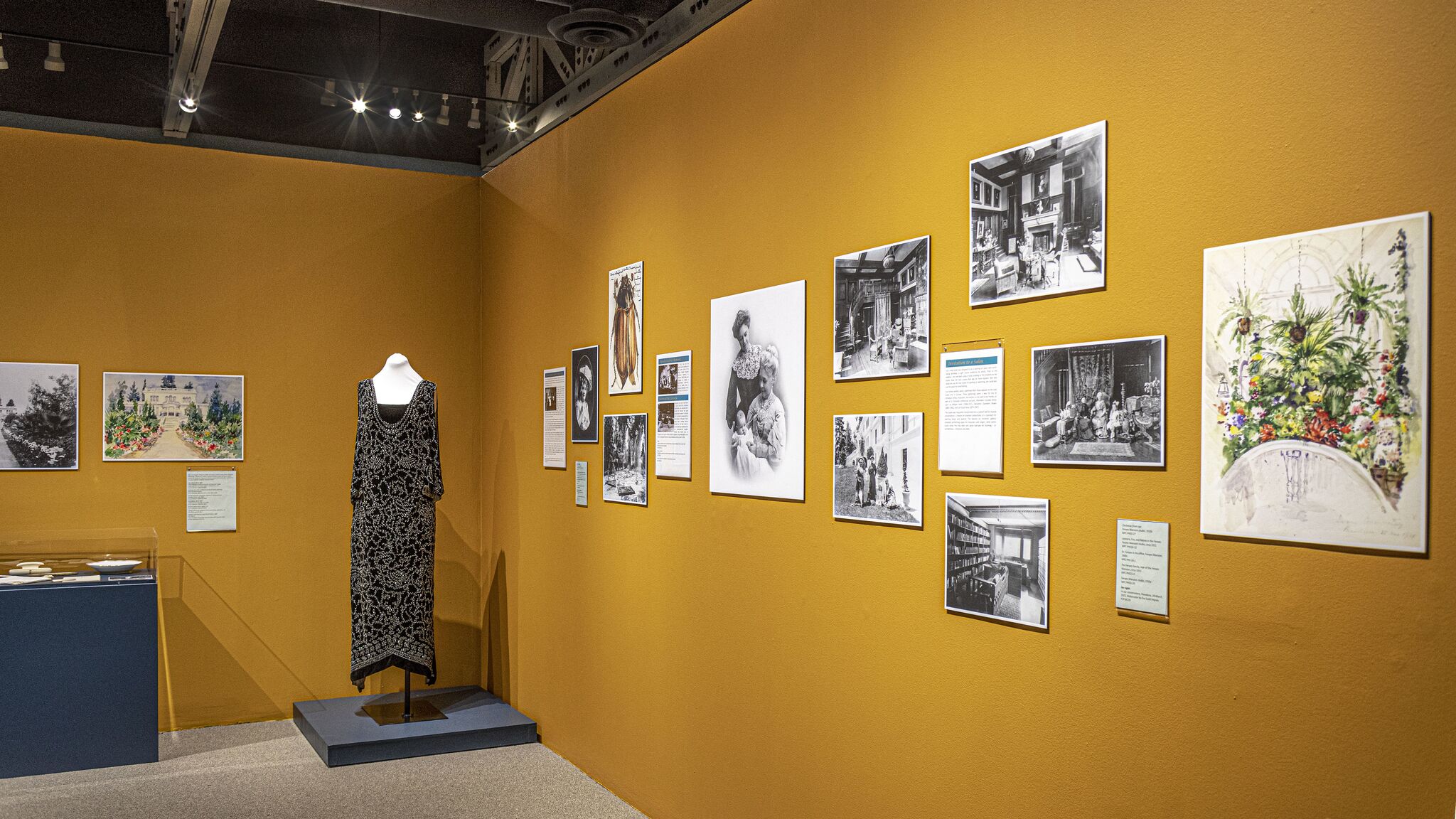
Macneil leads me to the next display, saying, “Our story goes on about the Fenyeses becoming part of the community. Eva designs her first mansion, a Moroccan palace on Orange Grove Boulevard. This is Eva’s sketch of her mansion – there is an area that’s all glass, one of the first commissions of Walter Judson of Judson Stained Glass Studios. Her daughter Leonora grows in age, marries, and moves away. Eva gets immersed in the community business-wise by buying real estate and as a socialite by being involved with the art scene. Dr. Fenyes gets his medical practice going.
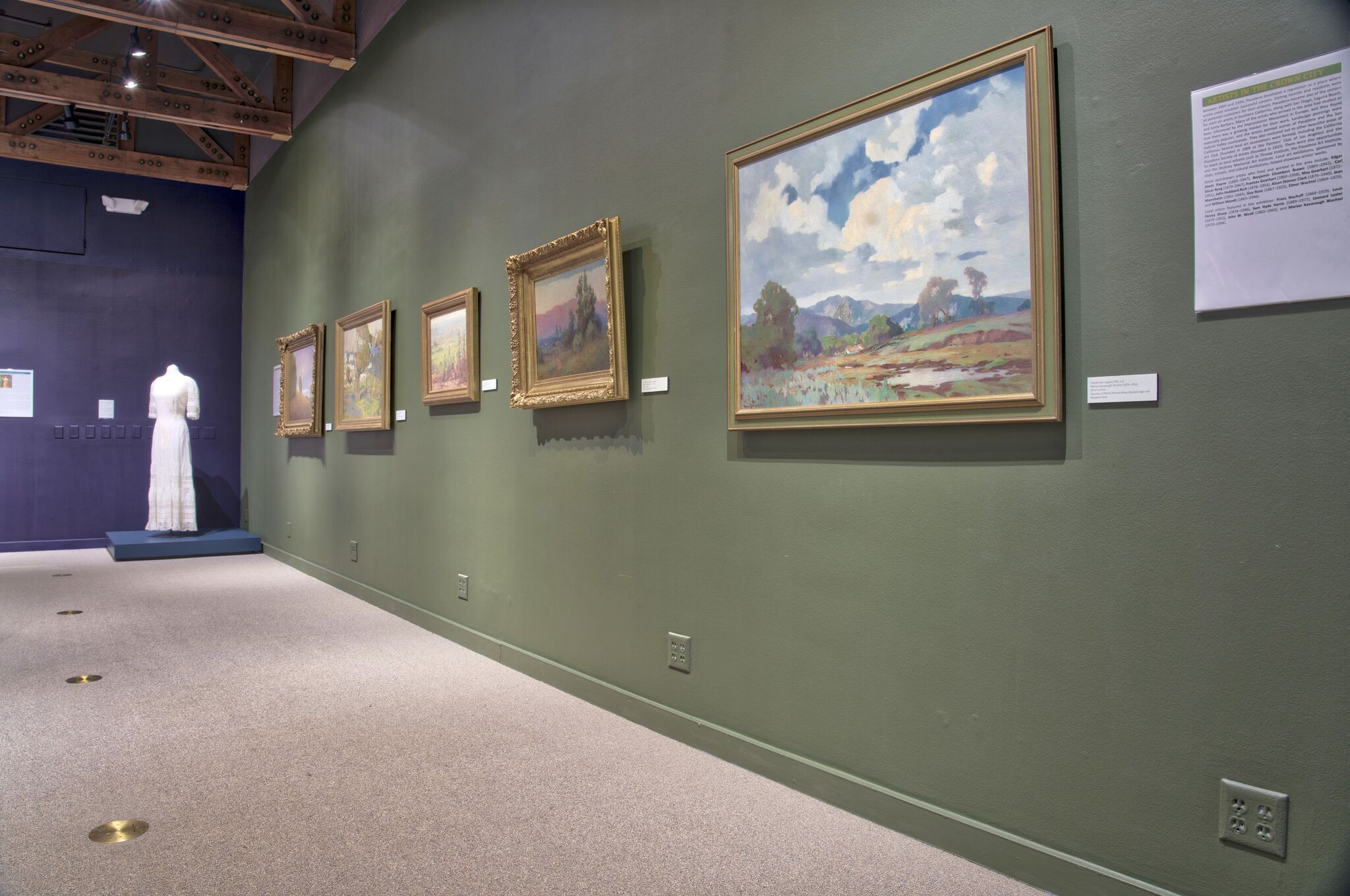
Local artists’ works | Photo by Marlyn Woo/Joanne Wilborn / Pasadena Museum of History
“Pasadena was one of the main art colonies in California during this period, so we have here a wall of art featuring selected works of the artists who lived here then. One of Eva’s biggest legacy was being patron of the arts and helping other artists in the community. She was a prolific painter herself and we have a lot of her art at the mansion, some of which we show here.”
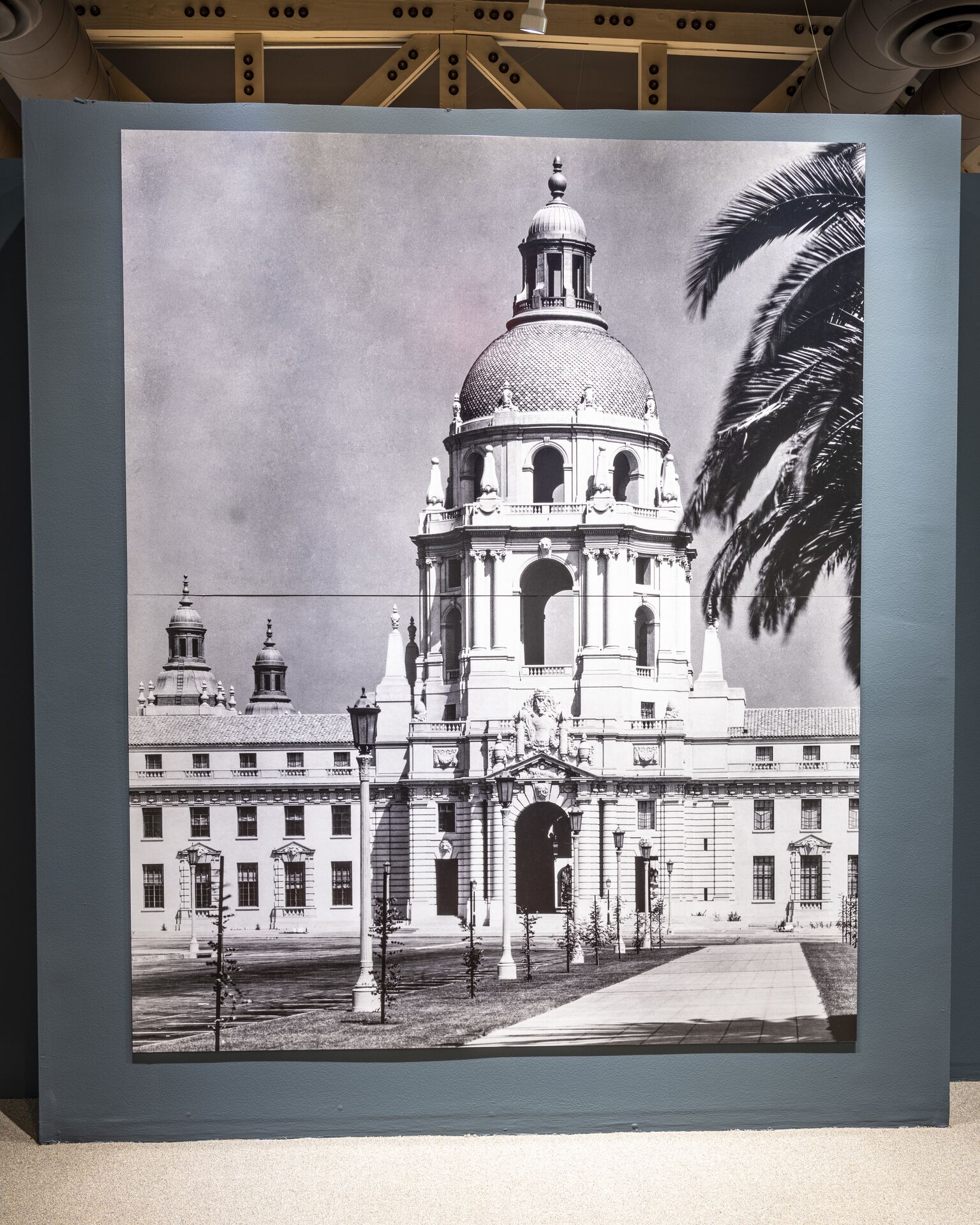
The second part of the exhibition, in the opposite hall, begins with an iconic image of City Hall and explores how the ‘City Beautiful Movement’ ushered the Golden Age of Pasadena. Macneil expounds, “In the Chicago Exposition of 1893, they built the White City. Many famous architects helped construct wonderful buildings, public plazas, and garden areas for the World Fair. The ‘City Beautiful Movement’ came out of that. The idea is that if you beautify the city with these magnificent public structures, it uplifts all the residents spiritually and morally.
An image of the Pasadena City Hall leads us to the second part of the exhibit | Photo by Marlyn Woo/Joanne Wilborn /Pasadena Museum of History
“A lot of people from Pasadena were able to go the Chicago Exposition of 1893 and when they came back, this philosophy took off. They pulled people together, held meetings, and talked about what they could do. And the first thing they did was clean up the city. They got rid of the tacky real estate signs in the main part of town, tidied vacant lots, planted trees and flowers, painted buildings, and regulated architectural styles. It began in the early 1900s with input from various people in the city – movers and shakers as well as the general population. They came up with the plan for the city and things took off in the 1920s when money and the will were there. And so they erected grand public buildings. A main area was the Civic Center – City Hall, the Public Library, the Civic Auditorium. Most of what we identify with Pasadena today – the beautiful architecture, the cultural institutions – were built at this time.”
“There’s a section called ‘Nature versus Man-Made Beauty,’” Macneil goes on to say. “Out-of-towners came here because of the natural beauty of the area – like the Arroyo and the mountains. Then people created man-made parks bringing in trees from other parts of the world, changing the landscape. We have images of Central Park by Castle Green, Library Park by the Senior Center, and Brookside Park. There’s Eva’s picnic basket because she enjoys going on picnics.”
Macneil points to the next section, “Here we talk about the various means of transportation. During this period of time, people got around town by walking. But there were also buggies and carts, trolley cars, and automobiles. But bicycles were the biggest thing – there were more bicycles per capita in Pasadena than any other city in the United States. This is an early-1900 map of the bike trails and roads in California.
“Because of the power of the bicyclists as a group, they put a lot of pressure to make the streets and signage better, even before they were done for cars. This is California Cycleway, an elevated tollway for bicycle traffic which ran from the Green Hotel to South Pasadena. It was planned to go all the way to Los Angeles but it was never completed because Horace Stubbins encountered legal battles with Henry Huntington over right-of-way. He decided not to pursue it, but the family did keep some of the right-of-way and was able to sell it to the state for the Pasadena freeway. This is still a dream of some people to build – imagine how wonderful it would be to ride your bicycle high above the streets on a road that ran along the Pasadena freeway.
The ‘Kids Corner’ has a display of things kids wore, what types of games they played, where they went to school. There are hands-on items like the stereoscope that kids can look through and see three-dimensional images.
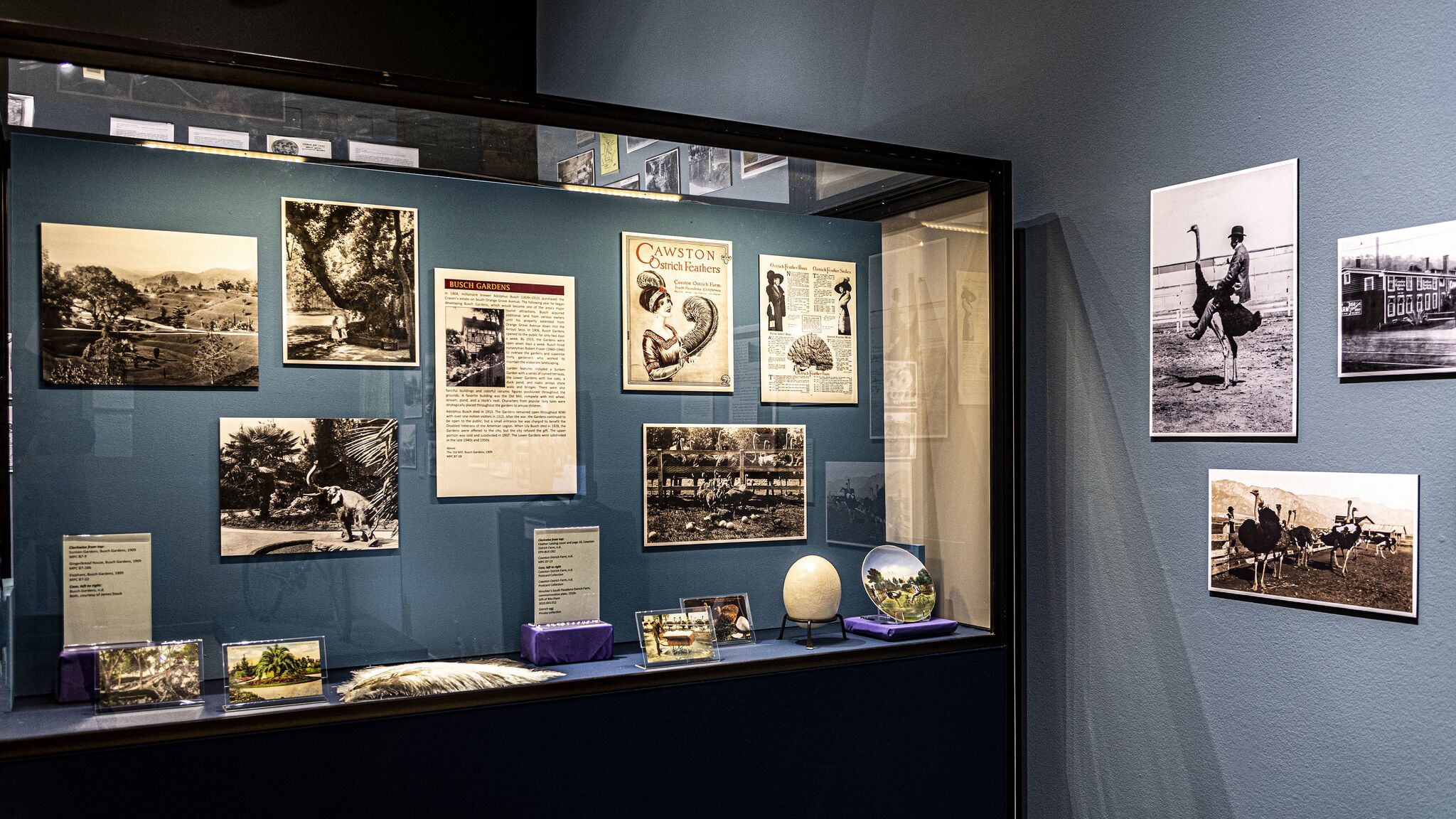
A section that Macneil calls ‘The Extraordinary Excursions’ features three early theme parks, the first of which is Busch Gardens. According to Macneil, Adolphus and Lilly Busch, of the Anheuser Busch and Budweiser fame, had a house on Millionaires’ Row. Adolphus bought approximately 37 acres, covering the area from his house on Orange Grove to the Arroyo, on which he created this magical park and opened it to the public for free. However, the park subsequently met the same fate as that of the grand estates in the area – it closed in the 1930s and 1940s and was subdivided. Lilly tried to make an arrangement for the city to take it over but it was too expensive for the city to maintain.
Cawston Ostrich Farm | Photo by Marlyn Woo/Joanne Wilborn / Pasadena Museum of History
Another was the Cawston Ostrich Farm. Macneil relates that entrepreneur Edwin Cawston, who had learned about ostriches and the ostrich feathers trade in South Africa, came in the late 1880s to open a business here. He had stores in New York, San Francisco, and Los Angeles selling feathers all over the world but it was in South Pasadena that he established one of the first ostrich farms in the country. At the same time, he created a beautiful park-like area where people could come and observe the ostriches’ little chicks, see the big birds being fed, and watch ostrich races. They could even ride on a cart behind the ostrich and, if they were brave, on the ostrich. It became quite a popular destination.
Around the corner you’ll come upon photographs of the Mount Lowe Railway, a series of scenic railroads which went up the mountains above Altadena, created by Thaddeus Lowe. Visitors taking the train up reached a beautiful destination with four hotels, a zoo, an observatory for star-gazing, and a golf course. Macneil says, “People would take the Pacific Railway from all over Southern California, but especially from Los Angeles, come into Pasadena and up to the foothills of Altadena. They’d get off the trolley car and on what they called the ‘white chariots’ that would take them on a steep incline. They would come up to the first hotel and alight there. Then they would get on a trolley car that wound around the mountains until they arrived at the topmost hotel – the Alpine Tavern.”
People got their entertainment during that period from the Pasadena Playhouse and cinemas which started out showing silent movies. “Then there was the Grand Opera House, which was located close to Green Hotel,” recounts Macneil. “It was built by entrepreneurs who brought great opera to town while simultaneously hoping it would help raise real estate values. However, it failed to take off partly because it competed with an opera house in Los Angeles which got the better acts.”
Macneil adds, “When I did my research, I used the city directories going back to the 1880s and found pages upon pages of clubs, associations, and societies where everybody belonged. People came together through their common interests – whether it was just for fun or for a civic purpose.
“We showcase three of these organizations: the Valley Hunt Club for men and women, started out in 1890 as a hunt club, as the name implies. It then became more of a social club and gave us the Tournament of Roses Rose Parade and Rose Bowl game. The Elks Club was a place for men to get together both socially and as a charitable group. The Shakespeare Club began as a women’s literary club to promote reading. All these three organizations were very involved with the community then and still are to this day. All these clubs, at one time or another, had entries in the Rose Parade and on display are trophies they had won. Some items are artifacts from the clubs.”
The Fenyeses display | Photo by Marlyn Woo/Joanne Wilborn / Pasadena Museum of History
Towards the end of the exhibit, the display talks about the Fenyeses selling their big Moroccan palace and downsizing to the mansion in 1906. This section explores the life of Eva and Dr. Fenyes from 1906 to 1930. While they were world travelers, Pasadena was their home base. They were involved in the community in different ways – she was still a socialite; he continued with his medical practice and, being an entomologist, his work with beetles. Leonora, Eva’s daughter, became widowed and came back to live with them. In 1911, Eva, Leonora, and Leonora II all lived here and created a wonderful bond of three generations.
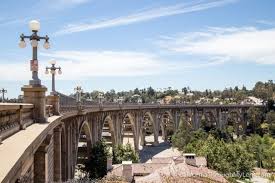
A wall of displays delves into the transformation of Pasadena. Macneil expounds, “Through the 1893 ‘City Beautiful Movement,’ city officials were able to hire architects from Chicago and established the Bennett Plan that created the Civic Center – the City Hall, the Library, and the Civic Auditorium. At the same time, more beautiful buildings were being erected and various infrastructure were being constructed. The Colorado Street Bridge was built in 1913 for people arriving by car to have a grand entrance into Pasadena. They also had plans for a beautiful art museum and school on Carmelita where the Norton Simon is now, although that never came to fruition.”
The 1920s were the Golden Age of Pasadena when innumerable buildings featuring European architecture were constructed all over the city. Schools and city service structures were being upgraded; the Rose Bowl was built. PMH’s exhibit has a video that shows the changing cityscape.
“And then the depression hit and everything slowed down,” says Macneil. “The Civic Auditorium hadn’t been completely built. Fortunately, city officials were able to do some creative financing to finish it but several things which were on the planning stage stopped. The resort industry collapsed – hotels were torn down and were reused for other functions. The Vista del Arroyo, for instance, became a hospital; today it is the Court of Appeals. Of the hotels built during that period, only the Huntington Hotel still stands today. Population growth halted as well.
Colorado Street Bridge | Courtesy Photo
“At the very end of the exhibit, we showcase PMH’s mission – capturing and gathering the history of Pasadena and the surrounding area and sharing it with the public. Our collection encompasses this productive and transformative period so our archives and collection department were quickly able to put together what we felt would represent that time.
On the Curator’s statement, Macneil confesses that while he was born and raised in the area – three generations of his family lived here – he didn’t fully appreciate Pasadena. It wasn’t until he went away for a while and then returned that he developed his deep love for the city. Through this exhibit, he hopes that he can share all that he has rediscovered
Macneil states, “We’re hoping parents come with their children to our exhibition. We’re purposefully keeping it open until July 3rd so students from both public and private schools can learn Pasadena’s history. How fun would it be for these young people to learn what happened a century before their time and then see the structures when they walk around the city.”
As PMH has detailed in the exhibition, some of the dreams of the city’s visionaries worked and some didn’t. But many of the magnificent and architecturally diverse structures from the city’s Golden Age remain and they are what give Pasadena the culture and history for which it is renowned. And through this exhibition, Macneil wants to remind people what we are capable of doing if we pull together as a community. The past can be used as a blueprint for the future.
Originally published on 16 December 2019 in the Pasadena Independent, Arcadia Weekly, and Monrovia Weekly
Artist’s rendering of The Huntington’s 2020 entry in the Rose Parade, designed by Phoenix Decorating Company. The float celebrates The Huntington’s 100th anniversary running from Sept. 2019 through Sept. 2020. – Courtesy photo / The Huntington Library, Art Museum, and Botanical Gardens
The Huntington Library, Art Museum, and Botanical Gardens will mark another historic event as its own float travels down Colorado Blvd. for the Rose Parade, 50 years since it last made an appearance at Pasadena’s famous New Year’s Day floral, equestrian, and marching band pageant.
Themed ‘Cultivating Curiosity,’ the 55-foot long float captures the spirit of The Huntington’s Centennial Celebration and highlights its rare research materials, inspiring art collections, and unparalleled botanical gardens which have made it a beloved destination that welcomes 750,000 visitors each year.
In 1969, the city of San Marino sponsored an entry that featured floral depictions of the institution’s world-renowned paintings ‘The Blue Boy’ and ‘Pinkie,’ an imposing replica of the historic Library building’s façade, and the Ellesmere manuscript of Chaucer’s ‘The Canterbury Tales.’ The float won the Grand Marshal’s Trophy. This year, The Huntington commissioned a float for the first time.
The Huntington’s float in the 1969 Rose Parade, sponsored by the city of San Marino. – Courtesy photo / The Huntington Library, Art Museum, and Botanical Gardens
Chatting with me by phone, Randy Shulman, The Huntington’s VP for Advancement and External Relations says “The last time we were represented at the Rose Parade, it was done by the city so it’s as if we’re doing it for the first time – it’s all Huntington content and people. It’s our centennial and it’s an opportunity to help celebrate and raise awareness of The Huntington and its centennial year.”
I ask why they’d never done it before and Shulman replies, “The Huntington is a non-profit that raises its operating expenses every year. External promotion is never going to be the top priority. Always, the top priorities will be running its education programs and doing its academic mission. The thought of doing a Rose Parade float is an exceptional moment so we need an exceptional moment. That’s why we chose to do it now.
“The decision to sponsor a Rose Parade float came out of a discussion of the Board and some of the people in our board community who said ‘This is a great moment.’ Our president, Karen Lawrence, joined The Huntington a little over a year ago and she was very quickly enthusiastic about it. So, we have a new president, it’s a new time, it’s a hundred years – all the planets aligned. Additionally, we were able to find private donors who would help us make it possible. Every dollar of the cost of the float is through donations, not through our operating budget.
“We had just told our entire donor community that we’re doing this float and if they wanted to volunteer we had 1,000 spots for people to volunteer and if they wanted to help by making a donation, that would be welcomed. And some people have done that. We posted the volunteer sign-up to help decorate our float on our website and spots were filled rapidly.”
The Huntington’s float on the first day of decorating. – Photo by May S. Ruiz / Beacon Media News
Choosing the float builder was a competitive process. Shulman discloses, “We had the major builders provide proposals and we evaluated based on the design and the background of the float builder. The design of the float itself came out of a desire to represent not just the Huntington that people are familiar with, but one that integrates discovery and curiosity. We wanted to have some familiar things that people recognize as well as other things that people may not recognize. The end of the float is the ‘Stinky Flower’ which is a playful way of talking about The Huntington’s very unusual Botanical Garden collection. Some of the materials being used are grown here – seeds, pods, bark, and some leaves. And that’s really great – it talks about us and the place. It’s also fun for many people who have been here and walked the place to see the familiar sights depicted on the float.”
Given the numerous significant things at The Huntington, I inquire how difficult it was to come down to seven elements that would be represented on the float. Shulman responds, “We asked the directors of the Library, the Art Museum, and the Botanical Gardens for their thoughts. But, of course, things decided by a committee never work out because it’s hard for a lot of people to have a consensus. What we did want to do is to keep it simple, recognizable to a point, but we also wanted to have a sense of playfulness. What people won’t see on the float are some of the more recognizable items like ‘Blue Boy’ or Shakespeare’s folio. But that’s because we want the opportunity to show something very beautiful that people might not know about.
The float’s Huntington Centennial Rose. – Photo by May S. Ruiz / Beacon Media News
“That was one of our President’s goals. She wants to have that moment when people say ‘What is it? I have to go see.’ She wants to have people have that joy of discovering more about The Huntington. It’s a complex place. There’s so much happening here with the different collections in the gardens and there’s always something new to discover in the gallery as well. Our float is a manifestation of the joy of The Huntington’s 100 years – both getting to the hundred-year mark but also looking forward to the next centennial.”
The Huntington’s float will have eight riders and will be followed by six walkers as it makes the 5.5-mile journey down Colorado Blvd. The float riders will include four youth participants from The Huntington’s community partner programs with the Heart of Los Angeles (HOLA) and the Pablove Foundation; Huntington President Karen R. Lawrence; two lucky staff members who won a staff-wide raffle; and leadership donor and member of The Huntington’s Board of Governors Mei-Lee Ney. The walkers following the float will include five of The Huntington’s teen volunteers and one adult supervisor.
The elements on the float include the Tempietto, the Moon Bridge in the Japanese Garden, The Ellesmere Chaucer, and Edward Hopper’s ‘The Long Leg.’ – Photo by May S. Ruiz / Beacon Media News
It was the design submitted by prominent float builder Phoenix Decorating Company (PDC) that won The Huntington’s vote. Curious to see what the float looks like, I visit their Irwindale site on the first day that volunteers arrive to help decorate. Chuck Hayes, Sponsor Relations Manager at PDC, is a gregarious man who warmly welcomes me and eagerly explains their association with the San Marino institution.
“The Huntington said they wanted a 55-foot float and detailed the elements they wanted on it. We conferred with them throughout the conceptual process – we held multiple meetings, made many visits to the facility, and took several images from which to come up with a design. Our artist worked directly with their team to arrive at something that included the components and fitted their requirements. We’re the interpreter of their concept and all the materials we’re using on the float help realize that vision. It’s what makes me proud to be a float builder – to be able to honor organizations like The Huntington. Every single float we build is a unique prototype, each is a one-off, and has never been done before. Floats are built by hand from scratch – from the design stage to getting each petal onto the float.
“The Rose Parade is a Southern California tradition and, as a float builder, we always want to give our clients the greatest thrill at that moment when they walk up to see it for the first time. We build everything to scale so people who are watching it along the parade route can really focus on the float. There’s so much for them to take in – while the float is traveling down the five-and-a-half mile-parade route at 2.5 miles per hour, there might be a marching band in front and equestrian riders behind it. We made sure that people who have never been to The Huntington would be compelled to visit it after seeing this float.”
Hayes continues, “Phoenix has been an award-winning Rose Parade float builder for 37 years. We have a team of professionals that works year-round constructing and deconstructing floats. We begin in January when the Tournament of Roses announces the theme for any given year – for 2020 it’s ‘The power of Hope.’ That becomes our emphasis and it’s how we bring everyone into the fold. The client comes into the parade excited – some have never seen a float before, some have never commissioned one so they don’t know what’s involved. We sit with them and we tell them what we do, show them pictures of floats we’ve built and decorated. Sometimes, clients hear about something we’d done through word of mouth, or have seen a project we worked on like ‘Earth, Wind, and Fire’ which the Forum commissioned to celebrate their 50th anniversary. That’s what The Huntington was looking for – something uniquely theirs.
Volunteers work on The Huntington’s float. – Photo by May S. Ruiz / Beacon Media News
“We have anywhere from 25 to 40 people on staff – artists and construction crew – at various times. The number expands as the activity progresses and we hire crew chiefs and assistant crew chiefs who work on specific floats. The decoration can be done by the organization’s volunteers and by anyone who wants to decorate. They can sign up on our website, on the Kiwanis site, or through the ‘Petal Pushers.’ Our crew chiefs and assistant crew chiefs work with the volunteers who show them how to glue the materials onto the float. The Huntington brought so many volunteers to fill the decorating shifts. But if, for some reason, a client didn’t have people show up, their float would still be ready to go down Colorado Blvd. on New Year’s Day.”
On the day I visit Phoenix, a coordinator with Tournament of Roses (TofR) is there and Hayes introduces me to her. That also prompts him to expound, “This is the 131st year of the Rose Parade. If it wasn’t for them we wouldn’t have a parade. They give the opportunity for organizations like The Huntington to get worldwide exposure; I believe they said somewhere in the world, the parade is shown every day of the year – because of tape delays in other countries. There are over 700,000 on the parade route, a regional and national TV audience, and international viewers. And with social media, people can now react and let others know what floats they like in real time. Awareness about the parade just keeps expanding.”
People watching the Rose Parade on Colorado Blvd. and television viewers everywhere will have the delightful experience of seeing a Huntington float that depicts the following iconic elements in The Huntington’s collections:
The Pavilion of the Three Friends. – Courtesy Photo / The Huntington Library, Art Museum, and Botanical Gardens
Pavilion of the Three Friends
Located in Liu Fang Yuan, the Chinese Garden at The Huntington, the Pavilion of the Three Friends is named for the ‘three friends of winter’: bamboo, pine, and plum. They are symbols of fortitude, integrity, and resilience. Carvings of these signature plants adorn the ceiling of the pavilion and also grow nearby.
The pavilion’s roof will be covered with eucalyptus leaves of green/grey. Painted tiles are made of light grey and dark grey lettuce seed. The main body is covered in red fine cut strawflower, white fine ground rice and light grey, light lettuce seed. Window insets are covered in light blue fine cut statice, green fine ground split pea, and shiny grey silverleaf.
The pathway of light is made of grey light lettuce seed; rocks of light grey, light lettuce seed and white fine ground rice; accents of green mood moss.
Maple trees have tops of orange and yellow dendrobs with underneath areas of green ground parsley flakes and branches of dark brown coffee.
Sculpted barrel cacti are covered in ground parsley flakes and light green carnation calyx. Flowers on top are bright yellow whole strawflowers. Juvenile golden barrel cacti are provided by Huntington Gardens. The area around small cacti is grey Spanish moss.
The Rose Garden Tempietto. – Photo by Alexander Vertikoff / The Huntington Library, Art Museum, and Botanical Gardens
Rose Garden Tempietto
The centerpiece of The Huntington’s historic Rose Garden, the 18th-century French stone tempietto houses a sculpture – Love, the Captive of Youth – which depicts Cupid and his captor, a fair maiden. Appropriately, the tempietto is encircled by a bed of ‘Passionate Kisses’ roses. The three-acre Rose Garden contains more than 3,000 individual plants and more than 1,250 different cultivated varieties (cultivars), including Huntington’s 100th, the newly hybridized rose marking The Huntington’s Centennial.
Rose Garden Tempietto is covered in white powdered rice, light grey ground white pepper, and dark grey poppy seed. Floral on top is made of green asparagus plumose, hot pink roses, and white and light pink dendrobs. Sculpted centennial rose petals are light pink and white gladiola petals, yellow and bronze fine cut strawflower, and white powdered rice.
The Japanese Garden features a small lake spanned by a moon bridge, a traditional house, and trellises of wisteria. – Photo by Martha Benedict / The Huntington Library, Art Museum, and Botanical Gardens
Japanese Moon Bridge
Completed circa 1912, the distinctive Moon Bridge is an iconic feature of The Huntington’s celebrated Japanese Garden. Commissioned by Henry Huntington himself, the Moon Bridge was built by Japanese craftsman Toichiro Kawai. The bridge’s high arch and reflection in the still pond below form a circle, reminiscent of the moon.
Japanese Moon Bridge is comprised of tan paper bark with underneath coverage of tan fine walnut and dark brown coffee; finials of black seaweed. Bonsai trees have tops of green mood moss, underneath areas of green ground parsley flakes, with branches of dark brown coffee. The pond has edges of green mood moss and water of purple, light blue, and dark blue iris.
Mary Cassatt’s ‘Breakfast in Bed.’ – Courtesy photo / The Huntington Library, Art Museum, and Botanical Gardens
‘Breakfast in Bed’ by Mary Cassatt
Painted in 1897 by famed American Impressionist Mary Cassatt, ‘Breakfast in Bed’ is one of the most-beloved portraits in The Huntington’s collection. Cassatt’s work often depicts the social and private lives of women; she is well known for capturing the intimate bonds between mothers and children.
Edward Hopper’s ‘The Long Leg.’ – Courtesy photo / The Huntington Library, Art Museum, and Botanical Gardens
‘Long Leg’ by Edward Hopper
The ‘Long Leg’ by Edward Hopper was painted in 1935 and has been a favorite painting among Huntington visitors since its debut in 1984 as one of the artworks that established the American art collection. With a nearly all-blue composition, the painting reflects two of Hopper’s favorite themes: sailing and the sea. In 2011, as part of the U.S. Postal Service’s American Treasures series, the work was issued as a postage stamp.
‘Breakfast in Bed’ by Mary Cassatt and ‘Long Leg’ by Edward Hopper feature frames of dark brown coffee, gold clover seed and light yellow fine cut strawflower. Backs of black onion seed. Floragraphs of various spices and seeds.
The Ellesmere manuscript of Geoffrey Chaucer’s ‘The Canterbury Tales.’ Shown is the introduction to ‘The Knight’s Tale.’ – Courtesy photo / The Huntington Library, Art Museum, and Botanical Gardens.
The Ellesmere Chaucer
The elaborately decorated Ellesmere manuscript of Geoffrey Chaucer’s ‘The Canterbury Tales’ was created sometime between 1400 and 1410. It contains what is believed to be a portrait of Chaucer as well as miniature paintings of 22 other fictional pilgrims who tell stories in order to enliven the journey from London to Canterbury. The medieval manuscript is on parchment.
The Ellesmere Chaucer has pages of white powdered rice, black onion powder and dark grey poppy seed. Binder is of red fine cut strawflower; floral top has green springeri, dark lavender roses, dark lavender carnations, and green leather fern.
A Corpse Flower dubbed ‘Scentennial’ bloomed on July 24, 2019. – Photo by Deborah Miller / The Huntington Library, Art Museum, and Botanical Gardens
Corpse Flower
In August of 1999, a rare corpse flower bloomed at The Huntington—the first known flowering of this exotic species in the state of California. This exciting (and smelly) occurrence provided an opportunity for thousands of visitors to witness one of the wonders of the botanical world. Since that extraordinary event, The Huntington has produced nine additional blooms—most recently on July 24, 2019—and has shared seeds and pollen with botanical gardens across the country.
Palm tree fronds have tops of green komodor fern, underneath of green ground parsley flakes, floral of yellow and orange cymbidiums, and trunks of reddish/brown palm bark with fiber. The bases of palms are sago palms with green cycad leaves provided by Huntington Gardens.
Corpse flowers are crème sesame seed, green fine ground split pea, and dark purple and red fuzzy cut strawflower; pots of red fine cut strawflower.
Deck of green is made of springeri, hot pink and red roses, red anthuriums, light pink, orange and pink roses, peach anthuriums, peach roses, orange and white with green “geisha” anthuriums, green springeri, and white cattleyas. Green leather fern, white dendrobs, white tiger lilies, coco stix with powdered rice and white starburst mums.
In a news release the communications department sent out this summer, Karen Lawrence expressed the institution’s message. “The Huntington’s incomparable collections have had an extensive reach over the past century, and we expect them to continue to inspire visitors, new and old, for the next 100 years in powerful and unpredictable ways. We welcome the national and international exposure that this celebrated parade provides and look forward to this joyful moment during our Centennial as a way of sharing our treasures with audiences the world over.”
Originally published on 15 October 2019 in the Pasadena Independent, Arcadia Weekly, and Monrovia Weekly
The Huntington Library, Art Museum, and Botanical Gardens | Courtesy photo
The year 1919 was significant for so many reasons but none would affect the art scene and cultural life of the San Gabriel Valley more than the founding of the Huntington Library, Art Museum, and Botanical Gardens. And we have Henry and Arabella Huntington to thank for bestowing on us their incomparable legacy.
An exhibition called ‘Nineteen Nineteen,’ which opened September 21 and will be on view through January 20, 2020, at the MaryLou and George Boone Gallery showcases 275 items from Henry and Arabella Huntington’s vast collections, some of which have never been displayed.
Co-curators James Glisson, interim chief curator of American art, and Jennifer Watts, curator of photography and visual culture, led a team from the three divisions and went through the institutions massive storehouse of 11 million items. The objects in the exhibition range from posters from the German Revolution, abstract art, suffragist magazines, children’s books, aeronautic manuals, self-help guides for soldiers returning home from World War I, and a book hand-printed by Virginia Woolf at her kitchen table. The thread that ties them all together is that they were all acquired in 1919.
During a preview of ‘Nineteen Nineteen,’ Glisson and Watts walk members of the press around the Boone Gallery to show the items, explain their significance, share their experience, and add their personal insights.
“This project took about two and half years from the very beginning to the end,” begins Glisson. “I went through, probably, 3,000 items, but it could have been more. And a lot of time was spent finding things from 1919 that were interesting, because there were a lot of stuff that weren’t,” he adds with a laugh.
“Or visually compelling,” inserts Watts. “Gathering these things was incredibly labor intensive but fun at the same time. I have to point out, though, that we had research assistants, interns, and grant assistants who did a lot of work – it was a collective endeavor. It involved every curatorial staff across all divisions – the library, the art museum, and the botanical gardens. We knew some things to look for and others were hunches. We asked our colleagues for assistance and they came to bat. They helped us find things we never would have unearthed on our own.”
The ‘1919’ Exhibition at The Huntington | Photo by Brianna Chu / Beacon Media News
Glisson expounds, “Often, it was ‘There’s this great thing, I think it’s from 1919;’ ‘Oh yes, it is.’ This is where the process was different. We knew where we wanted to take it but until we gathered the material together, we couldn’t tell a story. We didn’t know what the story was before we had the material. The verbs came when this checklist was two-thirds through – and we knew what the themes would be and gave it some shape. As Jennifer said before, we had to just be incredibly open to where the material was taking us. It’s like, we see a piece and we say ‘What does this mean?’ Or, sometimes, it’s ‘This is interesting, what is it?’”
“I like to take the analogy of when you look at a centennial and think of the founders, and you put them at the top of your pyramid,” explains Watts. “We decided to invert the pyramid, and put the context and the year at the top. Most of the time, when you’re doing an exhibition, people come up with an idea and they look for the material to support it. We flipped it and said ‘Let’s look at the material and figure out what the bigger ideas and themes are.’”
The exhibition that Glisson and Watts created from that starting point, which Glisson describes as ‘From the global to the local’ is organized around five broad themes – Fight, Return, Map, Move, and Build.
William Allison Sweeney, History of the American Negro in the Great World War, 1919, Cuneo-Henneberry, Chicago | Photo by Brianna Chu / Beacon Media News
Glisson elucidates, “We wanted to harness the large number of 1919-related items here into something provocative, allowing the visitor to interpret the period in a fluid way. Rather than telling a neat, resolved story, we tried to capture the jarring experience of life during a year that everyone understood was an inflection point for world history. Empires had fallen in the Middle East and Eastern Europe. Millions had died fighting and in a flu pandemic. Delegates at the Paris Peace Conference tried to sew a tattered world back together. Like today, people felt that irrevocable change was underway. The issues of 2019 – immigrant detention, women’s rights, and the fight for a living – were equally pressing in 1919.”
As detailed in a news release from The Huntington’s Communications Office, the ‘Fight’ section of the exhibit shows that, while the war might have officially ended in 1918, other battles raged on in Los Angeles, the rest of the nation, and Europe. A global influenza pandemic killed millions of people, claiming three percent of the world’s population. Laborers agitated for better pay and safe conditions. Rumors about a Bolshevik plot to upend the U.S. government led to a Red Scare. Violence erupted in a season described as ‘Red Summer’ for its deadly riots and lynchings of African Americans. In 1919, the bill that would clinch American women’s right to vote passed in the Senate, and temperance advocates won their fight for prohibition. Modern artists and writers responded to the tremors of the age, including the carnage of world war, by breaking with convention and tradition.
Items in this section include: German posters related to social and political upheaval; original photographs and materials documenting the flu pandemic here in Pasadena; national strikes and labor unrest; U.S. Marshal records (including mug shots and probation letters from German citizens jailed in Los Angeles during the war); and objects that tell the story of the fight to ratify the 19th amendment.
Victory Loan Flyers, ‘The Spirit of America’ Lithograph, and ‘Americans All’ lithograph | Photo by Brianna Chu / Beacon Media News
The ‘Return’ portion focuses on the immediate aftermath of the Great War, when millions of men and women – including 200,000 African America soldiers – headed for home. Survivors sought to understand and memorialize the war’s events through personal reminiscence and published accounts. Artists, some of whom served overseas, interpreted what they had seen, while others found inspiration in canonical tradition and myth. Popular music and illustrated books also offered safe harbor in tumultuous times.
Materials from this segment comprise: Liberty Loan posters; soldiers’ recollections; a rare Edward Weston portrait of dancer Ruth St. Denis; Cyrus Baldridge’s illustration ‘Study of a Soldier;’ and John Singer Sargent’s ‘Sphinx and Chimaera,’ which depicts a mythological scene.
John Singer Sargent’s ‘Sphinx and Chimaera’ oil on canvas | Photo by Brianna Chu / Beacon Media News
In January 1919, President Woodrow Wilson and Allied heads of state gathered at the Paris Peace Conference to make new maps of a changed world. The carving up of ancient empires created new nations in the Middle East, Eastern Europe, and Africa, while regional promoters published maps to highlight Southern California’s capacity for growth. High above Los Angeles – at the Mount Wilson Observatory – the world’s largest telescope was on a nightly quest to chart the universe. In a world turned upside down, maps offered a welcome measure of predictability.
What the charting of territory that occurred that year meant and its resulting significance are explored in the ‘Maps’ section. On view is a first edition of ‘Traite de Paix,’ the Treaty of Peace signed at Versailles on June 29,1919, with a map showing new territorial configurations; an album of autograph signatures gathered at the Paris Peace Conference by T.E. Lawrence, otherwise known as Lawrence of Arabia; rare maps depicting population, transportation, and demographic data in Los Angeles and the nation at the time; and original astronomical photographs of the moon and constellations.
Huntington was obsessed with maps | Photo by Brianna Chu / Beacon Media News
While working on this project, Glisson and Watts found out that Huntington was obsessed with maps. She says, “If you think about it, it’s not that surprising given that he was probably one of the most influential people in setting the course of how our sprawling city came to be. We discovered the spectacular 39-foot long Pacific Electric linen map that shows the real estate holdings contiguous to the line which is part of Huntington’s development scheme. People may not realize that while the Pacific Electric was a component of the world’s largest transportation network at the time, it really was a loss leader for Huntington. He was most interested in getting people to the communities that he’d developed – Huntington Beach, San Marino, Glendale.
“This is a one-of-a-kind map and has never before been exhibited. It is an incredible document – you could see the level of detail on it. Every redaction, every addition is recorded by him. It would have been something that the engineers – and Huntington with them, because he was very detail-oriented – would be poring over. I like to call this the papyri of transportation. It basically shows the Pasadena short line, which was one of the first lines that Huntington put in to the Pacific Electric system and it goes from Old Town Pasadena all the way to the edge of downtown Los Angeles.”
This Pacific Electric map display also falls under the ‘Move’ portion of this exhibition, which examines the ways 20th century technologies – planes, trains, and automobiles – propelled a society on the go. Henry Huntington’s network of streetcar lines brought Angelenos from ‘the mountains to the sea’ and to far-flung deserts and farms. A burgeoning national road system made automobile travel possible and pleasurable as never before.
Also taking the spotlight in this section is the interstate automobile adventure of five friends, including famed aviator Orville Wright, assembled in a rare photographically illustrated volume titled ‘Sage Brush and Sequoia;’ works by T.S. Eliot and Virginia Woolf, published by Virginia and Leonard Woolf’s Hogarth Press.
The last portion of the exhibition, ‘Build,’ focuses on Henry E. Huntington and the institution he created. In 1919, Huntington announced what some, including his New York librarians, had begun to suspect. He planned to load boxcars with the ‘world’s greatest private library’ – some 120,000 volumes – and send it off to the country’s western shores. By then, the property’s palm, desert, rose, and Japanese gardens were planted under the guidance of William Hertrich, Huntington’s landscaper. The mansion, designed by Myron Hunt, was completed in 1910. With the construction of the library building, the keystone fell into place for what would become the beloved tripartite institution we know today.
The George Washington Wall installation | Photo by Brianna Chu / Beacon Media News
A George Washington Wall – an installation of paintings – is also part of the exhibition. “This little section is an homage to Huntington’s own collecting and what he was doing in 1919,” Watts elucidates. “In 1919, he purchased four stunning portraits of George Washington, including the most famous one by Gilbert Stuart. Why was be buying portraits of George Washington in 1919? Firstly, it was the trend. There were a lot of things coming on the market then and George Washington was the most iconic figure at that stage of America. And, perhaps, because Huntington did this audacious thing of locating this giant institution and collection on the West Coast, for which he took a lot of criticism that he was taking what was considered the cultural patrimony of America and Europe and exporting it to this cultural wasteland of Los Angeles. I think Huntington wanted to ensure this institution took its rightful place in the cultural landscape and who better to do that than George Washington, the first in the hearts of his countrymen? And, of course, it also demonstrates Huntington’s admiration for first founders.”
Beautiful Medieval books | Photo by Brianna Chu / Beacon Media News
In December of 1919, Huntington invited members of the prestigious New York Authors Club to his Fifth Avenue home. At that exclusive event, he shared with them 35 treasures in which he took special pride.
Watts declares, “This was significant for a couple of reasons – we had very little understanding of what he liked or favored. We know what his collecting interests were but we don’t know what his personal favorites were because he didn’t write or talk about them. This group of objects gives us a little insight as well as showcases his overarching collecting interest. Out of these 35 items, we chose some things that we thought were really outstanding and not generally on exhibition. They include: Benjamin Franklin’s handwritten autobiography; Maj. John Andre’s Revolutionary War-era maps; the first Bible printed in North America in a native language, which is also called the Eliot Indian Bible after the Englishman who translated it; and Civil War General William Tecumseh Sherman’s four-part memoir never before examined by scholars. The pages open to the redaction pertaining to his mental illness which ran in his family.”
Rounding up the exhibition are displays related to the make-up of this institution. Says Watts, “One of the things I like to tell people is that in 1907, at the beginning of Huntington’s collecting career, there was a big article in the New York Times about the most important collectors in the country and Huntington appeared nowhere. In 1919, when this institution opened, he was called one of the world’s greatest collectors, having one of the world’s best private libraries. How did Huntington do that? He was a consolidator and amalgamator – he bought huge libraries all at once. He had purchased four of the libraries that were mentioned in the 1907 article. We included several book bills to show the range of people he was dealing with and also the kinds of things he was buying. A favorite of mine is the one from Rosenbach, who was one of his major dealers. He delivered $121,000 worth of Shakespeare’s works to the San Marino estate. That gives you a sense that he purchased aggressively.”
Myron Hunt presentation drawing, ink on linen | Photo by Brianna Chu / Beacon Media News
“Among the many surprising things we learned, we determined that in the early years he was planning on importing all sorts of seeds and plants not as a collector but to landscape his real estate holdings,” Glisson discloses. “He was trying to figure out what would work here and it evolved into a teaching collection, something akin to what Harvard was doing in his botanic garden. The other thing that was really fascinating was that in the beginning he thought he could finance this whole enterprise entirely on citrus. Through all sorts of formulation of various fertilizer and types of trees, Hertrich was able to tell Huntington which are the best varieties and how much they’re making. Unfortunately, citrus isn’t the most reliable revenue source and, on top of that, 1919 was a bad year for citrus. Huntington ultimately had to sell some properties to finance this place. In 1919, Huntington had 600 acres; today his estate has 207 acres.”
Watts leads us to a small section, explaining, “This is a kind of homage to Hertrich. Here we see some of the early photographs of the property that he took and his little notebook with a listing of birds which Arabella loved – there was an aviary here with 500 birds. Hertrich, in addition to overseeing the citrus and the grounds, also had to keep track of all the birds. A favorite of Arabella’s was the toucan and we have an original citrus crate label with a toucan, the only one we know that exists.
“We also found something interesting – the vast labor force that actually made this place come to be was not well represented. Although they didn’t necessarily go around taking pictures and keeping documents of their workers, we were able to find payroll records. We discovered that a third of the work force during the time were Mexicans from Mexico or Spanish, and they were paid significantly less than the European and American work force. It wasn’t surprising, but we’re starting to have scholars weed through and work with those documents that were heretofore unexamined.”
“And what would a show about Huntington be without talking about how much he was worth in 1919? He was worth $69 million that year and we have these preprinted ledgers and balance sheets, which he kept month by month, that showed his assets.”
“I will finish with a picture of Henry and Arabella – seen here as a young woman, not the woman we have come to think of as Arabella Huntington, the dowager wearing a widow’s veil,” pronounces Watts. “She was very much behind the scenes of this enterprise and was, in many ways, a huge force to be reckoned with. Her interests, as you may know, were in French decorative art and British portraiture, which he went on to collect later in time.
“When you exit the exhibition, you’ll see this great quote by Herman Hesse which we felt is emblematic of this project and of the year 1919: Every man is more than just himself; he also represents the unique, the very special and always significant and remarkable point at which the world’s phenomena intersect, only once in this way, and never again.”
Asked what he learned about Huntington that he didn’t know coming into this project, Glisson replies, “I haven’t been here that long so I didn’t know a great deal beforehand. In reading reminiscences about him and what people said, my takeaway is that he was someone who believed in trusting other people and he was very optimistic. He was always telling his staff to trust people to do the right thing. I thought that was very significant and interesting for a tremendously successful businessman and it suggests he must have found people he trusted and liked and then let them do their job. And that, to a large degree, is how you run a grand institution. In a sense, he clearly wasn’t that interested in being a book collector in 1905 or 1906 and then he got interested and focused on it. When it came to the grounds, his landscaper Hertrich suggested that they be systematic about it and create a scientific botanical garden like Harvard and he agreed right away. So there’s trust and this openness and a kind of capriciousness that, I think, shaped what we are today – an art museum, a botanical garden, and a library – which is a kind of unlikely combination.”
Displays in the ‘Return’ section | Photo by Brianna Chu / Beacon Media News
I inquire what they want people to get from the exhibition. Watt responds, “I always want people to leave with a sense of curiosity and wonder. For me, it was important that people understand the depth and wealth of our collection, that we’re an active research institution where scholars come in every day to study these materials, and that we have an active, vibrant collection which continues to grow.
Glisson says, “One, I hope that people, particularly those from L.A. and Southern California, come to the show and are surprised. Two, I hope they find something that they want to learn more about. And three, I hope they find something in the show that speaks to their own experience which, I think, is pretty likely because there’s all sorts of materials. Those are my hopes, and the biggest one is just for visitors to be very surprised.”
German Revolution Photos | Photo by Brianna Chu / Beacon Media News
As for his favorite display among all the objects, Glisson reveals, “I love this red poster. Visually, this just jumps off the wall. It’s an incredibly powerful thing. And then there’s the text – Achtung! Stehenbleiben verboten! Auf Zusammenrottungen wird rucksichtslos geschossen – which translates to ‘Warning! Stopping is prohibited! Crowds of rioters will be indiscriminately shot.’ My German isn’t so good and I kept reading it and wondered about it. It turns out that this poster would have been printed during the German Revolution in January 1919, and it was posted on a government building with armed soldiers watching around it. Talk about this poster being a snap shot of history and how improbable that it got all the way from Berlin, maybe from the Reichstag, to Los Angeles.”
That Henry E. Huntington had chosen to establish the institution that would bear his name in the San Gabriel Valley in 1919, when he could have done so anywhere in the United States, was quite improbable as well. It might have been seen by some as a foolhardy decision at the time, but we want to think it proved to be a stroke of genius!
Originally published on 23 September 2019 in the Pasadena Independent, Arcadia Weekly, and Monrovia Weekly
Christ Church College | Courtesy photo
Oxford, England, located in Oxfordshire (51 miles north of London), is best known for its university – the oldest in the English-speaking world and, quite possibly, the most esteemed institution of higher learning on earth. There was some form of teaching there as far back as 1096. Unlike at other university towns, the University of Oxford was there before the area was settled in, so the town was built around the school.
The first time I went to Oxford, 29 years ago, it was during the spring and it seemed like the quintessential college town. This time around, however, the atmosphere was as widely different as night and day.
My two young companions and I arrived in Oxford around 2:45 in the afternoon, having left Cambridge on the 13:30 train from London Kings Cross. Immediately, as we alighted, we felt the contrast between the two cities. Whereas Cambridge was calm even with tourists visiting for a few days and kith and kin descending into town for graduation week, Oxford buzzed with incessant activity and teemed with humanity jostling for space. Dozens of tourist vehicles, double-decker buses, taxis, and cars of all models and makes greeted us when we got out of the station. There were people milling every which way and vendors selling all sorts of souvenir items. It was a veritable circus.
It was also an uncommonly hot summer day for England where it’s usually cold and grey. We happened to be traveling there in one of their rare heatwaves. Thankfully, we were already in Oxford when Cambridge registered a temperature of 38.7C (101.7F), the highest ever-recorded in the U.K. (it beat the previous UK record of 38.5C set in Kent in 2003). But it wasn’t that less hot in Oxford either – it was 37C (98.6F).
But the situation only became worse when we got to the Van Brugh, a boutique hotel which was formerly a residence, and we found out it had no air conditioning (a fact they did not disclose on their website)! The building was ill-equipped for the soaring temperatures and the staff was woefully unprepared to allay the situation. The rooms were 32.7C (90.86F) at night and, for security reasons, the windows wouldn’t open more than a few inches. The electric fans and buckets of ice the staff provided didn’t do much to ease our discomfort.
We stayed outdoors sightseeing for as long as possible but there was no escaping the heat. We walked around town with the big umbrellas the hotel kept in every room, for the downpours that are normally expected, and we used them to shield us from the sun. We must have looked ludicrous. However, we saw several Asian tourists who had the same idea – it was like being back home in the San Gabriel Valley. In fact, it seemed like all the tourists were Asians!
This Thai restaurant on George Street has a bathtub for seating | Photo by May S. Ruiz / Beacon Media News
Happily, Van Brugh is located on St Michaels Street, off of George Street, and is central to all the places we wanted to go. We spent that first day meandering and decided to get an early dinner at Cote Brasserie on George Street as we made our way back to the hotel.
Oxford is a very popular tourist destination, with themed ‘Official Walking Tours’ to fit everyone’s interest. There’s the two-hour tour of the university’s most iconic buildings. Fans of the British detective series ‘Inspector Morse Lewis’ and ‘Endeavour’ can take a two-hour tour of the various locations used in the show. And then there are the ‘Official Harry Potter Highlights Tour of Oxford’ and the ‘Harry Potter and Alice in Wonderland Official Oxford Tour.’
Opting not to join any official tour, we set out on our own to see the various sights. Our first stop was Christ Church Cathedral and College – paradoxically the largest of Oxford colleges combined with the smallest cathedral in England. While Christ Church isn’t the oldest college (that claim belongs to University College), it is, arguably, the most prestigious.
Christ Church Cathedral and College | Photo by May S. Ruiz / Beacon Media News
Christ Church Cathedral’s and College’s architecture, population, and way of life have been a source of inspiration for many authors and filmmakers. Lewis Carroll studied, taught, and lived at Christ Church for 47 years and his ‘Alice’ was Alice Liddell, the daughter of the Dean at that time. In the Dining Hall, on the left-hand wall, the fifth window from the entrance bears portraits of Alice and creatures from ‘Alice in Wonderland.’
The Quad, Cloister, and Hall Staircase have been used in several films. Harry Potter fans will recognize the tops of the Hall Staircase where Professor McGonagall welcomes Harry, Hermione, Ron, and their classmates to Hogwarts. The Cloister is where Harry is shown the Quidditch trophy his dad won when he was a seeker. The Great Hall was replicated in a studio to become Hogwarts Hall.
Christ Church Meadow Entrance. | Photo by May S. Ruiz / Beacon Media News
We entered Christ Church through the Meadow and the Meadow Building bordered by the rivers Cherwell and Thames. The limestone path was lined with glorious blooms and made for an extremely pleasant walk, even on this hot and humid day.
The cathedral, which was originally the church of St Frideswide’s Priory, the patron saint of Oxford, was built in 1120. In 1522, Thomas Cardinal Wolsey selected the priory as the site for his proposed college and founded the cathedral as the college chapel (a dual role that’s unique in the Church of England). The choir has been there since 1526 when John Taverner was the organist and master of choristers. It was refounded in 1546 by Henry VIII when he established the College.
According to the Christ Church Information booklet, much of this ancient priory church was rebuilt between 1170 and 1190. The Cathedral used to extend towards the space where Tom Quad now stands but Cardinal Wolsey knocked down three bays of the name to accommodate the College.
The Jonah Window (made in 1630 by Abraham van Linge) is remarkable in that only the figure of Jonah is made of stained glass – the rest consists of small panels of painted glass, showing the city of Nineveh in minute detail. In the North Transept, the St Michael Window (created by Clayton & Bell in 1870) is the Cathedral’s largest. It contains Victorian glass that shows the Archangel Michael leading his army of angels to defeat the devil, who is depicted as a dragon beneath St Michael’s feet. The window also illustrates a scene from Revelation, the final book in the Bible.
St Michael Window | Photo by May S. Ruiz / Beacon Media News
What is believed to be either The Watching Loft or a Chantry Chapel, dating from the 1500s, is an exquisite example of medieval woodwork. Not far from the shrine is the Bell Chapel. It has an altar and a free-standing cross carved from its base made in memory of Bishop George Bell who, in 1942, opposed the bombing of German cities. Near the High Altar is the Bishop’s seat, indicating that this is the mother church of the Oxford Diocese.
The Cathedral’s vaulted ceiling is its chief architectural glory. Its striking ribs splay out from 12 stone lanterns which appear to hang miraculously in mid-air. Small interconnecting ‘lierne’ ribs in the center of the vault create eight-pointed stars, forming an image of heaven.
Located in the northeast corner is the Latin Chapel where the shrine of St Frideswide is found. The oldest monument in the Cathedral, it once held the relics of the saint but was smashed when King Henry commanded in 1538 that all monasteries be destroyed. He was then reburied nearby. The fragments of his shrine were discovered down a well and subsequently pieced together over 350 years later.
In the South Transept can be found the medieval Becket Window, the oldest in the Cathedral. It contains a rare panel illustrating the martyrdom of Archbishop Thomas Becket, who died at Canterbury Cathedral in 1170. He is shown kneeling between a monk and the four knights who murdered him. The panel was defaced in the 16th century in order to protect it from Henry VIII’s orders to destroy all images of Thomas Becket; the original face of Becket is now missing.
The Cloister, like the Cathedral, is part of the original Priory of St Frideswide, which stood here before the college was built. Human remains from the time of St Frideswide (8th century AD) were found in the central plot. The olive tree, a traditional symbol of peace, and the fountain are contemporary additions to the Cloister and mark the threshold of the Cathedral’s sacred space.
Christ Church Cathedral | Photo by May S. Ruiz / Beacon Media News
We were sitting in the Cathedral for the 12:00 Prayer when the priest asked everyone present to pray for the poor who are suffering from hunger, for refugees who are looking for safe haven, and for those being persecuted for their religious beliefs. And, lastly, he asked that we pray for Boris Johnson, who had just been elected as the new Prime Minister, so that he may find guidance to do what’s right for the U.K. An Oxonian himself (he attended Balliol College, one of the oldest colleges), Johnson was voted President of the Oxford Union in 1986.
How apt that we should be at this very Cathedral, on the 23rd of July, when my daughter’s English husband (who was her fiancé then) found out that the U.K. may indeed be in dire need of the world’s prayers. That he was soon to be wed and immigrating to the U.S. didn’t come as too great a comfort since his entire family lives in England.
From the Cathedral, we went to Christ Church College, which students endearingly refer to as ‘the house’ because it’s their home when they’re in Oxford – it’s where they live, eat, and study. It has several architecturally significant structures, including Tom Tower designed by Sir Christopher Wren, England’s most renowned architect. It is reputed to be the second wealthiest college after St John’s. It counts William Penn (the founder of Pennsylvania), C.L. Dodgson (whom we know as Lewis Carroll), Edward VII (when he was Prince of Wales), and 14 Prime Ministers, among its illustrious alumni.
The Great Staircase | Photo by Brianna Chu / Beacon Media News
We climbed the Great Staircase channeling Harry Potter and company even as we were cognizant of its greater significance. A door at the bottom of the staircase has the words ‘No Peel’ studded into it – a protest against the Home Secretary, Sir Robert Peel, who in 1829 proposed greater freedom for Catholics. Ironically, Peel was a Christ Church alumnus.
The Great Staircase leads into the Great Hall, the center of college life. It is where the academic community congregates to dine every day and where banquets are held on special occasions. Breakfast, lunch (brunch during weekends), and dinner are eaten there so the hall is closed during those times. We were there right after it reopened after lunch and there were still trays, carts, and signage for beverage choices – traces of the meal which had been recently served – which seemed quite mundane in the backdrop of this resplendent space.
The Great Dining Hall | Photo by May S. Ruiz / Beacon Media News
There are two dinner sittings: Informal Hall at 6:20 pm and Formal Hall at 7:20 pm and usually consist of a two- or three-course meal. During Formal Hall the academic community wears gowns, an undergraduate student says a Latin Grace at the lectern, and senior members dine at High Table. Wine, beer, and other drinks can be bought before dinner from the adjacent Buttery.
It is the largest pre-Victorian age college hall in either Oxford or Cambridge and seats as many as 300 people. Overhead is a magnificent hammerbeam ceiling and portraits of famous members, including a few of the 14 Prime Ministers educated at Christ Church, adorn the walls. Because Christ Church is a Royal Foundation, the reigning British Monarch acts as the representative of the Founder and is known as its ‘Visitor.’ A bust of her Majesty Queen Elizabeth II, as well as a portrait of the college’s founder King Henry VIII, can be seen behind the High Table.
As we passed back down the Hall Staircase, we came out onto the Tom Quad, originally called ‘the Great Quadrangle’ because of its grand scale. It is the largest in Oxford, measuring 79.5 x 80.5 meters. It was renamed ‘Tom Quad’ in the 17th century, after the six-ton bell ‘Great Tom’ was installed in Sir Christopher Wren’s new tower.
The Tom Quad – North Corner, the raised walkway around the Great Quadrangle, was meant to be roofed to form an enormous cloister as Cardinal Wolsey envisioned but was never completed. The arch shapes around the walls and protruding bases are all that remain. The new chapel Wolsey intended to build for his college along the north side of the quadrangle was never realized either. For 100 years the north side remained completely open with townspeople and cattle passing by on a muddy lane.
Tom Quad | Photo by May S. Ruiz / Beacon Media News
In contrast to the Gothic splendor of Tom Quad lies the classical sophistication of Peckwater Quad. These elegant 18th century buildings lie on the site of a medieval inn, which was run by the Peckwater family. Undergraduate accommodation is available in the symmetrical structures occupying the three sides of the quad. On the fourth side is a stunning library.
With all the tourists moving about it was hard to remember that students live and study there. I can’t imagine how they can actually study, though, with so much activity and noise going on around them.
There is a Christ Church Picture Gallery, which apparently has one of the most noteworthy private collections of Old Master paintings and drawings in Great Britain. But, alas, we were pressed for time and we wanted to see other places so we skipped it.
Oxford’s Bridge of Sighs | Photo by May S. Ruiz / Beacon Media News
We walked by Hertford Bridge, a city landmark, which is a skyway that connects two parts of Hertford College over New College Lane. It is often referred to as the Bridge of Sighs although it resembles not the original Bridge of Sighs in Venice but the Rialto Bridge. (Interestingly, Cambridge also has its own Bridge of Sighs). In one scene in the Harry Potter films, Draco Malfoy says to Harry ‘You won’t last 10 seconds’ under a tree. That tree is inside the grounds of New College and it can be seen from the Bridge of Sighs when you look at a certain angle.
You can’t go to Oxford without going to the renowned Oxford University Press. Besides being the university’s official publisher of all research materials, books, and publications for its academics and students, it also prints more than 6,000 titles globally in a variety of formats. Its range covers English language teaching materials, children’s books, journals, scholarly monographs, printed music, higher education textbooks, and schoolbooks. Its most famous publication, as everyone knows, is the Oxford English Dictionary (or the OED, as it is commonly referred to), the definitive record of the English language.
Inside Oxford University Press | Photo by May S. Ruiz / Beacon Media News
We lingered for hours to skim through some of their publications, to marvel at the 20-volumed OED, to buy some books and book bags and, I’m embarrassed to say, to escape the heat.
If you’ve ever been to the U.K. then you would know Tesco, their version of a Von’s or Ralph’s supermarket, except much smaller. I love their jute grocery bags and we stopped there the next day to buy a couple on our way to the Ashmolean Museum. The museum is named after Elias Ashmole, a celebrated antiquary, officer of arms, astrologer, and alchemist. He gifted his collection to the University of Oxford on the proviso that a suitable repository was constructed to house it. It opened its doors on the 21st of May 1683, making it Britain’s first public museum. Originally sited on Broad Street, it was relocated to its present location on Beaumont Street and completely redeveloped in 2009.
According to the Ashmolean souvenir book, it now ranks as one of the world’s great collections of art and archeology with an extraordinary range of objects from prehistory to the present day spanning Antiquities, Western and Eastern art, Coins and Casts. And that assertion is not an exaggeration. Visitors to the museum will be treated to a staggering amount of treasures and wealth found within.
Roman statues at the Ashmolean’s Level 1 | Photo by May S. Ruiz / Beacon Media News
On level 1, which explores the past, we beheld displays on Eastern art paintings, India from AD 600, Islamic Middle East, Medieval Cyprus, the Mediterranean world, and Mughal India. Level G is all about the ancient world – the Aegean, ancient Cyprus, ancient Egypt and Sudan, ancient Near East, the cast gallery, China to AD 800, Chinese paintings, European prehistory, Greek and Roman sculpture, India to AD 600, and Italy before Rome.
Level 2 has European ceramics | Photo by May S. Ruiz / Beacon Media News
Level 2 is where West Meets East – there are 18th century art, arts of the Renaissance, Baroque art, Britain and Italy, China from AD 800, Dutch and Flemish art, early Italian art, England from 400-1600, European art and ceramics, Japan from 1600-1850, music and tapestry, oil sketches, and still-life paintings.
Level 3’s 19th century art | Photo by May S. Ruiz / Beacon Media News
Special exhibitions are held on level 3 but it’s not usually open to the public so we went to level 3M which is dedicated to European art from 1800 to the present day –19th century art, De Morgan ceramics, modern art, Pissarro, pre-Raphaelites, Sickert and his contemporaries.
We spent several hours there and I can’t say that I was able to take it all in. The sheer number of floors to climb, galleries to enter, display cases to peer into, and captions to read, were mind-boggling. It was also laid out rather weirdly – with some collections which seemed to be misplaced. Additionally, there were so many twists and turns in the museum that it was easy for people to get lost.
Looking down onto the street from a Waterstones window seat | Photo by May S. Ruiz / Beacon Media News
From the Ashmolean we headed to Waterstones Oxford where it’s called ‘The Bookshop on the Corner’ because it’s inside William Baker House, located on the corner of Cornmarket Street and The Broad. After all the walking we did at the museum, it was a relief to sit down and read in one of the nooks. I found a great window seat on the third floor, from where I watched all the people and traffic below.
The following day was our last full day in Oxford and we squeezed in several sights. First on our list was the Bodleian Library at Old Schools Quad on Broad Street. The world’s largest academic library, it has six million books and one million maps. We met our tour guide at the Divinity School, which is attached to the Bodleian Library. It is a medieval building and room, the oldest surviving structure, and is used for oral exams and discussions on religion. It served as the infirmary in four Harry Potter films, and as the ballroom where Professor McGonagall taught students how to dance in ‘The Goblet of Fire.’
Divinity School | Courtesy photo
Our guide told us to store our handbags and all or belongings in a locked storage place. We were given earphones so we could hear her because, she reminded us, it is a working library and she had to speak at barely above a whisper. It was such a pity that taking photos was strictly prohibited (any device which could take pictures were kept under lock and key); it would have been such a thrill to have photos of places we recognize from watching Harry Potter movies. In fact, she carried a binder that contained laminated photos of the scenes from the films which she showed us.
She then took us to the Duke Humfreys Library, located above Divinity School. The oldest reading room in the Bodleian, it is divided into the original medieval section, the Arts End, and the Selden End, containing maps, music, and pre-1641 rare books. The books in the oldest part are housed in oak bookcases at right angles to the walls on either side. The ceilings are fitted with panels painted with the arms of the university.
Duke Humfreys Library | Courtesy photo
It was named after Humphrey of Lancaster, first Duke of Gloucester, a younger son of Henry IV. A connoisseur of literature, he commissioned the translation of classical works from Greek into Latin. He bequeathed his collection of 281 books to the University of Oxford upon his death in 1447, a generous donation since the university had merely 20 books (!) at the time. Only three of his original books remain in the library today.
The Humferys Library was used as the Hogwarts Library in the Harry Potter films. In ‘The Sorcerer’s Stone,’ Harry, wearing his invisibility cloak, steals into the restricted section at night to look for information about the alchemist Nicolas Flamel.
The Radcliffe Camera | Photo by May S. Ruiz / Beacon Media News
After our guided tour of the Bodleian, we walked to the Radcliffe Camera (Camera means ‘room’ in Latin), also known as ‘Rad Cam’ or ‘The Camera.’ It is a stunning structure designed by James Gibbs in neo-classical style built in 1749 to hold the Radcliffe Science Library. It was named after Dr John Radcliffe who donated the funds to build it and is now the principal reading room of the Bodleian.
We stopped in at Weston Library across the street which houses a large collection of rare and antiquarian books. It also has a souvenir shop where one can purchase Bodleian and Radcliffe Camera mementos.
Inside the Sheldonian Theatre | Photo by Brianna Chu / Beacon Media News
The Sheldonian Theatre was our next destination. Designed by Sir Christopher Wren, it was erected between 1664 and 1669, and has been described as one of the architectural jewels of Oxford. It is the ceremonial hall of the University of Oxford where graduations are held and is the venue for other university activities like lectures and concerts. Its most interesting feature is the eight-sided cupola in the center of the roof which has large windows on all sides that provide breathtaking views across central Oxford.
We then walked to the Oxford Covered Market, which reminded me of the Grand Central Market in Downtown L.A. It is where one can find over 50 independent traders selling gift items, clothing and shoes, fashion accessories, fresh flowers, prepared food, various beverages, and fresh produce and meat.
However, we didn’t find anything we wanted to eat or buy so we strolled to the shopping mall and went inside M & S. I hadn’t been to a Marks & Spencer store in almost three decades and thought it would be fun to see if I still remembered what it looked like. Nothing much had changed since except for the prices, which, understandably have gone higher. We had afternoon tea with Victoria sponge cake.
The Old Bank Hotel | Photo by May S. Ruiz / Beacon Media News
For our last evening in town we had dinner at Quod Restaurant and Bar at the Old Bank Hotel on Oxford’s famous High. Formerly a banking hall which was transformed by owner Jeremy Mogford, it boasts a show-stopping onyx bar and a stylish terrace. The delicious food and impeccable service at the Quod are matched only by the impressive and eclectic collection of modern art by young British artists such as Sandra Blow, Craigie Aitchinson, and Damien Hirst that hang on the walls.
It had been a lovely, albeit short, trip to Oxford. And while our visit was marked by extreme heat, it didn’t detract from our enjoyment. It’s a bustling city filled with tourists but when you get inside the colleges, there is that rarefied air you’d expect from an institution as revered as it is. I don’t know that it can ever be replicated. There is, after all, only one university called Oxford.
Her Instagram followers watch her work her magic online in real time. She writes words – names, dates, places – on a blank space and it becomes a piece of art. All in a span of a few minutes. Her calligraphy pieces grace wedding receptions, Hollywood film openings, Grammy events, and the New York fashion scene.
Katrina Centeno-Nguyen was 19 when she opened her eponymous company, Calligraphy Katrina, 12 years ago. She does a brisk business with a pen bought from an art store, and an immigrant’s determination, perseverance, and work ethic. Her journey is a model for everyone who’s arriving in this country to look for opportunities.
Chatting with me one sunny morning from her home in Pasadena, Centeno-Nguyen talks about coming to California as a 13-year-old, being raised by a single mom, and finding her career in the most unexpected way.
“My parents decided to emigrate from the Philippines – my dad arrived in Pasadena in 1997 and my mom followed in 2000. Unfortunately, their marriage didn’t work out and they divorced soon after. So it was up to my mom to find a way to get me and my sister here.
“Immigrating into the U.S. at that time wasn’t as difficult as it is today but it was definitely not an easy process. As comfortably well-off, highly educated, and widely-traveled as we were when we lived in Manila, we were still technically from a third-world country. We were coming here as dependents so that also meant my mom had to show how her children, who were still in the Philippines, were being financially supported. Propitiously, my grandmother (my grandfather had passed away) had income from their family business and rental properties so she made sure we were looked after.
“In time, my mom had obtained gainful employment as an analyst and had enough resources to cover the expenses for the petition process and the means to support us once we got here. I came here in 2001 and my sister arrived in 2005; my brother was born here.”
Continues Centeno-Nguyen, “I had finished 6th grade in Manila; I skipped middle school and went directly to 9th grade at Pasadena High School (PHS). That was quite an interesting cultural transition because I had gone to private schools in the Philippines and suddenly I was in a public school. Not only did it have a large population, students were talking back to their teachers!
“Though I have to say that socially, it wasn’t bad at all. PHS was a diverse school and a lot of students were culturally open because they also came from immigrant families. However, I had friends who weren’t necessarily immigrants. I was quite lucky because the classmates I hung out with were very much like me – we were all in the honors program; we mainly talked about school and homework. We studied and worked on projects in each other’s homes and, at the same time, had good, clean fun.
“Maybe my innocence also shielded me because I didn’t really know if bad things were happening. There might have been students who were doing drugs but I wasn’t aware of it. But the friends I had weren’t doing drugs either so there was no peer pressure. The core of our friendship was academics; it was why we became friends in the first place. We were nerds – we played chess and enjoyed physics class. We were also a good mix – some were in sports or arts; and we were volunteering in the same places. It was all about getting ready for college applications.”
Asked which college she went to, Centeno-Nguyen responds, “I actually didn’t attend college. We were still in the process of getting our residents’ visa; we didn’t become green card holders until 2007. Going to college as a non-immigrant was going to be quite expensive. Besides, I had to try to figure out a way to help my mom. While she had a great post, she had to work two jobs to enable her to support three children – in Pasadena, where it’s not cheap. So I took a full-time job as a nanny while I attended Le Cordon Bleu. It was also at this time that I started ‘Calligraphy Katrina.’”
Being a calligrapher was the furthest thing from Centeno-Nguyen’s mind in terms of a career. She relates that she became one by happenstance, “I’ve always had good penmanship and one day, one of my nanny friends saw me writing my grocery list. She was getting married soon and asked if I could do her envelopes. She informed me that I could make money addressing wedding invitations. So I looked into how pricing worked, invested $10 on a few pens from an art store, and bought a couple of envelope packets from Target. That was how ‘Calligraphy Katrina’ started. I began with two fonts and created new ones as I went. Sometimes I’d make an accidental swish and I’d say ‘Oh, that looks pretty cool. Let’s try that again.’
Centeno-Nguyen was brought up with a discipline and work ethic that made the transition to life in the United States easier. And it proved helpful when she endured a punishing schedule as she was establishing her business.
She recalls, “After I’d been doing wedding invitations for a while, a stationery store called Paper Source in Beverly Hills started taking notice and they asked me to bring my work there. I was still working as a nanny then. I was also in the night class at culinary school and I was doing kitchen work because that was a requirement. My day commenced at 6:30 when I woke up and I was at work by 8:00. Fortunately, the family I worked for lived in Pasadena so it wasn’t a bad commute. I left their house at 5:30 and I was at school at 6:00, where I stayed until 11:00 pm.
“I squeezed the calligraphy project whenever I had the chance. Sometimes I worked on it when the child I was caring for was asleep; I did readings when he was playing. At times I did the calligraphy after school, before going to bed. That was my hustle in those early days. I also did a few hours in the kitchen during weekends because that was important. I had to balance it somehow.
“It was then I decided to give up culinary school. My mom questioned my decision when I had already paid a lot of money for it. But in the restaurant business, it’s either you own an establishment or you’re really brilliant. I was good, but not that good. To get financial backing, you have to know how to run a restaurant already, which I didn’t have any background on. At that time, too, a lot of restaurants were going under. It just so happened that my work was standing on its own and, because Calligraphy Katrina was my baby, I had a deep personal investment in it.”
Centeno-Nguyen recalls, “Facebook wasn’t as widely used as it is now; there was no Instagram. Social media wasn’t a thing yet. There were wedding blogs but the Internet wasn’t that huge so there weren’t as many venues for my work to be seen by a great many people. So I posted photos on Craigslist every week – that was my marketing. Even back then, people were paying $4 to $5 an envelope. I did it in a platform like Craigslist because I was learning how to run it. It didn’t feel ethical for me to charge someone $3 when I didn’t know what I was doing. But I also disclosed to my clients that I was new at this so they knew coming in that it was why I was charging only so much. It was a learning process for me and my clients were hiring me because they just wanted something handwritten. As my artistry and knowledge evolved, I started increasing my prices. But even now, as my experience has broadened, my prices aren’t as high in comparison to what other calligraphers charge.”
“Soon, I quit my job in the kitchen and as a nanny. The calligraphy work was already gaining traction and I was secure enough to focus entirely on it. Still, I was petrified. Obviously, I didn’t really know how it would turn out. My mom and I would go to Beverly Hills every single weekend. She worked a lot so it became our special time together – we’d hang out there and meet the brides that we got from Craigslist at Starbucks.
“At the time, there were only a few people who could be called calligraphers and they were very old school – very traditional. They were master penmen who belonged to a group and they were leery about me. I was 19 and I didn’t get a formal education on the art so I was the outsider. That’s also part of my insecurity as an artist. I once had the privilege of working alongside a full-pledged calligrapher who saw me as a non-calligrapher because my slants weren’t the right size for Spencerian. But I wasn’t doing Spencerian, it was simply my own handwriting. This is why I work at such great speed.”
Centeno-Nguyen works on a mirror project | Courtesy photo / Calligraphy Katrina
“Not to diminish what they do, because it’s brilliant,” Centeno-Nguyen quickly says. “I wish I had that kind of knowledge but that sensibility is what differentiates my company from others. I do volume and I need to make that work. A lot of calligraphers say what I do isn’t calligraphy because I’m diminishing art. Every day, as an artist, I also have to account for my own individuality. Since I’m not conforming to the standard, am I a real artist? Do I feel like an actual calligrapher?
“Most calligraphers do this for the artistry of it. That’s not to say that I don’t, because I most certainly do. But it’s also my primary means of livelihood and I have to meet deadlines. My evolution as an artist is tied into the success of my company. I want to establish a stable business and a successful commercial venture. I have to look at it as ‘How can I make enough to support my family?’ And because I didn’t have the resources to do so, ‘Will I be able to ensure that my child goes to a four-year university?’ And ‘How is this going to increase my income so I can enjoy my family?’ When I become financially comfortable then I can think about my artistry.”
If success were to be measured by one’s popularity on social media then Centeno-Nguyen has definitely attained it. People see her working on huge projects involving pop stars and runway models online. She’s on Reddit and has a loyal following on Instagram, which she finds incredible.
Calligraphy Katrina does a brisk business on envelope addressing for corporate clients | Courtesy Photo / Calligraphy Katrina
Centeno-Nguyen explains that how she got into the Hollywood industry was opportune. “In 2008, a new PR company needed 30 envelopes addressed, not right now but yesterday, and calligraphers in the city gave them a timeline of a week for the project. They called me and I said if they delivered the envelopes that morning, I would have them done by the end of the day. My company officially opened in August 2007 and we did one or two envelope projects a week. By January – February, we were already doing corporate work.
“Because of my pricing, which was like air for a PR company with a large budget, they asked me to do more things like place cards. This was also a young PR company gaining their traction, and it was beneficial to them that I was actually meeting their deadline. That PR company then talked about me to other PR companies. The buzz started from my speed – I could work on the fly. It was my ace and, for a long time, it was what made me stand out. And more corporate work came rolling in.”
Mirror projects make up 50 percent of Calligraphy Katrina’s business | Courtesy photo / Calligraphy Katrina
Just like doing calligraphy work happened unexpectedly, working on mirrors wasn’t by design either. Centeno-Nguyen recounts, “We had a client who owned a mirror company and they were thinking of having a welcome sign for an event at the California Club. We discussed different things we could do on a mirror and we came up with a seating chart. They asked if I knew how to do one on a mirror and I said no but I’d figure it out. I didn’t know how I was going to grid it but being a nerd, I used math to measure it. I did it on site in four hours while they were setting up. I used a chalk and it looked really cool.
“This was ten years ago when I hadn’t seen anyone doing calligraphy on mirrors. No one cared for it because they said it was too hard to read. When I created calligraphy work on giant mirrors, though, everyone took note because it was different. After I did the videos, everybody wanted the mirror.”
“The mirrors are popular with weddings so 50 percent of our business comes from that and 50 percent is from corporate,” divulges Centeno-Nguyen. “We recently bought out a vintage store that carried antique mirrors from France when the owner decided to close shop last year because space rental was too expensive. We needed to have a place to store them so we opened a downtown studio. The way I see it, I’ve spent so much money buying them, I might as well have people come in to look at them. I got lucky because my space is a corner office so I get nice views on two realms. But it’s also very distracting because there’s constant activity outside and I want to see what’s happening. So I still work from home and the majority of my pens are here; that’s also because sometimes I write at 3:00 in the morning.”
Centeno-Nguyen at a recent corporate event | Courtesy photo / Calligraphy Katrina
Calligraphy Katrina operates smoothly with a lean staff, according to Centeno-Nguyen. “I have a house manager who’s also my daughter’s nanny, an assistant, and a driver who does all our runs in the city. This is my assistant’s first week – my previous production manager who worked with me for two-and-a-half years moved on to her dream job as a social worker. She was the one who helped me build this company to where it is now. She was with me during a difficult time. I had a tough pregnancy and I was on bed rest for nine weeks. My daughter was born at 29 weeks; she was 2 ½ lbs. and was at the Huntington Hospital for two months.
“We were also in the middle of a move to this house. I worked while I was bed-ridden and, because it relaxed me, I didn’t realize I was in labor. My daughter was born by Caesarean section at 12:03 in the morning after 26 hours of labor. New York is open at 6:00 am our time and I was on the phone taking notes because we were doing a show. It was much later they found out I was in the hospital. But I wasn’t going to miss that call. Giving birth isn’t an excuse; as long as I am awake I can write.”
Centeno-Nguyen’s reputation as a reliable artist who can get the work done fast is the reason she has long-standing clients. She’s been working with LACMA for almost ten years now and Chanel for nine years. On the morning we met, a delivery from LACMA arrived; there were several boxes of Chanel envelopes in the dining room for her to work on.
Twelve years after Centeno-Nguyen bravely took the leap to establish Calligraphy Katrina, she is a mainstay not only in the luxury bridal market, she’s also sought after by corporate clients including museums, fashion houses, The Grammys, and movie companies, among others.
When queried about which projects she enjoyed most, Centeno-Nguyen replies, “The Chanel fashion show was a fantastic gig. We’ve done a few fashion shows like YSL and Moschino and they were really fun, but the Chanel was doubly so because we were in New York for a whole week preparing for it. We even saw the rehearsal; it was like seeing a production come to life. But the most memorable one will always be my first mirror.”
It’s a sentiment shared by most immigrants – no matter how successful they become and how far they’ve come, they look back with gratitude at where they started.