The Huntington Library Supports the Common Core Curriculum

Originally published on 9 April 2015 in the Pasadena Independent, Arcadia Weekly, Monrovia Weekly, and Sierra Madre Weekly

Henry Huntington may not have known it at the time but his bequest is not merely a showcase of important art and historical artifact, it is also an instrument in shaping America’s future.

Through the Huntington Library‘s Teacher and School Programs, educators receive training on how to incorporate the Library’s vast collection of books, art and gardens in the implementation of the Core Curriculum. Huntington’s educators collaborate with teachers in developing lesson plans, which are nationally available online. Teachers from K-12th grade choose from 12 programs to provide their students appreciation, engagement and understanding of various subjects.   

Programs in Art include:  European Voyages where students in grades 4 through 8 explore 18th century British and French art in the Huntington mansion. In Discovering Art, kindergarteners through 2nd graders are introduced to basic concepts as line, shape, color, and texture. American Adventures dialogue tours introduce critical thinking and speaking skills to 1st through 12th graders using artwork from 1700 – 1980, while theme based tours encourage students to look, think, and discuss their ideas and perceptions.

Some of the Garden Programs are: Soil, Seeds and Surprises, which acquaints students in kindergarten through 2nd grade with botany. Students from grades 4 through 12 experience the Japanese Garden as an art form and contrasts it with a traditional European-style garden. Poetry in the Chinese Garden engages 4th through 12th graders in verse as they compose two-line poems inspired by the beauty they behold.  

The Library Programs cover: Explorations in American History for grades 5, 8 and 11 is designed to complement the American History curriculum. In Paper, Pens & Prose, students in grades 4 to 9 learn how books were produced, how paper and inks were made, and what scribes used to write.    
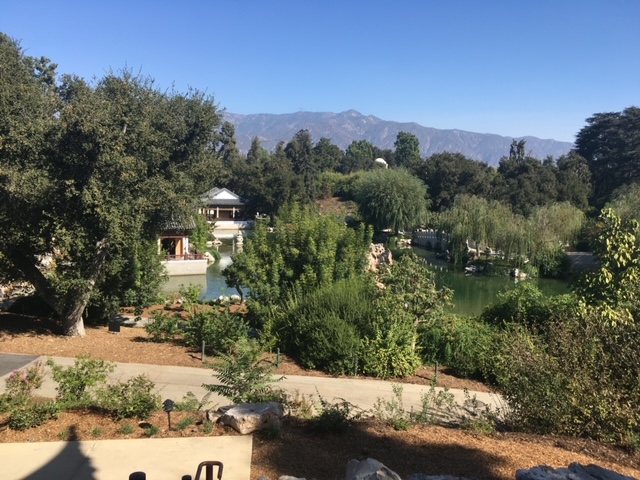
The Chinese Garden at The Huntington | Photo by Brianna Chu

The Huntington Library encourages teachers to use its grounds and facilities to make the learning experience enjoyable for students. Mikki Heydorff, Volunteer and School Programs Manager, would like educators to know about school field trips at no charge every Wednesday, Thursday and Friday from October through May. From 10:00 to 11:30 every morning on these three days, teachers can come in with their students to visit the Library and its gardens on docent-led  tours. To take advantage of this opportunity, teachers have to sign up on a first-come first-serve basis, starting August 1st, to reserve a date.

Educators, too, can take advantage of the many summer activities at the Huntington.  In its 11th year of implementation, Shakespeare at the Huntington is a three-week course for high school English and Drama teachers focusing on training through performance. Shakespearean educator Louis Fantasia and an international faculty train 6th to 12th grade teachers on development, scene analysis, acting and directing techniques. Getting your Green Thumb classes for teachers cover garden planning, gardening techniques and curriculum connections. Information on field trips, lessons plans, and interactive media are available on the Huntington’s website www.huntington.org under the Education page and teacher resources.

To ensure that it continues to support its various education efforts, the Huntington Library  embarked on a major expansion project. The $68 million renovation made possible through private donors will open this Saturday, April 4, as the Steven S. Koblik Education and Visitor Center.  It raised another $10 million to endow the new facilities’ operations. The project consists of 52,000 square feet of educational space and visitor amenities replacing existing construction built in1980 that no longer accommodated the needs of its visitors, scholars and staff. The Visitor Center features a 400-seat auditorium, a large café with indoor-outdoor seating and garden views, four multi-use classrooms, meeting and event areas, and an orientation gallery. 

This latest renovation followed the recent opening of the Huntington Store, a new specialty coffee shop, and a new full-service admissions and membership section.  

From its first opening in 1919, when Henry Huntington bequeathed his vast collection and botanical gardens to enrich visitors, it has grown into an internationally known research center for scholars, an important destination for tourists, and a tranquil retreat for locals. Every year 600,000 visitors come to the Huntington Library to experience its impressive collection of magnificent art, rare books, significant manuscripts and botanical gardens. Its education programs offer school visits, tours and hands-on activities to 20,000 students annually. More than 10,000 people participate in its public programs including classes, workshops, performances, and lectures.  

How monumentally proud Henry Huntington would have been if he were around to witness how his precious legacy is being utilized and preserved!
Pasadena Playhouse Launches Community Organizer Summer Internship Program

Originally published on 28 April 2015 in the Pasadena Independent, Arcadia Weekly, Monrovia Weekly, and Sierra Madre Weekly

As summer internships come, the one offered by the Pasadena Playhouse is, by far, one of the most challenging and exciting!  This year’s program was made possible through a grant from the Los Angeles National Arts Council, a first for the Playhouse.

The posted job description for this intern is that he or she will report to Seema Sueko, Associate Artistic Director, to activate the Playhouse’s Consensus Organizing for Theatre Methodology and represent the Playhouse through interactions with community leaders and members of the public. If that doesn’t sound daunting enough, the list of duties should give anyone pause.

Some of the intern’s duties include: conducting a dramaturgical examination of the plays in the 2015-2016 season; supporting the CO work by consolidating information, data and spreadsheets from the 2014-2015 season of CO work; brainstorming and activating Consensus Organizing partnership; and participating in the rehearsal prep work for the first show of the 2015-2016 season, among others things.

That the responsibilities are major and varied require this individual to be a self-starter with a tremendous drive and creativity. He or she needs to have a passion for theatre and its community-building possibilities. The successful candidate would be chosen based on his or her application letter that includes a one-page Community Organizer’s Statement telling Sueko his or her core values as an Organizer and/or personal mission.  

A consistent theme in this entire internship program is that of the Consensus Organizer – a concept originated by Sueko when she founded the Mo’olelo Performing Arts Company in San Diego. She based this methodology from Mike Eichler’s principles of consensus organizing for civic environment. When applied in theatre, this means building stakes in several pockets of the community and inspiring them to get involved back. If successful, this Consensus Organizing method should result in ticket sales and funding opportunities, and a more meaningful connection between the theatre and the community.

It is so apt that Sueko is advocating this concept in an environment that is open to such notion. The Playhouse’s history is steeped in community participation and involvement. When its founding director, Gilmore Brown, died in 1969 and the theatre closed its doors, The Pasadena Playhouse Alumni & Associates continued working. 

In 1985, it reopened as a result of a partnership between the local government, businesses, patrons and various philanthropists. The Playhouse went on to inaugurate new works and significant reproduction of American Theatre. Tony Award and Pulitzer-Prize winning plays and musicals of cultural and theatrical diversity have been featured on the Playhouse stage.

Sheldon Epps, who became Artistic Director in 1997, organized the Theatrical Diversity Program in 2005 that gave youths from disadvantaged backgrounds the opportunity to experience theatre through free student performances and arts education events. In 2013, it supported exploratory outreach initiatives to further engage the Hispanic and Asian/Pacific communities.

Under Epps’s helm, the Playhouse launched the national tour of Purlieincoordination with the Goodman Theatre; Sister Act: The Musical, which played at the London Palladium in the West End and at the Broadway Theatre on Broadway, and Baby, It’s You, which was presented at Broadhurst Theatre on Broadway.  He also oversaw the production of A Night with Janis Joplin; Stormy Weather: The Lena Horne Story, Can Can: The Musical, and Ray Charles Live. Other performances staged at the Playhouse include: Fences, starring Laurence Fishburne and Angela Bassett, with Epps directing; The Heiress, featuring Richard Chamberlain; Citizen Kane, with Val Kilmer; Above the Fold, starring Taraji P. Henson; Stoneface, with French Stewart; and KissMe, Kate, starring Wayne Brady, and once more directed by Epps.

Sueko’s addition to the Playhouse staff in January underlines Epps’s conviction that diversity and engagement with the community are founding principles of this venerable institution. In a January feature story in American Theatre, she explains consensus organizing for theatre. “A mutual stake is built by surfacing mutual self-interests. The theatre knows what its self-interests are, and it initiates mindful conversations with community members and businesses to bring their self-interests to the fore. Where things align, that’s where the organizing happens – we organize around that.”

The Playhouse has come full circle from its early beginnings as the Pasadena Community Playhouse, when the tremendous local support moved George Bernard Shaw into giving it the sobriquet “the Athens of the West.” 

It is in this scene where the Playhouse’s summer intern will enter to further act on the methodology Sueko pioneered called “consensus organizing for theatre.” For Epps, its success would be a defining moment for The Pasadena Playhouse and solidify its place in history as the State Theatre of California.             

Pasadena Museum of History’s Junior Docent Program

Originally published on 12 February 2015 in the Pasadena Independent, Arcadia Weekly, and Monrovia Weekly

They’re artists, entertainers, scientists and world-travelers. These words describe the former occupants of this glorious mansion on the southwest corner of Walnut Street and Orange Grove Blvd., Pasadena’s famed Millionaires’ Row. Now the Pasadena Museum of History, this Beaux Arts mansion was designed by architect Robert Farquhar, and built in 1906 when Eva Scott and her husband, Dr. Adalbert Fenyes, downsized. Their first Pasadena home was a 33-room Moorish mansion complete with stuffed peacock, a far grander residence than this mere 18-room house. It was home to four generations of the Fenyes clan until 1973.

I learned about the remarkable Fenyes family one Friday morning when I joined a group of 3rd graders from Roosevelt Elementary as our junior docent, KC Young, from Marshall Fundamental School, told us the story of Eva and the doctor. KC led us to a child’s bedroom on the second floor where she showed us an elaborate doll’s house and then to the master bedroom where a vanity held Eva’s grooming items like her brush etched with the distinctive Fenyes crest.

We went downstairs to the studio where an ancient Victrola shares pride of place with a grand piano. Eva played four instruments – guitar, piano, mandolin, and violin – and entertained extensively. They staged elaborate shows here and at one end of the room, a staircase leads to a platform where an orchestra played the musical accompaniment for performances and parties. It was also where Eva painted her portraits and landscapes. Eva’s wide circle of friends included many artists and her home became the salon and meeting place for the flourishing art colony in Pasadena.

Fenyes Mansion | Courtesy Photo

Our group’s last stop was the kitchen where we inspected the stove, icebox, bread toaster, irons, even an old Bissell rug cleaner, the precursor to a household staple, the vacuum cleaner .We were all intrigued by the ‘call box,’ which had the names and rooms of the various occupants of the mansion. The Fenyeses summoned their servants using this contraption, a more ‘modern’ version of the one American audiences see when they watch Downton Abbey on television.

KC Young is one of 31 junior docents for the Pasadena Museum of History. The Junior Docent Program began in 1988 as a collaborative project between PMH and Pasadena public and private schools. Through its peer-teaching method, exceptional students in 7th and 8th grade develop skills in leadership, time management, and public speaking. It fulfills the social studies standards mandated by the state and offers students an early introduction to community service.

According to Brad Macneil, PMH’s Education Program Coordinator, his challenge is getting young kids excited about life and culture in Pasadena at the turn of the 20th century, and how these contrast with the present day.  He has been spearheading this program for 14 years and is proud with what it offers – a rare opportunity for students to teach other students in a way that is quite different from how other tours are conducted.

In the fall, a select group of 7th and 8th graders undergo seven two-hour sessions on Wednesday afternoons. They learn everything there is to know about the mansion, its former occupants, and all the prized collections housed in this grand residence. Upon completing their course, these young docents give their first tour to their families. They are then tasked with leading tours for 3rd and 4th graders of PUSD in late winter and spring; junior docents give several tours in the duration of their term. Senior docents accompany them during their interactive tours to evaluate and coach them to perfect their touring skills. However, they don’t have memorized scripts to follow; they conduct tours the way that is comfortable for them.  

The day I was there, my first guide, KC Young, was the storyteller who engaged me and the 3rd graders with her inimitable enthusiasm and verve. I took a second tour and my guide, Preston Kealing, was the learned professor who taught me and 4th graders from Jefferson Elementary School how the Fenyeses’ remarkable personalities permeated Pasadena society and influenced the world of politics. KC and Preston had very different styles of imparting knowledge, yet they both conveyed the Fenyeses’ significant contribution to Pasadena’s culture and history.

At the end of the morning’s tours, all students and their docents gathered at the foyer where we all shared what we thought was the most interesting part of the experience. Asked what some students would like to take with them from 1906 to 2015, some said they would take the doll house, or the monkey cage, or the Victrola. While they each had a different idea of what was most memorable about this mansion, they all agreed that it had been a fun way to learn. 

I was amazed at how much I learned from 12 and 13-year-old students; I left the Fenyes mansion more aware and enlightened than when I first arrived. I am convinced the Junior Docent Program is as much a valuable Pasadena treasure as any mansion on Millionaires’ Row.