Comic-Con International Continues to Captivate

Originally published on 21 July 2016 in the Pasadena Independent, Arcadia Weekly, Monrovia Weekly, and Sierra Madre Weekly

In 1970, a group of comic book, movie, and science fiction aficionados got together and decided to organize a small convention (which they called minicon) in San Diego to establish awareness and raise funds for a much bigger event of this nature. They held it on March 21 of that year at the US Grant Hotel and it drew about 100 attendees.

It has since evolved into the San Diego Comic Convention (SDCC) and attracts thousands of followers to its multi-day gatherings in major cities the world over. The granddaddy of them all remains to be the annual Comic-Con International: San Diego, which will be held in several venues in and around the convention center from Thursday, July 21 to Sunday, July 25, with a preview night on July 20.

The comic convention has become hugely popular that it has spawned other events like WonderCon, held from 1995 to 2014 in Anaheim; the Alternative Press Expo (APE), held in San Francisco from 2002 to 2014 and in San Jose in 1995 to 2001; Comic Book Expo; ProCon; and Con/Fusion.

Image taken from Comic-Con website

Stephen Haydon, who works at a national retail store in Pasadena and is going this year as a member of the industry, is one of the organization’s most devoted attendees. He states, “Comic-Con has a reputation that preceded it long before it became mainstream. I’ve known about it for as long as I’ve been able to lift a comic book but it wasn’t until I was in high school that I learned the particulars of the event. I happened to be talking to my uncle who lives in San Diego and he suggested that my dad and I come out for it.

“I was born and raised in Iowa so Comic-Con seemed like an impossible dream but to hear that it was in such close proximity to my family made it an attainable goal. I first attended it in 2009 with my dad for four days and preview night. Unfortunately, my flight was delayed and I was unable to make it to preview night in time that year. I’ve tried not to miss it since,” Haydon continues.

Pasadena born and bred, Rachel Miller, loves reading comic books. The 20-year-old college student relates, “I must have heard about Comic-Con through an ad or at the comic store I frequent. Heading down to SDCC has been my dream since I was about 11 or 12, but this was the first year I was able to set any plans down in stone.”

For Miller’s 19-year-old former high school classmate, Brianna Chu, going to Comic-Con wasn’t exactly a childhood wish. She discloses, “I found out about it from friends like Rach but it wasn’t until I learned that my favorite actors from TV shows and movies went to it every year that I got really interested.

“Rach and I had considered going to it together, just the two of us, but having thought more about it we decided it wasn’t such a great idea to have two girls go on their own. So I asked two friends from university if they wanted to tag along,” Chu expounds.

Tom Williams, a 20-year-old who hails from Herefordshire, England, has also known about Comic-Con for a while. He recounts, “I had heard about it from various different sources, long before I ever conceived of possibly going there one day. It’s discussed and represented quite a bit in the general media, in such forms as gaming YouTube channels. And if you’re even vaguely interested in the Marvel film franchise, for example, it’s highly likely you’ll hear about it eventually. Some friends from back home and I considered going to London Comic-Con a number of times, although we were never able to organize it properly.

“Being from England, I obviously really didn’t think about traveling to San Diego until I went to university and made new friends. We knew we all wanted to go together! In my experience it’s always the people that make an event special and I’m really looking forward to enjoying it,” Williams continues.

Rebecca Montgomery, who is 19 years old and Chu’s flat mate last year at the university they both attend in the UK, has lived all over the world where her dad’s business operates. When school isn’t in session, she resides in Singapore. She says, “I found out about Comic-Con from watching my favorite TV shows, ‘Chuck’ and ‘The Big Bang Theory.’ While I had dreamt of going to Comic-Con it wasn’t until I met Brianna and Tom that it became achievable.”

The process of getting a badge to Comic-Con proved daunting for this group of friends. Miller says, “Badge purchasing was awful! You have to register long before you can actually buy tickets just to secure a spot in the ‘waiting room.’ On the day the badges become available you log onto this ‘waiting room’ an hour at most before tickets are up and you wait to get called into the page where you purchase them. In the meantime, banners pop up letting you know when days are sold out. On top of that, you can only purchase for yourself and a maximum of two others. It was stressful!”

“It was nerve-wracking while we were all waiting to see if we could get onto the actual buying site. I honestly wasn’t expecting we’d get lucky so I wasn’t really paying much attention. Then suddenly I realized I got in the purchasing page,” Montgomery relates.

Participants at Comic-Con San Diego 20 July 2013. Comic-Con draws hundreds of thousands of visitors every year and some attend in full costume. Image taken from Comic-Con website

The four friends were at school the day badges became available – Miller was in Philadelphia while Chu, Montgomery, and Williams were in Scotland. They were all on Skype together, watching the screen and hoping one of them would get selected.

Relates Williams, “Happily, Rebecca got chosen and she nominated Brianna and Rachel, who are both from Pasadena. That left me in a bit of a pickle. I had resigned myself into missing it this year but, thankfully, I was invited as an official guest of an exhibitor at the show!”

“We planned for this event for a good six months – figuring out when everyone would be meeting up and how we’d get there, as Rebecca and I live abroad. We also had to find accommodations at a reasonable price, decide what costumes we wanted to wear, consider our meal plan. The hardest part was making sure we’d all arrive at convenient times and that we’d have enough time beforehand to work and save up some cash,” Williams goes on to say.

They’re all looking forward to a thrilling experience. As Miller says, “Hopefully, it will live up to all my expectations of fun craziness. The trip still feels like a dream – it won’t be real for me until I step onto the convention floor on Thursday! While I anticipate to get much enjoyment, I also hope to gain a sense of independence and self-responsibility, traveling without my parents for the first time.”

Montgomery pipes in, “I’m delighted to be here in California; I shall make the most of this experience. I intend to have a great time, maybe see some cool panels, and listen to people talk about interesting topics.”

Meanwhile, Chu has one priority, “The first thing I’ll do is head to the Warner Bros. booth and hopefully get some autographs from the cast of ‘Supernatural,’ one of my favorite TV shows.”

One drawback about Comic-Con’s popularity is that tickets are in such high demand. Haydon, who has been going for seven years, illustrates, “The first time I purchased them, I went on the website a mere two months before the event. It was as simple as buying a movie ticket from Fandango, if not easier. Now the process is so complicated and badges sell out within 45 minutes after they are available for purchase.

“The price has also gone up – the first time my Dad and I went it cost $50 for all four days plus preview night; it’s now $275. But Comic-Con is part of my life; it’s hard to imagine a year without it,” Haydon states.

Image taken from Comic-Con website

Comic-Con International is the largest event of its kind and is held in 19 separate rooms in the Convention Center, at hotels nearby, and in the public library. Activities for attendees range from hands-on workshops, a masquerade cosplay costume competition, film screenings, an art show, portfolio reviews, autograph area, and the Will Eisner Comic Industry Awards.

People who weren’t able to purchase badges can attend events that are open to the public including booths, carnivals, obstacle courses, etc.

The presence of Hollywood celebrities promoting upcoming films and TV shows has added to the attraction and popularity of Comic-Con. David Glanzer, spokesperson for SDCC, says, “We have a wide variety of attendees, some of whom are interested in comics, writing, film, acting, producing, art, and other forms of artistic expression. It is great that those aspiring creators can meet and learn from those who are successful in their chosen field.

“In fact, I think there is a misconception that Comic-Con was originally just to focus on comic books. The reality is we always thought comics, film, and fantasy literature were areas of popular art that the public may not have fully embraced. So our hope was to bring wider recognition to elements we felt were truly great artistic forms of expression. In fact, it is heartening to see that in the 21st century, fantasy literature is so popular, that film is widely regarded with such high esteem that the US Congress established a film registry, and comic books are so popular that the public is aware of so many comics characters,” Glanzer expounds.

“The event is different for every person,” Glanzer concludes. “But we are all fans, who produce Comic-Con, so we try to create the type of show we would want to attend. We hope they learn something new and informative, enjoy the company of like-minded friends, and realize Comic-Con is a place where you can be yourself … or who you want to be.”

For the over 100,000 enthusiastic fans who will flock to San Diego this week, Comic-Con makes it so cool to be a nerd.


Interactive Children’s Tour Offered at Famed Fenyes Mansion

Originally published on 14 July 2016 in the Pasadena Independent, Arcadia Weekly, Monrovia Weekly, and Sierra Madre Weekly

The magnificent mansions on Orange Grove Blvd., in Pasadena, set along wide avenues and well-tended manicured lawns, are the stuff of fairy tales. The Fenyes Mansion is one such residence where kids would have so much fun playing pretend. At the same time, it is an excellent setting for today’s children to learn how people lived a hundred years ago.

From 10:30 am to noon, on Wednesday, July 20 and Saturday, July 23, the Fenyes Mansion is offering senior and junior docent-conducted and supervised immersive tours for kids aged six to twelve. Called ‘Growing up on Millionaires’ Row’, the visits offer a glimpse of what is was like to live in a grand house through the eyes of children.

Brad Macneil, Education Program Coordinator at the Pasadena Museum of History, designed the tour in hopes that this would be an occasion for grandparents to take their grandchildren on an enjoyable visit. He says, “It will be an intimate group of no more than 30 people for each session to allow for individualized attention. We will divide them into three groupings touring  different sections of the mansion. The first one will look at the public places – foyer, dining room and kitchen; the second will go into the studio and the conservatory; and the third will go to the upstairs private areas – the sitting room and the bedrooms.”

“There will be fun things to explore in each space. Obviously the kitchen is a wonderful place to see because while it looks somewhat like today’s kitchen, it is full of delightful appliances – old   fashioned toasters, ice box (refrigerator), stove – that children don’t see in their homes. We’ll show them how ancient phones functioned and how irons worked,” Macneil explains. 

“In the studio we have a Victor Victrola which we rarely use but it will be cranked up and will play music,” reveals Macneil. “It would be great to see the look on kids’ faces when they hear tunes coming out of that instead of from an iPod”.

Macneil further enthuses, “The conservatory is such an amazing place – how many people have their own private garden inside their house? How fun would it be for a child to come and play in this room devoted entirely to plants!”

“The group that will be looking at the foyer would become acquainted with how people arrived to visit – they had calling cards, for one, and they dressed far more formally than we do today. Children will get to pretend to come for a special lunch. They will see how the table is set and learn table manners. Just knowing which fork to use for certain foods require basic training; we have a book devoted solely to dining etiquette. I’m sure we’ll hear a lot of entertaining stories about that,” Macneil says with in amusement.

“Upstairs in the sitting room, children can dress up. Back then, girls and boys were taught how to be proper ladies and gentlemen.  We will have replica clothing they can put on to see what it was like – people wore different attires for various activities, including going out to tea or the theatre.  Women’s dresses had so many layers and weighed as much as 35 pounds! They carried accessories and the way they held their fans symbolized specific meanings, like if they wished to encourage conversation with a gentleman across the room. Even the flowers they received or offered to someone conveyed a particular sentiment. During the Victorian era, people  had to know the language of flowers. Who, these days, would even realize that when a gentleman gave a lady a white camellia it meant he found her adorable? And that getting back a bouquet of withered flowers was a dreaded rejection from a lady he so admired?”, Macneil adds.

“There’s so much the older generations can teach to children today, and that’s why we’re so excited about this.” Macneil continues. “We’re grateful that the Tournament of Roses gave us the funding to make this possible. Using these two sessions this year as a kick-off, we’ll evaluate how much interest it generates and if it’s successful we might make it a regular summer offering.  It is a wonderful addition to our mission of reaching out and sharing history with the community.”                      

Macneil states, “What I love about it is the sharing of information among multiple generations.  There’s nothing like observing a grandfather or a grandmother watching a child learn.  I can already hear the start of a conversation ‘When I was your age, I used to do ….’  It initiates a wonderful dialogue.”

The Pasadena Museum of History will be open to the public immediately after the tours so attendees will have the opportunity to explore the ongoing carousel exhibit, walk the grounds of the mansion, and stop in to purchase souvenirs at the gift shop. This interactive visit to the Fenyes Mansion can be a truly pleasurable beginning of a young child’s greater appreciation for history, the community, and the generations before them.                               

Laura Skandera Trombley Marks First Year at The Huntington

Originally published on 23 June 2016 in the Pasadena Independent, Arcadia Weekly, Monrovia Weekly, and Sierra Madre Weekly

The Huntington Library, Art Collections and Botanical Gardens in San Marino is a venerable institution beloved by residents in the San Gabriel Valley, recognized by scholars all over the world, and visited by tourists of every color and stripe.

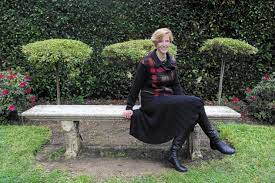
At the heart of this landmark foundation is Dr. Laura Skandera Trombley, who took over as its eighth president (and the first woman to hold the title) in July of last year. She oversees an organization with so many moving parts that perfectly coalesce to make The Huntington run as smoothly and seamlessly as it is beautiful and breathtaking.

Prior to her current post, Trombley served for 13 years as president of Pitzer, one of the Claremont Colleges in Southern California. Under her tenure the college raised its U.S. News & World Report ranking, and improved its acceptance rate. In 2012 The Chronicle of Higher Education named Pitzer College the top producer of Fullbright Fellows among U.S. colleges.          

Two weeks before commemorating her first full year at The Huntington, Trombley remarks on the past eleven and a half months, “It’s like discovering the wonderful contents of a treasure box – from the people, to the objects, to the gardens. The Huntington has the most amazing way of revealing itself like the petals of a flower. You see that the totality of it is stunning but the real beauty comes in the particulars. I’ve spent the year just looking at it a little more deeply than I have ever had before … and that has been really incredible for me.”

Like most people living in the area, Trombley is no stranger to the place. She remembers that as a child, she walked through the rose garden with her mother and went to tea. Years later she came back to The Huntington as a young scholar researching for her doctoral thesis. 

Image taken from the Los Angeles Times

“I felt this strong connection to it and I thought my experience was atypical. But I soon learned that it’s not. In fact I’ve met families who’ve volunteered at The Huntington for three generations; we have someone who has been actively volunteering for 54 years. That a quarter of a million people have the same robust ties to The Huntington – that this is so widely shared – was something that I could not have anticipated,” Trombley observes.

Trombley has fully immersed herself in the operations of The Huntington. She has worked alongside volunteers to prune and deadhead the roses in the garden, meet school buses as they arrive for tours, and wrap gifts during the holidays. She says, “I don’t want to just sit in my office; part of the fun is engaging with people here.”

The work for Trombley going forward is several-fold. She wants to focus on what goes on inside the buildings – continue to expand The Huntington’s collections, increase funding for art exhibitions. Additionally, she’s thinking of putting on more outdoor art displays, making sure all  staff are well-taken care of, and imagining how to enhance the visitor experience.

As president of Pitzer, Trombley grew its annual endowment from $42 million in 2003 to $133 million in 2014, and raised its national profile. As she is quick to point out, The Huntington is already a world-class organization as well as a global cultural institution and is in an incredibly robust financial position. Her charge is to continue to grow the institution and consider carefully its physical footprint. 

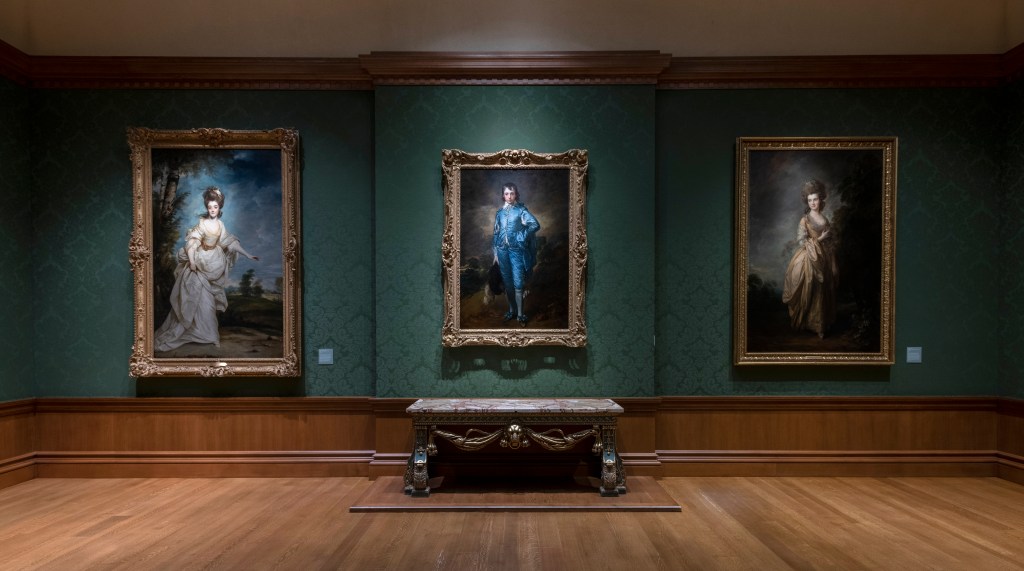
The Blue Boy Installation after the conservation project | Photo courtesy of The Huntington

And as Trombley did in her previous post, she intends to make The Huntington a model of environmental responsibility. She states, “We are moving strategically towards sustainability – analyzing how much water and power we consume and looking at how we can use less of both. 

“In fact, we will be a beta site for cutting-edge drip irrigation systems that are astoundingly sophisticated – they are all computer-controlled and can actually sense when it’s time to water. We’re considering installing low-flow toilets across the board, and maybe generating our own power. 

“These things are options that are important not just because we are a very challenged area when it comes to water and power but also because more and more the state is requiring that people take measures. Beyond that, we are always a teaching institution and we want to exhibit best practice. We want to show a path for how people can become increasingly sustainable in their homes at an affordable way,” Trombley expounds.

Ten months ago, Trombley embarked on a mission to make The Huntington a food destination. She explains, “The thing that’s interesting, and at the same time is complex, is that we have so many constituents when it comes to food. We have children who want grilled cheese sandwiches, tater tots, and mac n’ cheese; adults who want an authentic fine-dining experience with chefs designing their meals; our staff who want organic food and pre-prepared meals they can take home so they won’t have to go to the market and cook dinner from scratch.

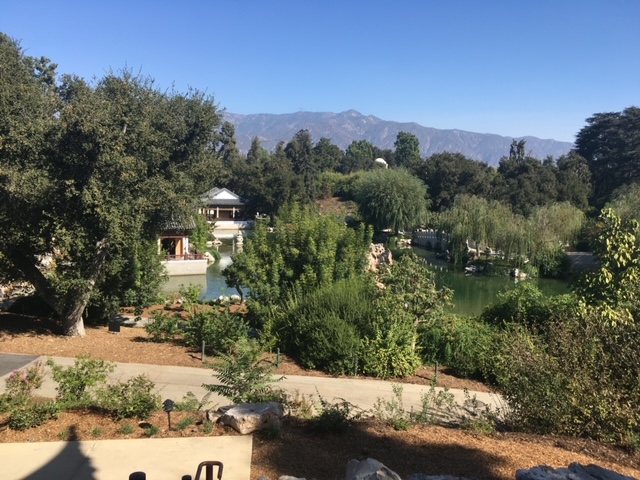
The Huntington’s Chinese Garden | Photo by Brianna Chu

“We plan to launch it in September and we hope it will be part of the attraction among the locals and particularly for our members. We want them to come for a nice walk and then enjoy an incredible meal with the best parking in Los Angeles. It would be so satisfying for me if people think of The Huntington when they want to have a world-class meal in an incomparable setting,” Trombley enthuses.

Dovetailing with this project is an expansion of their dining venues to accommodate the sheer number of people who visit. Trombley reveals they are building a second restaurant in the Chinese Garden – the Garden of Flowing Fragrance. The one that currently exists will very likely return to being a dim sum place, or become a real teahouse serving sweets and desserts, while the second restaurant would offer heartier fare. 

Trombley says further, “We have received an enormous number of requests for a place to accommodate large parties for weddings, first birthdays, even dances. Right now we only have our grass area and not everyone wants to be on grass; we also have to build a stage, which adds to the expense. To meet that space requirement, we are on the final phase of fund-raising for a 600-seat venue on the hillside of the Chinese Garden to be used for events. It will be able to support a tent so we can have events at any time of the year. It would have a spectacular view of the Chinese Garden and the two restaurants there can cater the affair.”   

There are several memorable events during Trombley’s first year that stands out in her mind. She describes her favorites, “The Huntington Ball is always lovely … I’d never been to a ball before … that was a lot of fun. It’s a fundraiser we hold every September for our members, guests and corporate sponsors. 

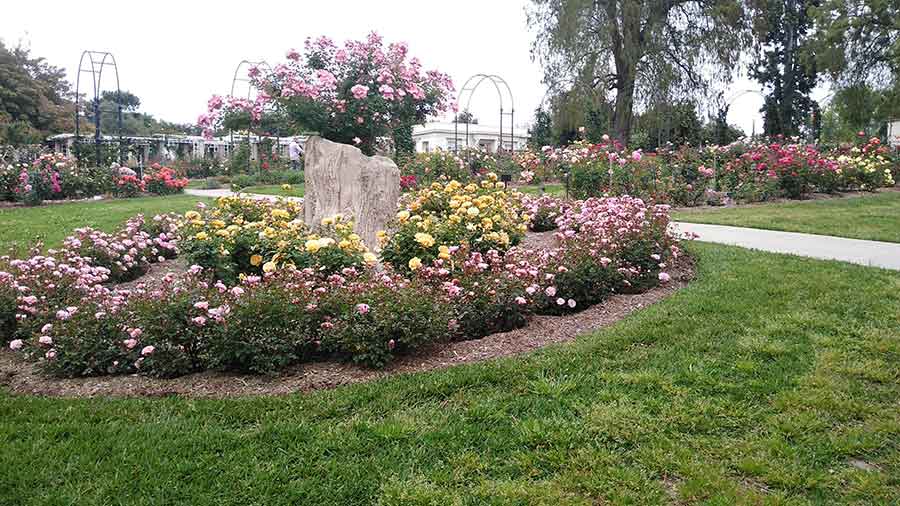
The Huntington’s Rose Garden – Courtesy Photo

One event they had for the first time is the San Marino Day which Trombley initiated. In April The Huntington opened its gates and invited everyone to come free of charge – about 20 percent of San Marino’s population came in that day, reports Trombley. Another favorite is An Evening Among the Roses, held for the LGBT community. She is also looking forward to the completion of the Garden of Flowing Fragrance, a grand celebration slated for 2018.

“There are so many events here … and I’m not even mentioning the fantastic speakers who have all been extraordinary,” Trombley hastens to add. “Except for the San Marino Day which we held with my coming in, these other amazing events have been going on for a long time. But it’s a place that’s very open to new ideas … to creative ideas. I find that to be one of the best parts of The Huntington.”

When asked what vision she wants people to have at the mention of The Huntington, Trombley laughs and protests, “I think it would be almost impossible for me to name just one. We have The Huntington rose, The Blue Boy, Mark Twain’s manuscript of ‘The Prince and the Pauper.’ What I’ve learned is that everyone has a different mental image of it.

But one thing that comes to mind above everything is that it’s a kind and gentle place where people are treated very, very well. And it’s a place where you could just have a sense of spontaneous exhaling and, at the same time, an inhaling of creativity. I think that’s the most special aspect of The Huntington,” Trombley opines. 

The Huntington is an institution that evokes as many different feelings and emotions as the tourists and visitors who come to experience it. And just as Trombley discovered when she came on board a year ago, every single person who steps into this wondrous oasis retains a deep connection to it.                    

While locals happily share The Huntington’s vast treasures with the thousands who come to visit annually, they are fiercely protective as they are intensely proud of this national treasure in their midst. They are also absolutely certain that in Trombley’s accomplished stewardship The Huntington will thrive and flourish for centuries to come.  

A Noise Within Unveils 25th Anniversary Season

Originally published on 21 April 2016 in the Pasadena Independent, Arcadia Weekly, Monrovia Weekly, and Sierra Madre Weekly

A Noise Within (ANW), the classical theatre repertory company based in Pasadena, is celebrating its 25th anniversary. Founders and Producing Artistic Directors, Geoff Elliott and Julia Rodriguez-Elliott, still find it amazing that they have reached that milestone. 

“If someone were to tell me a decade ago, when we were still in the cold, leaky Masonic Temple in Glendale, that I would be standing here in front of you today, I would never have believed it. I would have loved to hear it but I could not have imagined it to be the case. And yet here I am;  it’s simply beyond our wildest dreams,” Elliott humbly confessed before an audience of theatre supporters, artists-in-residence, and a few members of the press. 

On Tuesday, April 19, ANW officially began its 25th year celebration and unveiled its growth plans as well as the slate of play offerings for the 2016-2017 season. Michael Bateman, Managing Director, who opened that evening’s event described how the company plans to build on its success and thrive in the future. He also revealed how ANW will get the funding to support its grand initiatives.

The company’s ambitious growth plans include: continuing to invest in the artistic company – actors, designers, and directors; providing flexibility for ANW’s creative artists through ‘freedom funds’; maximizing educational outreach by providing additional transportation and ticket scholarships to underserved schools, and deeper engagement opportunities for teachers and for students, including sequential learning options and curriculum development assistance.

Continued Bateman, “While that sounds challenging, it is totally achievable. We are getting support for our initiatives through gifts and pledges. A single gift of $250,000 has been pledged by John and Barbara Lawrence, with $600,000 having been pledged overall. Jeanie Kay has pledged a bequest gift of $2.5 million; we are also hoping to find 25 new individuals, like Jeanie, to include ANW in their estate plans.”

After Bateman talked about the business of producing memorable plays,  Elliott and Rodriguez-Elliott took to the stage and announced ANW’s 2016-2017 season offerings. Amidst  

enthusiastic cheers from members of the company and theatre enthusiasts, who have been eagerly anticipating this announcement, they outlined each play – Tom Stoppard’s Arcadia; The Maids by Jean Genet; Moliere’s The Imaginary Invalid, adapted by Constance Congdon based on a new translation by Dan Smith; Shakespeare’s King Lear; Ah Wilderness! by Eugene O’Neill; Man of La Mancha by Dale Wasserman, music by Mitch Leigh and lyrics by Joe Darion; and A Christmas Carol by Charles Dickens, adapted for the stage by Geoff Elliott.

Geoff Elliott and Julia Rodriguez-Elliott | Courtesy Photo

“Four of the plays we are announcing for the 25th anniversary season speak loudly to us now from our history – The Imaginary Invalid, King Lear, Ah, Wilderness!, and Man of La ManchaArcadia and The Maids are new for us. Together, our actors, artists, and audience will take a journey through and beyond our wildest, and sometimes simply wild dreams – the same journey that Julia and I have taken over this past quarter-century,” Elliott pronounced.

And it has indeed been a journey that has surpassed all their expectations as they look back in time. As Rodriguez-Elliott remembers it, “In 1991 we were struggling students, fresh from American Conservatory Theatre, and we used our last $3,000 to produce Hamlet. It was a big success and we learned a lot very quickly – that Los Angeles was filled with well-trained talent, that there was an audience hungry to see plays of substance, that there were people and resources willing to support this effort, and that there was a press corps interested in writing about this work.

“All of this added up quickly to the beginnings of a community,” continues Rodriguez-Elliott. “In the nurturing of this idea of community, we found ourselves on a path that led to our next productions, the use of the Masonic Temple in Glendale, a 501(c)(3) designation, an administrative staff, and so on. We had suddenly built an organization, including a robust education program, which enabled us to share our love of the classics with local students.”

As ANW gained following, it also outgrew its venue. In the middle of the 2008 recession the company somehow managed to raise the $13.5 million needed to build its new home on 3352 East Foothill Blvd. in Pasadena. It is a three-story, 30,000 square foot facility with rehearsal space, scene and costume shops, classrooms, administrative offices, and a student learning resource center.

This new facility made it possible for the theatre company to increase its audience considerably, and in the last five years has surpassed its previous box office and attendance records annually. Each year ANW serves over 40,000 patrons from Southern California and elsewhere. It has also achieved the remarkable feat of 85% subscription theatre renewals, 12% more than the national average. And it still is adding new subscribers, increasing its total audience base every year.

The theatre company’s commitment to make theatre accessible to everyone is evidenced by its ‘Pay What You Can’ night for each production. Its Resident Artists also put on staged readings six times a year at no cost to the public.   

One of ANW’s distinguishing hallmarks is its educational outreach program. Thirty percent of its resources are dedicated to support schools, providing transportation for students to come to the theatre. It also offers: reduced ticket costs to attend a live on-stage performance; post-show discussions with the artists; in-class workshops; and standards-based study guides. It has served more than 250,000 students over the years; in the 2015-2016 season, 15,400 youths from 204 schools from 28 school districts participated in this program. Its acclaimed summer camp, ‘Summer With Shakespeare,’ has graduated nearly 900 students since its creation.

So much has happened in two and a half decades. Today ANW is considered one of the most successful theatre companies in the country. But the one thing that has remained constant is their unwavering artistic vision. As Rodriguez-Elliott says, “We focus on timeless works that speak to the human condition. It’s important for us to present these epics in an intimate setting, told with a personal and contemporary perspective – after all, what good are all these grand, sweeping narratives if no one can relate to them?” 

To celebrate its first quarter century, ANW is holding events across their disciplines. There will be a Summer with Shakespeare on July 16; The American Dream: A Resident Artist Reading Festival on July 22- 24, 2016 (an event which is free to the public); a free Open House on September 17, 2016; a Fashion Show featuring costumes the artists have worn in its productions

through the years on January 21, 2017; and a 25th Anniversary Gala at the California Club to commemorate 25 years of classic theatre on April 29, 2017.

Elliott and Rodriguez-Elliott have decidedly come very far from their humble beginnings when they used their last dime to produce Hamlet. And both are keenly aware that a loyal community of artists, students, theatre lovers, and friends will take the next 25-year journey with them to help ensure this art form remains flourishing for generations to come.            

Six Characters in Search of an Author Premieres at a Noise Within

Originally published on 14 April 2016 in the Pasadena Independent, Arcadia Weekly, Monrovia Weekly, and Sierra Madre Weekly

When Luigi Pirandello’s early play Six Characters in Search of an Author was first performed in 1921 at the Teatro Valle in Rome the audience protested with shouts of “manicomio!” (madhouse) because of the play’s irrational premise. Pirandello had to write a third edition in 1925 with a foreword to clarify the idea he wished to convey.

A precursor to the Theatre of the Absurd, Six Characters in Search of an Author, blurs the line between reality and illusion. It premieres at A Noise Within  (ANW) in Pasadena from March 27 to May 14, 2016 with Geoff Elliott and Julia Rodriguez-Elliott as co-directors.

Essentially a play within a play, it takes place in a rehearsal room where an acting company is working when they are interrupted by six people who come in from the street. They explain to the director that they are unfinished characters in search of an author to complete their story. While the director initially thinks them to be mad, he gives in to their claim as they relate their story. 

Elliott explains, “The director buys into it and agrees to stage their story.  But then a debate ensues as to who would best play the roles. The actors are convinced they are the ones who could bring the words to life and make these characters relatable human beings. Meanwhile the six characters argue that they should play themselves because anything otherwise would merely be an interpretation, and not who they really are.”  

Adds Rodriguez-Elliott, “This is why when Six Characters was first produced onstage there were protests. The play challenged the very nature of theatre; it showed how implausible theatre is. But when you parse it down to its most basic, it isn’t just an esoteric idea but a tale of passions.  It’s almost Shakespearean as it tackles infidelity, suicide and, possibly, incest. It is a story about a family seeking relief from a horrible event that has befallen them. And they believe that they would find that release they so desperately need if they could tell their story. It suggests theatre’s healing and therapeutic power.”

“Pirandello had these characters in his head who were so alive for him but he didn’t know how to use them or what play to put them in. Yet he couldn’t get them out of his mind,” Rodriguez-Elliott continues.

“They just wouldn’t leave him alone” Elliott interrupts with a laugh. “They kept causing great frustration so finally he gives in and lets them insert themselves into this rehearsal. I can’t help but think that writing this play must have been very cathartic for Pirandello. All writers or screenwriters, generally, dread to hand their work over to the actors because the actors will decide to rewrite it and make it into something they didn’t have in mind at all. What a joy it must have been for Pirandello to watch what happens when he haphazardly throws these characters into a play!”

Rodriguez-Elliott relates, “It’s quite fascinating – as we started working on the material, we saw the brilliance of Pirandello’s writing. We didn’t really completely comprehend it until we got into rehearsal and discovered its many facets. And, frankly, I found even more humanity in these individuals as we peeled away their layers.”

As Elliott puts it, “This play, more than any of the others we’ve done, reveals itself to us. It shows how your thoughts could change as you delve deeper into the story. It is fundamentally about a dysfunctional family. Who couldn’t relate to that?”

“Theatrically, it’s quite interesting to put on. We start out with a neutral rehearsal room with nothing much in the way of a set – a piano, some chairs, maybe. As the characters begin to tell their story, color is introduced; a garden comes to life; things appear and then disappear. The space takes on their reality at some point and you see that manifest itself through the pieces on the set. In a way it’s like our imagination; it can take us to certain places,” Rodriguez-Elliott elaborates.

“We hope Six Characters gives our audience a chance to experience theatre in its most non-linear sense and give in to it. Pirandello asks a lot of questions and puts them all out there. He doesn’t necessarily give us a solution nor neatly ties things together. It’s going to mean different things to disparate people; we can all observe the same event but each one of us would have a different perspective,” Rodriguez-Elliott concludes

In announcing the theatre company’s theme for the 2015-2016 season, Elliott declared, “As a recurring thematic element, ‘Breaking and Entering’ symbolizes breaking down the walls of ignorance or fear and summoning the personal courage to embrace a greater sense of truth. These plays are inhabited by characters who do just that.”

How apropos that Six Characters in Search of an Author culminates ANW’s impressive season staging groundbreaking masterpieces by playwrights who have given us permission to see beyond the obvious.                        

American Impressionism Exhibit Educates at The Huntington Gallery

Originally published on 17 March 2016 in the Pasadena Independent, Arcadia Weekly, Monrovia Weekly, and Sierra Madre Weekly

“I feel, as a curator, I am more of an educator,” muses Dr. James Glisson, Assistant Curator of American Art (Bradford and Christine Mishler) at The Huntington Library, Art Collections, and Botanical Gardens. And what a beautiful art education The Huntington visitors will be treated to!

Currently going on through the 9th of May at the MaryLou and George Boone Gallery, “The Artists Garden: American Impressionism and the Garden Movement, 1887-1902” features 17 paintings on loan from The Pennsylvania Academy of Fine Arts’ (PAFA) permanent collection. The show gives visitors and scholars a glimpse of painting as it relates to garden design. Glisson, who organized the exhibition and contributed an essay to the catalog states, “This exhibition gets behind the undeniable beauty of impressionistic pictures of gardens and asks questions about the social activity of gardening, the scientific hybridization of plants, and even early environmental conservation.”

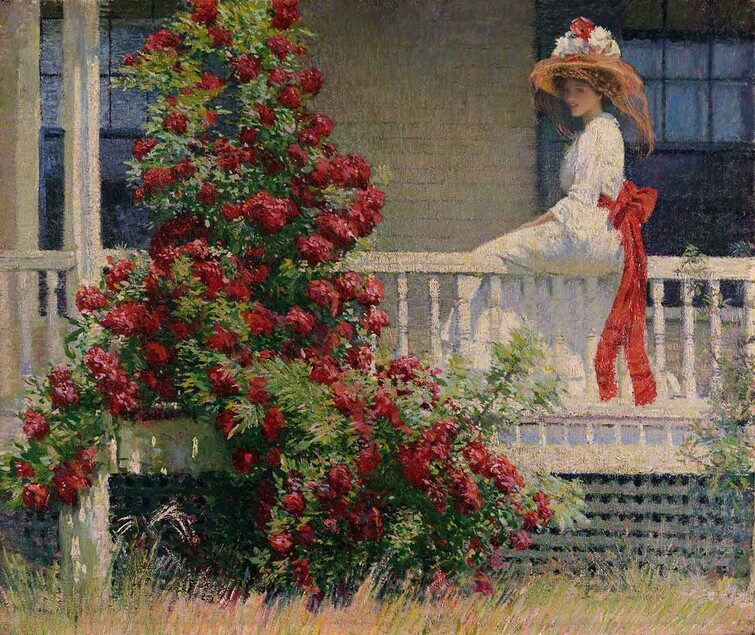
According to Glisson, the two paintings he selected to bookend the exhibition – The Crimson Rambler and The Hovel and the Skyscraper – sum up what the show is all about on a conceptual level. He explains, “Philip Leslie Hale’s painting shows a red rose bush, the Crimson Rambler, a common and hardy backyard plant paired with a woman wearing a wide-brimmed hat and dressed a la mode. I think Hale intends them to read as analogous to each other – she is on display like a beautiful flower; it may be a cliché metaphor but it’s still pretty effective. Both the woman and the newly hybridized rose are modern and contemporary for their time. Similarly, the painting technique used a modern application of colors.”

“When I talk to people about the exhibit I like to say that these are painters who are reflecting on modern American life in the late 19th and early 20th century, post industrialization and during urbanization. They painted landscapes that offer respite from the grunge of the city, an escape. The Crimson Rambler is a subtle rendering of this sentiment,” Glisson says further.   

Philip Leslie Hale’s ‘The Crimson Rambler | Photo courtesy of The Huntington

Glisson then points out, “Childe Hassam’s painting, on the other hand, is an explicit depiction of the time’s attitude. The Hovel and the Skyscraper looks out of the artist’s studio into Central Park. He delivers the message in his paint application – very precise with a lot of rectilinears; and the subject matter – a tall building. In 1904 New York’s skyscrapers were the epitome of an advanced, modern American city.  It resonated among its viewers in the same way we see the skyscrapers of Dubai or Shanghai. Yet, he painted the park as soft, gentle and beautiful, with no straight lines – a space of quiet, refuge and nature.”

“I see this painting as something that speaks to Angelenos and the real estate market; his views are about to be blocked by brand new buildings. It alludes to today’s teardown phenomenon where existing structures are being replaced by bigger, taller ones to  make a lot more money,” Glisson adds.

In the late 19th century, the railroad made it possible for Americans to conveniently travel from their suburban home into the city to work. In the same vein, painters commuted whenever they had to and their artwork reflected that lifestyle. Describes Glisson, “Painters at the time depicted what was near and familiar to them, which also happened to be really modern at the time.”

One piece of art in the show is by John Henry Twachtman, a member of the new suburban class who lived in southern Connecticut close to the railroad. His piece, called Snow, depicts his backyard covered in snow. Though not a farmer, he lavished great care on his yard.    

The exhibition also includes some of The Huntington’s collection of 150,000 chromo lithographs gifted by Jay T. Last. Chromolithography was a process used by artists of this period to produce illustrations for newspapers and magazines to make money. It was also widely used to advertise the new colors of hybridized roses, like the Crimson Rambler, and to create the seed packets for flowers being grown by Americans who have discovered backyard planting as a middle class leisure pursuit. 

The San Marino institution is the show’s only West Coast stop on a five-venue tour organized by Anna Marley, Curator of Historical Art at PAFA. She explains the rationale, “The Huntington, with its spectacular gardens and wonderful American art collection is the perfect venue for a show that traces the interconnections between the American garden movement and Impressionist painting. Also, the development of the Pasadena bungalow culture at the turn of the 20th century corresponds perfectly to the material in the exhibition, which was related to the broader national garden cities and British Arts and Crafts movement.”

“I hope visitors to The Huntington make the connections between their own homes and gardens and the lives of American artists living and working over 100 years ago. I hope they love the art but also take away a new-found knowledge of the history of the Progressive era in the United States, and particularly its relationship to the burgeoning movements of environmentalism and women’s suffrage, issues with great resonance today,” Marley concludes.

The historic gardens at The Huntington, an estate which once belonged to collectors and philanthropists Henry E. Huntington and his wife, Arabella, is planted with 1,400 varieties of roses artfully perched on arbors and trellises. It is easy to imagine how Arabella took delight in the magnificent blooms in her rose garden, and how 21st century women are experiencing the same to this day.        

Shaw’s ‘You Never Can Tell’ on Stage at A Noise Within

Originally published on 10 March 2016 in the Pasadena Independent, Arcadia Weekly, Monrovia Weekly, and Sierra Madre Weekly

Students of English Drama would all be in agreement that George Bernard Shaw, who wrote over 60 plays in his lifetime, is one of the most revered writers of all time. This Nobel Prize- and Oscar-winning Irish playwright, critic and socialist influenced Western theatre, culture and politics from the 1880s to his death in 1950.     

One of Shaw’s earlier plays, You Never Can Tell, provides much hilarity for Drama scholars and theatre enthusiasts alike as it is performed onstage at A Noise Within (ANW), starting March 6 through May 15, 2016.  

Stephanie Shroyer, an Associate Professor of Theatre Practice and the Artistic Director at the USC School of Dramatic Arts, takes the helm for this production.  She describes what’s in store for its audience, “I believe Shaw is telling us that life is hard and we should cherish every moment because, really, you never can tell what good will come our way. This is a wise, warm, and terrifically funny play – after all, what other play about love opens in a dentist’s office, with a practitioner who becomes the major love interest, pulling his first tooth without using anesthesia because it is an extra five-shilling charge?”

This is Shroyer’s first time to direct You Never Can Tell and she is thrilled. “I’m a big fan of Shaw – I love his wit and provocative thinking. I didn’t know this play intimately well but fell in love with it after reading it.   

When we did a bit of research for the play, we found this to have been Shaw’s answer to some people’s request for material with popular appeal for the modern audiences of the late 19th century. While the characters are intellectualizing, it’s lighter in tone. I liken it to serving the play’s message with a spoonful of sugar,” Shroyer enthuses.

Shroyer also imagines some of the characters in this play are what one would expect to see from Commedia dell’arte stock characters, “I want to have the circumstances in the material performed to their fullest – the actors will use overemphasized hand movements and gestures to show the exaggerated points Shaw is making intellectually.”

Longtime ANW company performer, Deborah Strang, who plays Mrs.Clandon, articulates everyone’s sentiment that staging You Never Can Tell is an enjoyable experience, “I loved working with Stephanie when she directed Blood Wedding during ANW’s very early years, and I still enjoy collaborating with her to this day. She is a visual artist and her training as a dancer shows when she asks us to do something that comes from another world, in a way. But eventually we get that her approach is left brain-right brain. And she makes us all laugh. We have way too much fun in rehearsal there must be something wrong.  I’m sure it will all fall apart sometime.”

Unlike her director, Strang isn’t particularly the playwright’s fan. She confesses, “In a way Shaw is too smart for me; he’s very much an intellectual. I’m a little stupider than he – I constantly feel like he’s two beats ahead of me. But this piece might have changed my mind and I might have to reread him from this new angle.  his play and the people in it are so delightful. Whereas a lot of his work deals with ideas, this one is more about the characters. It’s almost like Oscar Wilde’s The Importance of Being Earnest without the irony. It’s a comedy, it’s fresh and delightful.  Every single character is lovable and charming.”  

You Never Can Tell is set in a seaside town and follows the story of Mrs. Clandon and her three children – Dolly, Phillip and Gloria – as they return to England after an 18-year stay in Madeira.  Mrs. Clandon, a woman whose sensibilities are caught between the tug of restrained Victorian manners and the modern ways, raised her children on her own and never told them their father’s identity. Through a comedy of errors, however, they end up inviting him to a family lunch.  Meanwhile, a dentist named Valentine has fallen in love with the eldest daughter, Gloria. But Gloria deems herself a modern woman and declares to have no interest in love or marriage. The play goes about with various scenarios of confused identities, with the wisdom coming from a sage waiter who dispenses it with the phrase “You Never Can Tell”.

This play performs in repertory with Shakespeare’s Romeo and Juliet and Luigi Pirandello’s Six Characters in Search of an Author.  Elliott says of You Never Can Tell, “As Romeo and Juliet shows an aspect of love, George Bernard Shaw shows us love – and heartbreak – in an entirely different, bright and very funny way. This early play of his, before Shavian became an adjective, gives us a chance to take great delight in his outrageous situations and voice with a kind of unique wordsmithing that allows us to bathe in his glorious use of English.” 

Shaw’s imposing body of work that we find irresistible to read or watch on stage – from acerbic satire to historical allegory – clearly exhibits why his plays endure to this day.                  

Shakespeare’s Romeo and Juliet as a Street Performance at A Noise Within

Originally published on 18 February 2016 in the Pasadena Independent, Arcadia Weekly, Monrovia Weekly, and Sierra Madre Weekly

Beginning this Valentine’s Day through the 8th of May, A Noise Within (ANW) will be staging the greatest love story of all time – William Shakespeare’s  Romeo and Juliet. 

Directed by Damaso Rodriguez, Artistic Director of Artists Repertory Theatre, Portland’s longest-running professional theatre company, this Romeo and Juliet will be a far departure from how Shakespeare’s work is traditionally presented: as a period piece, with lavish costumes and grand sets. Instead the play will be presented as a street performance, in a graffitied and littered alley with garbage bins scattered about.

The vision for this well-known play came about when Rodriguez visited Havana, Cuba and  met with artists who staged bare-bone productions for a few attendees in humble homes. He relates one memorable evening, “We walked through a courtyard overlooking balconies – it is a beautiful environment but all around you could see peeling plaster from 50 years of decay.  We entered a small house, with light bulbs in tomato cans for stage lighting, the actors wearing their own clothes. The audience was made up of 20 people who came that night. And they proceeded to tell their story. It was a Cuban play which, I think, was about their daily struggles for survival. While there was a language barrier, what united the performers with the audience was the art form. It was a truly transformative moment for me.”

“Theatre companies without much in the way of money put on plays using found objects for props and scenery, and in very low-tech, low-resource performance spaces. The plays with just the actors themselves having to rely on their skills were powerful and inspirational.  In this place where there are few resources, actors and audience link as a community with the compelling need to tell and hear stories joining them as one.”

“I wanted to bring this experience to Romeo and Juliet – costumes will be clothes that actors own, props are whatever they find in the street, and the setting urban. The play will exist in the telling rather than the trappings.” 

“It will be an unexpected environment that in no way resembles the characters’ wealth and class.   I hope that by stripping the play down to its most basic, it will focus on the language and clarify the intention of the characters,” Rodriguez discloses further.

ANW’s artistic director, Geoff Elliott reveals, “When we approached Damaso about directing for us this season, he responded by saying that he has wanted to do Romeo and Juliet because it deals with the most basic of human emotions – love, rashness, hate, fate – and tribalism, which drives just about anything we call news. Humans have passion, conduct war, and kill each other over a tribal conflict the origin of which no one can even remember. And I think that Damaso has found a direct and compelling way to tell this story.”

Rodriguez says, “I hope people who come to watch the play, after a few minutes just try to conceptualize these characters and see them as humans. I hope they see a clearer version of the story and realize the universal essence of Romeo and Juliet.”

“It is a raw and harsh environment, yet we have an optimistic view that their death has brought the conflict between these two families to an end. People will realize this tragedy happened because of two opposing rigid world views – that it took the death of these young characters to end hatred. Romeo and Juliet taught them to look at life differently,” Rodriguez adds.

“It’s arguably daunting to present such a classical material in an unexpected fashion because you could be working with actors who’ve done it before. People who love Shakespeare have certain expectations; also there are scholars who think Shakespeare has to be done a certain way. But in the end all I can do is forget about that. I have to believe that a director has to find an emotional connection and impulsive reaction to it, and share that with his collaborators,” Rodriguez states further.

“It’s quite liberating, actually, to not be restricted by expectations and standards. While A Noise Within has staged Romeo and Juliet twice, I didn’t necessarily set out to find a way to make it very different from what they did before. I didn’t burden myself with that concern; I am merely satisfying an urgent impulse. It’s hard enough to just unpack the language of Shakespeare. I simply want to make the storytelling as clear as he would have wanted for his audience,” concludes Rodriguez.              

During Shakespeare’s time some plays were presented outdoors. Theatregoers had to use their imagination – there were no backdrops, lighting, or props to speak of. Furthermore, his plays were not intended to be read but spoken aloud; the lack of background meant there was nothing to distract the audience from the actors’ words and movements.     

That ANW’s Romeo and Juliet would be staged as they were originally performed four hundred years ago is the perfect tribute to the Bard’s timeless work.  

Alex Israel’s Contemporary Ouvre at The Huntington Art Gallery

Originally published on 16 January 2016 in the Pasadena Independent, Arcadia Weekly, Monrovia Weekly, and Sierra Madre Weekly

The Blue Boy by Thomas Gainsborough is so representative of The Huntington (Library, Art Collections and Botanical Garden) in San Marino that it is usually the first piece of art people seek out when they tour the gallery.   

Visitors to the venerable San Marino landmark will either find it delightfully amusing or downright shocking when they see this iconic painting juxtaposed to a decidedly modern selfie of contemporary artist, Alex Israel, wearing a Dodger’s blue jacket. A year in the planning, this art intervention of works by Alex Israel opened to the public on December 12, 2015 and will be on view until July 11, 2016. 

Kevin Salatino, Director of the Art Collections at The Huntington, says, “Not everyone would associate us with contemporary art, but we live in the 21st century so we should engage with all that’s 21st century. People think this mansion must have been exactly what it looked like when the Huntingtons were here, which is so far from the truth; it is not a static house. But there is a certain consistency to the kind of Gilded Age material that we continue to collect that complement what the Huntingtons had.”

It may surprise many to know that The Huntington has done the occasional contemporary intervention before now. Catherine Hess, Chief Curator of European Art, relates, “Our first intervention was a Ricky Swallow sculptures and Lesley Vance paintings exhibition in a small upstairs gallery.  It was the beginning of the earthquake and we got our constituents through that.” 

The decision to approach Alex Israel this time around was Salatino’s idea. He explains, “I have known Alex and have watched his career flourish. He loves L.A. and its iconography, the Hollywood dream machine, and fantasy. And so much about The Huntington is really about fantasy. About a year ago, Alex looked at the house and thought about his pre-existing work to decide which objects are right for The Huntington.

Our goal is to create a dialogue between the old and the new; we want people to see the old through the lens of the new, and vice-versa. Some people might react positively but some might respond negatively, but that would be better than for them not to think at all,” Salatino concludes.

Hess interjects, “One of the biggest surprises, at least in my perspective, after the installation was complete, was how some traditional Masters pieces were remarkably informed by the juxtaposition of Alex’s art, and the reverse. His work, in a vacuum, can read a certain way, but placed in this context, makes it compelling. I’m hoping people will also see it that way.”

Continues Salatino, “This contemporary installation is meant to be engaging, provocative, interesting. Then it goes away and we’ll do another one in a few years. A really good reason for having Alex’s work here is that he has a love affair with this area. It was much the same for Henry Huntington who fell in love with it after he visited. He initially thought he would buy the land and divide it up, but eventually decided to keep it. It was one of the first Beaux Arts residences and was the largest house for miles around until it was supplanted by Aaron Spelling’s mansion in West Hollywood. Alex grew up in the Holmby Park circle, looking up at Spelling’s house.”

The culture of Hollywood and celebrity is very much the central theme in Alex Israel’s oeuvre. Sprinkled throughout The Huntington are paintings, murals and sculptures that reference famous movies or icons from memorable films. It is a veritable scavenger hunt for visitors to the Art Gallery as they find contemporary pieces that have been placed alongside traditional art objects. 

There is the crystal egg on a mantelpiece that was an iconic piece from the 1983 coming-of-age Tom Cruise film Risky Business, for instance. In another gallery, a cleverly concealed bronze prop will undoubtedly cause visitors to do a double-take at one of the most recognizable 1941 Maltese Falcon prop. In the ceramics study room, Alex displayed a mold of an Oscar statuette – the very quintessence of Hollywood and celebrity.

The most dramatic of Alex’s installation is the transformation of the staircase where a fragmented sky backdrop mural bursts. Enthuses Salatino, “It is an Aha! moment – with drama and theatricality in a way that is not intrusive but complementary.  It’s stunningly beautiful and it looks like it’s been there forever. It’s deliberately titled backdrop because it is a backdrop for films. It serves as one for every visitor as if each were an actor in a film.”

During the holiday season The Huntington’s Christmas tree stood in this area, which Alex decorated with his self-portrait in miniature. It isn’t an ego-trip but a celebration of celebrity.   

Alex likens today’s selfies to the Grand Manor portraits of the early 19th century. His Dodger blue-jacketed selfie isn’t meant to be tongue-in-cheek – rather, it is his homage to The Blue Boy. Hopefully, art enthusiasts appreciate it as such.    

‘A Christmas Carol’ at A Noise Within

Originally published on 26 November 2015 in the Pasadena Independent, Arcadia Weekly, Monrovia Weekly, and Sierra Madre Weekly

It has become an all-too common occurrence – hordes of buyers fighting over the last $99.00 BluRay disc player at a big box store the day after Thanksgiving, heralding the Christmas shopping season. But there was a time, before the Christmas spirit took on the guise of Black Friday doorbuster specials, when this season meant goodwill towards humankind.  

A Noise Within (ANW), a repertory theatre company in Pasadena, is bringing back the sentiments that this time of year should evoke. Beginning this Saturday, the 5th of December through Wednesday, the 23rd, San Gabriel Valley residents can come to enjoy its production of Charles Dickens’ timeless classic A Christmas Carol.

Julia Rodriguez-Elliott, ANW’s co-artistic director with her husband, Geoff Elliott, says this is the perfect antidote to the consumerism that has defined the Christmas season. She says, “A lot of people just want to break away from all the shopping during the holidays.”

This is the fourth year that ANW is mounting A Christmas Carol on their stage and Elliott and Rodriguez-Elliott are sharing directorial credits. This collaboration is hugely beneficial not just for the performers but for the audience as well. As Elliott succinctly puts it, “Co-directing makes sense; two heads are better than one.”

Being the more tech-minded director of the two, Rodriguez-Elliott concentrates on all the technical elements. She expands on this, “A director has to mind the lighting, costume, props and at the same time pay equal attention to the actors. When we co-direct, Geoff can give notes to the performers while I give feedback to the designers.”

“It isn’t that I don’t like the technical aspect of directing,” explains Elliott, “I have to say I enjoy it as well – though maybe not as much as Julia does – but I want to focus in greater detail  on the performers and the honesty of the moment.”

Rodriguez-Elliott, for her part, says “The more I do it, the more I appreciate the designers and what they bring – they can illuminate, elevate what you’re doing with the actors. A perfectly lit moment, or a visual scene done correctly, has an impact on the audience beyond what happens in the rehearsal room under fluorescent lights.”

This iteration of A Christmas Carol is Elliott’s 2000 adaptation from the original ANW production. He relates, “The original production was incredibly successful artistically but it was dark and bloody. When we decided to revisit it in 2000, we wanted to bring the light, the love between the Cratchits and other characters in the play. We needed a different take on it.”

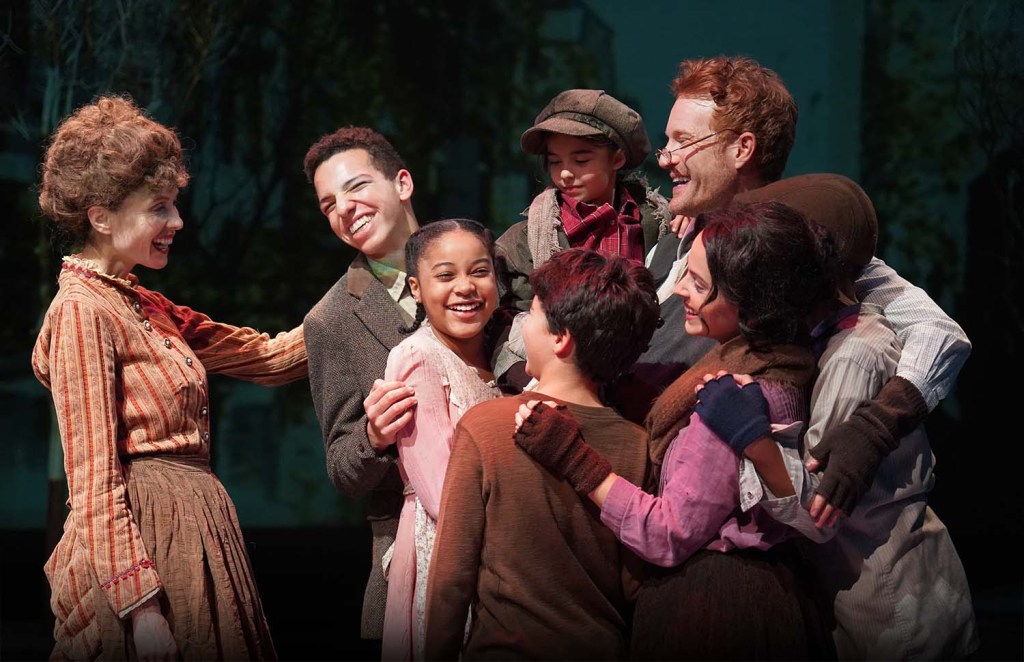
The Cratchits | Courtesy Photo

A Noise Within’s move to its present home in Pasadena was the excellent time and opportunity to mount this ambitious endeavor. Explains Rodriguez-Elliott, “The Masonic Temple didn’t have enough seats so it didn’t make much sense production-wise. With a finite number of days we can play it based on our schedule and the holiday, we wouldn’t have enough performances.  In this venue, we can give this adaptation a full run.”

It is a fortunate outcome for many of us who remember reading Charles Dickens’ memorable work of fiction growing up. That it is performed – with actual people on stage – gives this novella much greater extent and meaning.      

A Christmas Carol is the ultimate story of redemption and transformation ever written,” Elliott proclaims. “While we present the play every year, it is never stale because we always find something different to do. Even the performers who think they might want to take a break from it after having done it several times, come back to it because they realize it is a living, breathing fabric.”

Adds Rodriguez-Elliott, “I am seeing it fresh because I am in a different place from where I was a year ago. And as a director there’s always that feeling of ‘Gosh I’m not happy with this’. We have that opportunity to improve on it every year or make it better. And this is exactly what A Christmas Carol is all about – a tale of how even the most miserly curmudgeon on earth can change for the better.” 

“As scary as some children might think of Marley, and the Ghosts of Christmas Past, Present and Future, they are there out of love,” Elliott expounds. “They are all benevolent ghosts who want to help Scrooge. This is the attraction of A Christmas Carol; it is why people come to see it. We all want a chance at redemption.”

At the end of A Christmas Carol, Scrooge is overwhelmed with joy at the chance to redeem himself and is grateful for having returned to Christmas Day. He rushes out into the streets to share his newfound spirit. And from that day on, he celebrates the season by giving to the poor and treating others with generosity, kindness, and warmth.

How impressively mesmerizing it must be to behold this final scene as it unfolds before us! Maybe for longer than a few lingering moments, we wouldn’t equate Christmas with doorbuster specials. When Elliott pronounces that “live theatre is here to stay – it’s life changing,” this must be what he means.