Monrovia High School Students Perform on A Noise Within’s Stage

Originally published on 27 April 2017 in the Pasadena Independent, Arcadia Weekly, and Monrovia Weekly

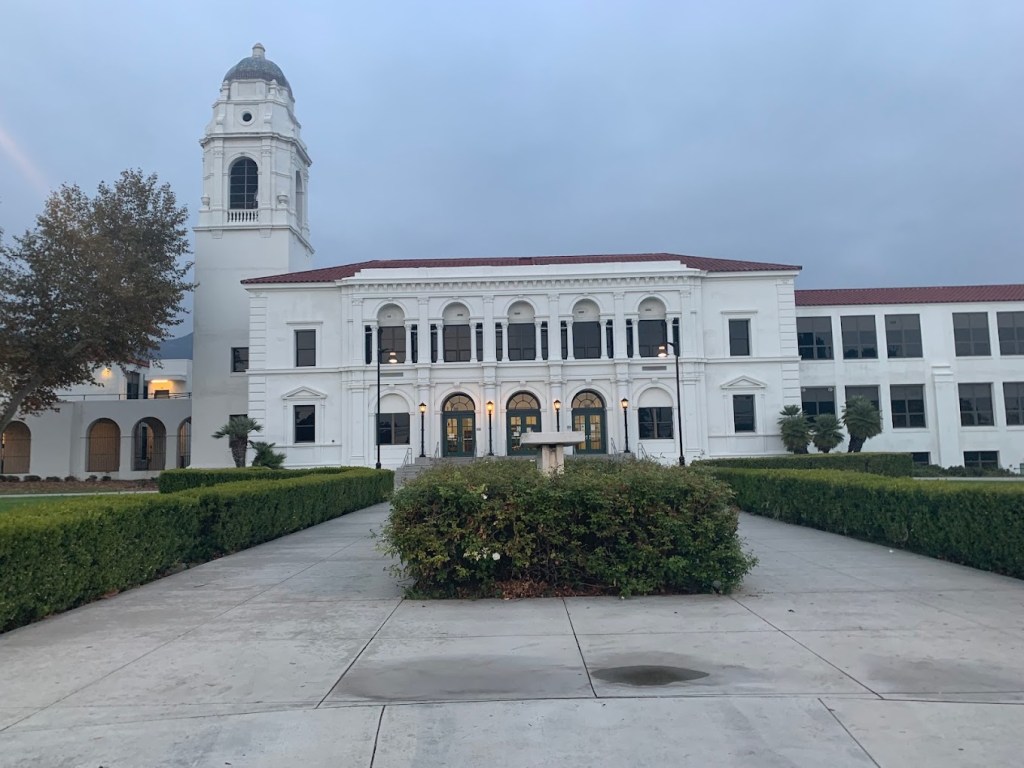
This past Tuesday night, April 25th, 23 drama students from Monrovia High School (MHS) put on a production of Shakespeare’s ‘King Lear’ at A Noise Within (ANW) in Pasadena. The partnership was a first for both the high school and the classical theatre company.

Nathanael Overby, MHS drama teacher who came on board in 2012 and was responsible for expanding the school’s drama department, advanced the partnership with ANW. He states, “A Noise Within clearly takes a unique approach to theatre – they have a quality and creativity unequaled by other professional groups. That was something I wanted my students to emulate.”

“We have been performing on our stage, which is quite impressive, but being on a professional stage would be an exciting experience for my students,” continues Overby. “ I wrote a proposal to partner with ANW and discussed it with Patrick Garcia, the director of performing arts for the Monrovia Unified School District, who reached out to ANW. When ANW’s artistic directors agreed to it, I began working with Alicia Green, the director of Education and Community Outreach at ANW.”

Concurs Green, “The director, Patrick, and I came together to discuss the proposed partnership and we decided to do ‘Lear’ as it worked best for the school and us. From the outset Nate and I worked to ensure students had a great experience and understood what it takes to do a show in a professional space.”

Overby adds, “This partnership is so much more than the students being able to perform ‘King Lear.’  We were able to join ANW’s cast for their table read of ‘Lear’ and we watched ANW actors perform it on stage. This gave my students the opportunity to join a professional cast on their journey on a production – to experience what it’s like to put on a professional show by observing ANW’s cast at several different points in their process. Furthermore, I want to develop a connection with ANW to inspire my students to pursue work with them after they graduate.”                     

“All students attended first rehearsal, some attended opening night, and all students came to a student matinee in mid-March,” Green said the week before their performance. “We wanted to immerse them fully in every step of the way – what it takes to make a full production a reality!  Nate worked with the students at Monrovia on the show and I am looking forward to having them come for the first time on Monday, the 24th, to rehearse on our stage, and then perform it the following night.”
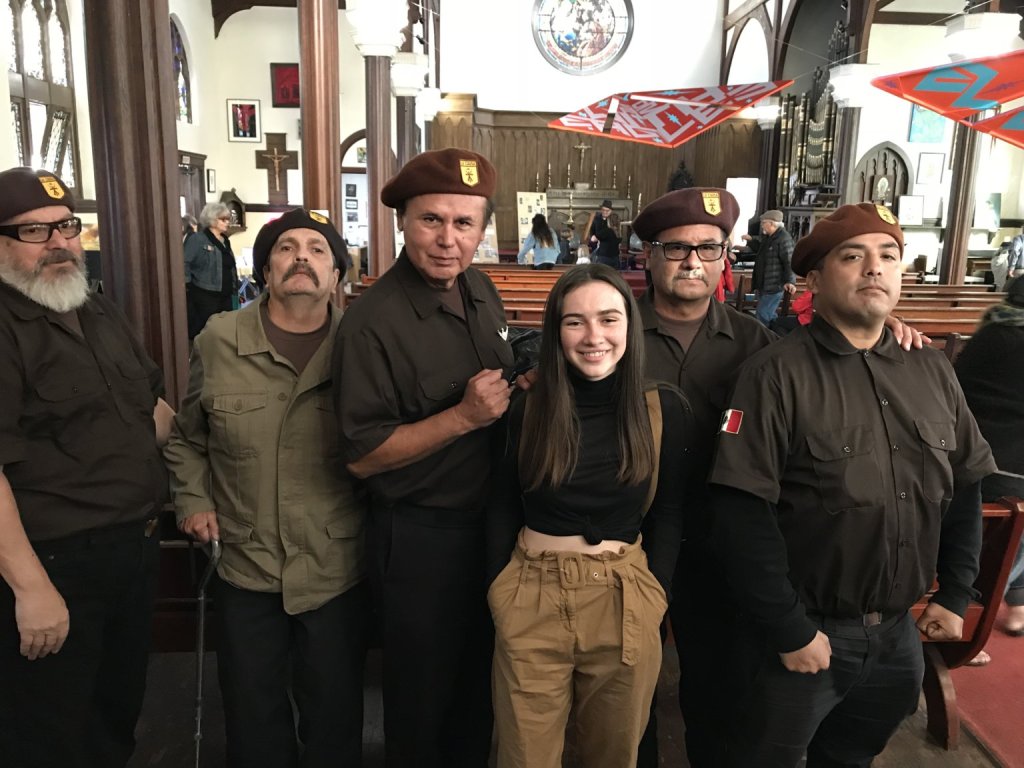
Monrovia High School | Photo by Alicia Valdez / Monrovia High School website

While the show was put on at ANW, it was truly a student production as Green relates, “Other than providing one tech person to help set up the lights/sound they need, their technical director and students will be running all of the technical elements and stage managing the show. We are here to support them, but this is their show and we encourage them to make the space their own!”

“We are constantly looking for ways to engage students in the world of classical theatre,” Green says about ANW’s outreach. “Equitable access is of key importance, and we continue to grow and develop our education program through attendance at student matinees and evening/weekend performances, in-school residencies and workshops, full-school partnership programs, pre-show engagement activities, post-show conversations with the artists and our free study guides. Ideally, every student would have the opportunity to participate in some way with our programing to enhance their education!”

A Noise Within has its ‘Summer with Shakespeare’ camp and Saturday conservatory classes where students perform on its stage and in the building. This past Tuesday’s performance of ‘King Lear’ by Monrovia High School students, however, was a first for this kind of project.

According to Overby, MHS had two drama classes back in 2012 when he came to teach at the school. He says, “Now we have a full-time department offering five different periods of drama, including a Stagecraft class and an Honors drama course. We also started out with one performance a year; we are currently producing three a year which includes at least one musical and one play. This year we produced ‘Dracula’ in October, ‘Urinetown the Musical’ in March, and now ‘Lear’.”

‘King Lear’ was the capstone to a great year for the school’s drama students. And what better venue to fully realize the essence of one of Shakespeare’s most celebrated works than in Pasadena’s premier classical theatre company. 

Indeed it was a dream come true for these Monrovia High School students. How propos that their performance took place towards the end of A Noise Within’s own season they called ‘Beyond our Wildest Dreams’.  
Octavia Butler Exhibition at The Huntington Library

Originally published on 20 April 2017 in the Pasadena Independent, Arccdia Weekly, and Monrovia Weekly

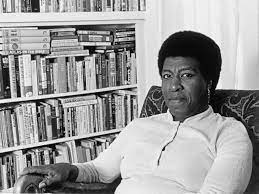
Octavia E. Butler was the first science fiction writer to receive the prestigious MacArthur Foundation ‘genius’ grant and the first African American woman to win recognition writing in a genre dominated by male authors. For all her literary fame and awards, however, hers is not a household name.      

But this is about to change if Natalie Russell, were to have her way. As curator of ‘Octavia E. Butler: Telling My Stories’ which opened on April 8 and goes on until August 7, 2017 at The Huntington Library, Art Collections, and Botanical Gardens, Russell was charged with organizing this exhibition. On view in the West Hall of the Library in chronological order, the retrospective includes approximately 100 items that reveal the author’s early years and influences, highlighting specific themes that repeatedly commanded her attention.    

States Russell, “I hope it introduces Butler to people who may not know her, who may not be familiar with her works; for those who have not read science fiction before but were intrigued about what she has to offer which are a little different from what they thought they were going to be reading. I hope that people who are fans of hers get to know the writer behind these works a  little deeper – that through the process they get to know the inner person.”

Butler was born in Pasadena on June 22, 1947 to a maid and a shoeshine man. Her father died when she was very young and she was raised primarily by her mother. A painfully shy, introverted child, she spent her time reading at the Pasadena Public Library where she discovered science fiction.   

At age twelve Butler saw a film called ‘Devil Girl from Mars’ and was convinced she could write something better. She later enrolled in every creative writing course at Pasadena City College to her mother’s disappointment, who wanted her to have a more reliable job as a secretary. 

In the early 1970s, at a workshop for minority writers, Butler met science fiction author Harlan Ellison, who introduced her to the Clarion Science Fiction Workshop.  There, among other like-minded writers, she learned to hone her craft and even sold her first story.

Butler’s conviction that she was going to be a successful writer grew stronger after the Clarion workshop. She did not want to find work that would distract from her ultimate goal so she took odd jobs to support herself. 

Success proved elusive for a while, until 1975 when Butler sold her first novel, ‘Patternmaster’ to Doubleday, which quickly followed with ‘Mind of My Mind’ and ‘Survivors’. This trio came to be known as her ‘Patternist’ series, which depicts the evolution of humanity into three distinct genetic groups. There is a review in the exhibition that lauds ‘Patternmaster’ for its especially well-constructed plot and progressive heroine, who is ‘a refreshing change of pace from the old days’.       

On display in the exhibition are motivational notes Butler would write to pick herself up during bouts of self-doubt – ‘I am a Bestselling Writer. I write Bestselling Books ….  Every day in every way I am researching and writing my Award winning Bestselling Books and short stories …. Every one of my books reaches and remains for two or more months at the top of the bestseller lists …. So Be it! See To It!’

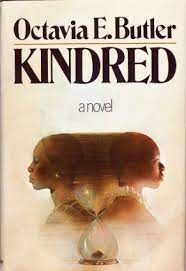
Butler’s readership continued to grow and with the publication of ‘Kindred’ in 1979 she was able to make a living on her writing alone. In 1984 she won her first Hugo Award for the short story ‘Speech Sounds’. Her novelette ‘Bloodchild’ won a Hugo, a Nebula, the Locus, as well as an award for best novelette from Science Fiction Chronicle, in 1985.                  

That Butler was a female writer of color informs many of her works. Russell concurs, “I think being a woman and African American gave her this unique voice. Butler said she never saw herself in any of the stories she read. So she decided to write herself into these books so she could see a woman character in a setting that reflected the diverse world she lived in”.  

Beyond race, Butler explored themes between genders and worked to develop strong female characters who resolved problems differently. Russell adds, “Her audience varied – young, old, people of color – anyone who’s interested in science fiction; her themes also covered a diverse range – disease; pharmaceuticals; fears about the environment, drought, and alien contact – the differences that divide us and how we overcome these to become better people and get together as human beings.”

 “In 2008 Butler’s papers arrived at The Huntington in two four-drawer file cabinets and 35 large cartons,” states Russell. “She kept nearly everything – from her very first short stories, written at age 12, to book contracts and programs from speaking engagements. The body of materials includes 8,000 individual items and more than 80 boxes of additional items: extensive drafts, notes, and research materials for more than a dozen novels, numerous short stories and essays, as well as correspondence.”

Photo courtesy of The Huntington

According to Russell more than 40 scholars were asking to get access to the Butler collection by the time she was done processing and cataloguing all the items. In the past two years, it has been used nearly 1,300 times – or roughly 15 times each week, making it one of the most actively researched archives at The Huntington.

“I was not familiar with her beforehand; it’s a shame because she’s so amazing,” confesses Russell. “But I hope that everybody can have the same experience I had while I sorted through all the materials she left behind – that it’s okay to start fresh. Be prepared to be amazed and entertained, to experience something new, and thought-provoking. She was a very shy, private person, but she has a big presence on the page; she has so much to say. Some of those inner thoughts and the struggles she underwent to become the person that she was is a story we can all be inspired by.”      

“When I look back at the things I sifted through in the collection, I think of the highlights, themes, and things that were important to Butler and how to share her with the world. That’s what I hope I have done with this exhibit,” concludes Russell.

After having lived in Seattle for several years, Butler had planned on returning to Pasadena. She died suddenly in 2006 before she realized that wish, but her literary archive has come home to reside permanently in The Huntington. Here scholars can come to examine the life and work of this extraordinary woman.        

She lived but 58 years but her legacy will endure far longer than her existence on earth.  Generations of future writers, and people from all walks of life, will find inspiration from Octavia E. Butler – a woman ahead of her time.        

No Boundaries in Art and Talent at PUSD

Originally published on 9 March 2017 in the Pasadena Independent, Arcadia Weekly, and Monrovia Weekly

There is no shortage of artistic talent among Pasadena students as the upcoming 12th annual ‘No Boundaries’ will once again prove.

Scheduled to open on Friday, March 10, which coincides with ArtNight Pasadena, and running through March19, at The Shops on Lake Avenue, this art exhibition provides a platform for young artists in the Pasadena Unified School District (PUSD) to showcase their two- and three-dimensional art. Presented free to the public, gallery hours are Monday to Friday, from 3 to 6 pm; Saturday and Sunday from 1 to 4 pm. 

The exhibition is also a host site during ArtNight Pasadena on Friday, March 10. ‘No Boundaries 12’ is housed in a commercial space on 345 S. Lake Avenue lent for the occasion by Merlone Geier Partners as a giveback to the community. It will be a shuttle stop during the citywide free evening of art, music, and entertainment when Pasadena’s most prominent arts and cultural institutions open their doors.

ArtNight Pasadena, sponsored by the City of Pasadena Arts & Culture Commission and the Division of Cultural Affairs, is an ongoing partnership between the city and local cultural institutions. Twice each year, many of the city’s non-profit arts and cultural establishments open on a Friday night to provide a variety of art, culture, and music to the public free of charge.           

According to Jennifer Olson, District Arts Education Coordinator for PUSD, the first ‘No Boundaries’ was started by a former Pasadena high school teacher, Alex Schultz, and the former PUSD District Arts Coordinator, Marshall Ayers. It has always been a group effort involving Arts teachers, community arts partners, parents, and volunteers.

Olson relates, “The first year it was just middle and high school student work and it was all put up in one night in the wind tunnel at Art Center. The next year the District Arts Office decided to include every school, and the structure was set that informs how we still do it today. There is an arts representative designated at each school who selects between 12 and 32 artwork per school, depending on the size of the school and whether it is an elementary, middle or high school.”

All 26 PUSD schools submit their highest quality work which are organized visually (2D, 3D, video), rather than thematically. The exhibit is a monumental undertaking given the number of students and schools involved. 

“It is a gargantuan effort!,” Olson agrees wholeheartedly. “We started accepting delivery of artwork February 2, and the exhibition doesn’t open until March 10. So there are several weeks of registrar work – entering all the student information and statements – mounting all the artworks, and then of course building out the space, curating the art pieces, hanging the show, marketing, and event planning.” 

Continues Olson, “For many years we have had a district arts team/community arts team, and this is a major endeavour undertaken by that group. We also work with the Pasadena Educational Foundation to help us find volunteers to help with all aspects.”

“‘No Boundaries’ is a true community effort,” proclaims Olson.“We work side-by-side with our community arts partners, teachers, and parents to make this exhibition happen. By that, I mean if you walk in on any given day during installation, these folks are the people painting the pedestals, nailing up the student statements, and installing the promotional posters.”

Rochelle Branch, manager of the Cultural Affairs Division of the Pasadena Planning and Development, created ‘Bridging Boundaries’ in 2007 as an offshoot of ‘No Boundaries’ to expand access and highlight the collaboration between the City of Pasadena, and PUSD’s Arts Education. She says, “‘Bridging Boundaries’ references the connection between the city and PUSD, but also the geographic location of what we call the Student Art Wall which is near City Hall bridge.”

“Arts Commissioners and a member of the community attend the installation of the PUSD’s ‘No Boundaries’ exhibition and select artworks based on high artistic quality and merit,” Branch explains. “They provide a small tag that says ‘Arts & Culture Commission selection awardee for Bridging Boundaries Exhibition’. Everyone who goes to ‘No Boundaries’ will see the selected art.”

“When ‘No Boundaries’ ends on March 19, the selected pieces are taken to a professional framer and mounted in two installments at ‘Bridging Boundaries’ exhibition hall outside City Hall Council Chambers,” adds Branch. “The city contracts with Pasadena-based artist, Denise Seider, to curate ‘No Boundaries’ and ‘Bridging Boundaries’. For about five months, each student group will have its artwork up for public viewing.”

“Students get back their artwork professionally framed and get city-wide acknowledgement of the quality of their piece. They get to come with their families and friends and see their creation outside of City Hall,” Branch concludes.
          

Olson shares that sentiment when she declares, “The greatest joy of this project is seeing students come in with their family members, bursting with pride when they find their artwork and they see that it is professionally displayed like a ‘real artist’”.

This joint collaboration – among the City, PUSD, and Pasadena’s arts and cultural organizations – celebrates, showcases, and shares students’ artistic talents with the entire community. But more than public recognition, these young talented students’ self-satisfaction in their accomplishments may be the greatest reward of all.             

‘King Lear’ and ‘Man of La Mancha’ Share Similar Worlds at A Noise Within

Originally published on 14 February 2017 in the Pasadena Independent, Arcadia Weekly, and Monrovia Weekly

Resuming its 25th Anniversary celebration, ‘Beyond our Wildest Dreams’, A Noise Within puts on a production of William Shakespeare’s King Lear which will run in repertory with Man of La Mancha later in the spring. Geoff Elliott and Julia Rodriguez-Elliott, co-producing and artistic directors of ANW, have conceived these two shows to be seen on the same day, allowing them to fully speak to each other. 

Both shows share the same leading man (Geoff Elliott), the same director (Julia Rodriguez-Elliott) and the same scenic elements, enabling a quick turnover between matinee and an evening performance so the two productions can play on the same stage.  

Of the opportunity to perform both Lear and Cervantes/Don Quixote, Elliott pronounces, “I feel I know Lear. He is stripped of everything, and must face his worst demons to find tenderness and uncompromising love in a very violent world. Lear spends so much of the play terrified of losing his mind. Anyone who goes through a similar self-investigation can’t help questioning his sanity as so much of the world that we live in seems insane.”

Continues Elliott, “In his way, Cervantes/Don Quixote is Lear’s doppelganger. As he assumes Quixote’s persona, Cervantes gains the courage and the strength needed to face the uncertain future of the Inquisition. He, along with his fellow prisoners and, ultimately, the audience are transformed.”  


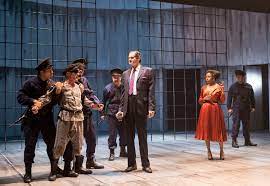
King Lear | Image taken from A Noise Within’s website

Says Rodriguez-Elliott, “In Lear, this personal journey of a family dealing with an ailing patriarch has global implications. The breakdown of a nation runs concurrent with Lear’s mental decline. At the beginning of the play, we see a man at the zenith of his power, a modern day dictator who is feared and has never heard the word NO. The world we enter is a violent, callous one. At the end, we see a man transformed.”

The world of La Mancha is as violent and callous as it is ripe and crying out for transformation. “Though many often associate Man of La Mancha with elaborate set pieces and fanciful costumes, its earliest stagings were sparse, encompassing the spirit of a rag-tag band of prisoners putting on a play with found objects,” explains Rodriguez-Elliott. “I wanted to return to those roots. Based on real-world prisoners, the conditions we’ve created for Cervantes and his fellow inmates are recognizable and terrifying.”

Audiences will likewise be transported to these worlds, in large part, because of the actors’ excellent portrayal of the characters they will inhabit for the next two hours. However, stage plays are a collaboration among many – actors and directors; as well as designers, which include costume, lighting, and set – and their success depends on how seamlessly these collaborators work together to create one magnificent piece.  

That Lear and La Mancha also share artistic team members – Fred Kinney (scenic), Angela Balogh Calin (costume), and Ken Booth (lighting) – makes for an exciting experience for the audience and for everyone involved in both productions as well.

Booth, ANW’s resident lighting designer, who has worked on over 40 productions for ANW since 1998 says, “I’m thrilled to be a part of it; this kind of challenge doesn’t happen a lot in small theatres. For Lear I am using a palette of warm and cold lighting, often in combination.  You don’t really see the source of light but it’s there being filtered through some unknown artificial source. Shifting the temperature of the lighting within a scene helps to punctuate or accent a moment. Highlighting one particular character helps create dramatic conflict within that character.”

“Lighting defines and redefines the performance space; it can influence the mood for the play and the audience. It enhances the atmosphere for the actors who are on stage to share their art and emotions with their audience,” Booth adds.

Man of La Mancha | Image taken from A Noise Within’s website

“Both Lear and La Mancha deal with a man with delusions of grandeur. The conflicts in both come not from without but from within the characters – their inner dilemmas of importance and immortality that affect them. To connect both stories, I will create lighting that seems omnipotent in certain scenes and confining for others. Beyond the giant set wall the plays share, you only see shafts of light that emanate from behind a window or door whenever it is opened. The wall is the horizon – there doesn’t seem to be an outside world – and for the most part the lighting of the wall is the same: a cool or bluish wash, beams of warm light seeping down; and a filtered break-up catching parts of it.”

Angela Balogh Calin, resident costume designer for ANW, has worked with Booth since 1998. She says she hasn’t done many shows when Booth didn’t light. “We go back a long time,” she declares. 

“Both Lear and La Mancha are going to have modern setting so costume-wise, I will give them a modern approach,” Calin discloses. “The clothes will be something the audience will be able to identify with; they will be easily recognizable. Lear will be eclectic, with 1950s flair.”

Lear and La Mancha will only be Fred Kinney’s second and third shows with ANW. An independent scenic designer, he was contracted for both shows last spring and immediately did his research. 

“I think Shakespeare’s work is better heard not read; so I watched a couple of film versions of Lear before I started conceptualizing the scenery,” Kinney reveals. “For La Mancha, I listened to the music and then watched the film. Then I came up with a concept that could work for both but different enough. They are unified in theme but the design will have enough variety to service the individual parts of the shows – the things that are unique to each production. I will have a base layer to which I can add elements to make the scenery distinctive to each.”

ANW provides a unique environment in which artists work together across decades. They are comfortable experimenting, trying new things; impressing as much as supporting each other show after show. These artistic relationships inform each of this repertory theatre company’s many exceptional productions for 25 years.

Booth expresses says it best when he says, “I want our audiences to remember what an otherworldly universe we created within our theatre for our interpretation of King Lear and, hopefully, they get a satisfying feeling of bittersweet closure. This is what I find exciting – the collaboration in putting on a production – to take a blank stage and create a beautiful picture that is like a painting come to life using the limited tools at our disposal.”

Pasadena Master Chorale Fosters Young Musical Talents

Originally published on 17 January 2017 in the Pasadena Independent, Arcadia Weekly, and Monrovia Weekly

Jeffrey Bernstein, Artistic and Executive Director of the Pasadena Master Chorale (PMC), has always been into music and music-making. He started playing the piano when he was eight years old; when he was 13 he sang Beethoven’s Ninth Symphony in a choir. 

It isn’t surprising, therefore, that Bernstein’s interest in music grew through the years. He  relates, “Like many people, I came to choral music in school. For me it was in college, at Harvard. That’s a natural place to have terrific experiences of community. In a way I realized I wanted to give that experience to people who weren’t going to leave in four years. I wanted to see what it was like to deepen that sense of community and to be embedded in the broader Pasadena community.”

In 2009 Bernstein founded the Pasadena Master Chorale which he imbued with his own personal stamp to distinguish it from other choral groups. He explains, “For one, we’re auditioned and it’s a pretty rigorous process. We take, on average, less than half the people who audition for us. We also re-audition the group every year so singers have to demonstrate they’re continuing in keeping up. I believe the higher the quality of music-making, the greater the sense of community.”

Bernstein continues, “The other thing that sets us apart, and which I’m very proud of, is our pricing model. Our concerts are offered on a ‘listen first then give’ basis; we sell tickets for zero dollars. We want people to attend our concert then offer a gift to us as they are moved and able.  We started this concept two years ago and our attendance and revenue have since gone up.”                              

“There are obviously people who can’t give very much, and I’m very proud of the fact that our concerts are so accessible to everyone. And there are people who give very generously because they recognize the value of what we do,” Bernstein opines.

Knowing that children are exposed to singing in a choir at a young age – whether it’s through a church or at school – Bernstein established an education program to foster middle and high school students’ love of music.

Expounds Bernstein, “Since we started we have always been involved with young people singing with us. It’s at the heart of what we’re trying to do – to create opportunities for young people who love choir music to learn about it and perform it. The program has grown tremendously and we currently have three offerings.” 

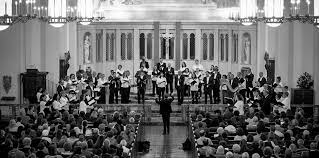
Image of Pasadena Master Chorale taken from South Pasadena News

According to Bernstein, their program for student singers is open to all Pasadena middle schoolers with a teacher recommendation. They rehearse with PMC’s associate conductor, Lauren Buckley Schaer, and perform a couple of pieces at the beginning of two of their concerts – Handel’s ‘Messiah’ and the Brahms concert. 

With a teacher recommendation, high school students who want to get a deeper experience with choral music can join PMC as apprentice singers. Says Bernstein, “They rehearse with us every Monday night as full members and they sing all the pieces the PMC does, including the ‘Requiem’ which we sing in German. This is a much smaller group of students because it is a big demand on their time and requires more familiarity with choral singing.”

Bernstein adds, “This year, we are again holding a program we began last year called ‘Listening to the Future’. Through an application process, we select composers from local private and public schools. We team them up with a composer mentor who meets with them almost weekly starting in November through June. They write music for us and we perform their work. PMC’s final program of the year is entirely composed by high school students. June last year was the first time we put on this program and it was a huge success!”

“We had four composers last year; this year we have six and they’re already writing. During the spring they’ll come to our rehearsal every now and then to hear us sing their composition. It’s thrilling! It’s hard to tell who’s more excited – the students or the singers. It’s great to work with living composers, but to work with someone so young …. This is a rare opportunity for  young composers to have a group play their composition, sing it and take it seriously. It’s almost unheard of. That’s a program I’m very, very proud of,” Bernstein proclaims.                                                         

“I’m a big champion of young people and music-making,” Bernstein expands. “I want our organization to serve the youth at as many different levels of development as possible. For this young composers program, we’re looking for students who are willing to roll up their sleeves and do the work. They must have had music training – maybe sang in a choir or played in an orchestra or band – and have a teacher recommendation. But we’re not going to judge their potential as creative people; instead we’re here to foster their talent and let them run with it. 

Last year we came up with four completely diverse sets of music. It was beautiful!  We don’t change what composers create, we don’t want to get in the way. We want to encourage creativity and we sing what they write for us.”

Image taken from The Hollywood Times

‘Listening to the Future’ commences right after Labor Day, when PMC publicizes the program and accepts applications. At the end of October, PMC selects the composers who start working with mentors in November. Both mentor and student develop a schedule for what pieces need to be written and when. Each composer will write at least one arrangement of a folk song which should be finished by February and one original composition which they will write from February to April.

Bernstein says of this program, “Composing is a form of communication. Student composers are communicating with the singers and singers are communicating with the audience.  We emphasize that the score has to be neat and without errors. Composers have to take into consideration if the words are easy to read, if the harmony is understandable. 

It’s a very interesting process for these young students to experience. They spend months alone in a room in front of their computer or with a piece of staff paper writing their composition.  Their faces light up when they hear a roomful of 60 people transform that music off the page.  It’s utterly amazing when that happens!”

Pasadena Master Chorale holds five concerts a year. Its 2016-2017 season began on December 11 when the group sang Handel’s ‘Messiah’ at First Congregational Church in Pasadena. On January 15, PMC performed Beethoven’s Ninth Symphony at the Oratani Theatre in Downtown L.A.  Brahms Unbound follows on April 22 and 23 at the Altadena Community Church. On June 10 and 11, PMC will be back at the Altadena Community Church to sing two pieces: Heinrich Schutz’s ‘Musikalische Exequien’ and Gabriel Faure’s ‘Requiem’. The season ends on June 25 at the Neighborhood Unitarian Church in Pasadena with a ‘Listening to the Future’ concert.

Financial support for PMC comes from the L.A. County Arts Commission, Pasadena Community Foundation, Pasadena Showcase House for the Arts, the City of Pasadena, and through various fund raising efforts.                 

While PMC has come far since Bernstein founded it, there are more things he wants to accomplish. He wants to one day be able to purchase a building to house their education program, for students to come in five days a week after school, with a staff of people who can provide training – from individual voice lessons to music theory – and who will encourage students to have their own choral group with leadership.

“It’s limitless what you can do and realize what difference you can make in one kid’s life … not just with choral music, but for them to have a place to belong,” Bernstein states wistfully.         

A Noise Within’s ‘A Christmas Carol’ is a Glorious Production

Originally published on 8 December 2016 in the Pasadena Independent, Arcadia Weekly, Monrovia Weekly, and Sierra Madre Weekly

The joyful observance of the holiday season isn’t complete without annual traditions one remembers with nostalgia. At A Noise Within (ANW), the classical repertory theatre company in Pasadena, it means a restaging of Charles Dickens’ A Christmas Carol. 

Celebrating its  25th anniversary and its fifth production of this time-honored tale, ANW will have 16 performances of A Christmas Carol starting Friday, December 2 and closing Friday, December 23, 2016. Producing Artistic Directors Geoff Elliott (who adapted the play from the novella) and Julia Rodriguez-Elliott co-direct this masterpiece about the redemptive power of love.       

Much like ANW’s ardent followers, the company’s resident artists look forward to this year-end event with anticipation. “Remounting our acclaimed presentation of Charles Dickens’ A Christmas Carol allows families to once again take a supremely theatrical journey, and celebrate the transformative power of forgiveness during the holidays,” says Elliott. She adds, “Ebenezer Scrooge’s rebirth from miserly curmudgeon to the epitome of love and generosity affirms our faith in the potent goodness of humanity during this beloved time of year.”   

“The beauty of going back to these great works is that you have a history with it – because they are in your muscle memory, you have the opportunity to discover new things,” explains Rodriguez-Elliott. “You don’t have the same pressure of having to create something for the first time; it’s very lived in.”

“For me there’s a unique aspect every year  – I can see something from a different perspective because I’m a year older,” Rodriguez-Elliott continues. “There are elements of a particular play that have altered because of where we are personally and where we are as a country. It takes on a different meaning for everyone, depending on where one is in life at that time.”

But wherever one finds himself in life, when the entire ensemble belts out Ego Plum’s majestic song ‘Glorious’ at the close, one will understand why it was undeniably worth the wait and coming back for. ANW’s A Christmas Carol is like aged wine – its flavor gets deeper and richer with each year. One could never have too much of it.               

One thing that will change annually is the casting of the Cratchit children. As Rodriguez-Elliott relates, “Last year, resident artist Freddy Douglas’s son, Eli, was too young but we knew at some point he would be right for Tiny Tim. He has a little sister who is in the wings getting ready for her turn. She knows all the songs and sings them in my ear during rehearsals.”

Ashlyn Woo, an eighth grader in Suzanne Middle School, plays Belinda Cratchit this year. She has previously attended the Fine Arts Academy of Dance and Summer with Shakespeare to prepare her for stage acting. While she has been in other shows, including the Nutcracker, this is her first professional performance in an ANW production. 

Enthuses Woo, “I found out I have been picked to play Belinda and be a part of the ensemble on a Friday after school. I read A Christmas Carol in seventh grade and now I’m a character in a production of it! How amazing is that!”

“To be in the show, I’ve had to do my homework in the car and sometimes during rehearsals,” Woo confides. “But it’s so worth it.”   

The Cratchits | Image taken from A Noise Within’s website

Another young actor debuting on A Christmas Carol as a Cratchit child is Samuel Genghis Christian. A sixth grader at Blair Middle School in Pasadena, he also trained at Summer with Shakespeare and Youth Conservatory at ANW.

Christian reveals, “I knew I wanted to perform on stage when I saw A Christmas Carol for the first time two years ago. It was one of the most exciting experiences of my life besides watching Harry Potter and the 2015 Super Bowl!”

“It was easy for me to get into the role once rehearsals started because I had seen the production before; I knew what it was going to be like,” adds Christian. “It’s such a wonderful show and I invited all my classmates and teachers to see it. My English class is coming to a student matinee.”

Of his time on the set of A Christmas Carol, Christian exclaims, “Everybody has been super nice to me and I feel really at home. It’s fantastalicious!”  Being in the company of talented ANW performers must produce such an incredible feeling if the experience moves one to invent words.

For Freddy Douglas, who is once more narrating, this year’s A Christmas Carol has greater significance as he shares the stage for the first time with his son, Eli Stuart. According to Douglas, Stuart hadn’t really shown an interest in acting until last year.

Says Douglas, “Eli saw A Christmas Carol last year and started singing ‘Glorious’, the final musical number on the show. Then seeing Apollo Dukakis in The Imaginary Invalid  caught his imagination and he agreed to have a go at Tiny Tim.”

Stuart is seven years old and attends second grade at Ivanhoe in Silverlake. Douglas states, “His teacher is working with us, helping him juggle the demands of school with that of the production.  He does extra reading on two show days.”

Douglas refrains from giving unsolicited advice to his young aspiring thespians. He discloses, “I just tell them to enjoy it and don’t bump into the furniture. However, this morning his four-year-old sister sang ‘The Charwoman Song’ about 50 times so he gets pointers from her.”

According to Stuart, “Working with my dad is a thrill; it feels special. I saw him on this show last year and I wanted to be on stage with him.” On the other hand, it was Douglas who was concerned. He confesses, “I was wondering if I might get very emotional after this song but so far I’ve managed to hold it together.”   

Sentiments like these are one of the reasons why ANW puts on A Christmas Carol every year.  As Rodriguez-Elliott points out, “It takes on a different meaning depending on where one is in life at that time.” 

ANW’s  ‘The Imaginary Invalid’ Makes for Uproarious Entertainment

Originally published on 20 October 2016 in the Pasadena Independent, Arcadia Weekly, Monrovia Weekly, and Sierra Madre Weekly

Moliere’s ‘The Imaginary Invalid’ opened at A Noise Within (ANW) over the weekend, a fitting final production of the fall in the repertory company’s 25th anniversary season. Long-time resident artists, Apollo Dukakis as Argan, and Debora Strang as Toinette, face off in this raucously hysterical play. At the helm is ANW co-producing director Julia Rodriguez-Elliott.    

On stage until the 19th of November, ‘The Imaginary Invalid’ tells the story of Argan, a man obsessed with his health and the lengths to which he will go to ensure that he will have a doctor to diagnose and cure his ailments. It’s a high comedy that calls for much sparring among the characters which the resident artists pull off with dexterity and aplomb.           

Rodriguez-Elliott says of working on the show with resident performers, “It usually isn’t until the third week of production that people begin to have a sense of each other and by week five it’s over. But here, we get right down to the task on the very first day of rehearsal so that the work becomes so much richer. I’ve observed guest artists begin to relax as they see the vocabulary of the place.” 

Strang immediately pipes in, “Apollo and I have played opposite each other on the stage so many times but as I look back on them I think we’ve had the same kind of relationship every single time.”

“It’s part of being in a company, as long-time colleagues we have such a familiarity and that instant connection. We’re there for each other,” Dukakis adds.

Dukakis has played ‘The Imaginary Invalid’s’ lead character, Argan, four times previously; the first one was 16 years ago. This time around, he was originally cast as the doctor but the actor who was to have played Argan had an emergency medical surgery one week into rehearsal.  Without too much preamble, Rodriguez-Elliott asked him to replace the lead and Dukakis graciously agreed.

ANW has produced Moliere and Shakespeare plays more than any other playwright’s.  

Molière as Argan in his play ‘Le Malade Imaginaire’. Illustration from Liebig collectible card series (‘Auteurs dramatiques comme Acteurs’/ ‘Famous Actor Playwrights’), 1921. M: (Real name Jan-Baptiste Poquelin) – portrait. French dramatist, comic playwright, and theatre director, 1646 – 1673 (Photo by Culture Club/Getty Images)

Rodriguez-Elliott rationalizes, “Moliere’s characters are people who are extremes; watching what happens when we’re obsessed fascinates me. His works give us the opportunity to play the characters with a humanity. It’s the same with Shakespeare when he writes ‘a street’ and you have no idea what that looks like and you have to create what the language of that particular production is going to be.”

“I find it interesting that both Moliere and Shakespeare wrote for repertory companies,” observes Strang. “I think every single character in their plays is rich and full-bodied because they had particular actors in mind. The fact they had repertory companies made them much stronger writers.”

Interjects Rodriguez-Elliott, “Even if Moliere and Shakespeare just had a sketch, they throw it to the repertory and they fill it out. That’s the power of having a company. It’s in that same vein that I was able to ask Apollo to fill in for the original actor playing Argan; I was very confident that we have resident artists who can handle the role. It was seamless, we moved the different actors to play the various characters. We didn’t have to scramble around to find someone.”

Rodriguez-Elliott says of ‘The Imaginary Invalid’, “This individual is in the throes of mental illness. The brilliance of Moliere is that he’s turned this destructive isolation into a sparkling, effervescent romp! So much of the comedy is about how oblivious Argan is to the vultures that are taking advantage of him, and the lengths in which people in his life navigate his neurosis.”                             

“It’s slapstick hilarity to watch the characters go right to the brink of insanity, but there is an underlying basis of reality – we are all blinded by our own behaviors,” Rodriguez-Elliott observes. “At the end of the play, Argan overcomes it all. What’s most interesting to me is his trajectory and his journey. It’s up to the audience to figure out if he ultimately finds enlightenment and takes ownership of his life as he becomes a doctor himself.” 

“I can have some high and mighty notion of what I think the audience should take away with them. But given what’s going on in the world right now it’s really great to be in a room with everyone just laughing hysterically … being together and having a really good time where we’re not dealing with complex issues, or things that are taxing and stressful,”  Rodriguez-Elliott concludes.

‘The Imaginary Invalid’ provides the perfect last fall production of ANW’s ‘Beyond our Wildest Dreams’ 2016-2017 season. It’s a blast of a play!

Orange County School of the Arts Expands to the San Gabriel Valley

Originally published on 13 October 2016 in the Pasadena Independent, Arcadia Weekly, Monrovia Weekly, and Sierra Madre Weekly

Duarte Unified School District’s (DUSD) commitment to arts programs will have its most tangible proof yet when the California School of the Arts-San Gabriel Valley (CSArts-SGV) opens its doors next year as a public charter school of the DUSD, operating from the current Northview Intermediate School campus. The first sister school to the Orange County School of the Arts (OCSA) in Santa Ana, CSArts-SGV is a partnership that is expected to benefit children in Duarte and the surrounding region.

“The choice of housing CSArts-SGV at Northview was based on the interest of our community to support the concept of neighborhood schools,” declares DUSD superintendent, Dr. Allan Mucerino. “In addition, we identified grades 7-8 as the point in time when 70% of our students of residence who transferred out of our district exited DUSD. As a result, we chose to reconfigure from K-6 to K-8 schools. That provided us the opportunity to repurpose Northview by entering into a license agreement with OCSA to create CSArts-SGV.”

This grade level reconfiguration will also necessitate a bit of relocation for current students.  Mucerino explains, “Starting in the 2017-2018 school year current sixth graders will remain on their present campus for seventh grade. Current 7th grade students will be housed in a satellite 8th grade facility between the existing Northview campus and Duarte High School for one year. In 2018-2019, the conversion to K-8 will be complete.”            

Dr. Ralph Opacic, who founded OCSA in 1987, explains the decision to expand to the San Gabriel Valley. “The OCSA is celebrating its 30th anniversary and we are now at capacity at 2,200 students. We attract 3,000 applicants each year for 400 spots from cities not only in Orange County, but also from adjacent Los Angeles, Riverside and San Diego counties. And so we began looking at areas where our program will have an appeal. The San Gabriel Valley quickly came to our attention as we know it will draw from the entire region. We’re likewise having conversations with school districts in the South Bay, at El Segundo, and the San Fernando Valley.”

“This is the first sister school of OCSA and is modeled after it,” continues Opacic. “Our goal is in ten years to be able to provide 10,000 kids who are passionate for the arts with a transformational experience. We want to offer a culture where they are surrounded by like-minded students; to afford them an academic preparation combined with an arts curriculum so they can continue on a path. But it isn’t a program to educate talented students to become future artists. Rather, it’s an innovative school environment that graduates highly engaged, creative young leaders who are well-equipped for meaningful, successful lives at the college of their choice and in any career they select. ”

Opacic describes, “Students will have the academic portion of their day from 8 am to 2 pm consisting of three 90-minute classes and a 30-minute tutorial block. CSArts-SGV will offer college preparatory, honors and advanced placement courses taught by fully credentialed faculty members, with the majority of them holding advanced degrees.

Image taken from CSArts-SGV website

Then high school arts students will be attending their choice of art course from 2:30 to 5 pm.  Conservatory for students in the 7th and 8th grade is scheduled prior to the high school conservatory. We’ll be offering ten arts classes – acting, classical and contemporary dance, classical voice, commercial dance, creative writing, instrumental music, integrated arts, musical theatre, production and design, and visual arts.”     

The opening of CSArts-SGV will bring in more jobs into the city. Opacic reveals, “We currently have job postings for the eight full-time arts teachers and will be interviewing within the next four to six weeks. We will be hiring academic and arts instructors after March 1st next year when we have an idea of what our enrollment will be. We hope to open grades seven to ten at 200 students per grade level. We staff our academic programs at 30:1 so we’ll probably have 20 – 27 academic educators and we staff the arts programs at 20:1 and we’ll probably have 40 arts teachers in the afternoon conservatory.”

According to Mucerino, the presence of CSArts-SGV in Duarte will infuse additional funding.  He says of the amount of Average Daily Attendance (ADA) revenue generated by 1,200 students in grades 9-12, three percent will go towards DUSD.       

Opacic will serve as the executive director of the California School of the Arts, which is the umbrella company for all schools they open going forward. As a charter school, CSArts-SGV will have its own board of directors, independent of Duarte Unified School District (DUSD), which is its sponsoring agency.

CSArts-SGV’s first principal will be Dr. William Wallace, who was Dean of Facilities and Supervision at OCSA, where he oversaw the expansion of the school from 1,800 students to its current size of nearly 2,200. He also assisted in supervising the construction of OCSA’s premier dance, music and science building, which was inaugurated in August of 2015; he also served as OCSA’s Assistant Principal of Student Services.

Image taken from CSArts-SGV website

Abbe Levine will come on board as the Dean of Arts Conservatories, having served as Director of Arts Environment and Program Expansion at OCSA. She has been teaching at OCSA since 2004 until she became Co-Director of the Creative Writing Conservatory. In that post she implemented innovative community programming and collaborative arts projects.

Mucerino has been an ardent supporter of arts programs and this partnership is the culmination of his months-long search for a genuine alliance. He says, “OCSA has created the blueprint for an innovative school that has proven that arts and creative educational experiences transform schools and communities. The evidence is powerful: children of all social and economic levels who experience high levels of art engagement have more positive outcomes in virtually every achievement indicator, compared to students who are not as lucky. Creative thinking and innovation are at the core of advancement in today’s globalized world. This unique public school/charter school partnership is an example of how historically polarized forces can work together to challenge the status quo and create exceptional and flourishing learning environments.

Over 1,000 people have already signed up for the first preview day on October 22. Judging from that level of interest, it’s going to be as popular as the original Orange County School of the Arts.  But what’s truly unique about this partnership is that it includes an opportunity for students in grades seven and eight to attend DUSD K-8 schools to prepare for CSArts-SGV by participating in the same conservatory program currently delivered to 7th and 8th graders in OCSA. The conservatory for 7th to 8th grade students will be on the CSArts-SGV campus in the same facility used for the 9-12 conservatory program and taught by the same instructors.”         

Students in Duarte and in the entire San Gabriel Valley are the fortunate recipients of education leaders’ out-of-the-box approach to teaching. Mucerino says it best when he quips, “There’s never been a better time to be a kid in Duarte.”

Beatrix Potter Inspires Pre-School Workshop at The Huntington

Originally published on 22 September 2016 in the Pasadena Independent, Arcadia Weekly, Monrovia Weekly, and Sierra Madre Weekly

Who, as a young child growing up, hadn’t enjoyed reading the adventures of the mischievous Peter Rabbit and his sisters, Flopsy, Mopsy, and Cottontail? Kids everywhere recognize this long-eared mammal, in the blue jacket with brass buttons, being chased by the ornery Mr. McGregor. He is one of the many delightful animal characters created by Beatrix Potter.

To commemorate the sesquicentennial birth anniversary of Beatrix Potter, The Huntington held a series of preschool workshops this month through the institution’s Youth and Family Programs.

Through four two-hour morning sessions, artist and educator, Paisley Callow, led a group of three- to five-year-olds around The Huntington gardens and immersed them in the make-believe world of Peter Rabbit, Jemima Puddle-Duck, and friends.

Callow, herself an avid collector of Beatrix Potter memorabilia, says she pitched a few workshop ideas for preschoolers. She relates, “Every year growing up, my grandparents gave me a Beatrix Potter figurine for my birthdays and at Christmas. So when The Huntington asked me to do this theme class, I was excited to be able to integrate my collection in the lessons.

“We did scavenger hunts in the gardens, where children and their parents weaved around the various plants at The Huntington. We read ‘The Pie and the Patty Pan’, and created our own mixed media pies. Because three-year-olds are learning their letter sounds, we crowned a pre-school ‘Prince or Princess of P’, who would hold up the letter P every time we said a P word, like ‘pie’, in our Potter’s Porcelain Animal Art class.

The Chinese Garden at The Huntington | Photo by Brianna Chu

“In one session we checked out the porcelain tea cups in The Huntington’s European Gallery; fashioned our own cups; and had a tea party for Beatrix Potter’s 150th birthday in the Rose Garden. Our potter class took us to story time in the lily pond where we read Jeremy Fischer, a frog who fishes on a lily pad. Using simple mold making, we crafted our own Lilies and Fish,” Callow expounds.

A graduate of UCLA’s School of Arts and Architecture, Callow also held one Saturday class on a temporary Huntington exhibition, Ishimoto Architects. Seven- to 12-year-olds and their parents viewed the works of California architects, Charles and Henry Greene, who were inspired by Japanese structures. Photographer, Yasuhiro Ishimoto, took a series of black and white photos of Greene & Greene houses, which are on display through October 3, 2016 at the Susan and Stephen Chandler Wing of the Virginia Steele Scott Galleries of American Art. The kids then designed their own architecture during the three-hour hands-on workshop.

Having lived in Asia, North America, and the Middle East with her diplomat parents during her childhood years, Callow shares her knowledge about world culture and arts with the children she teaches. In November, she will offer a Mini International Architects class for preschoolers and their parents. She explains, “In this class, the kids will look at exhibits and gardens as they relate to architecture around the globe. They will build Saudi Arabian castles, Iceland ice hotels using popsicle paint, and western skyscraper with recyclables. They will learn the letters I and C when they study two Greek columns – Ionian and Corinthian.  I incorporate literacy, math and science in my preschool art classes.”                       

“As a certified Montessori educator, I know that children learn best by creating something they make themselves, especially at preschool age. They’ll never forget their cool colors when they’re painting snow with their cold blue popsicle paint,” Callow concludes.

The European Gallery | Photo taken from The Huntington’s website

The preschool classes are an ongoing program at The Huntington. According to Julianne Johnston, senior coordinator, Youth and Family Programs and Community Engagement, “Over the past ten years, we have offered at least one in the spring and another in the fall. The Preschool Series offers an introduction to museum education programs through The Huntington’s collections.”

Johnston states further, “ Because it is usually children’s first experiences at The Huntington, each series is designed to include stories, a visit to a garden or gallery, and a hands-on activity to reinforce the theme or lesson. Each day in the series is centered on early education and discovery-based learning to develop both their motor skills and a love and appreciation for learning in a museum setting.”

“The public program is planned and designed anywhere from three months to a year in advance,” Johnston adds. “We try to take advantage of our many temporary exhibitions (such as Van Gogh and Friends, or The National Parks), as well as highlight our permanent collections – whether they are Library, Art, or Gardens. We collaborate with content specialists within our division and curators throughout our institution to ensure accurate interpretation of the different areas of discipline. We also work with contracted experts and professional informal instructors to lead these workshops and programs.”                     

Popular themes and literary favorites, like Beatrix Potter, are occasionally repeated as workshop classes. And this year, in celebration of the beloved author’s 150th birth anniversary, Dale Schafer from the Beatrix Potter Society attended the workshop’s last session for the fun activities and stories. Peter Rabbit and his friends would have enjoyed that too.  

Twelve-year-old Leila Wu Publishes her Second Book

Originally published on 8 September 2016 in the Pasadena Independent, Arcadia Weekly, Monrovia Weekly, and Sierra Madre Weekly

In 12-year-old Leila Wu’s head, there are perfectly formed people with magical powers who inhabit earth and can also live in another world, quite apart from our idea of reality. She describes these individuals and the place they visit in vivid detail in her book, The Mysterious World of Camelot. It is the second installment in what she plans to be an ambitious 14-book series.  

It all started with Jupiter – the planet – not the Roman god. Strange as that may sound, it was a research paper on the solar system that got then first-grader and six-year old, Leila, interested in writing.

“I spent recess time researching and I learned about the red dot, a storm on Jupiter. I found it so engrossing that I wrote ten pages for what was a seven-page work assignment. My teacher, Mrs. Watts, had to stop me at that point because the class had moved on to Saturn,” recalls Leila, now a 6th grader at Clairbourn School in San Gabriel.

In 2nd grade Leila wrote a little poem for Mothers’ Visiting Day that so charmed her teacher, Denise Wreede, that she submitted it to Paw Print, the school’s student publication. Her mom, Monica, was both impressed and touched when she read it.     

“I truly believe in passion first and foremost, and then in talent,” she discloses. “I try to expose my two children to different experiences to give them a chance to find out what interests them. I told Leila she might consider writing a short story too, and she rose to the challenge. She decided to pen a novel with 12 chapters and proceeded to craft the table of contents. She even knew how many pages she would devote to each chapter.”     

Then Leila hit a bump on the road so Monica approached Wreede for assistance.  Wreede relates, “I met with her twice or thrice a week after school, giving her direction and making her focus.  She would stand by me and tell me what she wanted to write and I typed it. After we finished the first working draft, I handed it over to Stephen Rivele, who was then the Clairbourn parent staff for Paw Print.”  

A best-selling author himself, Rivele, helped Leila develop and polish the text and illustrations for the story, then took it to Amazon. And The Mysterious Book of Magic was published; Leila was eight years old. It introduces readers to the fantastic world of Jennifer and Josephine, twin sisters, and their mom, Madelin. The twins chance upon this mysterious book which a boy, named Arthur, has inadvertently lost. 

That was the beginning of a friendship and a magical journey for the three young protagonists that Leila continues in the second installment called The Mysterious World of Camelot. Here, she establishes a darker universe as Jennifer, Josephine, and Arthur travel to his home, Camelot, and meet Arthur’s evil brother, Francis, who is attempting to assert his legacy as successor to their father’s reign in the kingdom. 

This second book – at 414 pages – which Leila began in 3rd grade, took much longer to write. It required meticulous rewriting and professional editing. Monica found another Clairbourn parent, Chris Trager, to guide her through this undertaking.  

Trager says, “It was really a collaboration; Leila already knew what she wanted to write and how to go about it. I think she has found her voice – I will pick up a book 20 years from now and I would know it’s her work.”  

Leila’s fictional crusaders are children her age whom she imbued with some of her own characteristics, interests, and beliefs. She intends for them to grow up alongside her and together they will go into ever more dangerous but fun adventures. Her heroes will brandish their acquired magical powers to fight on behalf of righteousness as much as she will wield her boundless creative ability to bring endless joy into the lives of her readers.