‘King Charles III’: A Contemporary Future Play on Stage at the Pasadena Playhouse

Originally published on 13 November 2017 in the Pasadena Independent, Arcadia Weekly, and Monrovia Weekly
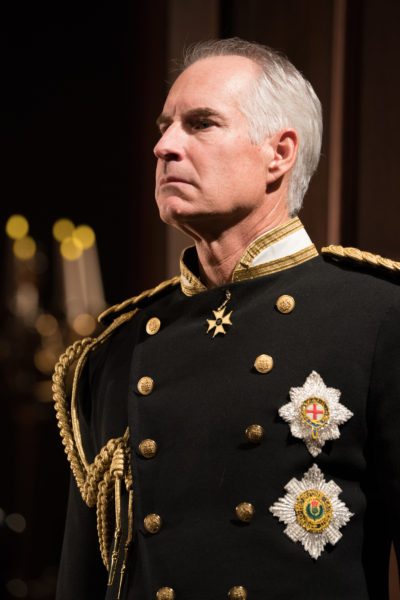
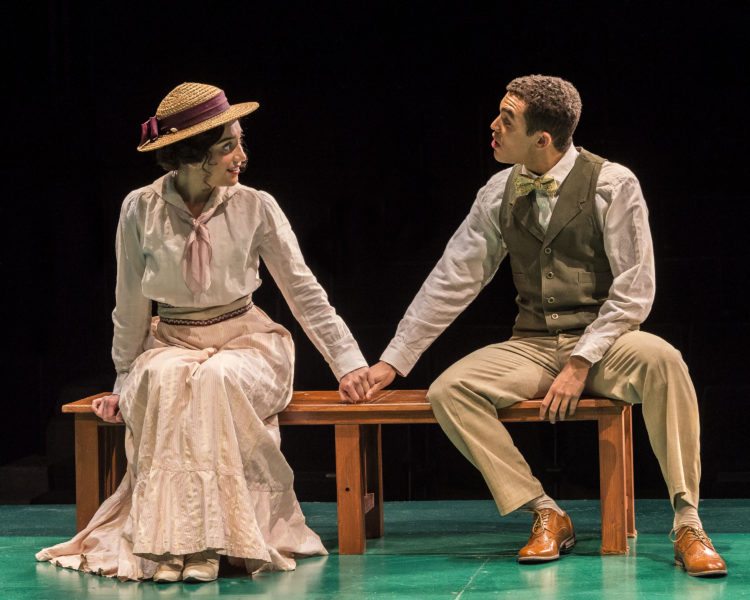
Jim Abele as King Charles III | Photo by Jenny Graham / Pasadena Playhouse

If we were to determine how we feel about our neighbors across The Pond by the popularity of shows on PBS and the BBC, we could confidently conclude that Americans are enamored with all things British.

Their class structure for one, which is vastly different from ours, is a source of endless curiosity. Our fascination with the English aristocracy made a phenomenal success of ‘Downton Abbey’ set at the turn of the 20th century depicting the intersecting lives of the Crawleys and those who served them. Never mind that breaching the class system at that time wasn’t slightly plausible; we wanted to believe the Crawleys had an innate goodness.

More recently, the lives of English monarchs, past and present, are being serialized in ‘Victoria’ and ‘The Crown’. These programs will chronicle two widely admired queens’ reign through the decades, for our extended viewing pleasure. We just couldn’t get enough of the Royals.

And now the British monarchy or, more accurately, ascension to the throne is the focus of a future history play that’s on stage at the Pasadena Playhouse from November 8 to December 3, 2017. Written by Mike Bartlett, ‘King Charles III’ was the winner of the 2015 Olivier Award for Best New play and is the second production in the Playhouse’s 2017-2018 season. It also marks the play’s Southern California premiere.

‘King Charles III’ is directed by Michael Michetti, who is also helming two other Pasadena productions – ‘Mrs. Warren’s Profession’ at A Noise Within, and ‘A Streetcar Named Desire’ in February at The Theatre @ Boston Court, where he is Co-Artistic Director.

According to Michetti he saw the Broadway performance, which was essentially a remount of the British production with the original cast, two years ago and absolutely loved it. When the Pasadena Playhouse’s Producing Artistic  Director, Danny Feldman, selected the play and asked Michetti to direct, he jumped at the chance.

Says Michetti, “While this staging is not going to be the same as what was done in London’s West End nor the one I saw on Broadway in New York, we are not intentionally trying to change it. I thought it was a wonderful production and it was beautifully done. But any time you mount a show you take into consideration all the conditions, including where it’s being produced, what the space is like, who the actors are, and what adjustments need to be made.

Because this is being produced in Southern California, at the Pasadena Playhouse, there were some concerns to address in pre-production. Among them is that the needs of the Playhouse space are very different from that of the Broadway’s.

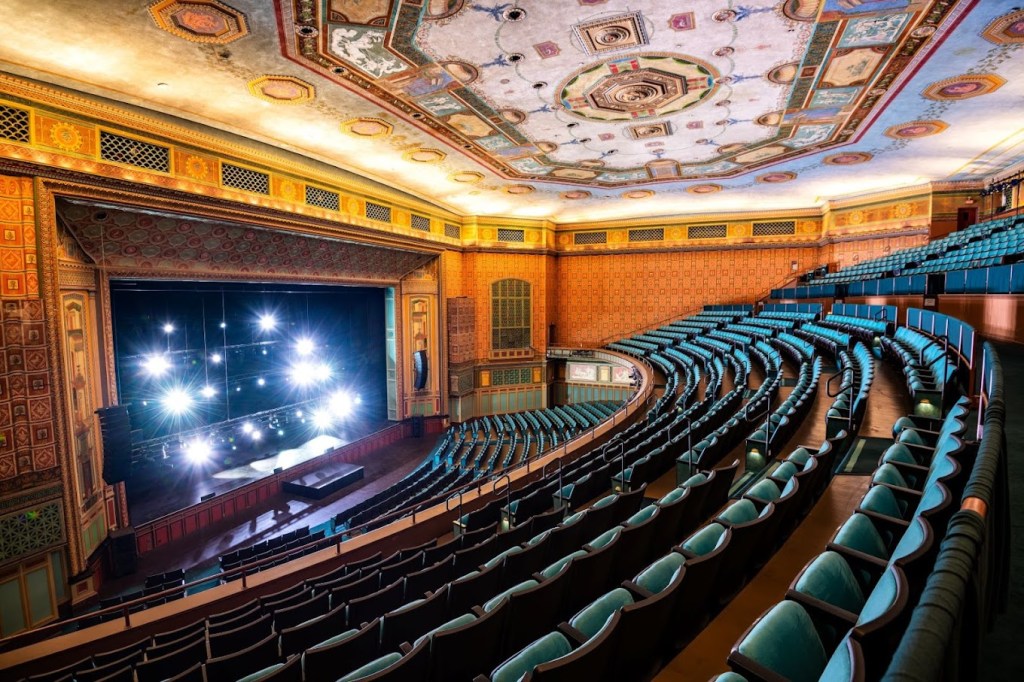
The Pasadena Playhouse is such a beautiful and historic theater but the challenge was that the stage was too high. Very early on, we brought in a scenic designer to work on the creative space. He fashioned an area that steps down from the stage level to bring the action closer to the audience. This means members of the audience are in the midst of the action, giving the production a real immediacy that’s supported by the style of the play.”

“It’s written in the style of Shakespeare,” Michetti expounds. “And like in a Shakespearean play, there are times when actors break the fourth wall in a soliloquy and speak to the audience. We made sure this connection was maintained. This takes advantage of the stage we have created, allowing for an intimate relationship with the audience. What adds to its intimacy is that the play involves the Royal family whom we know so well.
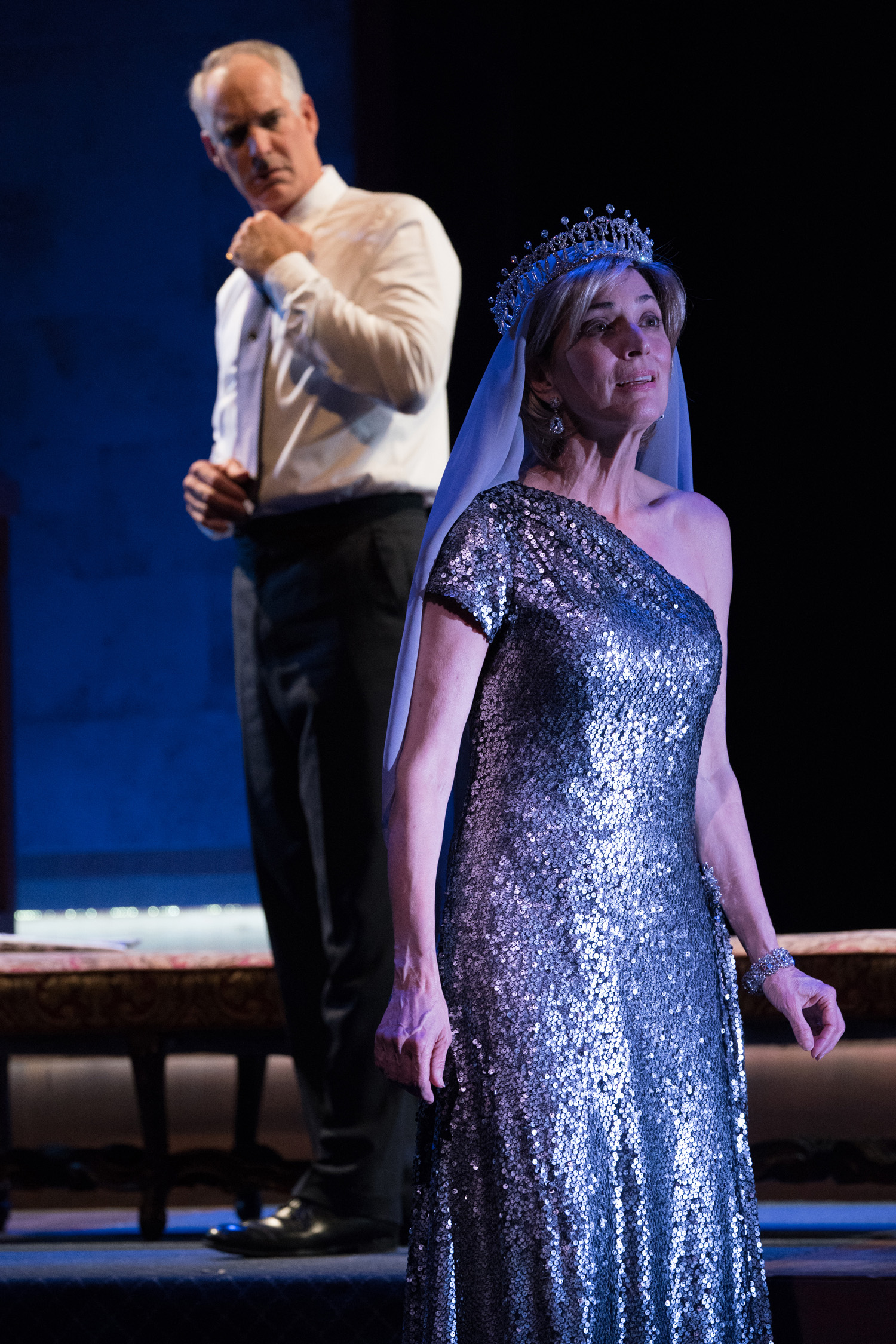
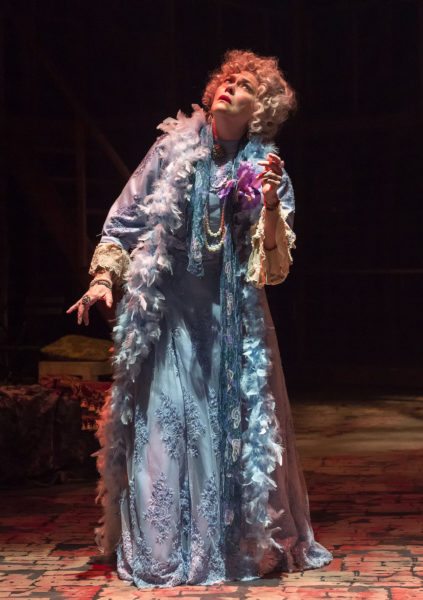
Jim Abele and Nike Doukas, as the family ghost | Photo by Jenny Graham / Pasadena Playhouse

The English royals are people we only see and hear on television interviews. They’re very protective of their image; they don’t let us into their thoughts so we’re not privy to what they’re thinking. Bartlett very cleverly allows us behind closed doors to listen in on conversations that might be happening. That’s extremely powerful.”

According to Michetti contemporary plays in the fashion of Shakespeare are pretty novel. While Bartlett uses a number of Shakespearean styles and inventions like blank verse, ‘King Charles III’ is told with modern characters and in present-day English as well. This makes it easier for the audience to understand.

As befits a play about the royal family, ‘King Charles III’ revolves around people American audiences are very familiar with – Camilla, William, Catherine, Harry – and a few fictional characters Bartlett conjured, including a new love interest for Harry, and a family ghost.

Over the past few years, with the marriage of William to Catherine, who is a commoner, there has been a resurgence in our enthrallment with the Windsors. This young couple has certainly made the royals feel more accessible. That ‘King Charles III’ is arriving on the Southern California stage on the 20th anniversary of Diana’s death has only increased our excitement.

“Our most common recollection of Prince Charles was during the Diana years, when he didn’t quite cut a sympathetic figure,” posits Michetti. “There was a great deal of negative backlash after Charles’s and Diana’s fairy tale marriage crumbled. But Charles and Camilla have since successfully built a healthy relationship with the British public. Many Americans may not be aware of it, but he has regained a good image. While Diana is still beloved in England, the prince, of late, has become more respected.

These days we see a great deal of the Duke and Duchess of Cambridge, William and Catherine, who are very popular with the media and they know how to use the press to better advantage. It is a power they have over the monarchy and the play touches on that.

Because ‘King Charles III’ is about real people my mandate is for actors in the role of Charles, Camilla, William, Catherine, and Harry to avoid playing them as they have been represented in the media. We made a very deliberate effort to make sure they are not delivering impersonations but emulating qualities of them.”
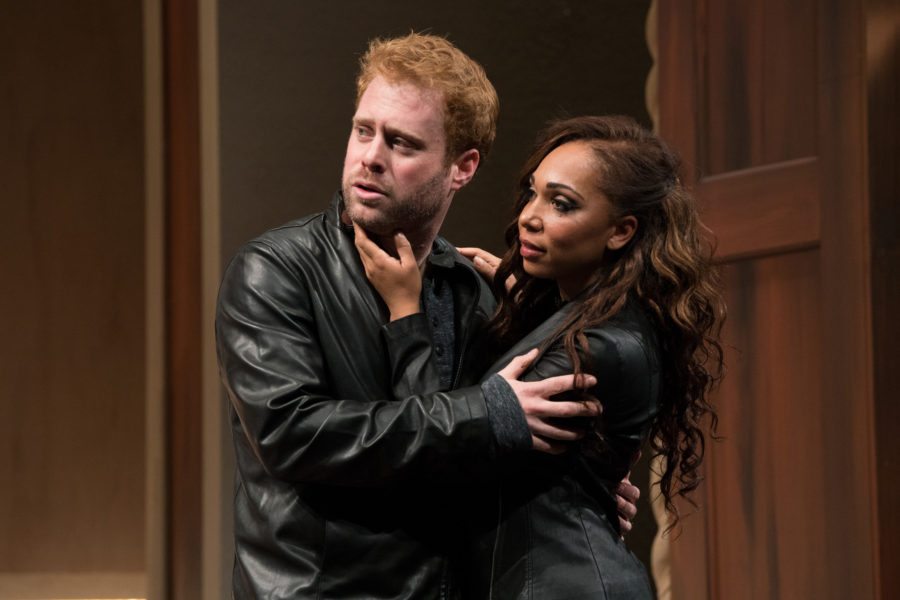
Dylan Saunders as Harry and Sarah Hollis as Harry’s love interest| Photo by Jenny Graham / Pasadena Playhouse

“The play is structured like a political thriller and it gives nothing away,” Michetti discloses. “It begins at the funeral of Queen Elizabeth II.  Charles has become king and he faces challenges which have personal and political impacts as he deals with the transition to the monarchy. The play is surprisingly funny in its portrayal of the characters and the wit with which they tackle their problems. It’s exceptionally smartly written.

When I saw it on Broadway two years ago I was dazzled at how well-crafted it was but it didn’t feel relevant to American audiences. But a lot has happened since. Concerns including the dangers of limiting freedom of the press, the difficulty of political transitions, conflicts between branches of government, and the potential for constitutional crisis are all issues on our headline news every day. I hope that while the circumstances and characters are different audiences will be able to see ourselves, and the current situations in America, reflected in this play.”

‘King Charles III’ has all the elements of ‘must-see TV’ except it’s performed live in front of us. It is replete with captivating personalities we merely glimpse in magazines at the supermarket checkout – a king facing a political emergency as soon as he begins his reign, a prince dating a young woman who has an embarrassing past, a lady coming back as a ghost to haunt the palace.

This production is one that Anglophiles will most assuredly relish. Eager as we are to see how the royals resolve this predicament in the end so are we reluctant to end our enjoyment in watching them keep their wry humor through it all. That they speak in iambic pentameter with their posh accent only adds to our delectation. ‘King Charles III’ is decadently brilliant!
Shaw’s ‘Mrs. Warren’s Profession’: A Timely Production at A Noise Within

Originally published on 31 October 2017 in the Pasadena Independent, Arcadia Weekly, and Monrovia Weekly

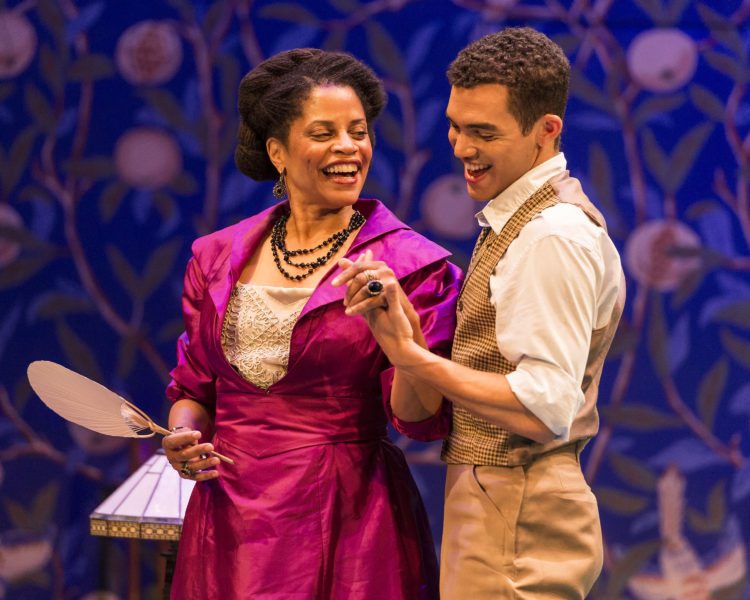
Judith Scott as Kitty Warren and Adam Faison as Frank Gardner. Photo by Craig Schwartz

George Bernard Shaw’s seminal play ‘Mrs. Warren’s Profession’ is currently playing at A Noise Within (ANW) until November 17, 2017. Directed by Michael Michetti, Co-Artistic Director of The Theatre @ Boston Court, it stars Judith Scott, known for her role as Claudia Crane on the current FX series ‘Snowfall’, in the titular role of Kitty Warren.

Written in 1893, ‘Mrs. Warren’s Profession’ was one of Shaw’s earliest plays which was published in a series called ‘Plays Pleasant and Unpleasant’ in 1898. It was widely branded as being immoral not so much because it dealt with prostitution but because the woman in the center of the scandal did not show remorse for her choice of career.

Michetti says of ‘Mrs. Warren’s Profession’, “It is shockingly modern. It’s a play that examines Kitty Warren’s choices from different perspectives and without judgment. Shaw was brazen to put the plight of women front and center in his art; it’s a choice none of his contemporaries made. It’s a protofeminist play before the terminology was even commonplace.”

“When Shaw wrote ‘Mrs. Warren’s Profession’ in 1893 he exposed women’s dilemma at that time and the double standard that society imposed,” Scott pronounces. “Prostitution was highly regulated and prostitutes were punished while the men who availed of their services got away with it.

This is a woman who has prostituted herself unabashedly and has remained unashamed for having done that. It is a powerful portrayal of women and the tremendous sacrifices they make to raise their children and give them opportunities in life.”

Scott got her acting training at Webster University, alma mater of acclaimed actress Marsha Mason, in Webster Groves, Missouri. She says, “It was at one time an all-girls school but it was coed by the time I attended it. I was there for three years; I left after the third year and moved to Paris. My friends used to call me the Wandering Jude.”

“A month after I got back in the States, in 1983, I went walking with my mother in downtown Chicago. I went into The Second City Theater to use the bathroom and after I came out I heard some people laughing. I entered the room and saw people improvising. When I rejoined my mother outside I told her, ‘that’s what I want to do’. That sealed my fate, I went to the bathroom and decided I want to be an improviser,” relates Scott.

“Actually, I grew up improvising; that’s how I made my mother laugh,” Scott hastens to confess. “So I have always been an improviser but when I saw what they were doing I knew I wanted to do that. I was there in the fall and by the spring I was one of 300 touring performers with The Second City Theater Company. I did that for six years.

My mother was an amateur actress, my grandmother watched soap operas and was kind of a drama queen. The path was already laid out for me all my life and I just took up the calling. But I didn’t really make it a serious career until I was in my 40s.”

ANW Resident Artist Erika Soto as Vivien Warren and Adam Faison as Frank Gardner. Photo by Craig Schwartz / A Noise Within

“Having studied all the classics in college, I’m familiar with Shaw’s work,” explains Scott. “’Mrs. Warren’s Profession’ is a very intellectual play; Shaw is a very word-heavy writer but there’s a tremendous amount of emotion and feeling in his work. That was what struck me – how much feeling was in his writing; it is replete with polemic discussion, there’s so much passion in it.

It is a powerful piece and playing the role of this strong and willful character was life-changing for me.  I related to Kitty Warren on a deeply personal level. The play has resonated with me because of what I know and where I come from; my ancestral history has certain parallels with her experience.

This role is not traditionally played by a woman of color and it has made a difference for me. It was a vehicle that changed my life – not only in my understanding of me as Judith, my mother’s child, but as a woman of color who comes from a long line of women of color before me who sacrificed a great deal to have the privileges that I now enjoy but take for granted.”

Adds Scott, “This is the first Shaw I performed ever and is also my first at ANW. It has been both challenging and illuminating. It helped me understand that I come with a certain history and perspective that I have learned to respect and honor more than I ever did before; Shaw gave me my identity.

By relating to the character it simply means that I have taken her seriously and deeply; I see Kitty through her eyes.  I don’t live in my skin color but I use it when it’s necessary to make a statement – in this role I have to fight diligently and ferociously. In Shaw’s work that revelation is more so.”

While Shaw wrote ‘Mrs. Warren’s Profession’ towards the end of the 19th century to expose the prevailing culture, women in the early 21st century are still fighting against double standards of behavior and inequality in the workplace.

Would that Shaw’s depiction of a woman being decidedly unapologetic for making her own fortune and shedding the inhibitions that society unfairly imposed serve as an exhortation for all women of this generation to fearlessly pursue their dream and resolutely determine their own destiny. May equity and parity be achieved long before the end of this century.

Giraudoux’s ‘The Madwoman of Chaillot’ at a Noise Within in Pasadena

Originally published on 9 October 2017 in the Pasadena Independent, Arcadia Weekly, and Monrovia Weekly

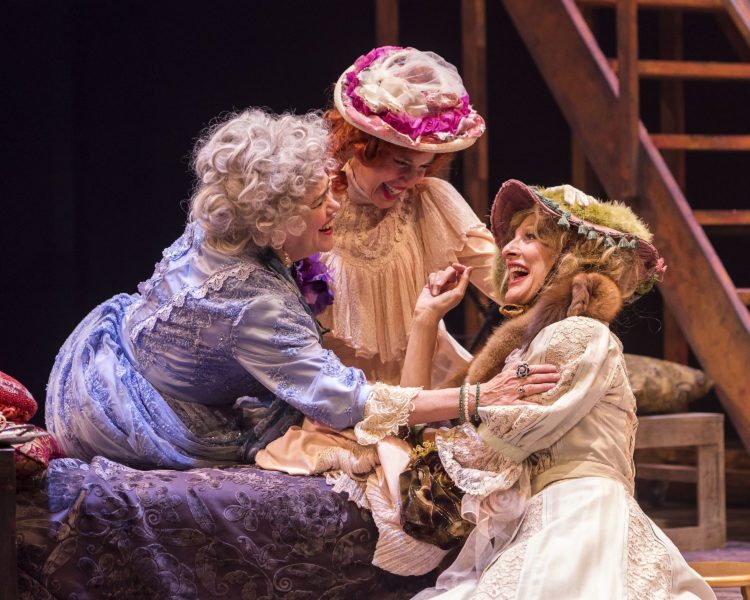
Deborah Strang plays the title role in Jean Giraudoux’s “The Madwoman of Chaillot.” | Photo by Craig Schwartz

Playing at A Noise Within (ANW) in Pasadena from September 17 to November 11, 2017 is Jean Giraudoux’s ‘The Madwoman of Chaillot’, translated by Maurice Valency, and directed by Stephanie Shroyer.

A tale of men’s greed and the common people’s fight against it, ‘The Madwoman of Chaillot’ addresses ecological and environmental concerns – issues that affect us to this day. It is also quite significant that it has a woman as the instigator of the battle, a role usually reserved for men, when it was written at a time when having female leads in theatre was not as commonplace.

Deborah Strang, resident artist at ANW, plays the title madwoman. She says, “Clearly Giraudoux loved women; he had a fondness for the female mind and ability. There was one other play he wrote called ‘Ondine’ that I saw a while back which also featured a female protagonist. Oddly, it was also directed by Stephanie Shroyer.”

“I am very excited to be playing the ‘Madwoman of Chaillot’. First and foremost because it’s by Giraudoux, who’s an incredible French playwright and I have never done one before. So it got me particularly intrigued,” says Strang.

“Valency’s translation and adaptation recreates the spirit of the piece,” continues Strang. “It is almost Shakespearean in its rhythm and use of language, the repetition of sounds, vowels, and consonants. It’s very beautiful just to speak it – it’s poetry, almost.”

“It’s an extremely thrilling role for an actor – on every page of the script the madwoman is speaking nonstop.  It’s an enormous challenge to carry almost all of the text in the play for two hours. It’s stimulating for my old brain to try to take it all in and comprehend,” Strang states self-deprecatingly.

“That it is being directed by Stephanie, whom I adore, makes it especially fun for me,” adds Strang. “This is the second time I’m working with her; the previous one I did with her was ‘You Never Can Tell’ which we had on stage a couple of years ago.

The way Stephanie puts things together is quite magical. She is a choreographer so she approaches her plays from a dancer’s mind; she directs the actors’ movements in a way that’s electrifying for the audience to watch. It’s exhilarating for actors because it’s like learning to dance; in the movement we discover new ways to explore the text.”

Deborah Strang (left) as Aurelia, The Madwoman of Chaillot; Jill Hill (center) as Therese, Mme. Gabrielle, The Madwoman of St. Sulspice, and Susan Angelo (right) as Paulette, The Madwoman of Passy | Photo by Craig Schwartz / A Noise Within

In ‘The Madwoman of Chaillot’, Strang co-stars with two other female resident artists whom she has known for a long time – Susan Angelo as Mme. Constance and Jill Hill as Mme. Gabrielle – and Veralyn Jones, who plays Mme. Josephine.

“Susan, Jill, and I haven’t been in the same play for some time. So it’s wonderful to work with two of my favorite actresses,” Strang says further. “The fourth madwoman, Veralyn, who is now my new best friend is someone I’ve heard of but have never worked with before. And she’s fantastic! To have four strong women on stage at the same time playing against one another is a rare treat.”

“Classical plays, in general, have more dominant male roles,” Strang points out. “And while ‘Madwoman of Chaillot’ has more men in it, they are the bad guys. Giraudoux may not have set out to create a feminist play so much as to show the underdog winning.”

Written in 1943, ‘The Madwoman of Chaillot’ follows three businessmen in Paris conspiring to destroy the city in order to unearth oil, which a prospector’s sense of smell located in the neighborhood.

However, Countess Aurelia, ‘The Madwoman of Chaillot’, hears about their plot. With an outwardly eccentric behavior but possessing a much common sense, she enlists the help of her fellow outcasts: the ragpicker, the street singer, the sewer man, the flower girl, the sergeant, and various other oddballs and dreamers. She invites them all to a tea party, reminiscent of Alice in Wonderland’s, then sends the greedy businessmen into a bottomless pit that opens out of her cellar.

“It’s a play that is extremely relevant in today’s world,” declares Strang. “When the audience hears certain lines like ‘What would you rather have in your backyard, an almond tree or an oil well?’ or ‘Why would you want a park for children?’, they all identify with the situation. This was true in Giraudoux’s time as it is now.”

“Yet in the end, the audience will have a very good time – it’s wonderful entertainment. They’re going to laugh, maybe think a bit,” Strang says. Then she adds wistfully, “Ideally it will change the world, we’ll be more generous and loving to one another.”

Musical Siblings Hold Benefit Concert for Team Fox’s Parkinson’s Disease Research

Originally published on 30 September 2017 in the Pasadena Independent, Arcadia Weekly, and Monrovia Weekly

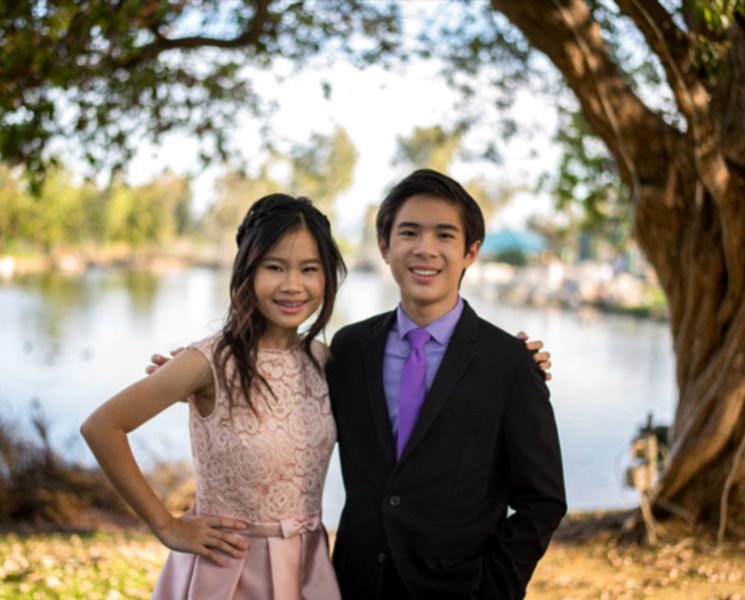
Melodey and Marc Soong | Courtesy Photo

“Music is a moral law.  It gives soul to the universe, wings to the mind, flight to the imagination, and charm and gaiety to life and to everything,” Plato wisely declared.

For San Gabriel Valley siblings, Melodey and Marc Soong, the influence of music is obvious.  Music is part of their life; they grew up surrounded by it. Melodey was four and Marc was three when they started taking piano lessons at the former Yamaha School in Arcadia. They both are currently studying under the tutelage of Professor Daniel Pollack and Vladimir Khomyakov of the USC Thornton School of Music.

On October 14, 2017 Melodey and Marc will share their love of music as well as support a cause – they will hold a piano concert to benefit Michael J. Fox’s (Team Fox) Parkinson’s Disease Research (click here to donate). To be held at the First Church of the Nazarene in Pasadena, the concert will feature pieces ranging from the Baroque to the late Romantic period.

Sixteen-year-old Melodey has won local and international competitions including the American Protégé International Piano and Strings Competition, the California Association of Professional Music Teachers for Contemporary Music Festival, the San Jose International Piano Competition, and the Seattle International Piano Competition.

These various piano competitions and festivals have taken Melodey in several parts of the United States and abroad.  She has performed in several venues – the Isaac Stern Auditorium Perelman Stage and the Weill Recital Hall at Carnegie Hall in New York, Zipper Concert Hall in Los Angeles, and Sala dei Notari in Perugia, Italy.

Twice Melodey was chosen as a winner of the Young Musician’s Foundation Scholarship Award.

A twelfth grader at Mayfield Senior, Melodey is a member of the school’s Instrumental Conservatory. But she has other hobbies besides playing the piano; she also enjoys reading and writing. She satisfies her writing interest being a reporter and copy editor of Mayfield School’s newspaper.

While playing the piano is an avocation she would always nurture, Melodey intends to pursue a medical degree.  She interns in the Nursing and Music Therapy departments at Arcadia Methodist Hospital.

Like his sister, 14-year-old Marc has reaped the same laurels and has added other awards – Classics Alive Young Artists; the Redlands Bowl Young Artists; and the Los Angeles Liszt Competitions – to the list.

The venues where Marc has played the piano include the Isaac Stern Auditorium Perelman Stage and Weill Recital Hall at Carnegie Hall, the Zipper Concert Hall, and the Redlands Bowl.

Marc was the recipient of the 2015-2016 Young Musician’s Foundation Award’s David Weiss Scholarship.  He also volunteers with the Pasadena Symphony Orchestra.

Music isn’t Marc’s only pastime, he is also keen on reading, swimming and playing video games. An avid math and science enthusiast, he has attended several programs at Caltech and participated in the National Youth Leadership Forum: Explore STEM. He is currently a sophomore at Stanford University’s Online High School.

The Team Fox concert is Melodey’s and Marc’s very personal way of sharing music with everyone.

Melodey and Marc state, “Music is a constant in our life and is something we could always come back to; it also serves as a way to connect with others. Music has the ability to lift other people’s moods – bringing joy and happiness to those who may not be in the best spirits. Music has the power to transform, to touch, and ignite emotion.

We are incredibly fortunate to have been exposed to music early on. We are so very grateful for this privilege and we would like to give back to the community. Our grandmother had Parkinson’s Disease so we decided to hold a concert to benefit research into it. We hope that through this benefit event we can raise funds and awareness for Parkinson’s.”

To be held from 5:30 to 7:00 at First Church of the Nazarene’s Lee Chapel, the first part of the concert features solos from Melodey.  She will perform J.S. Bach’s Prelude and Fugue in D Minor; W. A. Mozart’s Sonata No. 8 in A Minor; Widmung/Dedication by R. Schumann/F. Liszt; P. Tchaikovsky’s Dumka, Op. 59; and Black Earth by F. Say.

There will be a short intermission after which Marc will take his turn on the stage. He will be playing S. Rachmaninoff’s Prelude in D Major; Hungarian Rhapsody No. 12 in C-sharp Minor by F Liszt; S. Rachmaninoff’s Piano Concerto No. 2 in C Minor, accompanied by Dr. Vladimir Khomyakov; and Paraphrase Figaro’s Aria from the Barber of Seville by G. Rossini/G Ginzburg.

Melodey and Marc will conclude with a piano duo (two pianos, four hands) and play F. Liszt’s Hungarian Rhapsody No. 2 in C-sharp Minor.

The repertoire includes a variety of solos, duo, concerto, and duets to delight the audience with different styles and periods of music. It would be an evening filled with enchanting music – that it is also an event to benefit those afflicted with Parkinson’s Disease is fortuitous. Even Plato would approve.

‘With Love and a Major Organ’: Boston Court’s Last Play for the Season

Originally published on 27 September 2017 in the Pasadena Independent, Arcadia Weekly, and Monrovia Weekly

Boston Court Performing Arts Center in Pasadena ends its 2017 season with the West Coast premiere of Julia Lederer’s ‘With Love and a Major Organ’, from September 28 through November 5, 2017. 

Directed by award-winning co-artistic director, Jessica Kubzansky, ‘With Love and a Major Organ’ is a whimsical, quirky, and wildly original play that dissects physical human interaction in the age of technology. Its title alone is startling and it was what attracted her to the play at the outset.

Says Kubzansky, “I love this title and I think it’s deliciously funny. The story is about trying to connect in our ever more virtual world. There’s a character in the play who has been enclosed for years in her own privacy. She’s seeing an online therapist, Google Shrink, who recommends that she see more people so she speed-dates online. What’s contrapuntal to this is that she falls in love with a stranger she meets on the subway. She then gives her actual beating heart to this man and he disappears on her.”

‘With Love and a Major Organ’ follows the protagonist’s quest to retrieve her heart, accidentally cracking open those of others she meets on the way. The play is eccentric and edgy comedy about what it costs to give your heart away, and what happens when you discover you actually have one.

“To me one of the most profound ironies of our time is that we have never been more connected yet we have never felt more isolated,” Kubzansky declares. “There’s this amazing animation that someone made about people running around looking down on their phones – technology is changing their lives but they’re completely missing out on life around them. Technology is significantly improving our lives while considerably reducing our ability to connect.

Julia’s play is both truly hilarious and powerfully heartbreaking. She’s mining both the absurd lengths to which love will drive us and the deep loneliness that emanates from protecting our frequently bruised and broken hearts. Her text is poetry for the theatre and she pushes metaphor to its most surreal and deeply truthful limits.”         

Boston Court Performing Arts Center was founded in 2003 as a non-profit arts center dedicated to new and original works by living artists. Led by co-artistic theatre directors, Jessica Kubzansky and Michael Minetti, it has successfully established its place among the numerous theatre companies in Pasadena.    

“The journey has been exciting, challenging, and wonderful,” proclaims Kubzansky. “I’ve been extraordinarily privileged to have founded Boston Court with Michael. We had the thrilling task of creating the mission and vision for this place – it’s always stimulating for an artist to create what you want to share with the world.

We knew when we started that Boston Court is only four blocks from the Pasadena Playhouse; we realized we needed to offer something different. Frankly, the design of the place dictated many things: it’s beautiful but it’s also very intimate. It’s important for us to do risky, adventurous work because we have fewer seats to fill; we can afford to take chances in our programming.

Also, it’s imperative for me to do work that challenges both the artist and the audience – plays that encourage each artist to passionately pursue his own unique voice and vision. We don’t want cookie-cutter productions or something our audience can see somewhere else. We look for a variety of styles and we significantly reinvent the classic. The only time we wouldn’t re-envision a classic is when it’s  highly theatrical, textually rich, and visually arresting on its own – something we call a ‘Boston Court play’.

We put on four productions per season – usually one wildly re-envisioned classic; a world premiere; maybe one we had in our New Play Festival that subsequently ends up on our stage; and one that’s timely and needs to be done now. It’s all about passion and balance, but always the mandate is the same – it has to be highly theatrical, textually rich and visually arresting.”  

Kubzansky and Michetti actively seek out like-minded collaborators. She states, “When Michael and I meet with directors we would like to work with, we ask ‘What has been burning a hole in your gut? What do you need to talk about right now?’ Both of us have really astonishing experiences when it comes from our gut.”  

According to Kubzansky it took a while for them to fully grasp what sets Boston Court apart from other theatre companies in the area. She states, “It was much later, when our season had entirely world premieres and we had to extend every show, that it became clear to us that our audience liked the plays they’ve never heard of before. People now know that when they come to Boston Court, they will have a quality ride; they are confident that no matter what they see here it’s going to be a great evening.

Because our work is adventurous, it occasionally divides or offends people. But they also trust that they will see artistic excellence and the experience will be unlike what they get elsewhere. It’s incredibly important to us to take part in a cultural conversation that reflects the world as it is today. We ask our audience to be moved and to think – to crack open their heart and mind a little bit.  

In Los Angeles, you see a play, get in your car, and drive away. But in New York, after the show you go to a bar next door, bump into people who also saw the play, and have a discussion about it. We want to bring that kind of engagement in the L.A. theatre scene. Every Friday we have complimentary wine, sparkling water, and Chex Mix to encourage people to sit in our beautify lobby and have a dialogue about they had just seen.    

There’s a misconception that theatre-goers in Los Angeles don’t have the same passion for it as New Yorkers. It may be true that a much larger percentage of the population on the East Coast  sees a play on any given night – it’s so easy for them to go on the subway then get off after four stops. Los Angelenos are also passionate devotees and there are so many choices of theatres here, too. However, I think that geography has something to do with it – if you live in Venice and want to see a play here, you have to make a commitment in terms of the drive. Fortunately, Boston Court attracts subscribers from far afield – which is very thrilling. Pasadena is a beautiful place; it’s a really complex community and it’s exciting for us to be here.”

Before Boston Court existed the place it now occupies was a parking lot. It was purchased by philanthropist, Z. Clark Branson, to build a state-of-the art, intimate facility designed to bring artists and audience closer together. The 75-seat Marjorie Branson Performance Space and the 99-seat Main Stage are sites for the theatre’s season of bold, risky theatre and its eclectic, diverse music series. It is also the home of an annual New Play festival, an Emerging Artists Series, as well as Upfront, a rotating visual arts program.

As Kubzansky relates it, the theatre company’s name was born out of their desire to come up with a moniker that conjures permanence, heft, and gravitas. “We wanted something iconic like the Actors Theatre of Louisville or the Pasadena Playhouse – both of which were already taken. When we realized our building is located on Mentor Avenue and Boston Court, a lightbulb lit; we became Boston Court Performing Arts Center. We thought people will understand when they see that we named it after the street we’re on. 

What’s funny is that after we had our logo created, stationery printed, and signs put up, we received a letter from the City of Pasadena informing us that our address is in fact 70 N Mentor Avenue; Boston Court is actually our driveway,” Kubzansky says with a laugh.      

That inadvertent address error couldn’t have deterred its founders’ resolve to make their mark  on the city and theatre. Boston Court Performing Arts Center stands today as a stalwart advocate of artistic vision and inventive expression.                

DIAVOLO Debuts at Arcadia’s Performing Arts

Originally published om 5 September 2017 in the Pasadena Independent, Arcadia Weekly, and Monrovia Weekly

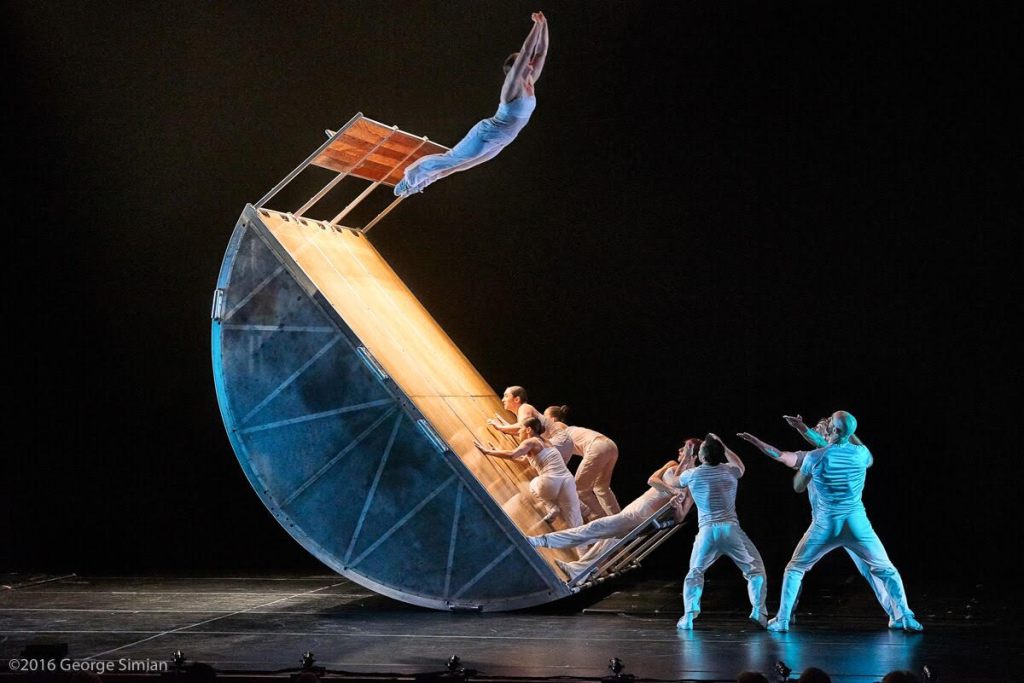
DIAVOLO, fresh from its performances on NBC’s ‘America’s Got Talent’, makes its high-energy Pasadena and San Gabriel Valley debut at Arcadia’s Performing Arts Center on September 23, 2017 from 7:30 – 9:00 pm.

Featured during this maiden show is DIAVOLO’s groundbreaking masterpiece, ‘Trajectoire’, which will be seen in its entirety for the first time on the West Coast this year.  Also performing on the stage are students of Arcadia High School’s ‘Orchesis’ and the Dance Conservatory of Pasadena.

This electrifying event is being presented by Jennifer Cheng, Artistic Director of the Dance Conservatory of Pasadena and Executive Director of DIAVOLO, and the Cheng Family Foundation.

Jacques Heim, DIAVOLO’s Creative Director, and I wanted to bring the Aesthetic of Architecture in Motion to Dance Conservatory of Pasadena and the San Gabriel Valley,” states Cheng.  “Dance in Los Angeles is experiencing tremendous growth; L.A. is fast becoming a new and exciting center for this art form in the world.  We want to share this extraordinary new phase in dance to Pasadena, Arcadia, and all of San Gabriel Valley.”

Cheng’s lifelong passion is dance.  Growing up in Pasadena, she started ballet at the age of five with Yvonne Cusack.  She then trained with Stanley Holden as one of his first students at the Music Center in Los Angeles and then later at his dance studio in West Los Angeles.

When she was 15 years old, Cheng received her Advanced Certificate from the Royal Academy of Dancing.  She was also the recipient of the Ford Scholarship for the School of American Ballet.  As a young dancer, she performed with Rudolf Nureyev and the Australian Ballet and the San Francisco Ballet, as well as dancing on various television shows like the ‘Brady Bunch’ and ‘The Odd Couple’.

However, Cheng’s parents didn’t want her to have the life of a dancer – eking out an existence in New York City, trying to find a job that was difficult to come by.  So she attended Pomona College where she received her bachelor’s degree in art history.  She then earned a law degree from UC Davis School of Law, and an MBA from UC Irvine School of Management.

Cheng went on to practice law but the dream of being in the dance world stayed with her all these years.  In 2011 she quit the law profession and founded the Dance Conservatory of Pasadena (DCP) on Waverly Drive.  Its mission is to provide the highest technical and artistic level of instruction for students to pursue careers as dancers, with an emphasis on offering performance opportunities.

“We started six years ago with just two teachers and grew pretty fast – we now have four studios and over 200 students,” Cheng describes.  “Our classes are divided into the children division for three through nine years old; pre-professionals are 9 years to 18 years old; and advanced ballet for adults.  Sessions are held after 3:00 from Monday to Friday and on Saturday.  Adult lessons are held mornings from Monday to Thursday and Saturday morning.

My students perform and compete as well.  We just finished the second year of competition and we won first place at the semifinals at Youth American Grand Prix in San Diego, which automatically qualifies us for the New York City finals.”

Adds Cheng, “While I established DCP primarily as a ballet school, we realized contemporary dance is an important component of one’s dance education to make it as a professional performer.  I brought in DIAVOLO to DCP’s studio, and that enabled us offer two levels of contemporary dance courses.

DIAVOLO is recognized as a contemporary and physical movement dance company.  We’ve been in existence for 25 years and are known all over the world.  In February 2018, we’ll be performing at the Kennedy Center in Washington, D.C., then touring the United States and internationally.”

DIAVOLO’s “In Flight” | Courtesy Photo

Established in 1992 by French-born choreographer and visionary Jacques Heim, DIAVOLO reinvents dance and reimagines theatre to create genre-bending stage performances with striking set pieces.  It is a cultural pillar of the Los Angeles community and has performed for hundreds of thousands of concertgoers worldwide and for millions on television.

“My students at DCP perform twice a year and we do a summer program,” discloses Cheng.  “We’ve presented ‘The Nutcracker’ as a full production ballet with 100 students participating.   We needed a professional venue which can accommodate a large number of performers and I discovered the Arcadia Performing Arts Center where we’ve performed it for two years now.

I personally think that there is no major dance, music, and media center in the San Gabriel Valley.  Most performing arts events happen at the Annenberg Center in Beverly Hills or the Broad Stage in Santa Monica and stop at downtown Los Angeles.  This year I met with a couple of PAC’s board members and told them I believe this theater should serve as the center of performing arts in this area.”

Cheng’s involvement with DIAVOLO led her to organize events where her students will be performing its dance style;  DIAVOLO’s debut at PAC is the result of that collaboration.  And because PAC is on the Arcadia High School (AHS) campus, she thought it makes perfect sense to invite AHS’s dance company, ‘Orchesis’, to perform as well.

Robyn O’Dell, dance teacher at AHS, says, “Orchesis is the advanced level dance course at AHS.  It is an art elective class for 10th to 12th graders and I currently have 30 students.  We hold four performances on campus and we go to different events and festivals.  Our biggest shows are Homecoming, the December Holiday program, and the spring dance production held in April.”

Continues O’Dell, “I teach a variety of dance techniques including contemporary, jazz, ballet, hip-hop, and modern.  Each year we bring a cultural style so students learn hula and Bollywood.  For our main show, which we gear up for every year, we perform 24 dances in an array of different styles and we bring in professional choreographers to work with the girls.”

“Ten of my students are working with DIAVOLO.  It’s a volunteer course, they rehearse after classes, and they don’t get grade credit,” O’Dell declares.

The Arcadia Performing Arts Center, one of San Gabriel’s Valley’s premier arts and entertainment venue, is a cultural destination and youth talent incubator that makes great art accessible to all.  Featuring a 1,163-seat main stage and black box theatre, this state-of-the art professional venue reaffirms the district’s 66-year legacy of arts excellence.  AHS alums include Stevie Nicks, Van Halen’s Michael Anthony Sobolewski, NFL Hall of Famer marching band member Bruce Matthews, and Emmy award-winning producer of ‘The Voice’ Barton Kimball.

Maki Hsieh, Executive Director of PAC, pronounces, “It is the Center’s privilege to host world-class treasure DIAVOLO which exemplifies integrity of artistic vision through the creative direction of Jacques Heim, and the executive leadership of Jennifer Cheng.  DIAVOLO’s infusion of power, precision, and passion in their groundbreaking performances, integration of up-and-coming artists, and global expansion are aligned with our Center’s focus on next-level immersive programing, and on advancing arts education in our new generation of cultural ambassadors.”

Ticket prices to the performance range from $15 to VIP $70; VIP Red Carpet is from 5:00 to 7:00 with appetizers, music, after-show meet-and-greet; and season passes at $10 – $45.

For Cheng, the event marks a step in the right direction for her, “I wanted to continue my passion and fulfil my dream.  I can’t be a dancer, but I certainly can bring dance to Pasadena and the San Gabriel Valley and to the United States, through DIAVOLO.”

‘The Royals of Pasadena’ Exhibit at the Pasadena Museum of History

Originally published on 17 August 2017 in the Pasadena Independent, Arcadia Weekly, and Monrovia Weekly

Not many cities in the United States have what they call their royalty but Pasadena is one of the few that could rightfully claim to have its own crowned heads. On January 1st every year,  millions along the parade route and watching on TV around the world marvel as the Tournament of Roses Queen and her Royal Court smile and wave to their well-wishers.

The history of the Rose Parade began on January 1, 1890 when members of the Valley Hunt Club reimagined the American version of the festival of roses in Nice, France. They staged a procession of flower-decked horse and buggies and an afternoon of public games on the town lot east of Los Robles between Colorado Blvd. and what was then Santa Fe Street. The story of the Rose Queen and Royal Court, however, did not begin until 15 years since the parade first traveled the streets of Pasadena.

By 1895 the parade had become a massive undertaking for the Valley Hunt Club to fund and manage on its own. The Tournament of Roses (TofR) was formed during a public hearing and a community subscription campaign raised $595.00 to underwrite the expenses of the 1896 Rose Parade.

Tournament of Roses 2020 Rose Parade | Photo by Terry Miller / Beacon Media News

The first Rose Queen was Hallie Woods who, in 1905, was chosen by her classmates at Pasadena High School. She sewed her own gown and helped decorate the float on which she rode. But those days of class voting and self-made garments are long gone. Today, selection of the Queen to preside over the parade takes on an immense process involving thousands of young women and hundreds of volunteers.

This annual Pasadena tradition and rite-of-passage-of-sorts among high school seniors (mostly, but not exclusively, females) who are enrolled in Pasadena-area schools is a spectacular event that begins as soon as that New Year’s Rose Bowl Game is in the history books. The TofR staff rolls out the next year’s schedule of events without breaking stride.

The 100th Rose Queen in 2018 will be crowned in October. In honor of this milestone, the Pasadena Museum of History (PMH) will present an exhibition celebrating TofR’s Royal Court from September 2, 2017 through February 11, 2018. This colorful and historical display will feature previous Rose Queens’ and Princesses’ gowns, daywear, accessories, and jewelry lent for the exhibit by former members of the Royal Court. It will also highlight Queen’s crowns from the last hundred years, on loan from TofR.

Laura Verlaque, PMH’s Director of Collections, reveals, “We’ve had a long partnership with TofR – we’ve collaborated with them in the past and we carry TofR souvenirs in our gift shop.   In 2013 we put on an exhibit about Pasadena anniversaries which included the Tournament of Roses because it was commemorating an important landmark.” 

“I worked with TofR’s marketing department and their wonderful marketing associate, Heather Sharpe, who gave me access to their collection,” Verlaque continues. “PMH borrowed several things for that exhibition including the crowns, and a silver saddle. She remarked to me then, ‘You know in 2018 we will be crowning the 100th Rose Queen. Would you like to do an exhibit about the Royal Court?’ to which I gave a resounding ‘Of course!’. So you can say that we’ve been thinking of and planning this since.”

Because TofR didn’t have in its collection the garments the Queens and Princesses wore PMH reached out to the alumni list. 

“It was nerve-wracking for us because we usually know going in what we have for the exhibit, but for this one we were dependent largely on loans,” reveals Verlaque. “However, it turned out we didn’t have cause for worry; we received so many responses from our initial request before we had a chance to send out a mailing to the entire alumni registry. We were offered more than we can show – there was an outpouring from the royal court who were interested in participating.”

“We got this plaid pantsuit from the 1970s; and yesterday someone came in to lend us an ensemble that has a Diana Rigg look from ‘The Avengers’. They’re such marvelous period clothing that I simply had to make room for them in the exhibit. It’s an absolutely delightful problem to have!,” Verlaque enthuses.

1968 Rose Queen Crown and Royal Court tiaras | Courtesy Photo

The show features about 30 queens and princesses coronation gowns from every decade starting with 1940, along with outfits from the Royal Court wardrobe, accessories and ephemera.

An exhibition highlight is the spectacular 1940 gown, made of ecru velvet with gold lace trim, designed and sewn by Pasadena dressmaker Margie Mudgett. Known as the ‘Camelot’ gown, it belongs to Margaret Huntley Main, the oldest living Rose Queen.

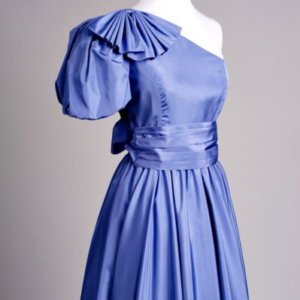
From the 1967 Rose Court wardrobe is an orange suit, duster and hat loaned by Princess Barbara Beckley. An I. Magnin & Company label 1976 Rose Princess gown made of sky blue chiffon over taffeta, a sequined bodice, and a chiffon capelet is on loan from Christina Nurches Pfleider.  A 2004 Rose Queen white gown with diagonal pleating designed by Tadashi Shoji was lent by Megan Chinen Oakes. The Pasadena TofR loaned three Rose Queen crowns for display.

“As part of the exhibit, we’ll have a pull-out section on how the Royal Court selection has changed over the years,” Verlaque states. “In the early days, the queen and princesses were friends of the people responsible for putting on the Rose Parade. Then there was a time when prominent society ladies were chosen for the court. There was a period when every female student at Pasadena City College (PCC) was required to try out; today it is voluntary.” 

Verlaque continues, “The notification system has likewise kept pace with prevailing practice and technology. Previous princesses have told me they used to sit by the mailbox waiting for the letters telling them if they’ve made it to the final 25. Later it was a phone call, and now it’s by email. It has such a fun history.”

Photo by Aaron Gil | Pasadena Museum of History

“The exhibition reveals shifting fashion styles,” explains Verlaque. “The very first gown evoked the medieval epoch – a lot of these early courts had that theme. The entire show makes for a fabulous historical display, really. Then we arrive at the Tadashi Shoji era (the official provider of the Rose Queen gowns since 2006, according to Heidi Hoff, Senior Director for Marketing and Communications. It’s so fascinating to see how his designs have evolved; in that sense this is also a retrospective of his work.”

It is a show that is beautiful, vibrant, and very visual according to Verlaque. “I hope that the ‘Royals of Pasadena’ manifests the pageantry and lavishness associated with the Royal Court. But the Rose Parade is so much more than a beauty pageant. In the course of my research and conversations with the rose queens and princesses, I have learned that the experience they had on the royal court changed their life. And this is the only city in the country that offers that kind of life-altering event for young women. I think it’s a wonderful tradition to be celebrated … examined, even – to see how it has adapted to reflect current affairs and sensitivities.”   

The Rose Parade is a renowned annual Pasadena tradition that has endured world wars and all manner of political strife. The Queen and her Court continue to gracefully perform their numerous community service functions through them all.        

For young women in the area, being part of the Royal Court is a transformative opportunity they hope to experience. A hundred years since the first Rose Queen was crowned, it is still an institution that remains relevant to the times we live in.                                     

Pasadena Master Chorale Ends Season with ‘Looking to the Future’

Originally published on 22 June 2017 in the Pasadena Independent, Arcadia Weekly, and Monrovia Weekly

The last concert in the 2016-2017 season of the Pasadena Master Chorale is a momentous event for its Executive Director, Jeffrey Bernstein – their rendition of original compositions in a show called ‘Looking to the Future’ brings to a close another successful year.  

Proclaims Bernstein, “Since we started we have always been involved with young people singing with us.  It’s at the heart of what we’re trying to do – to create opportunities for young people who love choir music to learn about it and perform it.”  

“The most exciting student program, by far, is ‘Listening to the Future’, the mentoring initiative we began last year,” explains Bernstein. “Through an application process, we select composers from local private and public schools. We team them up with a composer mentor who meets with them every week from November through June. They write music for us and we perform their work. PMC’s final concert of the year is entirely composed by high school students and it’s quite stirring.” 

Bernstein adds, “It’s a very interesting process for these young students to experience. They spend months alone in a room in front of their computer or with a piece of staff paper writing their composition. Their faces light up when they hear a roomful of 60 people transform that music off the page. It’s utterly thrilling when that happens!”

This year’s young composers Katherine Beggs, Elise Logan, Sean Segal, Tiffany Shi, and Olivia Shue will prove their musical talent when PMC presents their original work on June 25 at the Neighborhood Unitarian Universalist Church in Pasadena. These young composers were mentored by Nilo Alcala, who came on board last November.

Although only a rising senior at Westridge School, Katherine Beggs is already looking forward to college to pursue music and meet new people from different places to expand her worldview. But she thinks her high school life is something she will always cherish for the friends she made and the amazing people she has met. She is particularly glad to be part of PMC’s ‘Looking to the Future’ concert.

Beggs chose to arrange ‘O Waly Waly’. She states, “It is a traditional English folk song which I first heard as an arrangement by Benjamin Britten. It had a beautiful melodic structure and made me want to write my own. The visual imagery and figurative language in this song is very vivid which I tried to enhance with the music I wrote. It took me about three months, working one to two hour-sessions a few times a week.  Nilo and I exchanged many drafts before I finally felt like the piece was complete.”

“My original composition is called ‘Yo No Tengo Soledad’ (I Do Not Have Loneliness), a Spanish poem by Gabriela Mistral,” continues Beggs. “The poem’s message is that one is not alone when they are with the people they love. It reminded me of a lullaby that a mother would sing to a child and that is what I wanted to convey with my song. For the greater part of the piece, I have the basses and tenors sing a repetitive melody to emphasize an element of constancy and comfort.”

“This was surprisingly much easier to write because with the folk song I had to add on to a pre-existing melody and structure and I didn’t want my piece to sound similar,” discloses Beggs. “With my original composition I was able to create something completely new without fear of copying someone else’s.  Without that restriction I had a lot more artistic freedom to write as I pleased.”

Beggs declares, “Hearing something that was just in my head being performed by real musicians for the first time was completely surreal and extremely gratifying at once. It is really wonderful to hear a choir singing what I wrote because I can definitely feel the emotion – it’s vastly better than listening to a computer automated playback.”

Image taken from Pasadena Master Chorale website

Recent Pasadena High School grad, Elise Logan, plans to engage in music throughout her life. She reveals, “My AP Music Theory class was so much fun and introduced me to the world of composition. I enjoyed being around smart, young, driven, and talented musicians. I had a lot of collaborative and individual musical experiences through that class and grew a great deal as a musician and as a student.”

In the fall, Logan is heading to Barnard College, in the heart of New York City, to take further studies in this field. She says, “The newfound independence that comes along with being an out-of-state college student excites me.”

For her folk song arrangement, Logan did ‘Wade in the Water.’ She elaborates, “It is an African-American Spiritual which is very familiar and common in my family and my culture. This piece manifests themes such as faith, patience, resilience, and trust in the face of hardship – all of which are relatable and relevant. The idea solidified in three weeks but it took the entire duration of the program (November 2016 to June 2017) for me to completely revise the piece and get it ready to be performed.”

Logan’s original composition is titled, ‘The One that Could Repeat the Summer Day’. “I wanted to create a piece that contrasted the gloomy ‘Wade in the Water’. Reading Emily Dickinson’s poem about the beauty and celebration of sunrises, sunsets, and summer days inspired me to musically illustrate simple joys,” she explains.

Contrary to Beggs’s experience, Logan thinks this was more difficult to write, “The folk song already came with a melody; I only had the text upon starting my original composition so that meant I had to write the melody, rhythm, and harmony myself.”

“This was my first time writing music to be performed by other people; having the opportunity to have a professional choir sing my original work was a blessing,” Logan expounds. “This experience has been extremely educational and artistically rewarding. It’s an incredible feeling to hear professional musicians bring my compositions to life within minutes.”                

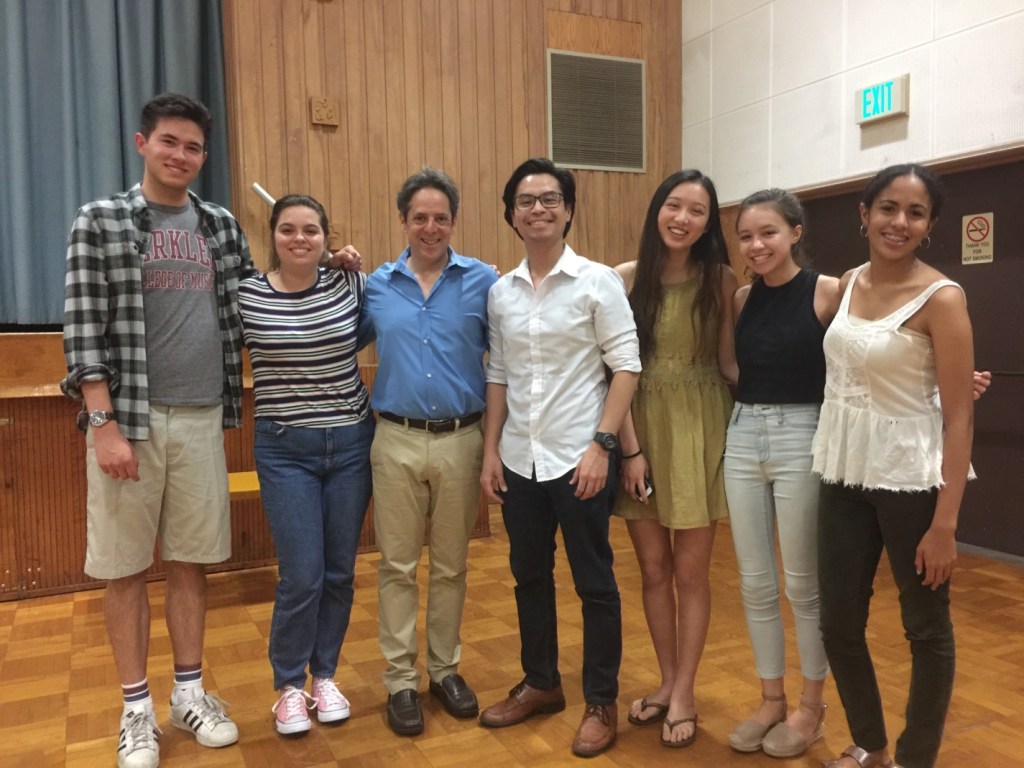
Pictured left to right: Sean Segal, Olivia Shue, Jeffrey Bernstein, Nilo Alcala, Tiffany Shi, Katherine Beggs, and Elise Logan | Courtesy Photo

Sean Segal, who graduated this month from La Canada HS, says his favorite high school experience was his choir tour to Seattle, Hawaii, Spain, and Italy. He will be attending the University of Michigan in the Fall, where he will be pursuing a double major in jazz and multidisciplinary studies in music. His long-term goal is to score a film.

“For my folk song, I chose to do an arrangement for ‘Mary Had a Little Lamb’”, says Segal. “I thought it would only be an exercise so I did something I could have fun with. It was the first thing that came to mind when I heard ‘folk song’ – it was meant to be fun and light. It only took me several hours to write; not too long, but it went through a few changes.”

Continues Segal, “My original composition is called ‘At That Hour When All Things Have Repose’, a poem by James Joyce. I knew I wanted to do it when I read it – it had the right length and had powerful images, which would be perfect with great music. It proved to be harder for me since I had to start from scratch; I had no existing melody to base it off of. It took me weeks to write – making sure each part worked and made sense.”

“People really bring your work to life when they sing it,” Segal says. “When you hear it for the first time it jumps off the page. Some moments are gratifying and some make you recognize when an idea doesn’t work so well. Sometimes you can tell something was good just from the choir’s reaction. It was the ultimate learning experience.”

A recent graduate of La Canada HS, Olivia Shue, will be attending California Institute of the Arts (CalArts) in Valencia to pursue a Bachelor’s Degree in Music Composition. It’s a small arts college that offers courses in music, theatre, art, film & video, dance, and critical studies. Students can take classes in classes besides their chosen major. She’s excited to be a part of  a community of artists.   

Shue’s folk song arrangement is called ‘Ondokusan’. She explains, “It’s a song I sing at my Buddhist temple and the Japanese text is a few words by Shinran Shonin. I chose to arrange it because it is my late grandfather’s favorite piece out of all the other songs we sing at Buddhist services. I procrastinate a lot so it’s hard to say how long it took me to compose it, but I would say probably just a week. When I finally got down to it, I was very motivated to arrange it.”

“I actually wrote two original compositions,” Shue says. “The first original song was called ‘Fire & Ice’ and it was based off a Robert Frost poem of the same name, which was about the beauty and horror of the destruction of the world. But I ended up submitting ‘Song of the Open Road’, a poem by Walt Whitman.  It’s actually kind of funny because last year I composed an original Walt Whitman piece in the same key.  What’s strange, too, is that writing ‘Fire & Ice’ had been a struggle but ‘Song of the Open Road’ practically wrote itself. I finished it in two days sans review or correction.”

This year marks the second time Shue is writing for PMC’s ‘Listening to the Future’ program. She discloses, “Now it feels natural to have them sing my work. I recently had my first string composition premiered on June 2nd, so I’m getting used to having my piece performed. The first time, however, was surreal.”

Rising senior at San Marino HS, Tiffany Shi, is a young woman whose interests lie in both music and math. She participates in her high school’s local division of Girls Who Code and loves the idea behind the club and its inclusive atmosphere. Mentors from JPL and Caltech work with them every Friday.

“I decided to arrange a folk song titled ‘Lavender’s Blue’ after my friend introduced it to me. I just loved the simple melody,” Shi relates. “My original composition is titled ‘Live Not in Vain’, which is set to the words of Emily Dickinson’s poem, ‘If I Can Stop One Heart From Breaking’. I love Dickinson’s writing, and after a few weeks of searching through different poetry archives, this poem’s uplifting tone and words really resonated with me and inspired me to write this piece.”

Shi shares a little of Beggs’s, Logan’s and Segal’s experience when she says, “Writing the original composition was a bit harder than arranging a folk song if only because we had to start from scratch and interpret our own poems. At the same time, however, it was really nice to have the freedom to create without the constraint of a given melody. It was a lot of fun.”

“It’s such an amazing feeling to have your piece read for the first time – it’s the culmination of all your effort and it’s a revelation when you see your work as something real. There’s so much going on – from recognizing what you need to change, to finding your favorite part of your own composition – but underneath it all is just a sincerely deep gratitude to the amazing choir, director, and mentor(s) who made it happen,” Shi concludes.

Image taken from Pasadena Neighborhood Unitarian Church website

An important figure for all these young composers is Nilo Alcala, who shepherded them this year to the project’s successful finish. He describes his part, “My role as mentor is to equip them with the compositional tools they need to bring out from within them their own compositional voice. I guide them through the creative process and help them craft and polish their works into its optimal form. It is also my job to constantly inspire them to be an ever improving version of their composer selves. When they get stuck at a certain point in their writing, it’s up to me to nudge them forward or steer them in the right direction.”

Alcala continues, “For those who will pursue composing as a career, it is also the mentor’s responsibility to prepare them for a possible career as a choral composer – not stopping at the skills and technical aspects but going into character. It is sometimes said that talent is overrated but work ethic is timeless. I would like to think that I’ve somehow imparted in them the necessary work ethic for success – being well prepared, punctual, positive, humble, teachable, courteous. And, above all, I want them to be passionate about their art.”

All these qualities are present in Alcala himself. An immigrant from the Philippines, he arrived in the United States armed only with his innate ability and his passion for music. And that relocation happened in a roundabout way. 

Alcala had earned a degree in Communications and was working for a non-profit in Manila when he decided to go back to school to earn a degree in music composition at the University of the Philippines.  That proved to be a pivotal move for Alcala as he got the opportunity to showcase his music internationally when he won several music competitions. He also joined the Philippine Madrigal Singers and sang in concert tours in several countries. 

In 2007 Alcala received the Billy Joel Fellowship that enabled him to get a master’s degree at Syracuse University in New York. In 2009 he earned the Young Composer Award from Seattle-based ‘The Esoterics’ and an ‘Ani ng Dangal’ (Reap of Honor) Award from the Philippine president. 

After being granted an EB-1(Extraordinary Ability) status, Alcala moved to Los Angeles. On December 15, 2015, his project commissioned by the Los Angeles Master Chorale premiered at the Walt Disney Concert Hall.

Alcala creates orchestral music for the Metro Manila Concert Orchestra and is currently writing a piece commissioned by the Manila Symphony Orchestra to be premiered this August. He composes for visual media and has scored a number of Filipino feature films. He recently scored ‘Candlestick Park: The Beatles’ Last Concert’ – a promotional short for Ron Howard’s Grammy-award winning film ‘The Beatles: Eight Days a Week’. He is music director/in-house-composer of Club Six Studios, a Silicon Valley-based mobile video game company.

The young composers PMC has chosen for this year’s student program have much going for them. The inspiration they draw from Alcala’s personal journey, fueled by Bernstein’s mission to give students the opportunity to hone their skills and follow their dreams, will most undoubtedly culminate in a triumphant concert.    

‘Listening to the Future’ is likewise a fulfillment of sorts for Bernstein, champion of young people and music-making. Through this concert, he is assured that the art form continues to flourish.                                                                   

The Adventures of Sherlock Holmes Afoot at The Arboretum

Originally published on 8 June 2017 in the Pasadena Independent, Arcadia Weekly, and Monrovia Weekly

Anyone familiar with Sir Arthur Conan Doyle expects nothing short of the impossible from his legendary creation. Fans will not be disappointed when Unbound Productions’ Mystery Lit staging of ‘Holmes, Sherlock and the Consulting Detective’ comes to the Los Angeles County Arboretum in Arcadia. It will run for 19 performances between June 2 and July 1 in and around the Santa Anita Train Depot.

Sponsored by the L.A. Arboretum Foundation, this immersive theatre event is a mash-up of three Sherlock Holmes cases, ‘A Scandal in Bohemia’, ‘The Red-Headed League’ and ‘The Adventure of the Copper Beaches’. The 105-minute, two-act play is the first Mystery Lit event from Unbound Productions, which creates the popular Wicked Lit series.

Unbound Productions, comprised of Jonathan Josephson (Executive Director), Paul Millet (Artistic Director), and Jeff G. Rack (Producing Artistic Director), was founded in 2008 with a mission to reimagine timeless stories for new audiences.

Josephson notes, “ In 2007 Paul, Jeff, and I began talking about establishing a theatre company that will put on plays inspired by classic literature. We had worked together in various capacities on different productions all over Southern California and we all had an idea to create dynamic new adaptations of classic literature of the horror genre.”

Image of Wicked Lit Production taken from Wicket Lit website

“In 2008 we mounted our first Wicked Lit production at the Greystone Mansion in Beverly Hills which went from downstairs to the courtyard. Up until that time we hadn’t really considered to be immersive but since that first play we’ve done only immersive style specific theatre. We’ve produced over 40 plays almost all of them world premieres. We’re working in really cool and exciting venues and it’s been fun so far,” Josephson states with obvious delight.

From 2010 to 2016 Wicked Lit has been staged at Mountain View Mausoleum and Cemetery in Altadena where audiences walk through the hallways of the mausoleum and among the headstones.

“Soon we thought about bringing new life to great literature that reflects history in creative ways,” recalls Josephson. “In 2011, we produced the inaugural reading series with the Pasadena Museum of History (PMH) featuring works by distinguished women writers of the 19th and 20th centuries: Harriet Beecher Stowe’s ‘Two Pictures in One’, Katherine Mansfield’s ‘The Garden Party’, and Charlotte Perkins Gilman’s ‘The Yellow Wallpaper.’ Performances took place at the Museum and private readings at Los Angeles-area schools.”

Josephson continues, “We create site-responsive theatre, crafting performances around a setting that already exists.  We found a Frank L. Baum story called ‘The Girl Who Owned a Bear” which we staged last year within PMH’s exhibit called ‘Flying Horses & Mythical Beasts: The Magical World of Carousel Animals’. We remounted  ‘Two Pictures’ and ‘Garden Party’ and held them inside and on the grounds of Fenyes Mansion as part of History Lit 2016.”

Unbound Productions expanded yet again in 2014 with Mystery Lit when it began a reading of ‘Holmes, Sherlock and the Consulting Detective’ at The Huntington, the Pasadena Central Library, and the Arboretum. This summer’s staging of the play is its world premiere and, as usual, the producers face challenges.

Photo courtesy of The Huntington

“As in all our immersive plays, we’re dealing with old buildings and historic settings. At the Arboretum, we have a beautiful venue but there’s no electrical power so we’re bringing in generators,” Josephson states.  “It’s also open to the public, with adults and children coming through, so we have a dual mindset about the structure. We have to think of it from The Arboretum’s perspective and the general public’s.”

Reveals Josephson, “When we started immersive theatre, we didn’t realize it was actually a movement. It presents so many opportunities and are impossible to replicate digitally. There’s a reality about a play that takes place at The Arboretum, with the actors right there, that’s irreplaceable. It’s enhanced storytelling, not gimmicking for a reason to buy a ticket. We’re intrigued by that and we try to heighten that experience for our audience.”

“Unbound Productions is a year-round company,” reports Josephson. “We’re in pre-production right now with Wicked Lit. We’ve selected the plays and are talking to playwrights and directors. We’ve developed twelve new plays with as many new writers; we’re stage-reading at the end of July; and we’ll be promoting our Fall show by the end of August.”

Continues Josephson, “We’re on a three-year planning cycle on projects, venues, and collaborators. Our partners are our number one priority. And while we’ve had multiple productions all at once, we’re also a three-person part-time staff. We employ about 50 people who are contractors on individual shows – we have a cast of 12, a running crew of five, a design team, skilled technicians, photographers, and assistants.”

Joe Camareno, who portrays Watson in Mystery Lit’s ‘Holmes, Sherlock and the Consulting Detective’ has worked with Unbound Productions in the past. He relates, “I played the devil in 2014 for Wicked Lit at Mountain View Cemetery. I had red eyes and I spoke with a Castilian dialect which was very cool. I was a sophisticated bad guy like Mr. Roark but very evil.”

“They have a huge fan base and are highly successful; they have also recently been awarded for their costume and sound design. I’ve worked with Paul Millet twice – he directed me in a show in 2003 and again in 2014. I did mostly film in the intervening 11 years. But it’s exciting to go back to theatre and I was happy when they asked if I was interested to take part in this play. They’re extremely professional; they take good care of their actors. We actually get paid and that’s rare in L.A.,” Camareno laughingly pronounces.

Image of the Santa Anita train depot taken from the L.A. County Arboretum website

During a tour of the Santa Anita Train Depot, Camareno describes,“The first act, which lays out the cases, starts with the actors on the balcony of the train station while the audience watches from their seats down below. People will hear the train whistle and see steam rise from the locomotive to establish the ambience. We’re mic-ed so they won’t have trouble hearing what’s being said.”

“In the second act, when the cases unfold, performers head from the balcony to the ground level,” continues Camareno. “As a member of the audience it will be so cool to be part of the story with actors interacting so close to you.”

Camareno says further, “In Act Three, when the cases get solved, the play moves to the open field at the back of the train station where they have built a western setting. The actors will be able to go inside these structures and the audience will see all of it like it’s real.”

“For actors it’s fun because some of us will play multiple roles and we’ll do that through slight changes in our costume – like donning a hat or a coat, or putting on a mustache to change one’s appearance to reflect the character. We’ll be doing all that in front of the audience but it’s at night so it’s subtle,” Camareno adds.

This role is a departure from what Camareno has previously done. He explains, “It’s physical comedy and it’s exciting for me as an actor because recently I’ve been doing heavy drama. The show is family-friendly and a lot of fun which I think kids will really enjoy. I imagine parents taking their children to The Arboretum in the afternoon to stroll around the lovely garden, having a light dinner at the café there, then coming to see our show in the evening.” 

Doyle’s cerebral detective, while having enjoyed a loyal following over the years among readers of mystery stories, has seen his fan base broaden to a much younger audience. Robert Downey, Jr. became an unlikely teenage idol overnight when the cinematic iteration of Sherlock came out in movie theaters.  The BBC’s version with Shakespeare-trained heartthrob, Benedict Cumberbatch, further extended the world’s fascination with everything Sherlock Holmes. 

This summer, at The Arboretum, Holmes will again dazzle you with his uncanny prowess at deduction. But this time you’ll be in on the cases as if you were unraveling the mystery with the great detective himself, proving once more that ‘when you have eliminated the impossible, whatever remains, however improbable, must be the truth’.                              

‘Memory 5D+’ Captures Essence of Chinese Culture in Spectacular Fashion

Originally published on 11 May 2017 in the Pasadena Independent, Arcadia Weekly, and Monrovia Weekly

Vivian (Ulan) Xuerong, a film and television producer based in Beijing with a local office in Los Angeles, grew up in Ordos in Inner Mongolia. She was raised in a culturally rich and diverse environment. This vibrant childhood had given her a wealth of ideas which she nurtured throughout her life.                

Three years ago, Xuerong decided to transform these imaginations from dream to reality in a spectacular show called ‘Memory 5D+’. She is sharing this once in a lifetime event for the first time outside of China on Friday, May 26, and Saturday, May 27, at 8 pm on both days at the Pasadena Civic Auditorium.  

Billed as an immersive musical odyssey to a distant past, ‘Memory 5D+’ is an innovative show of epic proportions, featuring 17 of China’s most revered musical performers – national treasures in their native country – playing rare traditional instruments largely unknown in the western world. 

The $4 million production puts together a cast of 43 musicians, singers and dancers who will perform against a backdrop of real, virtual and projected images and action that evokes China’s unique cultural heritage.  

Collaborating with Xuerong on this massive event are two of Hollywood’s respected visionaries. Creative designer Tom E. Marzullo – who has created, designed and directed international tours for Justin Bieber, Chris Brown, Prince, KISS, Luther Van Dross, among others – will create new imagery to provide the setting for the artists performing classical works of Chinese music.

Marzullo and his team are designing a multi-dimensional immersive journey for ‘Memory 5D+’ using state-of-the art concert production techniques, including high definition digital video and lighting, 7.1 surround sound, lasers, and aromatic sensory technology.        

The scenario for ‘Memory 5D+’ was written by filmmaker John Hughes, who is known for visual effects he generated in feature films such as ‘Frozen’, ‘Kung Fu Panda 2’, ‘Shrek Forever After’, ‘Spider-Man 3’, ‘Harry Potter and the Prisoner of Azkaban’, among others.   

“In ‘Memory 5D+’, the elusive nature of Chinese spirit becomes tangible and poignant,” declares Hughes. “Philosophies, characterized in the music, are those most Westerners know from Taoist thought including concepts of Yin and Yang, the Five Elements, Chinese Medicine, Astronomy, and Tai Chi. These have long guided millions of people and through performance, music can bring about a communication of the soul in a joyful and harmonious way.”

Image of Pasadena Civic Auditorium taken from Pasadena Civic Auditorium website

Against the background of the creation of the universe, ‘Memory 5D+’ frames a story of how the forces of darkness and light became one. Yin (darkness) and Yang (light) have travelled through time and space, flying across mountains and rivers to arrive at an ancient and mysterious Orient. They abound in the forest, and later encounter a variety of magical birds. Symbolic bamboo leaves and birds’ feathers dance in the wind and fall to the ground. Everything strikes the world as new and beautiful, and they are innocent of what is ahead of them.

Hughes dramatized a dance scenario backed by celebrated traditional Chinese music. The story captures the vital essence of Taoist thought: Tao is a oneness that contains two component forces known as Yin and Yang which have starkly contrasting qualities. Taoism describes the perfect symmetry of light and dark as so powerful it causes everything we know to come into existence and that they eventually intertwine seamlessly to establish a balance.

This equilibrium is depicted in ‘Memory 5D+’ through music and dance. Hughes describes, “A drama of contrasting responses leads to an imbalance, and the conflict carries the power for the universe to become unstable. Eventually the differences are resolved, and they once more fuse with each other in harmony. They again reach a state of interdependence and counterbalance. At the end, everything is peaceful and glorious.”

“Most importantly, ‘Memory 5D+’ reflects the significance of love, faith, and spirit, as well as people’s yearning for – and tireless pursuit of – love and all things of beauty,” expounds Hughes. “For when all matters cease to exist in the universe, the only things that are truly immortal are spirit and love. I hope that, one day, mankind will really understand that love is the universe’s biggest mystery and that finding energies in others that most perfectly complement oneself are the foundation for amicable coexistence.”   

‘Memory 5D+’ features many of China’s most important musical instruments with defining influence on its culture. These include: the cowboy flute, gijak, guqin (Chinese zither), guzheng (zither), konghou (Chinese harp), morin khuur (horsehead fiddle), pipa (Chinese flute), shamanic drum (tuva drum), topshur, and yekele.    

Chinese theatrical productions are replete with a rich tradition of stage techniques. ‘Memory 5D+’ employs Chinese acrobatics, one of the oldest traditional performing arts that emerged during the Warring States Period; dolan muqam, a comprehensive classical performance art developed by the Uygur ethnic group that features free and unrestrained style, coupled with simple yet powerful dance rhythms; khoomei (throat singing), a magical singing art created by the Mongolian people; urtin duu (Mongolian long tune), which represents the highest achievement of Mongolian singing art and reputed as the ‘living fossil of prairie music’; shadow play, which integrates shadow, art, paper cutting, sculpture, dance, music, talking, and singing; Suzhou Pingtan (storytelling and ballad singing in Suzhou dialect); and Tibetan folk songs. 

‘Memory 5D+’ showcases the diversity of Chinese culture which many Westerners aren’t aware of.  As Hughes says, “America is strong because it’s made of up of different groups and cultures, thus is called a ‘melting pot’. China, with its 56 ethnic groups, is just that – a ‘melting pot’. The show will acquaint its audience with some of these groups that have their own distinctive art forms and characteristics.”   

Xuerong adds, “This 90-minute production will introduce ten instruments which are almost obsolete that not many people know how to play them. They are also not known in the western world. Through the musical interpretations in ‘Memory 5D+’, I want to show that China is so advanced – these instruments existed over a thousand years ago, long before other nations’  history began.”

“The show itself is based on an ancient philosophy that the Chinese have been imbued with since birth and which they handed down through the ages,” Xuerong continues. “Through ‘Memory 5D+’ I would also like to pass along China’s ancient beliefs and culture to the next generation, many of whom are not familiar with it.”

After finding the artists, performers, and various technical personnel to help her realize her ambitious undertaking, Xuerong traveled with them to Ordos where they rehearsed the show. She discloses, “Audiences from several towns away previewed ‘Memory 5D+’. It was an unprecedented immersive experience for them – together with the performers, the audience travelled through space and time in their search for the key to a happy life. The show gained a brilliant reputation and met with much success.”       

Of all the cities in the U.S. in which to inaugurate ‘Memory 5D+’, Xuerong chose Pasadena. “Culture and heritage are deeply important to me, and I think Pasadena has much of both,” she reasons. “It is the perfect venue from which to debut its worldwide tour. The Pasadena Civic Auditorium has hosted many awards shows, musical performances, and theatrical events. It has so many happy memories; it will bring good luck to us.”

From its American premiere, ‘Memory 5D+’ will travel to several Chinese cities, with a performance in Guangdong scheduled in June, according to Xuerong. She also says discussions with promoters from French and Italian professional institutions are underway.

Following its international tour ‘Memory 5D+’ will go back to Ordos. Reveals Xuerong, “After the rehearsal and preview, the local government decided to invite ‘Memory 5D+’ to be a resident show. And although it has won much praise, we are still making improvements to the program. We are chasing perfection and even greater breakthroughs in stage technology; we are endeavoring to give our audience the very best in technological magic.”

Xuerong has come far from her humble youth in Ordos. She has successfully established the China Film HuaTeng Movie & TV Culture Co., Ltd. in Beijing and L.A., and has produced several shows. But her most spectacular creation yet – ‘Memory 5D+’ – which originated from her early childhood musings may be the one to bring her the greatest acclaim.

Ordos, which Xuerong asserts is the final resting place of the immortal Genghis Khan, is a land rich in cashmere as well as rare natural resources. It is referred to as the ‘Ocean of folk songs and hometown of dance’ to honor the natural artistic talent of the Mongolian people who inhabit it. It will be here that ‘Memory 5D+’ will ultimately reside – a fitting tribute to Xuerong’s beloved homeland and Chinese heritage.