Introducing Ancient Chinese Culture to a Wider Audience

Originally published on 26 February 2018 in the Pasadena Independent, Arcadia Weekly, and Monrovia Weekly

Wu Man (left) playing the pipa with the Huayin Shadow Puppet Band | Courtesy Photo

The Chinese civilization is one of the oldest known to humankind. Its vibrant cultural heritage dates back thousands of years, and the country’s rich and diverse musical tradition forms a vital part of that heritage. Traditional music – with its essential instruments including the pipa, guqin, ruan, xiao and zheng – is deeply ingrained in people’s daily lives and intersects with other art forms and traditions like drama, storytelling, and shadow puppetry.

The New World certainly has much to learn from this ancient civilization. This is why Wu Man, a pipa virtuoso who is regarded as the foremost ambassador of Chinese music and culture, has made it her calling to ensure that the early Chinese traditions are not merely preserved but kept alive and relevant. She has spent most of her life travelling the globe acquainting modern audiences with the pipa whose history goes back over two millennia.

We in the San Gabriel Valley will have the opportunity to hear and see Wu Man and the Huayin Shadow Puppet Band on March 5 at 7:30 pm when they perform at The Huntington Library, Art Collections, and Botanical Gardens in San Marino. This is one of three California stops (UC Santa Barbara on March 8 and Hertz Hall in Berkeley on March 11) as part of their North American tour encompassing a dozen appearances in Utah, Idaho, Arizona, Nebraska, Washington DC, New York, Ohio, and Massachusetts.

For many of us who aren’t familiar with the pipa and the shadow puppet, this show will give us a glimpse of and an appreciation of these musical and performance art forms. Wu Man is eager to share her vast knowledge and experience about them.

Wu Man explains, “Pipa is a pear-shaped, lute-like, string-plucked instrument which was introduced to China 2,000 years ago from Central Asia or the Persian area. It is related to the middle eastern instrument called ‘ud,’ and is in the same string family as the European lute, the American banjo, and the Indian sitar.”

“The pipa has a long history with the Chinese people. Music for the pipa was developed during the Tang Dynasty. In many paintings and statues you will always see the beautiful goddess holding the instrument,” continues Wu Man. “While it is an ancient instrument, it has survived to the modern days. The instrument I’m using today is one from the 19th century, which is bigger than the 16th century pipa which is on display at the Metropolitan Museum of Art in New York.”

To introduce the pipa to the public and gain a wider audience for it, Wu Man has been teaming up with internationally recognized artists and performers. One of her early collaborations was with the Kronos Quartet in the early 1990s. They premiered their first project called ‘Tan Dun’s Ghost Opera’ at the Brooklyn Academy of Music in 1997. Their partnership endures to this day and she participated in the Quartet’s 40th anniversary celebration concerts at Cal Performances in Berkeley, CA and at Carnegie Hall, and was Artist-in-Residence with the Quartet in February 2016.
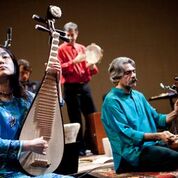
Wu Man with the Silk Road Ensemble |Courtesy photo / Max Whittaker

Wu Man was also a founding artist of Yo-Yo Ma’s Silk Road Project and has performed throughout the United States, Europe, and Asia with the Silk Road Ensemble (SRE). She is a featured artist in the documentary ‘The Music of Strangers: Yo-Yo Ma and the Silk Road Ensemble,’ as well as on the film’s 2017 Grammy Award-winning companion recording, ‘Sing Me home,’ which includes her original composition ‘Green’ (Vincent’s Tune) performed with the vocal ensemble Roomful of Teeth. She has recorded six albums with the group. Her recent performances with SRE include a 2016 tour to summer festivals such as Tanglewood, Wolf Trap, Blossom, Ravinia, and Hollywood Bowl; as well as with Mark Morris Dance in Berkeley and Seattle, and a tour of Asia.

Locally, Wu Man was the Inaugural Artist-in-Residence at The Huntington in 2014 for which she composed a piece called ‘Three Sharing.’ She recalls, “It was meant as a celebration of the relationships among Asian countries. I played the pipa with two of my friends, one playing the Japanese flute shakuhachi and the other the Korean drum janggo. It was such a fun collaboration, we each contributed something to the music.”

Depending on whom you ask, there is the assertion that China has attained world dominance. Even if this weren’t entirely true, we can definitely say that it has a presence on the world stage and people are paying more attention to China.

Wu Man reflects on this, “I have noticed changes since I came to this country 20-some years ago when it seemed that no one knew anything about Asia and Chinese culture. In the past, my audience has been mostly older Chinese who knew about the pipa growing up. Today we are attracting people of different cultures who are open-minded and are willing to know more about China and its ancient musical instruments.

After a performance people usually come up to tell me the pipa sounds like a guitar or a banjo. Every once in a while I hear remarks like ‘it’s like listening to a harp or a ukulele.’ They’ll bring up the various plucked instruments. I observe a greater appreciation for it now.”

It’s also important for Wu Man to educate young Chinese people about their ancient roots. She says, “The younger generation is exposed daily to western culture and music through the Internet and social media. While it’s great that they are embracing others’ way of life, there is the likelihood of them forgetting their ancestry. That’s why tied in with my concert performances, I visit classrooms – all the way from elementary to college level – to talk about Chinese history, music and specifically, the pipa.

Even my performances for adults are usually concerts/informational talks because not everyone knows Chinese ancient musical instruments. So my goal is to make this as familiar as the guitar. It’s such a beautiful instrument and it would be a shame if people didn’t know about it. It has a very rich history and it’s really pretty cool. It’s gratifying for me that recently people have been seeing the pipa in a much better light – they see its many potentials.”

Wu Man tours extensively and has practically visited every continent. She says, “I see different audiences and I get different reactions. Californians are more familiar with Asian culture and they are more receptive to my music. I get a vastly atypical reaction in Japan – the  audience is so quiet I can hear myself breathe. Normally there would be the little noises during a concert like someone moving his chair. But over there the silence is almost reverential. It’s only after the performance I would get a wild applause and hear them exclaim, ‘Wow, that was truly amazing.’ That’s always a wonderful feeling for a performer.”

Wu Man with her pipa | Courtesy photo / Kuan Di Studio

A few years ago Wu Man traveled to China’s remote regions to unearth the country’s ancient musical traditions that are in danger of being lost, and explored the customs of the Huayin Shadow Puppet Band, which was then known as the Zhang Family Band. It comprises farmers from Shaanxi Province’s Huayin County in a rural village at the foot of Mount Hua in northwest China.

For more than 300 years the Huayin Puppet Band has toured the countryside bringing its rugged shadow puppet plays that recall the mythical heroes and gods of the oral folk culture of Shaanxi, often evoking famous battles of the Tang dynasty (618-907), to temples, fairs and rituals.

These shadow puppet plays are accompanied  by ‘old tune’ (laoqiang) traditional music with guttural and high-pitched singing with a rough, mad spirit; percussion, including clappers, cymbals, and gongs; stringed instruments including the yueqin (moon lute) and fiddle; the shawm, a double-reed instrument similar to the oboe; and a natural trumpet.

The shadow puppetry tradition that exists in the village first appeared during the Qing Dynasty under Emperor Qianlong (1736-1796) and has been passed down from generation to generation. For many years the shadow puppetry was part of the Zhang family household only, and not until recently has it had been passed down to performers outside the family.

Wu Man is excited to bring the Huayin Shadow Puppet to The Huntington. This is only the second time she has performed with them in the United States since their first visit in 2009 as the Zhang Family Band.

“The Huayin Shadow Puppet music is very dramatic and earthy, it’s almost like Chinese gypsy music,” declares Wu Man. “Our audience will see that Chinese traditional music isn’t limited to the pipa, ruan, and zheng. I’ve been wanting to share this for a long time.”

In our digital era we tend to move past one new thing speedily to go to the next, lest we get left behind. It would be refreshing to stop hurrying for once and appreciate Wu Man’s effort to bridge the past and present.

For even as we enjoy a world of technological advances, we could still learn a thing or two about the simple pleasures in life from those who occupied this earth thousands of years before our time.
APAC Integrates Students in all its Professional Productions

Originally published on 21 February 2018 in the Pasadena Independent, Arcadia Weekly, and Monrovia Weekly

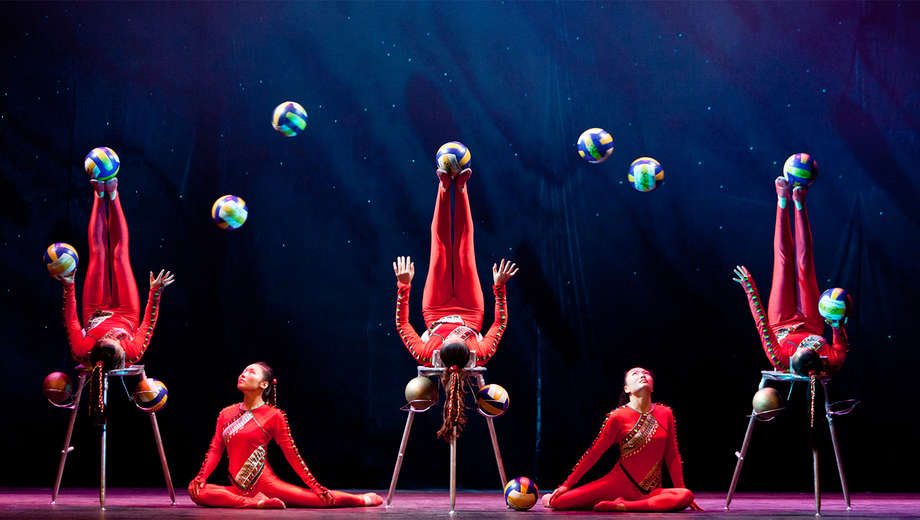
Lunar New Year Production at APAC | Courtesy Photo

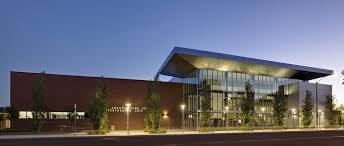
At the northwest end of the Arcadia High School (AHS) campus stands the Arcadia Performing Arts Center (APAC), a 40,000 square-foot venue that was funded by Bond Measure 1 which passed in 2006. The $20 million structure opened in 2012 and the non-profit Arcadia Performing Arts Foundation (APAF) was created to maintain and manage it.

It is the hub for Arcadia High School students who are taking courses in the various art offerings. Any time during the day kids can be seen practicing with their band in the parking lot while another group hangs out at the lobby waiting for their rehearsal to begin.

In the evenings APAC is transformed to host performances by renowned American and international artists. The 2017-2018 season, with its slate of 16 productions, draws an audience that comes to Arcadia from different cities in the San Gabriel Valley.

With its state-of-the-art facilities, APAC is an important cultural destination and is the venue for touring artist concerts, recitals, distinguished speakers, special events, and commercial filming. Booked for 257 days of the year, it is the busiest performing arts center in the area, surpassing even that of the Pasadena Playhouse and the Pasadena Civic Auditorium.

It is also a youth talent incubator that makes great art accessible, a descriptor that Maki Hsieh, APAF’s Executive Director, would like the APAC to live up to in every sense.

Hsieh, who was installed in January 2017, spent her first hundred days in office doing an assessment analysis.  She explains, “I worked from the inside out, meeting with key stakeholders including Arcadia philanthropist Micky Segal, Mayor Peter Amundson, former Mayor Tom Beck, AUSD superintendent David Vannasdall, the PTA president, and every single board member to get their private perspective on how things were going.

Then I met with other community leaders, community partners, guests, and patrons before venturing outward to other people in the industry, like the Association of Performing Art Centers, to see how we compare with them. I spoke with some of our competitors to gauge how we can do better and obtain dominant market share that would, in turn, help us attract donors, funders, and grant makers.

After that 100-day assessment period I decided on what I want APAC to look like as a foundation and determined our place in the region – from the component of the board all the way down to our staff, including their specific titles and compensation structure – by our 10th, 20th, and even 50th anniversary. I presented to the board our vision going forward together with plans for making changes.”

Arcadia Performing Arts Center | Courtesy Photo

When Hsieh speaks with her team she emphasizes the four pillars of a successful organization – people, product, process, and profit. She asserts, “These are not something I made up but came from a quote by Steve Forbes I read a long time ago in the Wall Street Journal. He said there are only three things important in business and those are product, profit, and people. While he made an excellent point, I think he’s got it backwards. I would put people first because they make the product; you have to customize your product around your people. I mean ‘people’ in its broadest sense – your guests, team, board, city, community, and the industry. Then the process has to be solid to have that fulfillment and delivery. The end is the profit and that’s the whole P&L aspect including expenses, operational issues, etc. You can track and calibrate these four components in a very dynamic way in order to succeed. That formula works for any organization from a coffee shop to a major corporation.”

Hsieh’s first year as Executive Director can be defined by the word ‘quality.’ She expounds, “This past year we increased the quality of our product, the front of house, the production understanding, our VIP events. Our VIP hospitality went up 50 percent and ticket sales increased 120 percent within one year. Ticket sales now cover 53 percent of our expenses while the industry average is 38 percent. That says a lot about the team for finding creative ways to cut costs.

We improved the quality of our marketing in the sense that we’re really starting to have a brand. Before we had four shows here and there, almost at random; there was no plan, no story, no infrastructure. Productions cost money to put on so how do you make money when there’s no fundraising or grant program in place? There were so many missing pieces and the quality piece was one of those.

Now we’re showing the community we have a passion for furthering the next generation and the future of the valley. We want to be known as an impact-driven social organization, not just a performance group. We do life-changing work; we’re here to touch every person who comes through our doors.

We’re determined to increase the quality of life of families and children in need. We donate tickets to underserved children so they can come to our shows; we give them raffle tickets to participate so they don’t feel like outsiders.

We’re enhancing the quality of life for seniors. For example there’s a senior center whose residents want to come to our show but they don’t have a driver to take them here every other month. We coordinated with them and offered assistance by providing a driver to drive their vans.

We’re extremely serious about our outreach. Working with Foothill Unity Center, we’re very actively raising awareness on poverty, hunger, and homelessness. We are donating a show to them called Arcadia Poetry Slam on April 8. High school students will compete for prizes.”

Continues Hsieh, “Going into my second year, in addition to quality I want all of us to focus on loyalty. By that I mean high affinity and returning guests. We want our guests to go beyond buying a $10 ticket; we want them to come back and not necessarily for a show. It could be in the form of a donation or support, sponsoring a show for a school.

I spent 80 percent of my time last year on marketing and operations and this year I will devote that time on fundraising, which is tied into loyalty. There’s a large corporation in our town that gives $1,000 for an ad to which they can easily add a couple of zeroes. They were able to do that for an Olympic sponsorship so surely they can invest in our community.

Their donation goes directly to our children. APAC has a $400,000 venue capital need for new microphones, speakers, and lighting which are now falling apart and are put together by duct tape. We also have an Arcadia Children’s Choir which we are ready to launch that gives children an opportunity to perform with a professional orchestra twice a year. And, finally, the school district needs to hire arts teachers from K to 5.

Tied into fundraising is looking for grants which are not easy to get. This year we will be collaborating with Rachel Repko to write grants. With her assistance we will create a grant program that involves getting one gift at a time. We won’t be seeing results right away but we will be increasing perception about the organization until people see that we’re building long-term sustainability.”

Another one of Hsieh’s initiatives is to attract bigger productions. She says, “Our General Manager for Programing and National Sponsors, John Nicholas, headed EMI Sales and Marketing before it was bought out by Universal. He has toured and worked with major artists in the industry including Katy Perry, Pink Floyd, Tears for Fears, and Rolling Stones. He will pitch the idea that APAC is a campus theater, a showcase for students, and serves all the children in the community. He will try to get performers at 50 percent off their price so we can, in turn, offer discounted ticket prices to children. Because he knows the artists, their agents, and managers they will be willing to negotiate with him.”

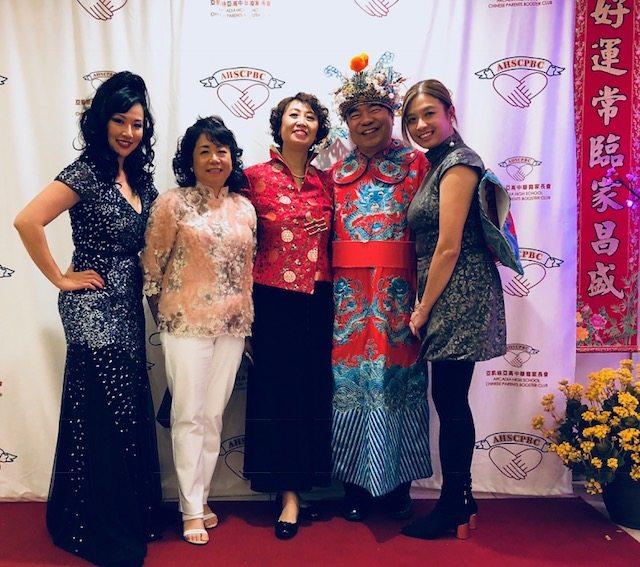
Hsieh (far left) with (L to R) Christine Lee, APAF board member; Connie Liao; Tim Lee; and Jennifer Yang, APAF board member during the Chinese New Year banquet | Courtesy Photo

All of Hsieh’s efforts are focused on offering children and young people a way to express themselves and gain confidence in their talent. She pronounces, “We were recently nominated for the ‘Make Change Award’ because the core of our work is dedicated to children. Helping children develop their artistic talent and perform at world-class level has always been the heartbeat of the foundation. We encourage the inclusion of arts in children’s daily school activities.

Students in the Arcadia Unified School District are integrated in all our shows. They’re an essential part of the production either as interns or volunteers; they work at the front of the house or as crew. Some of our interns are involved in our marketing process helping with concessions, handing out flyers, putting up posters.

We also provide them with a venue where they can showcase their talent. For the Chris Mann Gala Concert, which officially opened our 2017-2018 season, we integrated 165 students including Orchesis, which is the Arcadia High School (AHS) dance group, the AHS marching band, the AHS advanced orchestra, Arcadia Stage. All the resident youth companies of the center came together and performed at the event. For the Beatles Tribute Concert, held last Saturday, February 17, the Longley Way Elementary School Glee Club was featured alongside a professional tribute band.”

This greater involvement of students in the productions held at APAC is Hsieh’s deliberate effort to prove that the arts are fundamental components of a happy and successful school experience. She relates, “Since I came on board I have learned so much about the community. Arcadia has a 60 percent Asian population and parents want their children to focus on math and science. They send kids to ‘cram school’ to prepare for ACTs, SATs, APs and SAT IIs. Counselors at these schools tell their students they should drop their arts classes to make time for studying to get higher GPAs. They make it sound like arts courses are a waste of time which is simply erroneous.

Now all our shows will be opened by students from one particular school. Parents, grandparents, siblings, and friends can enjoy watching students’ accomplishments. Being on a professional production is something students can put on their resume as they build their portfolio for inclusion in their high school transcript. I want for families to recognize that participation in these events advances their children’s prospects for college and beyond.

But more than simply an entry in a college application, the arts occupy a far greater role. I am a firm believer in the positive impact of the arts in children’s development so much so that I have campaigned for the integration of visual and performance art courses in all the elementary schools in our district.

While the ancient Asian perception still carries on today, I am slowly hoping to change people’s minds about the importance and relevance of the arts in children’s lives. And my agenda is to make parents continue their investment in arts courses for their kids. That while they don’t see it now, their investment will yield positive results and change the perspective in our community.

APAC’s slogan is ‘Coming Together’ to highlight how the arts can be the bond that unites families in our community as it is the glue which connects us with other communities. We have strengthened our relationships with other school districts in the San Gabriel Valley.”

There’s so much going on at APAC it’s a hopping place. What’s surprising about that is Hsieh took the helm at APAF not that long ago. But what a change she’s made in that short time.

Maki Hsieh will debut her ‘New Moon’ album at APAC on March 24 | Courtesy Photo

To say that Hsieh is an overachiever is a colossal understatement. At the age of 15 she debuted at the National Recital Hall for Taiwan’s First Lady. She has also performed for Queen Paolo of Belgium. She was classically-trained at Peabody as violinist, concert pianist, and opera singer who performs in 12 languages.

Hsieh attended the Taipei American School where she earned awards in orchestra, choir, theatre, poetry, and the Veterans of Foreign Wars Voice of Democracy Speechwriting Prize. She went on to Phillips Academy Andover and served as concertmaster of two orchestras and received the Andover Music Prize.

From there Hsieh went to Johns Hopkins University and graduated with a degree in pre-med majoring in Sociology. She won the Hopkins Provost Prize for her research on inner-city youth academic achievement and worked for Al Gore as part of her Hopkins fellowship.

Extending her record of stunning achievements to her professional life, Hsieh was responsible for closing over 6.6 billion in sponsorships, investment banking, and new business development during her 20 years in media, entertainment, and finance industries.

Prior to her leadership of APAF, Hsieh was Executive Director for the private equity company JTN Group. She also had extensive experience in executive communications for the Chairman of the Walt Disney Company, institutional advancement as Director of Development at the Gallo Center for the Arts, and asset management for Fortune 500 corporations including Visa and Deutsche Bank.

A consummate performer, Hsieh made a 2013 Skrillex remix which made number one for five weeks on Los Angles, U.S., and global electronic music charts. She has appeared in a Cannes Film Festival film and in over 300 red carpet events, performing arts centers, festivals, and arenas including the Special Olympics World Games, and singing the National Anthem at a Major League Baseball Division Series televised on FOX Sports Network. Fittingly, she will unveil her album ‘New Moon’ on March 24 at APAC.

Hsieh is propelled with a determination to succeed in her role as overseer of this outstanding organization that is equaled only be her desire to prove that the arts are essential to life. Her mission is to make APAC the home of arts and culture in the San Gabriel Valley. And given her fiery spirit, she will undoubtedly make that happen.

Boston Court’s ‘A Streetcar Named Desire’ Speaks to Significant Issue of our Time

Originally published on 13 February 2018 in the Pasadena Independent, Arcadia Weekly, and Monrovia Weekly

‘A Streetcar Named Desire’ is arguably Tennessee Williams’s most celebrated and momentous  work. Originally a play which opened on Broadway in 1947, it has been made into a film, adapted as an opera, ballet, and for television.

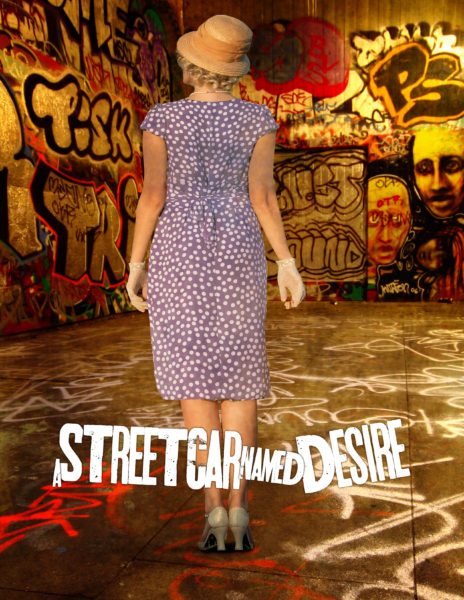
And now Boston Court Performing Arts Center in Pasadena presents a reimagined modern version of ‘A Streetcar Named Desire,’ featuring a multicultural cast and contemporary setting.  Onstage from February 15 to March 25, 2018, it is directed by Co-Artistic Director of Boston Court, Michael Michetti, and stars Jaimi Page as Blanche, Desean Kevin Terry as Stanley, and Maya Lynne Robinson as Stella.

Michetti had a very successful run directing two other plays in Pasadena – ‘Mrs. Warren’s Profession’ at A Noise Within and ‘King Charles III’ at the Pasadena Playhouse – and is aiming for a trifecta with ‘A Streetcar Named Desire’ at his home theatre company.

“I’ve never done any Tennessee Williams before now but I’m a big fan of ‘A Streetcar Named Desire,’” discloses Michetti. “I’m not exaggerating when I say I love it so much that I must have seen a dozen or more productions of it. I’m glad to have a ‘home’ where I can do passion projects.

Interestingly, I’ve been thinking about this play for a couple of years as a response to what I was sensing was happening to our world, before even a Trump presidency was possible. But the current political climate has only made it more timely; all the issues which were bubbling underground a little bit have now come to the surface.

‘A Streetcar Named Desire’ is so thematically rich – different threads stand out depending on how you focus it. Great works like it can be revisited in different eras and political circumstances and reflect current society.”

Michetti’s vision is a wide departure from its classic production as he sets it in the modern day  with diverse actors. Pronounces Juilliard-trained Desean Terry, “It’s going to be a very different take and that’s why I’m really interested in it – Michael’s setting it in contemporary America. Blanche is a remnant of American history, dressed in the costume of the 1940s; she’s the only traditionally cast character and only Caucasian actor amidst an ethnically diverse group in modern clothes. She’s incongruent to the setting. As in the original play, Blanche is a fish out of water and Michael brings more attention to that fact. It’s a very intriguing concept, really.”

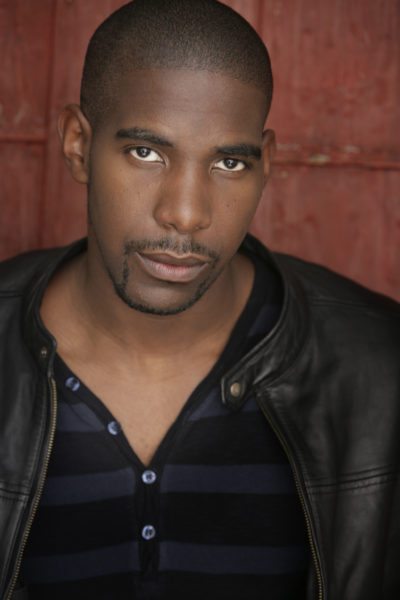
Desean Kevin Terry as Stanley. Courtesy Photo

On assuming the role memorably portrayed  by Marlon Brando in the 1947 play and the 1951 movie, Terry declares, “Fortunately I never saw the original play and I don’t remember much about the film version, which I think I saw when I was quite young. I don’t know what Marlon Brando did and I think that works to my advantage. I can try to recreate the character as I see the circumstances in the play and in response to our particular production. I will definitely honor the text in the way that it described Stanley.”

“To be honest, I’m a bit freaked out to be playing the role that Marlon Brando immortalized,” confesses Terry. “Well, actually I didn’t think about it until after I got the part when I told myself ‘What are you doing, Desean? Now you’re pitting yourself against an icon.’ However, Michael didn’t have a set idea of what Stanley should be like so it’s been a discovery process for both of us; we’re continually working on each role as part of the whole play.”

“We’re illuminating the love between Stella and Stanley which I think got shortchanged,” expounds Terry. “In this play we’re developing that relationship more, creating a healthy dynamic between them as much as we can with the play which has incidents of domestic violence. It’s pretty challenging what we’re trying to accomplish. I hope our interpretation of the play gives our audience a fresh appreciation for it.

“For me, personally, I hope they see a more human version of Stanley. If people respond to that I would feel pretty good. I’ve been in plays that speak to race relations and I enjoy the opportunity to effect change,” Terry concludes.

Michetti adds, “The primary impetus for this production was the discovery of the important themes of class, gender, and race that Williams touched on when he wrote it. Among them is how Blanche comes from a world with social privileges that even then, when the play was first produced, were no longer pertinent. Belle Reve, where Blanche grew up, was a big old house that came with a great deal of history but it was not a working plantation even in the 1940s. She was trying to hold onto an expectation about a way of the past that’s slipping away.

Even then Williams was exploring the changing demographics – there were more immigrants, people of different backgrounds. Many people were having trouble accepting that shift. It was something inherent in Blanche’s relationship with others.

By setting this production in contemporary urban environment populated with people of color and dropping in a Blanche, a white woman from the 1940s in that period’s clothes, hairstyle, and behavior, we emphasize to an even greater degree how much she is a relic of the past, unable to accept the world and move on. It was a contrast that Williams had intended and which I am visually amplifying.”

Director Michael Michetti. Courtesy Photo

“It’s tricky because the play is so complex, it cannot be boiled down to single issues,” continues Michetti. “Within this treatment Blanche represents, in many ways, the loss of equilibrium that many white people are feeling. I want to deeply explore the flaw in her inability or trouble in accepting that the demographics of the world are changing. That said, any imbalance is uncomfortable. This was true then as it is today and is something we need to recognize. We’ll heal better by embracing and acknowledging it instead of avoiding or ignoring it.

White people should not keep trying to hold onto our privilege. The truth is, there is a cluelessness among us whites and we all need to be awakened. At the same time there is a real sense of loss that we should also be empathetic to.”

“However, I will not impose my morals on my audience – I want this play to reflect humanity and let people make up their mind about it,” says Michetti . “I think everyone is going to experience it through a different lens and see different things in it. There’s certainly an idea of investigating this divisiveness we have in our country right now and what that means. The beauty of this play is that all the characters are flawed people but also people we could be empathetic to. While I don’t think we will ever heal the divisions in our country we can show compassion to one another.

There are systemic problems we haven’t quite tackled but the beauty of theatre is that if you can do it well it’s an opportunity to explore these things through living, breathing humans, which touch not only our minds but our hearts. I think our minds are more successfully changed when our hearts are also changed.”

Michetti pronounces, “I’m very grateful to be doing for a living something that I love and am excited about. But more importantly, I’m always trying to discover what’s meaningful to me, to continue growing and reinventing myself. I’m in a period in my life when one of the most powerful things I can do is to help address vital issues in our time with an authentic sense of social justice focus. I think we have a great potential as a nation and a culture to be much better than we are. I want to genuinely fulfill the promise that our forefather said that all men are created equal.”

Through ‘A Streetcar Named Desire’ Michetti proves that his projects are not merely works of art but agencies of change as well. That is the true transformative power of theatre.

‘Henry V’ at a Noise Within Stars Pasadena-area Native

Originally published on 6 February 2018 in the Pasadena Independent, Arcadia Weekly, and Monrovia Weekly

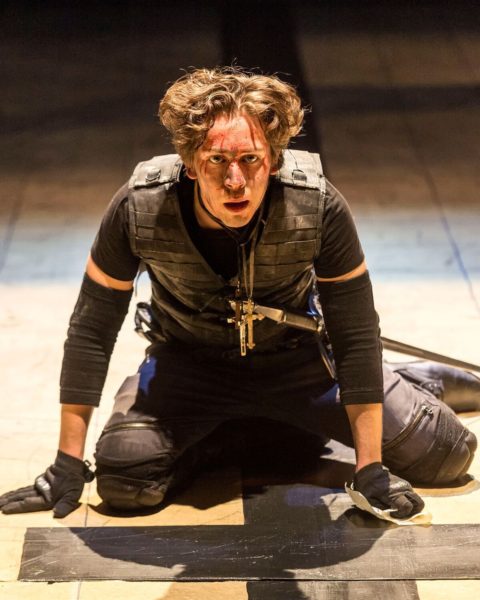
Rafael Goldstein as Henry V. | Photo by Craig Schwartz

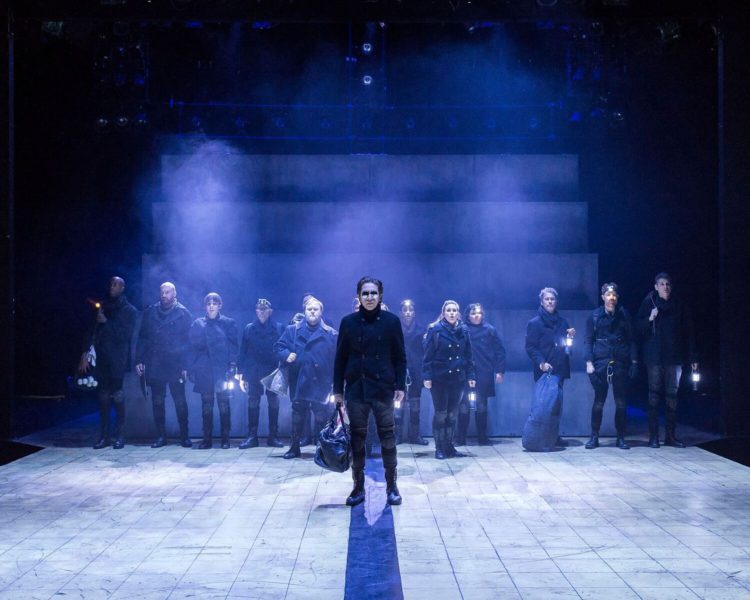
William Shakespeare’s ‘Henry V’ goes on stage at A Noise Within (ANW), the acclaimed repertory theatre company, from February 4 to April 6, 2018. Co-directed by Geoff Elliott and Julia Rodriguez-Elliott, it focuses on the Battles of Harfleur and Agincourt and has been streamlined into a dynamic thrill ride infused with modern relevance.

“‘Henry V’ is a play about going to war, and the propulsive energy that leads to conflict,” declares Elliott. “We’ve zeroed in on the conflict between Henry and France, and captured the unifying, almost euphoric energy that comes with having a shared enemy. While the play is not explicitly for or against war, it does provide an in-depth look at the politics of war and our thirst for conflict. Ours is a very physical, visceral production: we have three fight choreographers and a live percussionist. Expect a fast, furious, and ferocious evening.”

At the center of the intense action is ANW resident artist, Rafael Goldstein, who assumes the title role. He states, “When I found out I was going to be playing Henry I started training – running four or five miles a day – and eating better to get in shape. We spent hours staging the battles. Our fight choreographer, Ken Merckx, and a couple of his assistants  have done a fantastic job of putting this together. It’s edge-of-your seat excitement and really bloody action. It’s a spectacle not to be missed.”

Shakespeare’s history play tells the story of King Henry V of England and takes place during the Hundred Years War. ANW’s iteration of it, however, does not specify an era. States Goldstein,  “It’s a timeless tale set in a timeless way. Men’s need for conflict and war never goes out of style. When you’re working with a story this malleable and universal you could pretty much do whatever you want with it and the strength of the story would stand up.

This particular production happens in a ritualistic arena where this group of people comes together to tell a story about humanity’s need for conflict. They use Shakespeare’s words and plot to tell this very human story but it isn’t set in 1415 on a battlefield with knights in armor. It’s a modern version of what warfare looks like and what it does to people. While we’ll be sporting contemporary clothes, we’ll still be wielding swords. And we’ll be wearing crowns so the audience can tell who’s the king, the prince, the princess, and so on.”

Henry V ensemble | Photo by Craig Schwartz / A Noise Within

Ever the professional, Goldstein prepares for his performances seriously. He declares, “No matter what show it is and what role I play, I go over the script two or three times a day. And during the lead-up to rehearsals when we get ‘off-book’ I try to have all my lines memorized before the first run-through so when I get into the room with all the other actors, I can communicate with them and not have to look down at the script.

Memorizing, especially Shakespeare, is a joy. The language is so rich and the characterizations are so clear. He gives you so many clues as to how to read and understand it that it becomes a familiar song, a part of who you are.”

This talented and prolific actor hails from the Pasadena area and his involvement with ANW goes way back. Goldstein discloses, “I was born and raised at the base of these mountains, in Altadena. I went to St. Andrew Catholic School on Raymond Avenue in Pasadena. And then I went to the Los Angeles County High School for the Arts (LACHSA).

Actually, the summer before I went to LACHSA, I took the Summer with Shakespeare program at A Noise Within when it was still in Glendale to give me a leg up and little bit more training under my belt before I head into this conservatory-style setting. That fall, ANW contacted me and asked if I wanted to be in their production of Macbeth. So I worked on high school stage productions and professionally with ANW all through high school.

I attended New York University’s (NYU) Tisch School of the Arts and stayed in New York for a while. When I moved back here in 2011, I rekindled my association with ANW. So not only did I come back to my birth home but to what has become my stage home as well. They cast me in Antony and Cleopatra as Eros, a wonderful little role as Antony’s servant on the battlefield. When Antony realizes that all is lost he asks Eros to kill him. Rather than kill Antony, Eros kills himself instead.

In my many years at ANW, I have played key characters. I had a principal role last season in Tom Stoppard’s ‘Arcadia,’ which was an ensemble piece. I’ve also played title roles before but never in a venue like this; it’s challenging in a nice way. One of the obstacles is thinking of Henry as a lead role because even though the world of the play hinges on his experience, that world is still very much alive and independent of him. There are so many things that he can’t control in this world. He causes a lot to happen but things happen to him as well.

Being in a titular role, I do feel a certain amount of responsibility for ensuring our play is well received and resonates with our audience. That’s why I have been preparing for as long as I have and as assiduously as I possibly can. But, like Henry, I can’t take all the credit because there are so many moving parts and aspects to this play. It really does take a village to raise a mountain of a play and incredibly long hours of hard work that goes into the production that the audience will eventually see.”

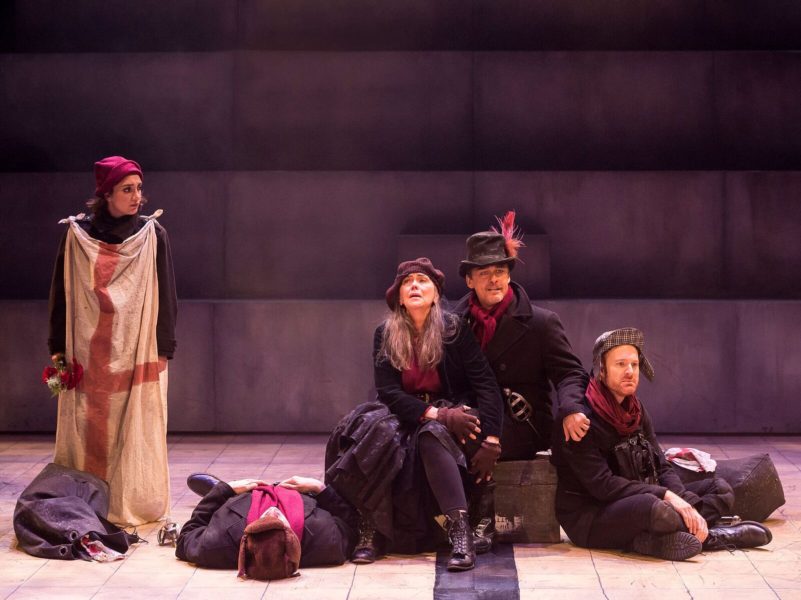
Henry V cast (left to right): Erika Soto as Boy; Jeremy Rabb as Bardolph (supine); Deborah Strang as Mistress Quickly; Frederick Stuart as Pistol; and Kasey Mahaffy as Nym | Photo by Craig Schwartz

I have worked in other theatre companies like Theatre Forty and Sacred Fools, and a part-time job at Pasadena Playhouse, but ANW is my home base. ANW and doing theatre are vital to my life; they’re essential to who I am. My poor wife sees me maybe one day a week but that’s the life of an actor – it’s hard and grueling. It’s not always rewarding in the way you would like it to be, you hear the word ‘no’ more than ‘yes.’ But when you do have a job and you’re doing a play that feeds your soul, you couldn’t ask for anything more – it’s the fulfillment of a passion. You give something of yourself to your audience as they watch you on stage. There is a symbiotic relationship between the actor and the audience, a true communion.

Other professional pursuits keep Goldstein busier still. He says, “I do voicing for video games, standing in a dark room screaming into the microphone. I’m also involved in film-making with a friend who has started a small company. Right now he’s doing mostly music videos and we shot one wild little film recently at Joshua Tree. We have plans to put together some shorts and features, going through the fund-raising phase, pitching the idea for possible funding. I’ve been in a number of short films as well and one TV spot on Investigation Discovery Chanel.”

“Theatre is my first love though,” Goldstein hastens to add. “It has been since I first went on stage at the age of three and played one of the sons of Adam and Eve in a little play at a Unitarian Church about the creation of the world. I remember I had one line and the audience laughed. I was hooked.

If that weren’t enough motivation for me, my father is an English professor who would bring home plays for us to read aloud. My mother, my sisters, and I would divide the parts and we’d talk about it after. We’d read Eugene O’Neill, Shakespeare, Neil Simon, any author he was doing a unit on at the time.

My mother is a psychologist who would talk to me about people and human behavior and thought. I never had a chance: I was always going to be an actor. So for as long as I still have all my hair and teeth, I’ll be on stage somewhere many years from now telling stories and, hopefully telling them well.”

While Goldstein’s little three-year-old self couldn’t have foretold that he would be playing incredibly memorable roles in numerous acting projects at age 30, empirical evidence suggests he has been honing his skills for ever more significant performances.

‘Henry V’ may be Rafael Goldstein’s star vehicle but it’s only the beginning of his journey. His career’s ascent may not be akin to a fast, furious, and ferocious evening of ‘Henry V’ on stage but it will be steady, strong, and superlative. And that would be a far more thrilling ride.

Frolic with the ‘Pirates of Penzance’ at The Pasadena Playhouse

Originally published on 16 January 2018 at the Pasadena Independent, Arcadia Weekly, and Monrovia Weekly

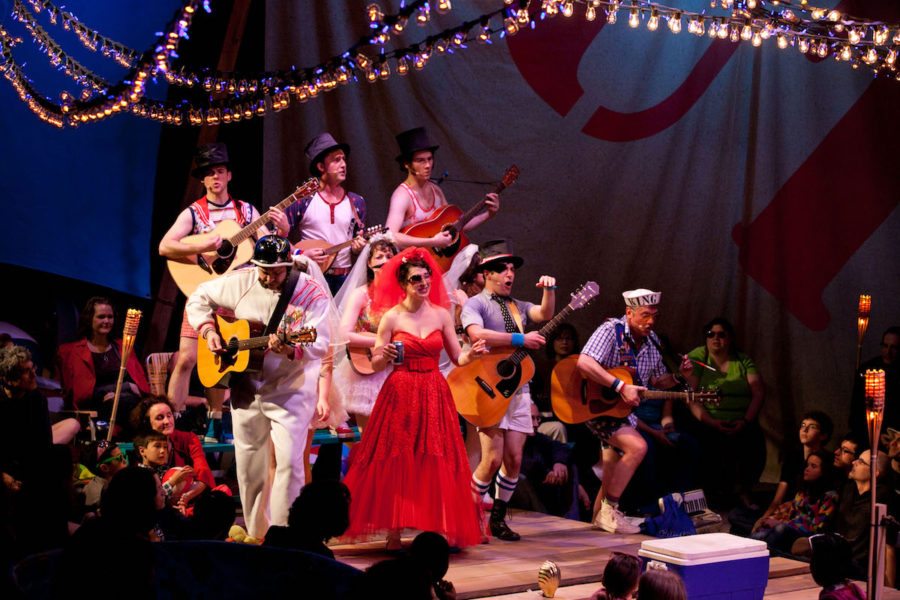
The Hypocrites’ “Pirates of Penzance” at Arizona Repertory Theatre | Courtesy photo / The Hypocrites

When have you ever been to the Pasadena Playhouse to enjoy a romp on the beach? In the venerable theatre’s 100 years of existence its stage has never been converted into a seashore … until now.

From January 23 to February 18, ‘Pirates of Penzance’ by The Hypocrites, fresh from its successful New York run, will be playing at the Playhouse. The production is adapted and directed by Hypocrites Artistic Director Sean Graney; co-adapted by Kevin O’Donnell and with music direction by Andra Velis Simon.

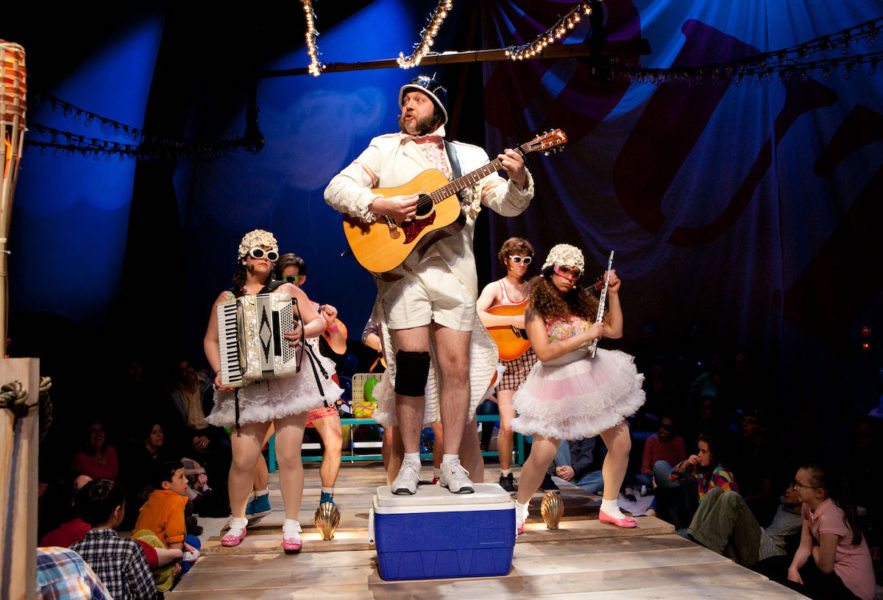
Ten actors will perform the Gilbert and Sullivan classic with a zany twist while staying true to its original spirit. The Playhouse will be venue for the wackiest beach party imaginable, complete with flying beach balls, rubber duckies, ukuleles, banjos, plastic swimming pools, and a tiki bar.

In a re-envisioned Playhouse, all the orchestra seats will be removed and in its place a deck will be built. The entire theatre will turn into a playing area with actors and audience sharing the space to create a fun, magical evening of theatre.

Graney says , “I remember listening to ‘Pirates of Penzance’ the first time and thinking how brilliant it was. It is joyful, playful and welcoming, which was a perfect place to start to remove the walls between actors and audience and get rid of the pretense of theatre. It has proven very successful for us. We first performed it in 2010 and we’re still doing it eight years later.”

Founded 20 years ago by Graney, The Hypocrites is currently run by Graney and Executive Director Kelli Strickland. One of Chicago’s premier off-Loop theater companies, it specializes in bold productions that challenge preconceptions and redefining the role of the audience. Its reputation in Chicago is that of a company that creates exciting, surprising, and deeply engaging theatre as it re-interprets classics and tackles ambitious new works.

“I went to college in Boston, Massachusetts to study acting,” Graney relates. “I was fortunate enough to have a professor who told me I was a bad actor so I searched for other venues within theatre and I ended up writing and directing. After graduation I moved to Chicago with two college friends and together we decided to form a theatre company. There are so many of them in Chicago and if you have a name that stood out, it would give you a certain advantage. Everyone had an adjective or noun theatre company so I thought we should just come up with a band’s name.

‘Hypocrites’ is a theatrical word derived from the Greek ‘hupokrites’ which means ‘actor’ or ‘pretender.’ But also, our events are an amalgamation of a lot of different aesthetic styles which cannot necessarily be pinned down because they’re contradictory at times – like mixing tragedy and comedy in the same show. It’s the general feeling that there are opposing aspects in human nature and, in essence, we’re all hypocrites.

And so in 1997 we put on our first show from a whopping $250 funding we were able to raise. The gentlemen I started The Hypocrites with left and moved on to other things after a while. I stayed on and found other like-minded artists and friends to continue what I had started.”

In the period since, the company has seen several changes. Says Graney, “We started small in the beginning with two shows and as we grew we added more productions to our season. There were years when we were able to do as many as 11 shows and then at times we did only two. This season we’ll have five shows from September to July.

The Hypocrites’ “Pirates of Penzance” at Arizona Repertory Theatre. – Courtesy photo / The Hypocrites

When we began mounting Gilbert and Sullivan productions we were touring as well as maintaining in-town programming and the institution grew fairly large. Then last year we hit a financial roadblock and so we re-evaluated the financial side of the organization and how we would go about producing. Demand is also a factor in the number of shows we do per season.”

Graney reveals the rationale behind their shows, “We wanted to find musicals which were in the public domain so we could develop a relationship with them instead of being held to copyright laws. ‘Pirates’ came about for a specific need – we could adapt it to fit our group and audiences.”

The adaptation process doesn’t take too long according to Graney, “I do a version of the libretto in a couple of days and then I give it to my musical director who will break the orchestration down to mostly chord charts for the guitars. We keep the melodies and vocals the same but we’ll figure out how to support the vocals with stringed instruments. We’ll pick which part would have the flute and where we could put the clarinet. Once we have that together, we get it to performers’ hands. We do a couple of workshops and make adjustments from there. Even now we tweak it each time we rehearse – we make changes to the script to make the jokes more clear, or make the sound better. We’re still improving on it.

We have produced other Gilbert and Sullivan shows, including ‘Mikado’ and ‘HMS Pinafore’ but it was ‘Pirates of Penzance’ we’ve done the most because it aptly suits The Hypocrites make-up. A group of 20 actors plays the various roles in ‘Pirates’ and each time we go on tour we figure out which is the best combination of performers. It’s an hour and 20 minutes, written to be done by ten actors who can play their own instruments so there’s no orchestra.

‘Pirates’ was adapted to be mostly string instruments like the guitar, banjo, violin, mandolin, ukulele, accordion. The audience gets to roam around the stage with the actors and there’s an open bar. It’s a fun event where performers and audience occupy the same space in a joyous occasion.

We premiered ‘Pirates of Penzance’ in Chicago in 2010 in the middle of winter in a basement theatre. It was exciting for the audience to be able to leave the blizzard and snow to have a good time for an hour or two. Several theatres have shown interest in it since and we’ve toured it in Boston, Louisville, New York, and now Pasadena.

From here, ‘Pirates’ will tour Berkeley and then in the summer we’ll be in Maryland, between DC and Baltimore, in The Olney Theatre. No matter what city we played in, we’ve been lucky to have audiences enjoy the show and I hope Pasadenans will react to it with the same enjoyment and pleasure.”

The Hypocrites’s ‘Pirates of Penzance’ is nothing like what we have ever seen at the Playhouse. But there is no better venue where Graney and his band of ‘pretenders’ can infuse their brand of theatre nor will they find a more appreciative audience than in Pasadena. We will happily mingle with pirates, sip mai tais, and frolic on the beach any day.

CSArts-SGV Production of ‘Pippin’ at Arcadia Performing Arts Center

Originally published on 2 January 2018 in the Pasadena Independent, Arcadia Weekly, and Monrovia Weekly

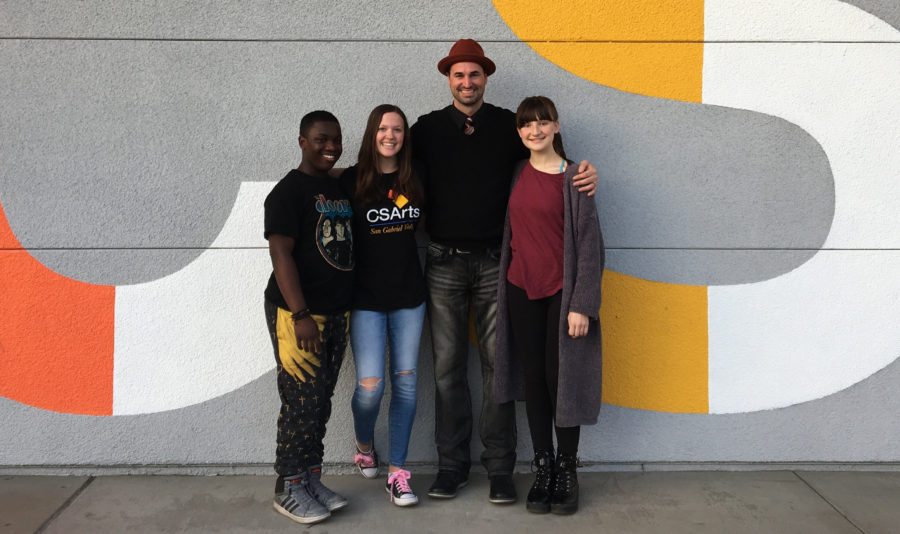
Jay Wallace (third from left) is shown with (left to right) Christian Dorey, Jessie Ellico Franks, and Lily Annino | Courtesy Photo

Pioneering students at California School of the Arts-San Gabriel Valley (CSArts-SGV) will display what they’ve learned, as well as their natural talents, when they present an all-school performance of the celebrated musical ‘Pippin’ at the Arcadia Performing Arts Center on January 11 to 13, 2018.

Filled with dance, humor, and soaring songs by Stephen Schwartz (‘Corner of the Sky’, ‘Magic Do’, and ‘Glory’), ‘Pippin’ tells the story of a young person’s journey to find his place in the world. This original production is set with a unique and imaginative steampunk aesthetic, offering a relevant edge and visceral quality that will leave the audience questioning what it truly means to be extraordinary.

Erik Altemus, an OCSA (CSArts-SGV’s sister school) alumnus who was an original cast member of the 2013 Tony Award-winning Broadway revival of ‘Pippin’, came on campus during a master class and rehearsals leading up to the show.

It was a significant occasion for all the conservatory students who had the opportunity to hear Altemus speak about his experience auditioning for parts and how he finally realized his passion for the performance arts.

One student for whom Altemus’s words hit home was Christian Dorey, a ninth grader from Covina, who has the role of the leading player. He says, “Back in August when the show was announced during a CSArts-SGV growth retreat, I felt a spark within me. I was quite excited and decided that I wanted to be part of this show.  To set myself apart from the other talented people who were also trying out for the same part as I, I practiced my audition song for quite a while – I made sure I was conveying the spirit of the song and staying in the right key.

It was a lucky coincidence that I sang ‘Corner of the Sky’ for a musical revue in middle school.  I already knew the story of ‘Pippin’ and its characters, so I felt I already knew the essence of the characters. I also did my research and for my audition I chose the song from a another show choreographed by Bob Fosse.”

“Students went through a separate dancing and singing audition for an amazing casting panel. I chose to do the movement/dance audition first and it was to the opening number of the show, ‘Magic to do’. When I went to the song audition, I sang 16 bars of ‘Willkommen’ from ‘Cabaret’. I got a callback for the role of leading player and all potential candidates sang 16 bars of ‘Simple Joys’. The next day, the cast list was posted and I got an email that I had been chosen for the role I had been hoping for,” states an ecstatic Dorey.

Sierra Madre resident and ninth grader, Jessie Ellico Franks, is playing a starring role in this musical. She echoes  what Dorey says, “It was a very well executed process that began with a vocal and dance audition which then moved onto callbacks. They had us read sides for certain characters and, if needed, sing a song from the show. It was nerve-wracking of a good kind and an easy process at the same time.

To prepare for the audition, I searched through repertoire books to see if there was a song that fit a character from the show I was interested in and one that was suitable and showed my voice range and acting abilities. For the dance call, I made sure I was warmed up and calm. And I made sure I had a water bottle with me!”

The choice of ‘Pippin’ came about intentionally. Explains Jay Wallace, CSArts-SGV’s Chair of Theatre, “Selecting the inaugural musical for our school was quite the deliberation. There were many considerations. We certainly wanted to mount a production that would set us apart from many traditional high schools. But, we needed to make sure that the show would be accessible to our student body, as well as accommodating to our current talent pool.

I wanted something with a bit of flare and energy. And something with an undercurrent of substance and carries a level of relevance. ‘Pippin’ provides so many creative opportunities. To a certain extent, it is a blank canvas. This show allows us to craft our own unique impression and perspective of the universal story of the search for one’s voice and purpose in life.

‘Pippin’ also allowed us the chance to provide multiple performance opportunities for singers, dancers, and actors. It is truly an ensemble production and that was an important priority. I was not looking for a star vehicle for our first production.”

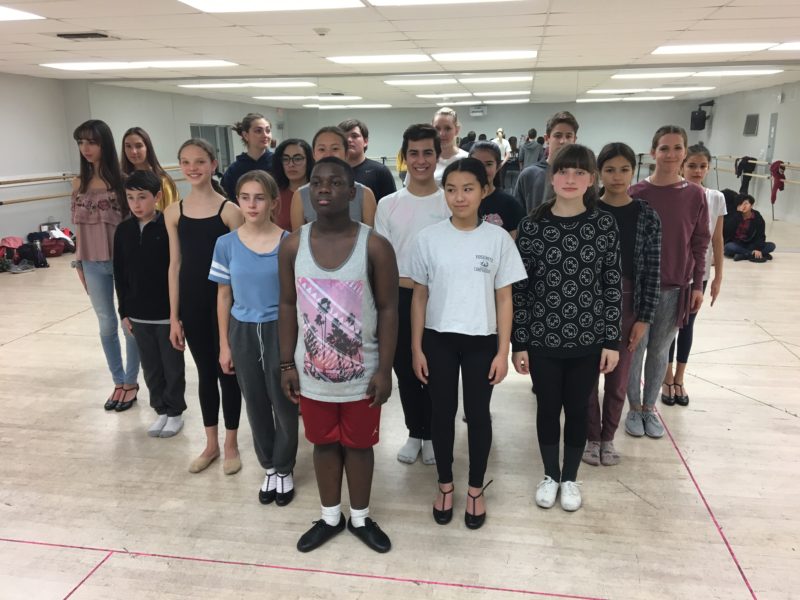
CSArts-SGV students in formation during “Pippin” rehearsal | Courtesy Photo

This reasoning is a reflection of the school’s mission. Wallace states, “As Chair of Theatre, I lead the Acting and Musical Theatre Conservatories. Collectively, we are an ensemble of creative, empathetic, and collaborative storytellers growing together as artists and individuals.  Empowered through musical expression and dynamic storytelling, our collaborative and goal-oriented performers will excel as professionals on stage and screen and impact society as innovative, passionate leaders. Culture is the highest priority and provides a challenging but nurturing environment for students to find their creative voice, build self-confidence, and develop into exceptional performers.”

Accomplishing its lofty objective requires a daily regimen for its students to adhere to – a full  day of academic courses followed by two Conservatory courses. Acting and Musical Theatre students take four courses in their field of study per semester. They are also enrolled in year-round Acting Technique classes. Musical Theatre students attend a year-round Musical Theatre Repertoire and Technique course.

Additionally, there are classes that provide diverse opportunities for students to explore and develop specific skill sets. They get the chance to work with high echelon Master Artists who visit CSArts-SGV conservatories to inspire the next generation of artists. Students involved in a main-stage performance rehearse each evening until 8:30. A typical rehearsal production process lasts six to eight weeks that culminates in a presentation of their work for audiences.

This combination of a disciplined artistic program and rigorous academic schedule necessitates a balancing act for students. As Franks explains, “Quite a few people who aren’t aware of how conservatory-type schools work have asked me how I do it. And my answer is ‘motivation.’  If I don’t do well academically, I will not be able to take part in events that involve my art within my school. I am for my art, so I want to be a part of it as much as I possibly can.

I would like to attend a college in the future and high grades will help in that goal. So that motivates me to get my work done on time, to make sure it is executed in a way that shows my knowledge of the subject, and the end-product is something I am proud of.”

“My hope is that this school betters me both as a performer and a human being. The classes I am taking have already taught me so much about my craft – some information might have been things I had already learned but some are completely new – and I want to keep learning more!

So far this school is a dream come true for me. And while there are a few things which could be better, one has to make allowances for the fact that it is a brand-new school and it needs time to hit its stride. I hope good things are yet to come. But as long as I leave senior year proud of the work I produced and the performer I have become, I’ll be as happy as a dog with a bone!,” Franks concludes.

Dorey offers another aspect to the CSArts-SGV experience, “The teachers are extremely understanding of our busy schedules. They recognize the extent of my involvement not only in my conservatory classes but also in the musical production and in the performing group, FUSION. They have given me extended times to turn in and finish assignments.

I am very happy with what I have accomplished, so far. I have the most amazing teachers who are focused on what we are doing and who see our passion. They realize that this is what we want to do. But I’m still awestruck  at the amount of time into what they’re doing with us. They truly want to not only make us into the best performers but the best people we can be.”

“There is a big emphasis on acceptance at CSArts-SGV,” Dorey says further. “The thing I love is that they don’t pick favorites here. All of us are treated equally as people and as performers. It is an environment that allows us to find ourselves.”

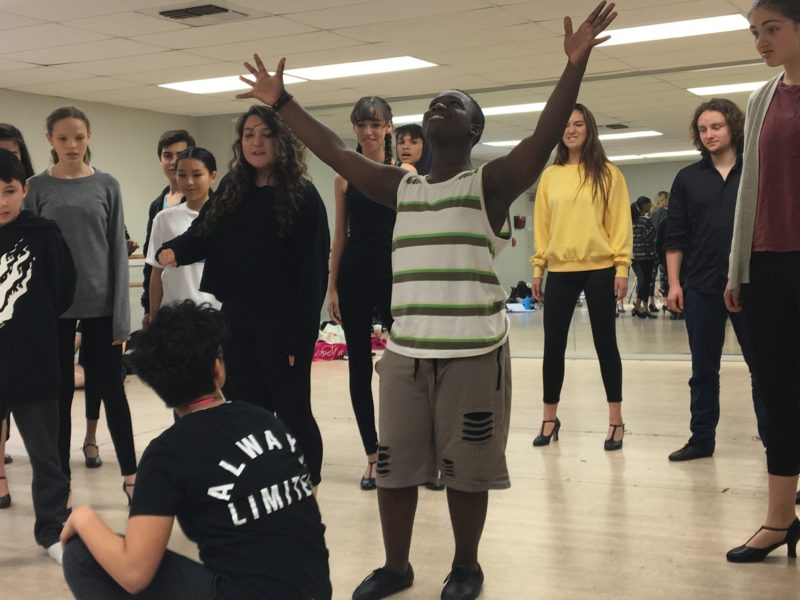
Christian Dorey, leading player, during rehearsal | Courtesy Photo

Lily Annino, an 11th grader from Arcadia, is a Musical Theatre student and assistant to the creative team. She has learned how to navigate this world, “I utilize office hours – 30 minutes between academic and conservatory hours – a lot. Sometimes I use my lunch time to finish work.  I make sure to get all homework done the evening it’s assigned so I don’t have to worry about it on a day with different blocks.”

“I like what I’ve seen and done at CSArts-SGV,” appraises Annino. “There are so many very hard-working, professional students who are determined to make their experiences at this school matter. I expect that I will leave school fully prepared to audition for professional theatre companies and productions. And in the long run, help me grow into a well-rounded and professional individual.”

It certainly looks like Annino has already made a positive impact. Wallace describes her as “offering ideas, dictating notes, and generally bringing a wonderful spirit to the room.”

That is quite a validation coming from Wallace, who has spent the past 12 years working alongside the directors of the Orange County School of the Arts (OCSA) Acting and Musical Theatre Conservatories. Widely recognized as a leading school for the arts, whose alumni have gone on to achieve great fame on Broadway, television and in films, OCSA opened a sister school in the San Gabriel Valley to give the same opportunities to students in the region who are passionate in the arts.

“OCSA provides an excellent foundational model to align our programs after,” Wallace declares. “We share similarities in relation to curricular offerings. Each Conservatory proffers a comprehensive and progressive program designed to provide training in the specific areas of focus related to either Musical Theatre of Acting. We are looking to produce versatile, balanced, and informed young artists in these two fields of interest.

However, we are also striving to create our own CSArts-SGV Musical Theatre and Acting Conservatory identities. This will be crafted through our cultural approach as well as our production selections.

Through our production of ‘Pippin,’ we are establishing our own specific aesthetic by looking at the story stylistically through the lens of Steampunk. Our inaugural Acting Conservatory show was ‘The Yellow Boat,’ a powerful, dramatic piece based on a true story that carries a message with significant social impact.

It’s important to me that we create a healthy balance between entertainment and content that is socially aware. Likewise, it’s imperative that students are exposed to a wide variety of styles, genres, playwrights, and composers.”

The school location also provides a different atmosphere. States Wallace, “OCSA’s campus is in a much more urban environment. There is also a bit more sophistication due to longevity. CSArts-SGV’s locale tends to be a bit edgier and energetic while having a more traditional campus setting. Both campuses thrive off passion for the arts and a desire to achieve excellence. As our conservatories evolve, the sophistication will take hold.”

Wallace asserts, “We expect our Musical Theatre and Acting Conservatory students to be their best each day. We are an ensemble growing together as artists and individuals. We must always be prepared, be willing to take risks in our work, support one another, and value each opportunity. This is just the beginning of the journey. But, I look forward to seeing every one of  these young artists to achieve their true potential.”

Those confident words are a source of inspiration for Annino, Dorsey, and Franks. They are an assurance that through their individual hard work and concerted efforts they will one day realize their dreams.  Aspiring to greatness is, after all, what compels everyone to do their best.

‘Beauty and the Beast – A Christmas Rose’: A Lythgoe Family Panto at Pasadena Civic Auditorium

Originally published on 13 December 2017 in the Pasadena Independent, Arcadia Weekly, and Monrovia Weekly

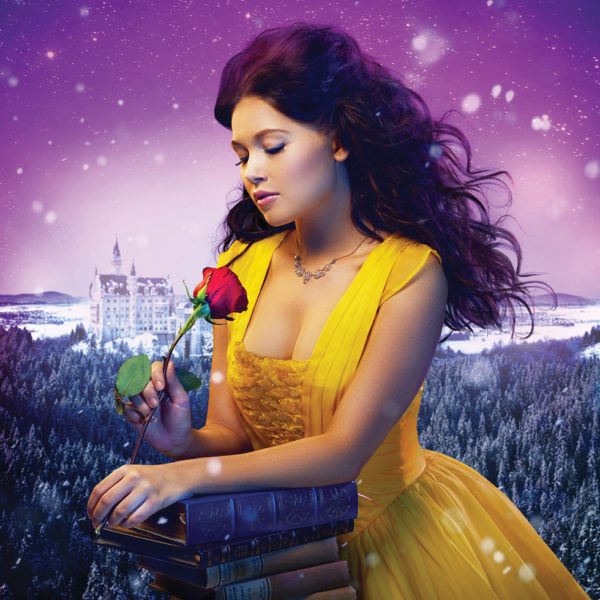
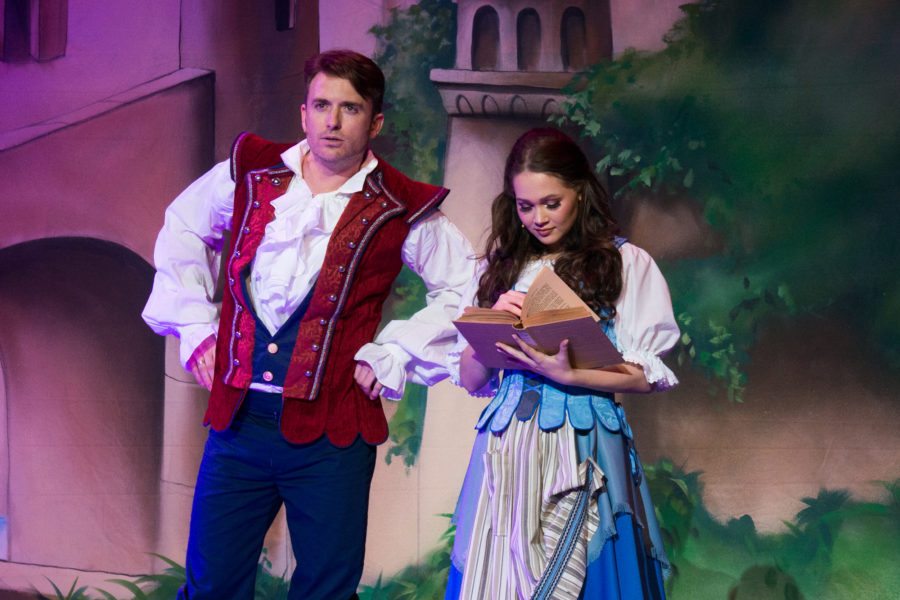
Kelli Berglund as Belle | Photo by F. Scott Schafer | Art direction by Melchior Lamy.

There’s dancing, singing, magic, and comedy, with audience interaction mixed in. It’s ‘Beauty and the Beast – a Christmas Rose’ and it’s happening at the Pasadena Civic Auditorium.

Lythgoe Family Panto (LFP), in association with the Pasadena Playhouse, presents the world premiere of an updated version of this classic fairy tale in the style of the time-honored British family Panto from December 13 to 24, 2017.

‘Beauty and the Beast – A Christmas Rose’ stars Kelli Berglund (Disney XD’s ‘Lab Rats’) as Belle; Jonah Platt (Broadway’s ‘Wicked’) as the Beast; James Snyder (Broadway’s ‘If/Then’) as Gus; Gedde Watanabe (Broadway’s ‘Pacific Overtures’ and John Hughes’s ‘Sixteen Candles’) as Marcel; Harrison White (Broadway’s ‘The Lion King’) as Dame Chanel; John Tartaglia (Broadway’s ‘Shrek, The Musical’) as Louis Vuitton; and Jared Gertner (Broadway’s ‘The Book of Mormon’) as Pierre.

James Snyder and Kelli Berglund | Photo by Philicia Endelman / Lythgoe Family Panto

This production is directed by Sheldon Epps and choreographed by Mandy Moore (La La Land), with book by Kris Lythgoe and music direction and arrangements by Michael Orland (American Idol).

With the casting of Kelli Berglund, the Lythgoes continue their tradition of featuring breakout young talent. Their past Panto performances at the Playhouse featured notables including Ariana Grande and Jordan Fisher, who recently starred in ‘Hamilton’ on Broadway.

Berglund, understandably, is immensely delighted.  She states, “Belle has always been a favorite of mine.  What I love about fairy tale princesses is that they all have a reputation for showing strength and will to overcome the greatest of odds. I think Belle’s story is unique, and perhaps one of the best examples of how defiance and authenticity from the heart can work together.”

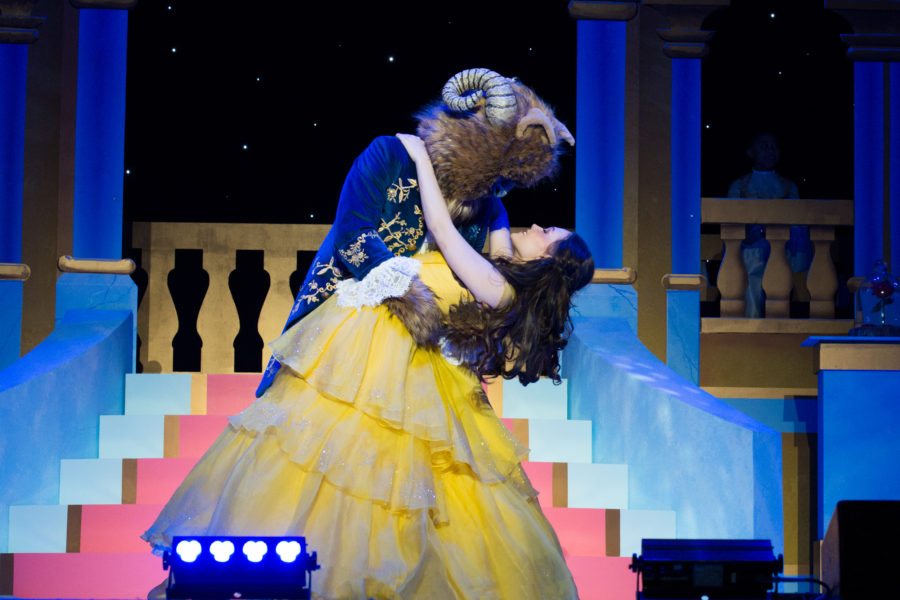
“There’s nothing wrong with wanting to find true love,” explains Berglund. “It’s one of her dreams. And wouldn’t we all desire that? However, her relationship with the Beast is one that no other princess encounters. He’s not the knight in shining armor nor the man with the greased hair and a perfect smile.

There’s a storyline, connection, and even tension that’s more than skin deep … which shows that Belle truly looks at others from the inside out. Maybe it’s her fantastic grasp on the feelings that come from both her head and her heart.  It’s real.

Playing this character who is familiar and beloved not only by children, but adults as well, was intimidating and challenging as it was fun. She is, after all, a big character to live up to! With the pressure to portray her in the best way possible, there has to come a lightheartedness throughout the entire process. In the end, it’s still a fairytale and still a show to put a smile on people’s faces. And, hopefully, a smile on mine, too.”

While Berglund’s background is mostly television, she is not entirely on strange territory. She discloses, “I did a bit of stage musicals when I was younger. To be totally honest, though, it’s been a while. But what’s interesting is that all the elements that go into something like this – acting, dancing, singing – I’m extremely familiar with and have a love for.”

Berglund wonders out loud, “I’ve asked myself why I haven’t done more stage work, and I think it’s because film and television are where my path has taken me, thus far. I did choir all throughout my school years and have worked with several voice coaches on various projects that involved a bit of singing.

Working with the musical director on this production, Michael Orland, has helped me gain confidence and skill when it comes to singing. Plus, I’ve had the opportunity to work with vocal coach Eric Vetro, one of the best in the biz! It’s quite the honor to be part of this. And stepping outside my comfort zone is unexplainably overwhelming in the best way.”

Jonah Platt and Kelli Berglund | Photo by Philicia Endelman / Lythgoe Family Panto

“This show also has a lot of dancing integrated into it,” Berglund adds. “One of my greatest, if not my greatest, strengths is dance. We’re working with the amazing choreographer, Mandy Moore, who has really made every movement in this production special. She has a creative eye for the small details that make the bigger picture look absolutely perfect. Knowing that I have dance background, she’s integrated it all throughout each song.”

“The hugest difference from my previous work is the pace at which things operate. Television, and especially film, are both a game of ‘hurry up and wait’. What I’ve learned is that in theater, it’s simply ‘hurry up!’. It’s definitely a nice change. Still getting used to dialogue being said five times faster and five times as dramatic than usual, but I’m catching on!”, Berglund laughs.

A Panto presentation involves more physicality than other productions and Berglund is up to the challenge. She reveals, “Luckily, I’ve seen a Panto performance so I knew what I was getting myself into!  I saw my friend, Olivia Holt, play Sleeping Beauty a few years back, and if I could have summed up that performance in one word, I’d say FUN! And experiencing it myself now, everything has led up to that word completely.”

“This is my first Panto performance and with the fun comes a lot of required energy. It takes stamina and adrenaline to keep you going. Dancing and singing at the same time is NOT easy … I don’t know how all the pop stars do it. Props to them!” Berglund states in awe.

Berglund says of Epps, “Sheldon is wonderful to work with. He knows exactly what he’s talking about since he has quite the experience in theater. At the same time, though, he’s very open to how we all see our characters. One of the first things he said to me was that it was very obvious how determined and strong I was making Belle from the very start. We’ve discussed how great it is that these qualities are present … at the same time there are moments of vulnerability and fear, something we don’t ever see from Belle.”

‘Beauty and The Beast – A Christmas Rose’ does not follow the traditional story in exact detail,” concludes Berglund. “To people who know and love the story, there will still be an element of surprise with the characters and the direction in which the story goes. I will say the set and costumes are absolutely BEAUTIFUL. These are definitely components the audience will find both appealing and interesting. Plus, it’s interactive so the show is great for the kids. There are some hilarious modern-day jokes, and everyone in the audience can sing along to contemporary songs they’ve heard on the radio.”

For Berglund, playing Belle is a wonderful Christmas present – a dream come true. For its audience, ‘Beauty and the Beast – a Christmas Rose’ takes us back one more time to our childhood when this season meant miracles do happen and fervent wishes are granted.

‘Miracle on 34th Street’ at The Pasadena Playhouse

Originally published on 13 December 2017 in the Pasadena Independent, Arcadia Weekly, and Monrovia Weekly

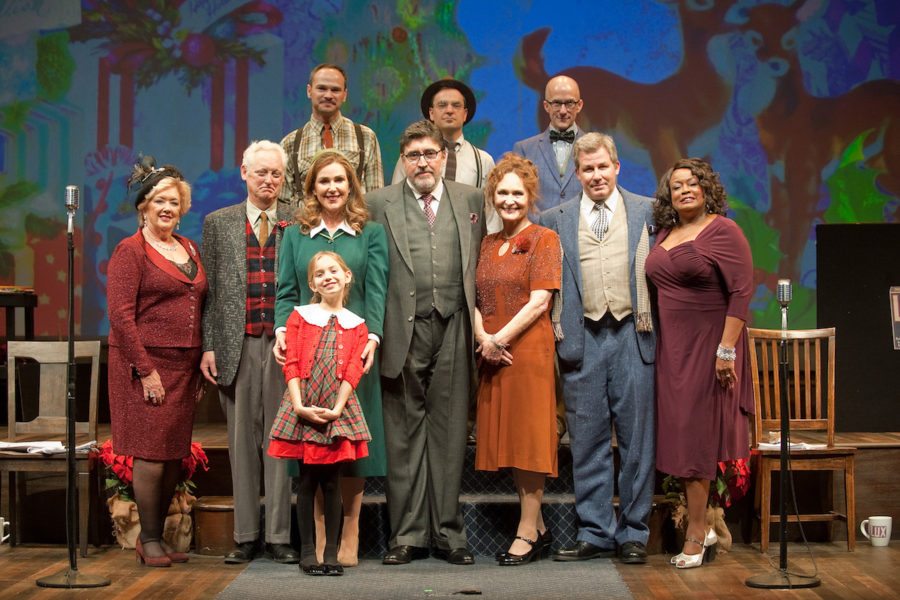
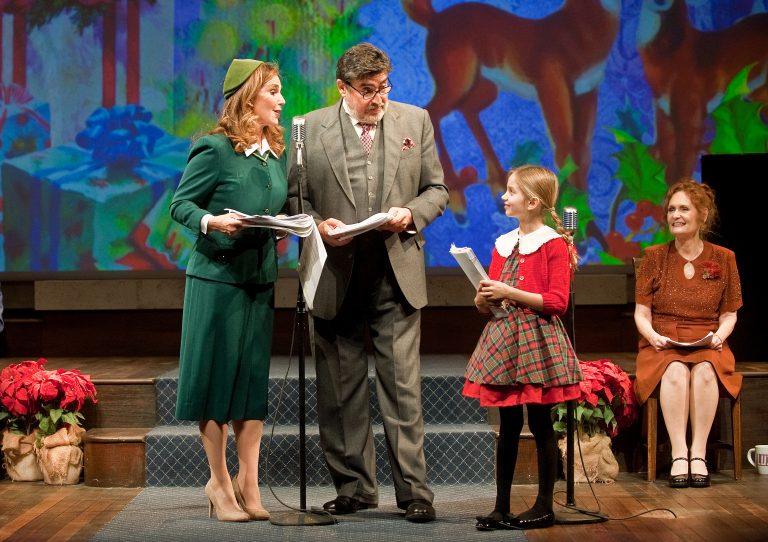
Cast of “Miracle on 34th Street” | Photo by Nick Agro / Pasadena Playhouse

The Pasadena Playhouse, the State Theatre of California, presents a limited engagement of 14 performances of ‘Miracle on 34th Street’ from December 14 to 23, 2017. Originally a radio play, it is celebrating its 70th anniversary on stage, fittingly, at the Playhouse which is marking its centennial year.           

Directed by Cameron Watson, who helmed the recent revival of Tennessee Williams’s ‘Cat on a Hot Tin Roof’, it stars Peri Gilpin (Roz Doyle on NBC’s ‘Frasier’), Beth Grant (Beverly Janoszewski on Hulu’s ‘The Mindy Project’), and award-winning film, television, and stage actor Alfred Molina (‘Raiders of the Lost Ark’) as Kris Kringle.

‘Miracle on 34th Street’ is a staple on TV during the holidays. Most of us know the story of Kris Kringle, who substitutes as a department store Santa Claus and claims to be the real thing. He goes all the way to the Supreme Court to prove his sanity and his assertion.

“What is much less known is that this story was very popular as a radio play, when all of America used their ears and their imaginations to completely realize the story,” discloses Danny Feldman, Pasadena Playhouse’s Producing Artistic Director. “And now in 2017, seventy years later, the eyes of our audience get to watch what went into producing the performance live, which its original listeners never got to see.”

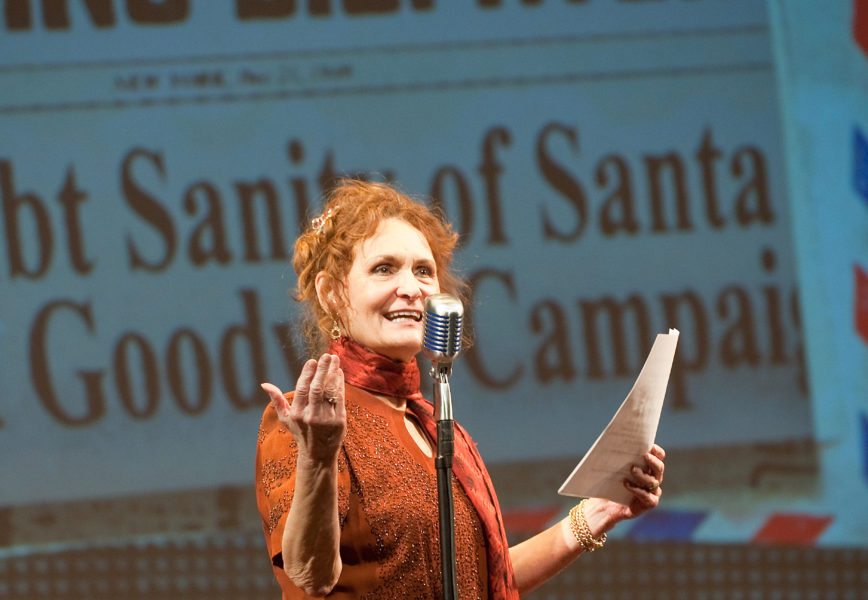
“I’m happy to report that the story in the radio play and movie are very similar,” informs Grant. “What’s going to be fun for us is that we will be presenting it as though we are actually doing a radio play with sponsors, commercials, a foley artist, and a narrator. I can’t wait!  I’ve always thought it must have been such an imaginative process for people who were only listening to it.”

Grant plays the role of the mother of the little boy whom Santa sends to Gimbel’s to get the fire engine which Macy’s doesn’t have. She enthuses, “I’m very thrilled and honored to play the role that Thelma Ritter made famous in what was her first feature film. That has always been my favorite sequence and Thelma Ritter is one of my heroes.”

Besides that part, Grant will be playing others.  She pronounces, “When Cameron told me I would be playing several different roles I got so excited! I love doing character work and disappear in my character, and to do so many in one night would be a fun challenge.”

Beth Grant | Photo by Nick Agro / Pasadena Playhouse

“This isn’t the first time that Watson is directing Grant and she is quite ecstatic to be reunited with the director. “I said ‘yes’ as soon as Cameron asked – I will always work for him anytime, as long as I’m available. He is the most collaborative director I know. He is gentle, kind, and loving but at the same time he’s tough. He’ll keep after you if he sees something that needs to come out,” Grant states.

“Cameron is crafting a ‘framing’ for the radio play, adding his artistic genius to create the reality of being in a live performance,” adds Grant. “He is also using unexpected casting in the various roles – we have some great surprises!”

On learning who her costars were going to be, Grant declares, “I am so thrilled to be working with Peri; she and I have been friends for years, through Cameron. I saw them act together at The Pasadena Playhouse in ‘As Bees in Honey Drown’ by Douglas Carter Beane. She is such a lovely person, with a terrific sense of humor. All that, and beautiful too! And Alfred Molina as Santa? Say no more!”

It’s refreshing to hear that admiration for fellow performers coming from an actor as seasoned as Grant.  She has been in several celebrated and honored films in the last few years that you’d think she has a knack for picking the right project to attach herself to.

Known as Hollywood’s lucky charm, Grant has co-starred in three Academy Award-winning Best Pictures: ‘The Artist’, ‘No Country for Old Men’, and ‘Rain Man’. She has twice received the Screen Actors Guild Ensemble Award for ‘Little Miss Sunshine’ and ‘No Country for Old Men’. She also voiced the Academy Award-winning Best Animated Feature, ‘Rango’.

Grant says of her previous successes, “I have been very lucky to have been in so many great films but I have not picked them so much as they have picked me. I try to say ‘yes’ to any great role, no matter the size or even the character, as long as I understand the character’s role in the story and I believe that the story needs to be told. I love to be challenged, to find the goodness in a ‘bad guy’. I love a story with a heart, to make a statement as long as it’s entertaining in the process.”

“From reading the scripts and knowing the filmmakers, I can tell which ones would do well with audiences and academy members. I did believe that Barry Levinson’s ‘Rain Man’ and the Coen Brothers’ ‘No Country for Old Men’ would go all the way,” continues Grant.

“I was pleasantly surprised that ‘The Artist’ was so commercially well-received. I loved it so much but because it was a black-and-white, silent film with subtitles, French stars, and French director, I thought it would just play the art houses. I was so proud and thrilled that it was appreciated on such a grand scale.

Peri Gilpin, Alfred Molina, Cecilia Witt, and Beth Grant | Photo by Nick Agro / Pasadena Playhouse

I’ve been right a few times, wrong a few times; liked movies that didn’t do well. But, always, I go back to the work and have that optimistic anticipation for what’s next,” Grant says further.

This seasonal production is a first for Grant, “I have never done a Christmas show and I’m thrilled because I love Christmas more than any other time of the year. I’ve always felt renewed during the holidays and I promise you that every single year something magical happens in my life! I am still a child at heart, especially during the holidays. I love everything about the season!”

‘Miracle on 34th Street’ is showing at the Pasadena Playhouse, another first for Grant. She declares, “I’ve been to see quite a few shows at the beautiful Playhouse but have never worked here before and I’m very honored! And did you know it’s also their 100th anniversary!

I love TV and movies, but there is nothing like this experience. When you are on the stage, creating a character, telling a story to a live audience, something truly spiritual happens. We are all one on this journey together. I feel so close to the audience; and each one has his own personality!”

Grant concludes, “I hope everyone who sees ‘Miracle on 34th Street’ has a swell time, feel happy, and encouraged about life after they get back home.”

‘Miracle on 34th Street’ makes even the most skeptical among us believe that wishes can come true. That is the true magic of Christmas. One can only imagine Grant contentedly sipping hot cocoa, joyful with the knowledge that she somehow helped bring the spirit and warmth of the season to one and all.

A Noise Within Presents ‘A Christmas Carol’ for the Sixth Year

Originally published on 6 December 2017 in the Pasadena Independent, Arcadia Weekly, and Monrovia Weekly

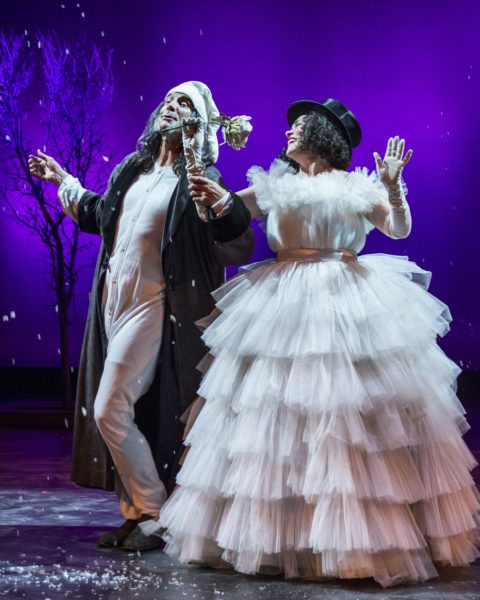
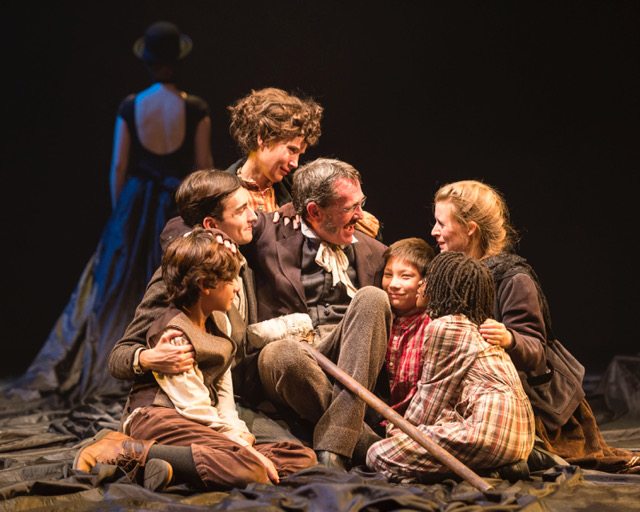
Geoff Elliott is Ebenezer Scrooge and Deborah Strang plays the Ghost of Christmas Past | Photo by Craig Schwartz/
A Noise Within

A Noise Within (ANW), the acclaimed repertory theatre company in Pasadena, presents Charles Dickens’s ‘A Christmas Carol’ for the sixth year. Onstage from December 1st to the 23rd, it remains, to this day, the embodiment of the true spirit of this season.

Adapted directly from the original novella by Geoff Elliott, ‘A Christmas Carol’ is directed by ANW’s Co-Producing Artistic Directors, Geoff Elliott and Julia Rodriguez-Elliott.

‘A Christmas Carol’ features mostly the same cast members as in previous years, including: Geoff Elliott as Scrooge; Rafael Goldstein as his nephew, Fred; Deborah Strang as the Ghost of Christmas Past; and Frederick Stuart as the narrator. Seven-year-old newcomer, Ryan Dizon plays the youngest of the Cratchit children, Tiny Tim.

“I’ve watched the movie and I saw ‘A Christmas Carol’ here two years ago and I enjoyed it a lot. I can’t remember much about Tiny Tim but I’m really excited to be playing him,” Dizon says with a big smile.

Dizon is not a stranger to acting. According to his mom, Corinne Chooey, he started modeling for commercials as a baby and expanded to print work. Lately, he appeared in the film ‘Dr. Strange’ and just finished work on the television show ‘Jane, the Virgin’.

This artistic interest runs in the Dizon-Chooey family. Both his parents and two older brothers, Ethan and Zachary, are in the entertainment business. He and his siblings all attended ANW’s ‘Summer with Shakespeare Workshop’ as well as the Saturday acting class.

“In the Summer with Shakespeare workshop I learned four different types of plays – comedy, romance, history, and tragedy,” Dizon informs proudly. “Comedy always has a good ending. In tragedy everybody gets a bad ending. Romance play is where the good guys have a good ending and bad guys get a bad ending. And history play is about England.”

Ryan Dizon is this year’s Tiny Tim | Courtesy Photo

“This is my first stage play,” continues Dizon. “Rehearsals began on November 14 and the show opened on December 1st. I didn’t really have a lot of lines to memorize so it’s easy.  Everyone is nice – they all treat me like a child. Because Tiny Tim can’t walk, I am being carried a lot on the show. The entire experience is so much fun that I would like to be on other ANW productions.”

“Besides acting, there’s some singing on this show – I start the first lines of the Tiny Tim song, and I sing in another number; I’m also part of the ensemble,” Dizon states, grinning.  “My favorite portion is the end where Scrooge turns into a kind man and where we all sing ‘Glorious’.”

“Christmas is my favorite holiday because it is when we spend time with our family. Last year all my cousins came over to my house and we had a grand time,” Dizon volunteers without prodding, which touches his mom immensely.

“We have a large family on both sides; Ryan has a lot of cousins. It’s a big occasion in our house – we have a Christmas tree, we gather as a clan, we open presents. Since we have two different cultures, Filipino and Chinese, we blend the two together. It’s an especially big holiday for my husband because he’s Filipino; I think Filipinos start celebrating it in September. On Christmas eve our table is filled with food – mostly desserts,” Chooey laughingly discloses.

Acting is embedded in Dizon’s genes. Chooey reveals, “My grandparents were movie stars from Hong Kong and my aunts are dancers. My cousins are also actors, dancers, musicians, and producers. So, for me, getting my children involved in it was simply a natural consequence.

However, my husband and I don’t make them do it; we let them pursue it only if they want to. Ryan’s older brother, Ethan, who is 15 years old, revels being on screen. He was in the summer movie ‘Spiderman: Homecoming’ and also appears on some TV shows. Zachary is nine years old and was in the TV series ‘Henry Danger’ in 2014. He chose to quit acting and we were fine with his decision. But after a year he asked, ‘When’s my next audition’. And Ryan, here, seems to like it enormously.”

For his audition as Tiny Tim, Dizon met with Elliott. He recounts, “I walked into the rehearsal room and he asked me to pretend there was a window and there were a lot of toys to play with. Then he asked me to walk with a limp. And the last thing was for me to sing; I sang ‘Happy Birthday’ because that’s the only one I know the words to.”

Dizon adds, “To prepare for this role my mom downloaded some vocal warm-ups and the songs in ‘A Christmas Carol’ on my Kindle. That helped me memorize the songs and prepare me to become Tiny Tim.  I can’t wait for my whole family to come and watch the show.”

“Christmas is a big, happy occasion for the Chooey and Dizon clan. We’re very excited that Ryan is part of this cherished family play. I hope everyone who comes to see it leaves the theatre with the spirit of kindness and bigheartedness the show inspires,” Chooey says.

That sentiment is echoed by Rodriguez-Elliott, “Ebenezer Scrooge’s rebirth from miserly curmudgeon to the essence of love and generosity affirms our faith in the potent goodness of humanity during this beloved time of year.”

Elliott adds, “‘A Christmas Carol’ is the epitome of Christmas entertainment which encompasses warm moments, beautiful score, memorable scenes, and great performances. Half a generation of children have grown up on it and families continue to make it our most popular production of the year. Students studying Dickens come to see his story leap off the page onto our stage.”

For all these reasons, being Tiny Tim in ‘A Christmas Carol’ this year is of deep significance to this second-grader. Indeed, it is one Christmas carol Ryan Dizon shall remember the words to and sing in years to come.

Scrooge with the Cratchits | Photo by Craig Schwartz/ A Noise Within

Parson’s Nose Theater Finds its Home in Pasadena

Originally published on 27 November 2017 in the Pasadena Independent, Arcadia Weekly, and Monrovia Weekly

A scene from 2017’s “Government Inspector” with cast members (left to right) Aiden Rees, James Calvert, and Paul Perri | Photo by Lance Davis / Parson’s Nose Theater

Mary Chalon Davis and Lance Davis, who founded Parson’s Nose Theater (PNT) in 2000, are feeling quite content these days. After 17 years as a gypsy theater company they have finally found a permanent home in Pasadena.

Their 2017-2018 season debuted last month at the beautiful ivy-covered Parson’s Nose Abbey on 95 North Marengo Avenue with Lance’s adaptation of Nikolai Gogol’s ‘The Government Inspector’.

For two weekends in December – 9 and 10; 16 and 17 – PNT will present a Readers’ Theater Series of Charles Dickens’s ‘A Christmas Carol’. Actors, dressed in the attire of the era  will read this beloved annual production as it was meant to be staged.

Lance explains their rationale for establishing PNT, “People say live theater is dead. Why would they want to see a play when they have television at home? But the idea of returning to the live art form where the actors and audience are both present and no one is looking at screens is what theater is about. You’re interacting with the literary art form for the most part so you have to listen to the words and the ideas.

During World War II, in London, in spite of all the bombings going on, theaters were full because people wanted to go out and be with others. That sense of socialization and community is what we’re trying to bring back. While our plays are only 90 minutes long we take a break so people can get up to talk with each other, have a cup of coffee or a glass of wine, and chat.”

PNT’s productions are designed to be introductions to the classics. Students are a big audience so they deliberately addressed the most common complaint students voiced.

“We eliminated all the things that students said they don’t like about theater, one of which is that Shakespeare plays are too long,” Lance says. “So I distilled them to 90 minutes. The idea is to keep them short but complete – the language, the characters, the plot, and the spirit of the play are intact.

One of the students who watched our production of ‘Twelfth Night’ told us she went to see it at a theater Festival. About an hour and 30 minutes into it, she just said, ‘Excuse me, I saw this before and I know it can be done more quickly’”.

“But there was a reason why these classics are too long,” Mary interjects. “At the time they were written people didn’t have much to do for entertainment. We re-introduced these for the modern audience so they can enjoy the very same plays that adults, before our time, knew.”

That students actually enjoy these classic plays was revealed recently. Lance recounts, “We had a group of eighth graders from Pasadena High School and during the intermission they were all conversing with each other while their parents were checking their cell phones.”

Lance Davis starred in “A Middle Class Nobleman”, a PNT 2013 production | Photo by Peter Zuehlke / Parson’s Nose Theater

PNT’s productions are comedy classics because Lance is particularly gifted in the art form. Expounds Mary, “Lance came from the Guthrie Theater Minneapolis which informed his choices; it’s his orientation.  But also because comedy makes people laugh; it lifts their spirits in a way.”

Lance adds, “Besides that, we want to recognize that these classics, like the plays Moliere wrote in the 1660s, were the basis for some of modern plays. For instance, Moliere wrote about this miser who thought of nothing else but money. This character engendered Scrooge. Then came Jack Benny and his obsession with money; and then much later on there was Burnseneezer Scrooge in the animated show ‘The Simpsons’. All these modern day comic characters came from the works of early playwrights.

Our most recent play ‘The Government Inspector’ is about a clerk who comes into town whom people thought  is the expected inspector who’s to expose all the evil deeds that the mayor is doing. o all these local officials are going around bribing him and he eagerly accepts them so he’s just as corrupt as they are. All this time the town officials thought they’re safe because they’ve bought off the inspector, until one day the real inspector arrives.”

“My Character in the play is the mayor’s wife and she see meets this man whom she thinks is the government inspector,” Mary relates.  “She plays matchmaker between him and her daughter, and he proposes marriage. So Mary thinks this is going to change their life – they’ll leave this crummy place and move to St. Petersburg; all their dreams have come true. She snubs the townspeople then she finds out he’s not the real inspector so all her hopes come crashing down.”

“This is something we still see today,” expounds Mary. “So people who watch this show realize we have a link with these characters. Classics have universal themes and audiences connect with them. And because they’re funny they become more accessible and disarming.”

Lance interjects, “We laugh at them and then we realize, ‘Oh, that’s me!’ Through these plays, we see human nature. There are ideas that seem so foreign to us like, in one of Moliere’s plays, how the dowry is very important. We think it’s funny and say no one does it anymore but we still do, only in a different way. Today when one’s daughter is dating someone, parents think ‘who is he?’; ‘what are his parents like?’; ‘what are his prospects?’”

How they came up with their theater company’s name is a story in itself as Lance laughingly relates. “First of all Parson’s Nose was the only name my wife and I agreed on. It’s a quote from ‘Romeo and Juliet’ where Mercutio talks about Queen Mab’s speech that dreams reflect one’s passion and desires – she tickles a sleeping parson’s nose with a tithe-pigs tail and he dreams of a large donation. And we’re always dreaming about grants. It’s very far-fetched.

On the other hand, when I was growing up, in Philadelphia, a parson’s nose was the tail-end of the chicken. So if you look at our logo it’s either a sleeping parson or the tail-end of a chicken. In that sense that’s a metaphor for us – while we do the classics, we don’t take ourselves seriously.”

“This company has been around for 30 years,” Mary stresses. The individuals we work with – the actors, the designers, including us – are trained people who went to Julliard, Yale, and other drama schools with 30 years of experience and have worked all over the country. Many of us are from New York and ended up moving to California in our mid-adulthood and raised families.

We bring a lot of skills to the work; we’re not amateurs. People who come to our show are watching something that’s well done. We don’t spend a lot of money on our sets but we focus on the art of acting and storytelling. That’s key for us. It’s like ‘theatre unplugged’. These actors, several of whom are from Pasadena, are here because they love acting.”

We started PNT 17 years ago and our first production was ‘Twelfth Night’ then ‘The Miser’ which we did at Interact. The Geffen Playhouse came over and loved what we did and asked us to do their Saturday shows which toured for schools. While we didn’t envision ourselves doing that, we thought it was a nice opportunity. We produced all the hour-long shows and we were able to hire a company of actors to do the tours for six years.

From there we came up to the Pasadena Playhouse where we produced family-oriented performances that brought families to the Playhouse. All these shows that we were producing for the Geffen and the Playhouse were all under their name but we were thankful because they gave us a foundation. This went on for about nine years until the Playhouse scrapped this component of their programming when they downsized.

PNT’s 2016 show, “The School for Wives”, featured (left to right) James Calvert, Marisa Chandler, John Harnagel, Lance Davis, Aiden Rees, and Matt Franta | Courtesy Photo

In 2008 we realized we had been working all these years but no one knew who we were. So we decided that this was the time to reinvent ourselves – we had to get the name Parson’s Nose out there.

The first production we did under our own name was at Pacific Asia Museum. We were then at Lineage Center for the Performing Arts where we stayed for seven years. It’s a dance company on Fair Oaks, south of Green Street, and they rented out their space. We were their tenant for five years. We were briefly in South Pasadena where we did the ‘Under the Tent’ series. Then the recession hit big time. So we stopped making full productions and we did readings instead.

We were in New York for a while and readings of new plays are common there. It’s not as common here where readings are usually table readings for movie scripts. We started to do readings and people were fascinated – actors make the characters on the page come to life. So we began doing that; of course it’s also a less costly production.

When the economy improved over time, we started putting full productions back in.  We were doing this at Lineage but as we were renting only the performance space, we had to find other places for our requirements – costumes were stored in one location; props were at a different space; rehearsing was done at yet a different site.  We became experts at being a gypsy theatre company – arriving in a van, setting up props, and stuff.”

Lance adds, “We began to look for a space in earnest which took longer than we thought. We looked at all kinds of spaces.  We now know Pasadena inside out – if you say Discount Tires, we know where that is.  When, after three years of searching, our realtor discovered this place, he declared, ‘this is Parson’s Nose’.

And, to us, finding the Abbey is such a gift.  It’s a place where we can hang lights and have a set that can stay up all the time.  For the first time we can argue with each other and just storm out the door.  We don’t have to pick up and fold our chairs before leaving.

The city was very happy to have us occupy this space; they’ve been very supportive.  And we are ecstatic to be here.  Now our challenge is to tell people where we are, how to get here, and how to make it a destination for people.

This year we were part of ArtNight Pasadena and a lot of people came in to see us.  We did 20-minute readings of radio plays people grew up with, like Flash Gordon.”

Following the 2017 fall full production of ‘The Government Inspector’ and Charles Dicken’s ‘A Christmas Carol’, PNT will present a full production of Moliere’s ‘Too Learned Ladies’, then a Readers’ Theater Series of ‘An Irish Celebration’ with select Irish poems, stories, and songs in the winter.  The 2017-2018 season will close in May with a full production of William Shakespeare’s ‘Clearly Classic: Twelfth Night’.

Plans for more productions for schools and an outreach for seniors are underway, as well as plays multi-generational families can enjoy.

Parsons Nose Theater is a hidden gem in Pasadena, as one of its board directors noted.  However, with its founders’ achievements in staging timeless classics for students and families and plans to extend its reach to an even wider audience, it is on track towards getting recognized.  This hidden gem will be found at last.