School District Highlight: Monrovia

Originally published in 2015 in the Pasadena Independent, Arcadia Weekly, Monrovia Weekly, and Sierra Madre News

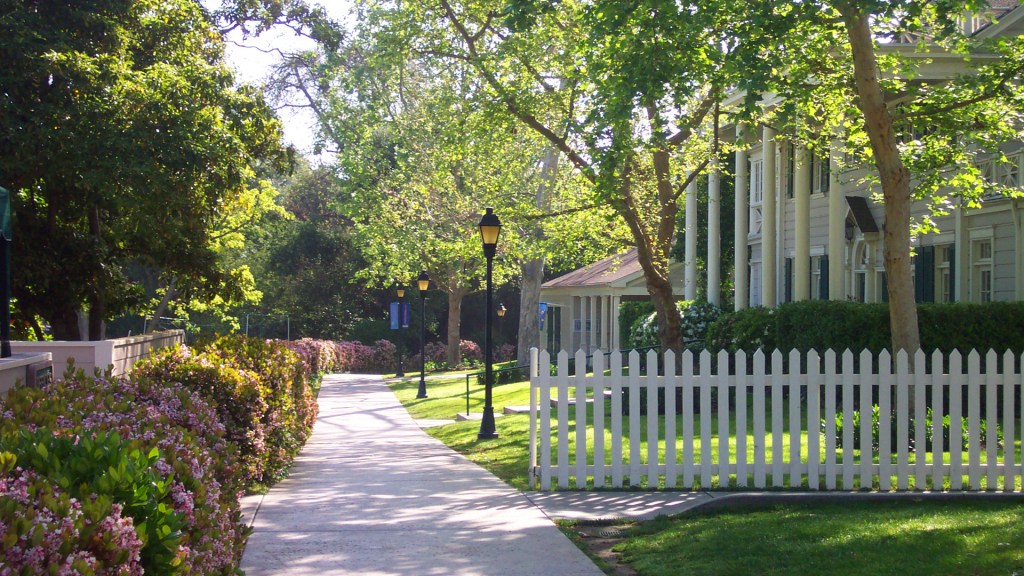
Nobel Prize in Economics co-recipient Thomas J. Sargent walked its vaunted halls as one of its students some five decades before earning that distinguished award in 2011. The institution – Monrovia High School. Nestled at the foot of the San Gabriel Mountains, it paints such a pretty picture that it served as the setting for Hollywood films A Cinderella Story; Not Another Teen Movie; Liar, Liar; Leave it to Beaver; and Drive Me Crazy.

The picturesque scene, however, belies Monrovia High School’s academic prowess. The US News & World Report Best High Schools gave it a silver medal, ranking it at 12% nationally and 6% statewide. It has a college readiness score of 31 and an academic performance index at 802, above the California index of 789. It is the only 9 -12 comprehensive high school in the Monrovia Unified School District. MHS has a total enrollment of 1,766 students (51% male and 49% female), a total minority enrollment of 72%, 51% economically disadvantaged, and 5% English learners. It has 74 full-time teachers, giving it a student/teacher ratio of 24:1.

According to Dr. Katherine Thorossian, Monrovia Unified School District Superintendent, 100% of Monrovia High School’s Math and Science Academy 2014 graduates fulfilled the University of California entrance requirements with four years of college-preparatory English; three years of math; two years of lab science; two years of history/social science; two years of foreign language; one year of fine art elective; and one year of an additional elective in a college-approved course. Ninety percent of all HMS 2014 graduates enrolled in college.

The school’s accolades are equally robust in the athletic arena as the Wildcat student athletes compete with excellence. Monrovia High School offers athletic teams for both boys and girls and competes in the Rio Hondo League in the Southern Section of the California Interscholastic Federation (CIF). MHS teams have earned numerous league championships and the Wildcats are home to CIF championship programs in football, baseball, basketball, track and field, and swim dating back to 1967.

The world-class education to which the district aspires would not be complete without a comprehensive arts department. Whether film or video production, vocal or instrumental music, ceramics, drama, dance, or art; students hone their own talents with the expert guidance of college level instructors, highly qualified teachers, and artists-in-residence. Indeed, the professional theatre program within the city is sponsored by the Monrovia High School District  offering students an opportunity to share the stage with actors from across the region.

Given its achievements in academics, athletics, and the arts, it is no wonder that in 2006 the community approved a $45 million bond to finance the high school’s enhancement project. Major construction transformed the campus by establishing a modern Performing Arts Center; constructing a science building with tech labs; and building an event center to support robotics as well as athletics competitions, a stadium and bleachers.

Monrovia High School boasts a beautiful bell tower and is one of a few select schools within the state equipped with a fully functional observatory where the Astronomy class convenes. In fact, during the 2012-2013 schoolyear, students in the Math and Science Academy communicated with the NASA space station through the dome link that is used in the Performing Arts Center.

Monrovia High School’s motto promoting ‘scholars and champions’ reflects the extensive work being done by their team of four college counselors and counselor technician. These are the architects of the annual college fair, financial aid and essay workshops hosted on campus. College tours are also available over spring break for juniors. Personalized attention is provided by counselors and additional resources are available in the Career Center where students prepare and complete their application during the college admissions process.    

The Monrovia Unified School District emphasizes the role its citizens play in their youth’s development. Residents of this small tight-knit community know that it takes a village to raise productive, responsible citizens. Parents, teachers, and neighbors share the responsibility for providing guidance to their studentry. At no time was this more palpable than in 2012 when the city was beset by the fourth teen suicide in two years. This propelled the leaders of the community to establish Healing Connections, a program aimed at eliminating teen suicide. A third of its membership is comprised of high school students. Through it, they launched the March for Balance campaign to reduce the stigma attached to mental health problems. MHS holds a fair on campus where families can come to meet with psychiatrists and family counseling professionals, to learn about coping with mental illness and treatment options. Healing Connections earned MUSD the prestigious Golden Bell Award, the district’s 18th such award.

This collaborative approach was utilized by MHS’s most acclaimed alumnus, Thomas Sargent, when his and Christopher Sims’ research on how changes in interest rates and taxes affect growth and inflation was awarded the Nobel Prize. According to Wikipedia, Thomas Sargent ranks 14th among the most cited economists in the world. What an honor it is for Monrovia High School, where the sound of his footsteps echoes on its halls long after he has left it. 
School District District Highlight: Arcadia

Free run peacock in park.

Originally published on 15 January 2015 in the Pasadena Independent, Arcadia Weekly, Monrovia Weekly, and Sierra Madre Weekly

A college education used to be something only a privileged few could attain. But that was in my parents’ time. There are now more college applicants than ever before and parents want their children to attend the best high schools to ensure acceptance to the university of their dreams. This monthly feature will focus on one school district at a time to cover as much information necessary to help parents with school-age children in their quest for schools.

In the San Gabriel Valley, Arcadia is well-known for its excellent school district. According to the website education.com, the Arcadia Unified School District (AUSD) comprises 11 schools serving 9,807 students from kindergarten through 12th grade.  AUSD’s elementary and middle schools are highly-ranked, preparing them well for high school. Its two high schools are Arcadia High School (AHS) and Rancho Learning Center.

The U.S. News & World Report Best High Schools evaluated 19,000 high schools in the country and gave AUSD a Gold Medal three years in a row (2012, 2013 and 2014), a feat attained by fewer than three percent of schools evaluated. It ranked AHS 432nd nationally and 89th statewide.  Arcadia High School’s college readiness is at 49.7, which is above the California average; its academic performance index is at 897, well above the California level of 789. It has a total enrollment of 3,665 students (51% male and 49% female), 84% of whom are minorities.  It has 145 full-time teachers (student/teacher ratio 25:1). 

AUSD’s website lists the following high school curriculum standards: Language Arts from 9th to 12th grade; Math courses in Algebra, Geometry, Math Analysis, Calculus, and Statistics; Science courses in Biology, Chemistry, Physics, BioPhysics, Environmental Science, and Human Physiology; Social Science courses in U.S. History, Modern World History, Government & Politics, and Economics.  World Languages being offered are: French, Japanese, Mandarin, and Spanish.

Arcadia High School has a wide range of Performing and Visual Arts course offerings including: Dimensional Studio Art, Drawing & Painting, Theatre, Film, Animation, Art History, Music Theory, Chorus, Percussion Ensemble, Treble Choir, Ceramics, among others.  There are 35 AP and Honors Programs altogether.

It is in high school that most great athletes get their start and shine. Arcadia High School offers a vast array of sports activities to fit most teen-agers’ interests.  Their sports teams include:  baseball, basketball, cross country, football, golf, pep squad, soccer, softball, swimming, tennis, track & field, volleyball and water polo.

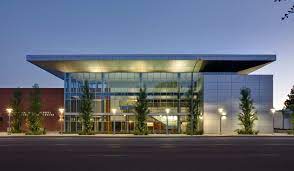
Arcadia High School | Courtesy Photo

If your children are thinking of playing sports in college, make sure they look into the NCAA requirements (www.ncaa.org) and let their coach and counselor know.  Several universities offer athletic scholarships and college coaches scout the country in search of the next rising star.

Life at AHS is abuzz with an amazing choice of academic teams and clubs. There is never a boring day on campus when you have activities like Academic Decathlon, History Bowl, Math Team, Speech and Debate, to name just a few.  

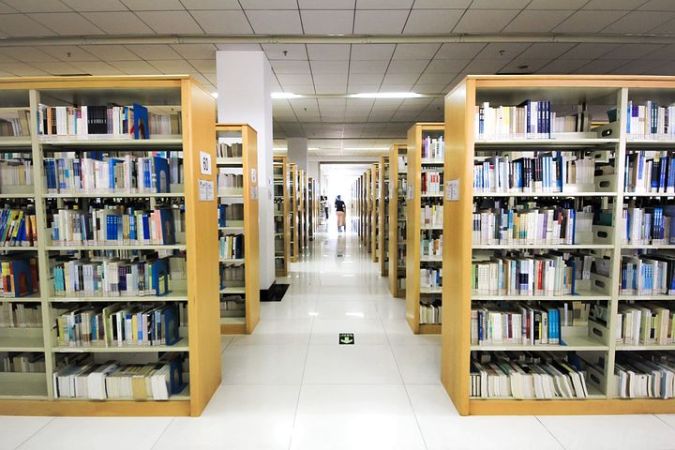
One of the most important hallmarks of Arcadia High School’s curriculum is its attention not only to its students’ academic life, but to their total development. At the same time that it had 22 seniors named National Merit Scholarship finalists and one of its seniors achieving a perfect  score on the AP Calculus BC exam, the school boasts award-winning and nationally-recognized performing arts and athletic programs. To provide an enhanced experience for their students, AHS inaugurated a world-class Performing Arts Center on campus two years ago. They are opening a brand new state-of-the art library and cafeteria; they just got a new turf sports field; and a new pool and aquatics center are on track for completion this summer.   

A news article written by Scott Hettrick last June lauded Arcadia High School’s 2014 graduates.  Nine hundred seniors, or 99% of the total graduating class, attended their graduation ceremony held at Santa Anita Park. He reported that this year’s graduating class had an average GPA of 3.34, average SAT score of 1846, average ACT score of 29. Ninety-four percent of these graduates planned to attend college (five were heading to Harvard, one to MIT, four were going to Stanford). There were three students who were accepted to Princeton, one to Yale, four to Brown, ten to Carnegie-Mellon, 47 to USC, and 56 were accepted to UCLA. These are formidable numbers indeed. It’s no wonder AUSD is the envy of other school districts. 

The fact that Arcadia High School is such an academic powerhouse is not lost on most parents.   They know that a B student from AHS is looked at more positively than an A student from a less scholarly institution, making their children’s acceptance to a highly selective university more likely. This has sent real estate prices soaring, much to the chagrin of would-be house-buyers. 

Let me be the one to give hope to parents whose children aren’t attending AHS, though. High school college counselors provide college admission directors a profile of their school, which includes their course and extra-curricular offerings, a history of their seniors’ grades and what schools they were accepted to. It also contains a grade distribution for individual subject classes offered by the high school. The distribution helps a college determine where each applicant stands so they can compare students in the same class who are applying to the same college. If your children are attending a school that doesn’t historically send academically-gifted and accomplished graduates, your children will have a greater chance of setting themselves apart from their classmates. The competition would not be as insurmountable.   

The lesson is that whatever school your children are currently attending, they have to concentrate on taking the most rigorous courses available, getting stellar grades, tackling extra-curricular activities, taking enrichment programs and putting in a good number of community service hours. Make sure your children are making the most of their high school career and are setting their sights on getting into the college that is the right fit for them.

January College Search Guide

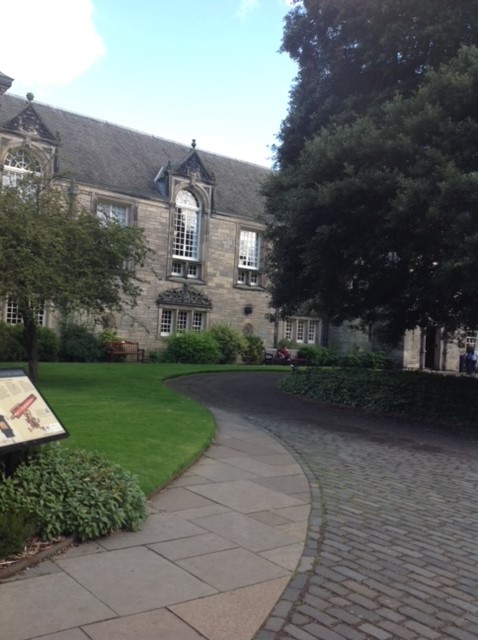
St. Mary’s College, University of St Andrews | Photo by May S. Ruiz / A San Gabriel Valley Inquirer

Originally published on 8 January 2015 in the Pasadena Indpendent, Arcadia Weekly, Monrovia Weekly, and Sierra Madre Weekly

The road to college

It’s a rite of passage for every high school senior in this country. It’s called college applications. The phrase alone inspires fear and trepidation in students and their parents. Stressed-out teens saddled with schoolwork, extra-curricular activities, and standardized testing navigate this complex process with their equally anxiety-riddled parents who watch helplessly, much as they want to extend a helping hand. As we all know, everyone survives it, most of us with our sanity largely intact.

For some parents who had gone through it in their youth, they would soon learn that the process has changed because today’s competition has become extremely intense. More teens are opting to go to college now than ever before. There is a growing surge of foreign students applying to American universities. Less selective universities are seeing an increase in student applications while their available spots have stayed the same, resulting in fewer acceptances. Universities implement more rigorous standards in their selection process as they put together a well-rounded class made up of outstanding individuals.

While both my husband and I were college-educated, our experiences had not been the same as our daughter’s. We did not spend our summer months building houses in a third world country, or handing out groceries at a food bank, to put on our resumes. We did not enroll in a summer program at science camps or art schools to further enhance our academic record. We did not have an array of activities to show college admissions directors that we spent a meaningful summer. 

My husband and I are immigrants: he is from Taiwan and I am from the Philippines. There were no convoluted college searches where we came from. To make up for what I did not know, I started reading up on the admissions process. But no amount of book-reading and research could have prepared me for the onslaught of emotions and self-doubt that seized me once the process was at hand. I constantly questioned myself if I had provided my child with all the tools necessary for her to successfully make it to the finish line in this marathon.    

My daughter went to a private school, which a reporter for a local newspaper referred to in a 2007 feature story commemorating the school’s centennial, as “Pasadena’s most elite school.” This school, which I shall henceforth refer to as REPS (Really Elite Private School), has a team of college counselors who starts a discussion with students and their parents about college applications in the fall of junior year.

However, I feel that REPS college counselors should have given students and their parents an overview of what the process entails back in 9th grade. I think that neither students nor their parents are made fully aware of how grades and extra-curricular activities during their high school career affect the final outcome of their college search. Waiting until the second half of junior year to talk about what colleges are looking for when they assemble their incoming class is far too late. Indeed, when I started doing my research into the admissions process, one of the reference books I used broke down students’ preparation starting in 9th grade. After having read a few parents’ books on this subject, I came to the conclusion that this daunting, nail-biting process brings out the neurotic in us (I could argue, therefore, that kids started this application process the minute they toddled into their first class; that they were auditioning for college back in nursery school).

This monstrously arduous experience had been such an eye-opener for me, that I thought it might be helpful to some parents if I wrote about it. Some parents might find it elucidating; at the very least, I hope it provides some form of respite from the stress they are going through. If I could help even one parent or student find his/her way in this maze it would have been well worth my effort.

The road to college will follow a high schooler’s journey from freshman year through move-in day at university in September. As I will be speaking about our family’s journey, it will not totally reflect what other students experienced. The result of my daughter’s college search would not be the same as someone else’s. I will include anecdotes about my daughter’s high school days and her subsequent college application, with the hope that some readers can apply some of her experiences to their own situation. Some of the stories might elicit a small chuckle while others would sound too absurd to be believed but all the anecdotes are true and actually happened. Lastly, I would be addressing parents and students alternately.

FRESHMAN

Typically, the beginning of the year marks the halfway point in the schoolyear. First semester grades would soon be released, if they had not been sent out yet. If your 9th grader’s marks are not great, he/she would need to use the second semester to better them as it’s the end-of-year grades that show on the transcript. A student’s grades are a very important, if not the single most important, component of the college application. 

Continue your extra-curricular activities in arts or sports, with concentration on one or two where you excel. Do not attempt to dazzle college admissions directors with the range of your interest, unless you are a budding Leonardo da Vinci and have mastered every single craft. Find something you are truly passionate about and do it throughout your four years to show your commitment. My daughter realized she loved acting but she only found out in her junior year so she did not have much time to fully engage in it.

SOPHOMORE 

This is your student’s second year and by this time he/she should have fully transitioned into high school. He/she needs to put extra effort into weak subjects and solidify grades for the second semester. Your student should continue his/her focus on academic performance skills, sports participation and arts involvement. He/she should also start studying for the PSAT (www.collegeboard.com). Taking a practice PSAT in 10th grade gives your student the chance to identify weaknesses then work on them before taking the NMSQT (www.nationalmerit.org) in 11th grade. At REPS, students meet with their grade level dean in the winter of 10th grade to discuss year-end testing options and junior-year course options. Sophomores enrolled in Advanced Algebra and Pre-Calculus register to take the SAT II Math Level 2 exam in June of their sophomore year. Sophomores enrolled in Functions, Trigonometry, and Advanced Algebra (FTAA) take this same exam in June of their junior year, after completing the Advanced Topics and An Introduction to Calculus-Honors (ATIC-Honors) course. Sophomores who are thinking of going into science, medicine, architecture and engineering are encouraged to take the SAT II exam in Chemistry in May or June of their sophomore year. Your student should also start lining up summer activities.

JUNIOR

The second semester of junior year is significant as it is the beginning of the college application process. From their college research, students are now ready to start planning a visit to colleges.  They can even do their initial campus virtual tours online www.campustours.com, www.CollegeProwler.com, www.SmartCollegeVisit.com, www.YOUniversity.com. College

counselors usually recommend that students use their spring break to go to several different types of schools. A good list should include a small liberal arts college, a medium-sized research university and a large state university to let them have a feel for what “small” or “large” school means. They should be able to experience firsthand if a large city like New York makes them feel alive and vibrant or if it totally overwhelms and scares them. They need to experience if a school with 20,000 students is the right setting for them. They don’t necessarily have to visit the schools they are actually considering applying to, this trip should give them ideas about what they are looking for in a university. Once they’ve established  the elements they are looking for, they can start making a list of schools they would put on their list of colleges to apply to. 

SENIOR 

All college applications should have already been sent out for the January 1st regular decision/admission deadline.  Some universities, like Georgetown, have a later deadline.

Parents should already have filed their income tax returns; get ready to submit FAFSA (www.fafsa.ed.gov). Apply for scholarships. There are several websites to help you with your search like www.scholarships.com, http://www.collegexpress.com, or www.scholarships360.org.

Ask your school to send your mid-year grades to colleges and verify that all your application materials have been sent. Breathe a sigh of relief; the hard part is done. The rest is out of your hands. 

(Ms. Ruiz is NOT a licensed counselor nor does she dispense professional advice for college applicants.  Her knowledge on the subject is limited to her personal involvement in her daughter’s college search.  She had been actively involved in her daughter’s elementary and middle school years as a parent volunteer in several school activities.)

Mt. Sierra College: Educating Through Hands-on Courses

Originally published on 19 March 2015 in the Pasadena Independent, Arcadia Weekly, Monrovia Weekly, and Sierra Madre Weekly

These days we hear so much about the all too common sad tale of America’s youth graduating from a four-year college course and saddled with several thousand dollars’ worth of student loans but unable to find jobs.

Mt. Sierra College, a Monrovia-based institution founded in 1990, helps students escape this pitfall by offering courses tracked for gainful employment. Geared for working students, flexible year-round class schedules allow for graduation in as few as three years. Many of its instructors are working professionals and leaders in the industry, who help students learn the appropriate skills for a specific career.

From its humble beginnings in Pasadena, with two classrooms and four paying students, Mt. Sierra College today occupies over 30,000 square feet of school space in its present site, with over 430 students. In October 2014, Wellsland LLC, owned by Chinese businessman, George Jie Zhao, acquired Mt. Sierra College and installed Dr. Bill Kakish as President. Together, this dynamic duo hopes to position the school at the forefront of technological learning in Southern California.

Zhao is a product of Mainland China’s automotive manufacturing family that counts Volvo and the London taxicab companies as part of its vast holdings. As a businessman with Geely Automobile Holdings Ltd, he was instrumental in that company’s, restructure that established two venture associated companies in Ningbo and Shanghai. He further achieved record international sales volume for Geely and the firm’s recognition as a major player in the European market as it established the Geely franchise distribution network in over 60 countries.

However, Zhao’s true passion has always been education. He was one of the founders of Beijing Geely University, which has over 50,000 students. In 2012, he established Wellsland LLC intending to expose both American and international students to the cultures of the world. Wellsland aspires to foster an understanding of cultural standards and business practices in a global workforce and provide support to students in developing fluency in English and world languages.

Enter Kakish, who has an extensive background in postsecondary education in various capacities as a faculty member, administrator, accreditation liaison officer, state regulatory staff and campus president. Kakish holds a B.A. in Modern Languages from Notre Dame, an M.M. in Management from Northwestern University’s Kellogg Graduate School of Management, a PhD. and M.A. in Comparative Literature from the University of Chicago and a J.D. from the John Marshall Law School in Chicago, Illinois. Such employment accomplishments and academic achievements make him more than qualified for his post as Mt. Sierra’s head.      

Together, Zhao and Kakish are embarking on an ambitious five-year plan that would catapult this school as a leader in Business Administration and Entrepreneurship, Media Arts and Design with concentration in Visual Effects, Digital Video, and Game Arts and Design, Information Technology with concentration in Computer Information Technology and Information Security, and Telecommunications Technology.   

Kakish’s first step in meeting this grand scheme was to hire ten full-time faculty who are experts in their field, and invite recognised professionals onto its board. In mid-February, Mt. Sierra announced the appointment to its Board of Directors, screenwriter and director Xiaolu (Lulu) Xue. She is concurrently Associate Professor and Graduate Study Program Supervisor in the literature Department of Beijing Film Academy and the Director of Beijing Film and China Television Screenwriters’ Committee.    

In February, Mt. Sierra College vied in an international weekend global game jam competition that saw over 77,000 contestants creating video games. Mt. Sierra mounted the second largest contingent of participants in Southern California with over 100 student entrants, second only to the Southland’s USC, which had over 300 contestants, and had more student aspirants than Chapman.

Mt. Sierra’s career counselors help place graduates with a variety of outstanding employers including Apple, IBM, ABC, CBS, NBC, Disney, WB, Caltech, JPL, Parsons, Universal Studios, SEGA, Boeing, Blizzard, Obsidian, etc. Mt. Sierra College has been in conversations with a Nigerian university and Costa Rica’s Department of State to establish international partnerships to build educational and career opportunities for their students.   

In the works is a plan to build a larger campus in Monrovia that will house twice the number of classrooms, a subterranean parking structure and which will be made from sustainable building material with solar paneling that will power the school’s entire edifice. 

Zhao and Kakish want to ensure that all of Mt. Sierra’s graduates succeed as employees and entrepreneurs. Indeed, there is such bright future ahead for Mt. Sierra College and its students!

Clairbourn School: Technology in Education

Originally published on 19 March 2015 in the Pasadena Independent, Arcadia Weekly, Monrovia Weekly, and Sierra Madre Weekly

The morning bell rings and a gaggle of Kindergartners run excitedly into the classroom ready to start the school day. But instead of the usual crayons, pencils and paper, the children have iPads, and sitting in front of them on their desks are computers. There is no blackboard to be seen anywhere; around the periphery of the room are large screen monitors. The five-year-olds await with anticipation today’s important lesson.  

This is the daily scene for Paul Barker, technology teacher, at Clairbourn School in San Gabriel. And, along with his students, he discovers how using technology in the classroom is making the learning experience that much more alive and vibrant.

Founded in 1926, this independent private school offers an excellent educational program for nursery-age children as young as three years old, all the way to 8th grade. Adhering to its original mandate of preparing its charge for a full and rich life, Clairbourn teachers cover the core subjects of English, Math, Science, History, and Language much like their predecessors did all that long ago.  What is different, though, is the way they teach.   

Dr. Robert Nafie, Clairbourn’s head of school, understands that children today are bombarded with bursts of information coming at them from various video platforms. Gone are the days when students sat at their desks to listen to their teacher lecture about a subject matter. Children today retain knowledge when they put into immediate use what they learn; that piece of information goes from their short-term memory into their long-term memory. “The challenge,” he says, “is for us to capture their attention and engage them during that small window we have.” 

Clairbourn School fully addresses this shift in the way children learn. And, as teachers integrate technology in their everyday lessons they are, themselves, still learning about it. Nafie says, “Schools are just figuring out technology along with the kids they’re expected to teach. It’s a new challenge for educators who are digital immigrants (having been largely paper-trained) to teach kids who are digital natives.”       

Meanwhile, in his computer lab, Barker types on his iPad what he wants his students to do. Eager faces look up at the large screen monitors for their instruction, and proceed with the lesson. Using the language Scratch, he teaches them how to program. With each touch of the mouse, they command the Scratch sprite (which looks like a cartoon cat) to walk, run, or skip. They can invent a storyline for this Scratch cat, and using various backdrops available to them, create an interactive book.

First graders learn a Lego program and build simple robots using Mindstorms. In 2nd grade, they learn basic robot controls; in 3rd grade, they add devises to their robots. When they reach 4th grade, they build complicated robots from scratch. In 5th grade, they research and outline a project using all the concepts they learned, their robot-building knowledge, and experience. In middle school, they construct an actual working robot that they will present to their classmates, teachers, and parents. According to Barker, some of his middle-schoolers built a bathroom, complete with flushing toilet and working sink.

Recently, the computer lab got its own 3-D printer from a local manufacturer, Deezmaker. The heart of the contraption is a small index-card size CPU (central processing unit) and is capable of printing simple blocks or complicated objects.  Students are now able to use all the knowledge they gained in Math and Science to design and create something. Using their programming skills, they can make the 3-D printer replicate what they built in their mind into something they can touch and feel and experience.  

The lessons Barker teaches in his computer lab class complement the topics his students are learning in their other classes. He has a list of subjects for each grade level and the lessons on discussion at each point in the schoolyear. When the English teacher is teaching Shakespeare in her class, Barker integrates that lesson in the lab. It makes memorizing Hamlet’s soliloquy, for instance, easier and more fun.

What a long way Clairbourn School has come! From the Bourne family’s first vision of how they wanted their children to be educated, when Mrs. A.K. Bourne held classes in their conservatory for a handful of students, to the interactive teaching instructors now provide.

Under Dr. Nafie’s capable stewardship, technology is not just a promising academic supplement, it is a fundamental component of the Clairbourn student’s everyday learning experience.

Introduction to A San Gabriel Inquirer

The Chinese Garden at the The Huntington Library, Art Museum, and Botanical Gardens, October 2020 | Photo by Brianna Chu

I have lived in Pasadena for four decades and though I’m not a native, I proudly call it my hometown. It’s a city steeped in history and tradition and rich with art and culture. It is as much a center of education as it is a seat of commerce in the western San Gabriel Valley. Resting at the foot of the San Gabriel Mountains, it has an abundance of natural beauty.

All these offer a writer fascinating material for articles and stories to share with readers. There are so many events worth capturing in words and pictures. There are countless individuals and organizations who make Pasadena and the San Gabriel Valley a great place to live and raise families in. I want to shine a light on these wonderful people and their causes so they can get the recognition they deserve. And I hope that in the process, their accomplishments influence others to also do good in the community.

I would love to hear from you and get feedback on the articles.

May S. Ruiz