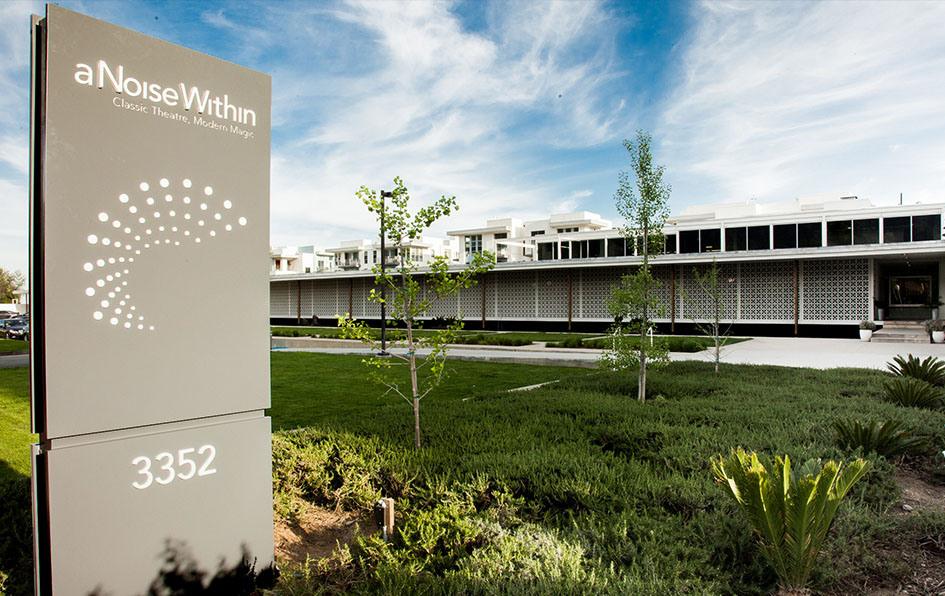
Shakespeare’s Romeo and Juliet as a Street Performance at A Noise Within

Originally published on 18 February 2016 in the Pasadena Independent, Arcadia Weekly, Monrovia Weekly, and Sierra Madre Weekly

Beginning this Valentine’s Day through the 8th of May, A Noise Within (ANW) will be staging the greatest love story of all time – William Shakespeare’s  Romeo and Juliet. 

Directed by Damaso Rodriguez, Artistic Director of Artists Repertory Theatre, Portland’s longest-running professional theatre company, this Romeo and Juliet will be a far departure from how Shakespeare’s work is traditionally presented: as a period piece, with lavish costumes and grand sets. Instead the play will be presented as a street performance, in a graffitied and littered alley with garbage bins scattered about.

The vision for this well-known play came about when Rodriguez visited Havana, Cuba and  met with artists who staged bare-bone productions for a few attendees in humble homes. He relates one memorable evening, “We walked through a courtyard overlooking balconies – it is a beautiful environment but all around you could see peeling plaster from 50 years of decay.  We entered a small house, with light bulbs in tomato cans for stage lighting, the actors wearing their own clothes. The audience was made up of 20 people who came that night. And they proceeded to tell their story. It was a Cuban play which, I think, was about their daily struggles for survival. While there was a language barrier, what united the performers with the audience was the art form. It was a truly transformative moment for me.”

“Theatre companies without much in the way of money put on plays using found objects for props and scenery, and in very low-tech, low-resource performance spaces. The plays with just the actors themselves having to rely on their skills were powerful and inspirational.  In this place where there are few resources, actors and audience link as a community with the compelling need to tell and hear stories joining them as one.”

“I wanted to bring this experience to Romeo and Juliet – costumes will be clothes that actors own, props are whatever they find in the street, and the setting urban. The play will exist in the telling rather than the trappings.” 

“It will be an unexpected environment that in no way resembles the characters’ wealth and class.   I hope that by stripping the play down to its most basic, it will focus on the language and clarify the intention of the characters,” Rodriguez discloses further.

ANW’s artistic director, Geoff Elliott reveals, “When we approached Damaso about directing for us this season, he responded by saying that he has wanted to do Romeo and Juliet because it deals with the most basic of human emotions – love, rashness, hate, fate – and tribalism, which drives just about anything we call news. Humans have passion, conduct war, and kill each other over a tribal conflict the origin of which no one can even remember. And I think that Damaso has found a direct and compelling way to tell this story.”

Rodriguez says, “I hope people who come to watch the play, after a few minutes just try to conceptualize these characters and see them as humans. I hope they see a clearer version of the story and realize the universal essence of Romeo and Juliet.”

“It is a raw and harsh environment, yet we have an optimistic view that their death has brought the conflict between these two families to an end. People will realize this tragedy happened because of two opposing rigid world views – that it took the death of these young characters to end hatred. Romeo and Juliet taught them to look at life differently,” Rodriguez adds.

“It’s arguably daunting to present such a classical material in an unexpected fashion because you could be working with actors who’ve done it before. People who love Shakespeare have certain expectations; also there are scholars who think Shakespeare has to be done a certain way. But in the end all I can do is forget about that. I have to believe that a director has to find an emotional connection and impulsive reaction to it, and share that with his collaborators,” Rodriguez states further.

“It’s quite liberating, actually, to not be restricted by expectations and standards. While A Noise Within has staged Romeo and Juliet twice, I didn’t necessarily set out to find a way to make it very different from what they did before. I didn’t burden myself with that concern; I am merely satisfying an urgent impulse. It’s hard enough to just unpack the language of Shakespeare. I simply want to make the storytelling as clear as he would have wanted for his audience,” concludes Rodriguez.              

During Shakespeare’s time some plays were presented outdoors. Theatregoers had to use their imagination – there were no backdrops, lighting, or props to speak of. Furthermore, his plays were not intended to be read but spoken aloud; the lack of background meant there was nothing to distract the audience from the actors’ words and movements.     

That ANW’s Romeo and Juliet would be staged as they were originally performed four hundred years ago is the perfect tribute to the Bard’s timeless work.  
Azusa Science Educator Selected for New Teachers Academy

Originally published on 11 February 2016 in the Pasadena Independent, Arcadia Weekly, Monrovia Weekly, and Sierra Madre Weekly

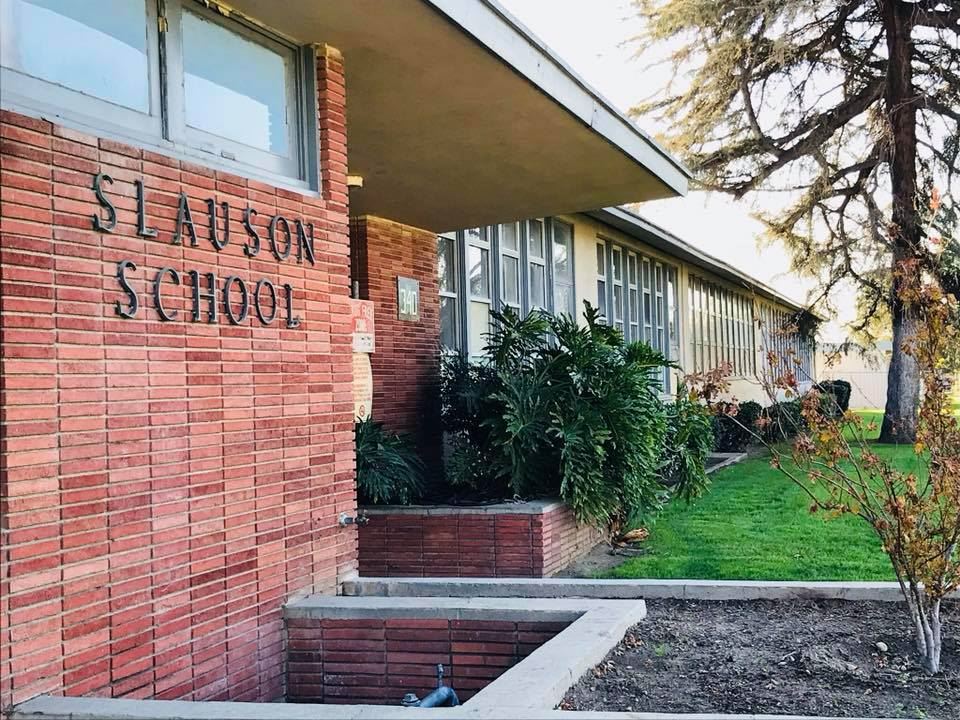
Young students are predictably impressionable creatures who emulate the teachers they admire.  And if that were true for middle schoolers at Slauson Middle School in Azusa, they would have the perfect teacher after whom to model themselves in Donna Hawkins.

Hawkins, who has been teaching science for 16 years, has recently been selected as one of 25 educators across the country to be the first participants in Northrop Grumman Foundation’s STEM Professional Development Program. This Teachers Academy is a joint collaboration between the National Science Teachers Association and Northrop Grumman Foundation which aims to elevate STEM education in middle schools in the districts located in Northrop Grumman communities.

This is Hawkins’ third year teaching STEM and has found the experience both stimulating and daunting. Project Lead the Way, an organization that offers training and collaboration for STEM teachers, has helped her immensely. Last summer, she took two classes at Cal Poly Pomona – Flight in Space and Designer Modelling.   

“Frankly, I’m slightly terrified. While this is an exciting opportunity, it also is a big commitment. But my children are grown so I have the time to dedicate to STEM training and teaching. STEM education is such an important part of students’ learning and future.”

The 25 science educators taking part in this Teacher Academy will be attending the 2016 National Conference on Science in Education in Tennessee. During the summer they will participate in a five-day workshop at a Northrop Grumman facility to discuss strategies on how to effectively integrate engineering design work in their classroom.  They will go through a two-week immersive externship at a Northrop Grumman facility where they will be partnered with an engineer or technologist to observe and experience STEM skills in action. What they take away from these activities will serve as their guide when they develop classroom projects with real-world applications.

Hawkins teaches Physical Science and STEM in 8th grade. This year she started a 6th grade STEM class where, she says, there are more girls than boys. She would like to see girls develop a passion for science.

“That’s what I like about teaching – being able to encourage students to take a real interest in science, technology, engineering and math. I try to make the subject as engaging and real-world as possible. I’ve recently started teaching knitting to make them work with their hands.  And there’s some physics involved in that activity even if they’re not thinking it,” Mrs. Hawkins relates.

Throughout her years teaching science, Hawkins has observed, “They either love it or they hate it. STEM is not a required subject and I make them apply for a place in my class. I want to see the students, who really love it, attend my class. With the Common Core in place, I no longer teach to the test. I can slow down a little bit to show my students how science applies to everyday things. We recently learned about mixtures and we broke them down to their basic components. It is such a joy when students’ eyes light up as they absorb what I’m telling them.”

Hawkins has always been interested in science. She relates the winded path that led her to  where she is. “I started out at Cal Poly as a pre-med student and took Biology and Chemistry  but I switched to Food Science and Nutrition. I thought of becoming a dietitian but it required more schooling, which I really didn’t want to do.

“After graduation, I took a job in quality control at a soup manufacturing firm. Then I worked for ten years at Miller Brewing Company. I loved working there but I didn’t want to do it my entire life – I just couldn’t see myself doing that forever.

“So I quit; my kids were small and I decided to spend some time as a stay-at-home mom. One day I was volunteering in my daughter’s kindergarten class and I helped a little boy write a story.  That was my Aha! moment – I want to do this; I want to be a teacher,” Mrs. Hawkins concludes.

Hawkins says she didn’t intend to teach science at first. She went back to school to earn a multi-subject credential and taught 2nd grade. After a year she found she didn’t like it and struggled with the realization that teaching may not be right for her. Nevertheless, she took some science supplemental classes at Mt. San Antonio College at night and then started subbing at Azusa Unified School District. She taught 8th grade science and enjoyed it.

Watching Hawkins today, one would be left with absolutely no doubt that she loves what she does. Recently, she taught her students how to use computer-aided design (CAD) using Autodesk Inventor, a program used by drafters, engineers and architects. By the end of the course, her students will know how to digitally create their own playground equipment.

If science could be this much fun, Azusa students will be breaking the door down to get into  Hawkins’ class!    

Arcadia High School Senior Makes Intel Science Talent Search Finals

Originally published on 28 January 2016 in the Pasadena Independent, Arcadia Weekly, Monrovia Weekly, and Sierra Madre Weekly

Seventeen-year old Arcadia High School senior, George Hou, has a lot of things on his mind right now. This is the time when 12th graders are waiting to hear back from the schools to which they applied. But college decisions aren’t what he’s currently preoccupied with – he’s busy continuing the research project that earned him a spot in the 75th Annual Intel Science Talent Search.

George’s research titled Separating Mixed Signals in Noise-Polluted Environments Using Global Optimization was prompted by his desire to find a better hearing aid for his grandfather. He says “I was very close to my grandpa growing up and enjoyed talking to him. He’s in his 80s and has always been hard of hearing so we had to raise our voices. But in December 2013 he completely lost his hearing and started to wear a hearing aid. Then he stopped using it because it only amplified the background noise.  All of a sudden we couldn’t talk to him and that came as a shock to me.” 

To help his grandpa, George investigated various hearing aids on the market to see if more expensive brands were better at filtering out background noise. But none of them could. Through his Internet search, he came across a book called The Mathematical Modelling and Signal Processing in Speech and Hearing Sciences by a UC Irvine professor, Dr. Jack Xin. He found it very interesting but realized his 10th grade math wasn’t enough to make him understand much of it. 

“I took a leap of faith and emailed the author and, to my surprise, he responded after a few weeks and even offered to mentor me,” George relates. “We developed a good relationship and he sent me various materials to read. That led us to pursue this further – using applied math we were able to use mathematical theory and analysis to develop an algorithm than can successfully separate sounds. We were able to prove that this can be done under specific circumstances. So all background noise can be separated individually – like birds chirping or people talking.”

For the next one and a half years, George worked on his research with Xin’s guidance. During the school year, he spent anywhere from seven to ten hours per week on it. In the summer months, he devoted nine hours a day and twice a week drove to UC Irvine, to confer and to show his progress to Xin. 

While George worked on this project on his own, outside of school, his teachers encouraged him to enter the Intel Science competition. He confesses that the application process for the competition was … “insanely long – like working on five college applications. I almost didn’t want to do it but my teachers spurred me on – they really were the driving force behind me. They all said I had nothing to lose.”

And that prognostication proved omniscient. On January 6, Arcadia High School’s principal received a letter from Intel Science Talent Search informing him that George has been selected one of 300 semifinalists. Arcadia High is one of 191 schools  across the country from which one or more Intel STS semifinalists were named this year.

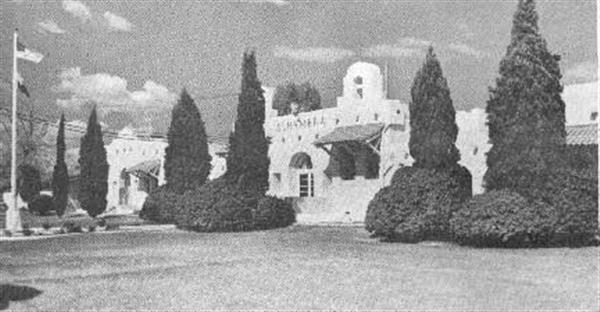
Arcadia High School

On January 20, George was named one of 40 students to make it to the final round who will attend the Intel Science Talent Institute in Washington, D.C. from March 10 – 16 to compete for top awards. Three $150,000 awards will be handed out; each Intel STS semifinalist and the school he or she attends will receive $1,000.

George is monumentally thrilled to be coming face-to-face with the judges. “I am mentally preparing myself to stay composed when I meet all these Nobel Laureates. I don’t want to embarrass myself by totally geeking out on them when they ask me about my work,” he confides.

I am also very eager to use this as a platform to share my research with other people and spread awareness. There are 360 million people worldwide with disabling hearing problems; maybe my idea will allow other researchers, inventors, and scientists to build off it. With our combined effort we could tackle the problem and create something to help older people hear better,” George concludes.     

Shortly after George returns from Washington, D.C. he will find out if he has been accepted to the schools he applied to. He wants to attend a large research university to pursue Applied Math and Signal Processing, and where he can continue to work on his project. He would like to come up with a robust algorithm and method to implement with current hearing aids.  In the future he would like to be able to design a new generation of hearing aids.   

At the very least, hearing problems could be a source of much annoyance for millions of senior citizens. If George is successful in his endeavor, there could one day be a hearing aid that older people would actually want to wear. And that would significantly improve the lives of seniors during their waning years.   

Dual Immersion Program at Alhambra Unified Schools

Originally published on 21 January 2016 in the Pasadena Independent, Arcadia Weekly, Monrovia Weekly, and Sierra Madre Weekly

There has been a sea change in the employment landscape in the past decade as evidenced by shifts in what’s available to people looking for work. Some positions that today’s youth would one day fill may not even exist yet, or may be located in foreign countries.

The Alhambra Unified School District has been actively finding opportunities for its student population to be ready for 21st century job requirements. This Fall, AUSD is rolling out its Dual Immersion Program to add to its slate of initiatives to make their students competitive in the global community.  

Leading this charge is Jim Schofield, Program Director. He says, “Dual immersion is critical because future jobs could be in other parts of the globe. More and more, we do business with other countries, and knowledge of the local language is essential. An employee who can speak, read, and write in the dialect is much more valuable to the company.” 

Schofield cites research to advance the case for dual immersion, “Although the majority of the world is bilingual, statistics show that only 17 percent of Americans speak another language; 56 percent of Europeans and 36 percent of Brits do. Being bilingual puts one on a higher tier in the American  job market.

“Health-wise,” continues Schofield, “it protects one against diseases like dementia and Alzheimer’s. A 2012 study conducted by the University of California, San Diego, revealed that of the 44 elderly participants who could speak both Spanish and English, those with higher proficiency in both languages were less likely to have early onset of either disease. While it doesn’t necessarily mean that being bilingual is the magic cure-for-all, it may help keep diseases at bay longer. Besides, it makes for a more enriching cultural experience; and being able to communicate is the best feeling in the world.”  

According to Dr. Gary Gonzales, Assistant superintendent for AUSD, the Dual Immersion plan started two and a half years ago as a collective effort by his division. He postulates, “We felt the AUSD is perfect for this initiative because of the diversity of our enrollment. Additionally, if we are to prepare students for participation in a global economy, bi- or tri-literacy is essential.”  

Based on AUSD’s research, students who are bi- and tri-lingual develop a high level of thinking, listening, speaking, reading, and writing proficiency in the targeted language and English beginning in transitional kindergarten through high school.

Dual immersion also inspires students to strive for academic excellence in all subject areas and meet or exceed California State Standards District assessment results. They also develop positive attitudes and appreciation for world languages and cultures, which promote their involvement in world issues.

And so, in March of last year, Schofield, who at the time was the principal at San Gabriel High School, was tapped to head the initiative. He went through a transition period and in July was fully on board. He and other AUSD administrators, instructional specialists, and teachers visited several schools with dual immersion programs to get ideas and to see for themselves how it’s working. 

Schofield remembers one particular school they went to in Venice and relates what they encountered. “We went there three months into the school year and the students were responding to their teacher in Mandarin. It was amazing how quickly they absorbed a new language! This is why we decided to start Dual Immersion in transitional kindergarten, when it is developmentally best to start introducing a different language.”    

AUSD chose Spanish and Mandarin because their research showed that 26 percent of California’s population speak Spanish, with two percent speaking Mandarin. Says Schofield, “While two percent doesn’t sound like a huge number, it is the second most-spoken language after Spanish. And the reality of the state of the economy is that so much business goes to China.  It’s safe to say that the U.S and China have a codependent relationship.”

The teaching method AUSD is adopting is a 90:10 and 50:50 model. The first number refers to the amount of instruction time initially spent for teaching in a partner language. The second number is the percentage of time for instruction in English. In a 90:10 model, the amount of time in the partner language decreases annually by ten percent until a 50:50 balance is achieved in the duration of the program.    

Schofield, describes AUSD’s model, “Each class will ideally comprise one-third English-speaking only students, one-third partner language learners, and one-third native speakers. The Spanish classes will be based on a 90:10 model – in kindergarten all the subjects will be taught in Spanish except for English Development, which is ten percent of the students’ day. As students move on to 1st grade, 80 percent of their subjects will be in Spanish with 20 percent of reading and writing development, and so on as they progress each year until they reach 50:50 in 5th grade.” 

Adds Schofield, “We are comfortable with having students learn using the 90:10 model because Spanish and English are both rooted in Latin and use Roman alphabet; there’s more transference with Spanish.”

The first Alhambra elementary school | Image taken from AUSD website

The Mandarin model, will be 50:50 at the outset. Schofield explains the rationale for this,  “Mandarin is made up of characters which students have never seen or encountered. Students will have Chinese language development, math, science and culture taught in Mandarin; English language, math and social science instruction in English.

“We have also determined to start educating in traditional Mandarin then switch to the simplified version.  I presented our plan to district constituents, parents, and students who wholeheartedly embraced our thinking,” Schofield continues.

AUSD administrators are currently on the curriculum-building stage on their Dual Immersion initiative, deciding on instructional materials. Schofield says they will be holding site meetings with the initial group of parents who have shown interest in the program. “They will have a lot of knowledge and input. In March, we will have the first official parents meeting with those whose children have been accepted into the program.”

To ensure students receive a high-quality education, educators in the dual language program will receive the same training in state standards and strategies all AUSD teachers get. The district will also hire only teachers who are authorized to educate on the specific language.   

They are hoping there would be enough community demand for the program as the district is committed to see it go all the way through 12th grade.  

“It will take 14 years to get there and by then I might be retired. But it would have been a great honor to be asked to lay the foundation for this program. If successful, AUSD students who have participated in it would be better equipped to enter in the competitive global community. And that would be a very satisfactory and gratifying outcome indeed,” Schofield concludes.          

Alex Israel’s Contemporary Ouvre at The Huntington Art Gallery

Originally published on 16 January 2016 in the Pasadena Independent, Arcadia Weekly, Monrovia Weekly, and Sierra Madre Weekly

The Blue Boy by Thomas Gainsborough is so representative of The Huntington (Library, Art Collections and Botanical Garden) in San Marino that it is usually the first piece of art people seek out when they tour the gallery.   

Visitors to the venerable San Marino landmark will either find it delightfully amusing or downright shocking when they see this iconic painting juxtaposed to a decidedly modern selfie of contemporary artist, Alex Israel, wearing a Dodger’s blue jacket. A year in the planning, this art intervention of works by Alex Israel opened to the public on December 12, 2015 and will be on view until July 11, 2016. 

Kevin Salatino, Director of the Art Collections at The Huntington, says, “Not everyone would associate us with contemporary art, but we live in the 21st century so we should engage with all that’s 21st century. People think this mansion must have been exactly what it looked like when the Huntingtons were here, which is so far from the truth; it is not a static house. But there is a certain consistency to the kind of Gilded Age material that we continue to collect that complement what the Huntingtons had.”

It may surprise many to know that The Huntington has done the occasional contemporary intervention before now. Catherine Hess, Chief Curator of European Art, relates, “Our first intervention was a Ricky Swallow sculptures and Lesley Vance paintings exhibition in a small upstairs gallery.  It was the beginning of the earthquake and we got our constituents through that.” 

The decision to approach Alex Israel this time around was Salatino’s idea. He explains, “I have known Alex and have watched his career flourish. He loves L.A. and its iconography, the Hollywood dream machine, and fantasy. And so much about The Huntington is really about fantasy. About a year ago, Alex looked at the house and thought about his pre-existing work to decide which objects are right for The Huntington.

Our goal is to create a dialogue between the old and the new; we want people to see the old through the lens of the new, and vice-versa. Some people might react positively but some might respond negatively, but that would be better than for them not to think at all,” Salatino concludes.

Hess interjects, “One of the biggest surprises, at least in my perspective, after the installation was complete, was how some traditional Masters pieces were remarkably informed by the juxtaposition of Alex’s art, and the reverse. His work, in a vacuum, can read a certain way, but placed in this context, makes it compelling. I’m hoping people will also see it that way.”

Continues Salatino, “This contemporary installation is meant to be engaging, provocative, interesting. Then it goes away and we’ll do another one in a few years. A really good reason for having Alex’s work here is that he has a love affair with this area. It was much the same for Henry Huntington who fell in love with it after he visited. He initially thought he would buy the land and divide it up, but eventually decided to keep it. It was one of the first Beaux Arts residences and was the largest house for miles around until it was supplanted by Aaron Spelling’s mansion in West Hollywood. Alex grew up in the Holmby Park circle, looking up at Spelling’s house.”

The culture of Hollywood and celebrity is very much the central theme in Alex Israel’s oeuvre. Sprinkled throughout The Huntington are paintings, murals and sculptures that reference famous movies or icons from memorable films. It is a veritable scavenger hunt for visitors to the Art Gallery as they find contemporary pieces that have been placed alongside traditional art objects. 

There is the crystal egg on a mantelpiece that was an iconic piece from the 1983 coming-of-age Tom Cruise film Risky Business, for instance. In another gallery, a cleverly concealed bronze prop will undoubtedly cause visitors to do a double-take at one of the most recognizable 1941 Maltese Falcon prop. In the ceramics study room, Alex displayed a mold of an Oscar statuette – the very quintessence of Hollywood and celebrity.

The most dramatic of Alex’s installation is the transformation of the staircase where a fragmented sky backdrop mural bursts. Enthuses Salatino, “It is an Aha! moment – with drama and theatricality in a way that is not intrusive but complementary.  It’s stunningly beautiful and it looks like it’s been there forever. It’s deliberately titled backdrop because it is a backdrop for films. It serves as one for every visitor as if each were an actor in a film.”

During the holiday season The Huntington’s Christmas tree stood in this area, which Alex decorated with his self-portrait in miniature. It isn’t an ego-trip but a celebration of celebrity.   

Alex likens today’s selfies to the Grand Manor portraits of the early 19th century. His Dodger blue-jacketed selfie isn’t meant to be tongue-in-cheek – rather, it is his homage to The Blue Boy. Hopefully, art enthusiasts appreciate it as such.    

January College Search Guide

Originally published on 7 January 2016 in the Pasadena Independent, Arcadia Weekly, Monrovia Weekly, and Sierra Madre Weekly

The road to college

FRESHMAN 

Typically, the beginning of the year marks the halfway point in the schoolyear.  First semester grades would soon be released, if they had not been sent out yet. If your 9th grader’s marks are not great, he/she would need to use the second semester to better them as it’s the end-of-year grades that show on the transcript. A student’s grades are a very important, if not the single most important, component of the college application. 

Make sure your children are continuing  their extra-curricular activities in arts or sports, with concentration on one or two where they excel. They shouldn’t attempt to dazzle college admissions directors with their range of interest, unless they are a budding Leonardo da Vinci and have mastered every single craft. Finding something they are truly passionate about and doing it throughout their high school years show their commitment. My daughter realized she loved acting only when she reached 11th grade. Thus, she didn’t have enough time to engage in it, and her resume reflected that. 

SOPHOMORE 

This is your student’s second year and by this time he/she should have fully transitioned into high school. He/she needs to put extra effort into weak subjects and solidify grades for the second semester. Your children should continue their focus on academic performance skills, sports participation and arts involvement. They should also start studying for the PSAT (www.collegeboard.com). Taking a practice PSAT in 10th grade gives them the chance to identify weaknesses then work on them before taking the NMSQT (www.nationalmerit.org) in 11th grade.

At my daughter’s alma mater, students meet with their grade level dean in the winter of 10th grade to discuss year-end testing options and junior-year course options. Sophomores enrolled in Advanced Algebra and Pre-Calculus register to take the SAT II Math Level 2 exam in June of their sophomore year. Those enrolled in Functions, Trigonometry and Advanced Algebra (FTAA) take this same exam in June of their junior year, after completing the Advanced Topics and An Introduction to Calculus-Honors (ATIC-Honors) course. Sophomores who are thinking of going into science, medicine, architecture and engineering are encouraged to take the SAT II exam in Chemistry in May or June of their sophomore year. Your student should also start lining up summer activities.

JUNIOR 

The second semester of junior year is significant as it is the beginning of the college application process. From their college research, students are now ready to start planning a visit to colleges. They can even do their initial campus virtual tours online www.campustours.com, www.CollegeProwler.com, www.SmartCollegeVisit.com, www.YOUniversity.com. College

counselors usually recommend that students use their spring break to go to several different types of schools. A good list should include a small liberal arts college, a medium-sized research university and a large state university to let them have a feel for what “small” or “large” school means. They should be able to experience firsthand if a large city like New York makes them feel alive and vibrant or if it totally overwhelms and scares them. They need to experience if a school with 20,000 students is the right setting for them. They don’t necessarily have to visit the schools they are actually considering applying to, this trip should give them ideas about what they are looking for in a university. Once they’ve established  the elements they are looking for, they can start making a record of schools they would put on their list of colleges to apply to. 

SENIOR 

All college applications should have already been sent out for the January 1st regular decision/admission deadline. Some universities, like Georgetown, have a later deadline.

Parents should already have filed their income tax returns; get ready to submit FAFSA (www.fafsa.ed.gov). Apply for scholarships. There are several websites to help you with your search like www.scholarships.com, http://www.collegexpress.com, www.scholarships360.org, http://www.affordablecollegesonline.org/graduating-debt-free.

 As much as I want to say “Tell your kids to breathe a sigh of relief because the hard part is done,” the reality is that they will be anxious because all that’s left now is the wait. And, oftentimes, the waiting is more difficult than the application process. Just be there for your kids to remind them that they have done a great job and they should let the admissions professionals do theirs.

The months from January through March can still be a time for your children to do something to help their cause. Mid-January is when high schools get their first semester grades finalized. If your student’s mid-year report is particularly spectacular, this could be a very good thing especially if he/she is applying to a highly competitive college. When your children’s high school sends the grades, have your children follow up with an email to the area representative telling them about their hard work and interest in that college.

If your children have been deferred at a college when they applied through early action or early decision, it is advisable for them to send in an additional teacher recommendation, but only if this supports their application. Likewise, if your student has received any notable honors or made any significant achievement, he/she should let the admissions officers know by email.     

Having done all these, you and your children will now just have to wait patiently for the process to play itself out.           

Kenneth Bell Mentors Duarte’s Youth

Originally published on 31 December 2015 in the Pasadena Independent, Arcadia Weekly, Monrovia Weekly, and Sierra Madre Weekly

As Ken Bell puts it, he might not be here today if it weren’t for a vice-principal’s timely and thoughtful involvement when he was a very young student living in Los Angeles.  

After Bell beat a gang member one Friday morning in school, word went around that there was going to be a showdown between him and the same gang member when school let out. The wise vice-principal sent him home 15 minutes before school ended and when the kids came back to class the following week, they had forgotten the incident. Thus, trouble was successfully averted.

That lesson he learned early in life taught him the value of intervention to avoid a possible combustible situation. It stayed with him during his years at the “Hard Core Gang Unit” in the District Attorney’s office.  And it was what prevented riots from breaking out after the Rodney King beating trial in 1992. 

Anticipating problems after the Rodney King proceedings verdict, Bell invited 19 inner city gang leaders to his church on 52nd and Hoover Street in L.A. to meet with the various police chiefs in LA County. Bell smiles as he recounts that momentous event, “No one has ever managed to get law enforcement officers and gang leaders together. It was tough getting them there, but it was tougher getting them to leave – the communication was so good that a certain respect was reached among them.”        

As a member of the Duarte School Board, Bell created the “Yes, We Can!” (As in: Yes, we can have a safe campus and get along as fellow students) program in the city’s middle schools. The program wasn’t anti-gang, it was anti-violence. According to Bell, he selected 25 student leaders on campus to serve as role models for kids in elementary school. With them, he talked about how they could be agents for the positive, how they could help identify brewing problems, and how they could stave these off before they escalate. 

With the sponsorship of The Gas Company, Bell held an all-day summer camp at Monrovia Canyon Park for these “Yes, We Can!” student leaders. He invited several prominent city officials, including district attorney, Jackie Lacey, to be guest speakers. During the camp, they also discussed possible situations they might come across, and how to handle these.

Dressed in T-shirts emblazoned with the “Yes, We Can!” logo, this multi-cultural group leaders visited all six elementary schools in Duarte. There they spoke to 6th graders and discussed transitioning to 7th grade. Alums of the elementary schools spoke of their middle school experience; this helped calm the minds of kids about what awaited them in 7th grade.

According to Bell, they also invited all 6th graders to spend a day at Duarte High School to vie in sport competitions. Students from the six elementary schools were mixed to play in the various competitions, in a fun environment. Boundaries were broken that day – students played together and they all had fun. Everyone realized that each one was the same after all and it made for a seamless transition into middle school where they will all meet again.           

The “Yes, We Can!” campaign was eventually handed over to the school counselors and Bell went on to start yet another initiative – STAR or Students Taking Action Responsibly. Some “graduates” of “Yes, We Can!” are now in STAR. It is a two-year program aimed at holding various campus activities promoting campus safety. 

Now Duarte Unified School District (DUSD) is known as the place Where Everybody Belongs (WEB). Transitioning from elementary to middle school or middle school to high school can be a daunting prospect. To help Duarte’s youth ease into new grade levels confidently and smoothly, DUSD implements national programs called WEB and Link Crew. WEB is a middle school orientation and transition program that partners 8th grade mentors with 7th graders. Every transitioning student is assigned a mentor and all student mentors go through an application and interview process; those selected then receive two days of extensive leadership and mentoring training.  

Throughout the year, WEB and Link Crew mentors put on various social and academic activities for the 7th and 9th graders, ranging from holiday parties to team competitions, to classroom lessons on bullying prevention and school success. More importantly, WEB and Link Crew mentors are a source of encouragement and support for 7th and 9th graders on campus, and the programs ensure that all students feel they are in a place where everyone belongs.

Schools, parents, and society, in general, are all responsible for providing a positive and safe environment for all young people Duarte students. He knows that young people need to be able to talk to someone they can trust. Timely intervention can save one young man from a gangster life. Bell can attest to that with utmost certainty.    

Bell’s efforts on behalf of the youth have not gone unnoticed. For his dedicated service to the affairs of the community and numerous contributions to the residents of L.A. County, the  NAACP Pasadena branch honored him with the Community Award. He was feted during the 30th Annual Ruby Knight Williams Awards Dinner held on October 8, 2015. 

For Ken Bell, it is a journey from a possible life on the edge of violence to one of model citizenship. 

‘A Christmas Carol’ at A Noise Within

Originally published on 26 November 2015 in the Pasadena Independent, Arcadia Weekly, Monrovia Weekly, and Sierra Madre Weekly

It has become an all-too common occurrence – hordes of buyers fighting over the last $99.00 BluRay disc player at a big box store the day after Thanksgiving, heralding the Christmas shopping season. But there was a time, before the Christmas spirit took on the guise of Black Friday doorbuster specials, when this season meant goodwill towards humankind.  

A Noise Within (ANW), a repertory theatre company in Pasadena, is bringing back the sentiments that this time of year should evoke. Beginning this Saturday, the 5th of December through Wednesday, the 23rd, San Gabriel Valley residents can come to enjoy its production of Charles Dickens’ timeless classic A Christmas Carol.

Julia Rodriguez-Elliott, ANW’s co-artistic director with her husband, Geoff Elliott, says this is the perfect antidote to the consumerism that has defined the Christmas season. She says, “A lot of people just want to break away from all the shopping during the holidays.”

This is the fourth year that ANW is mounting A Christmas Carol on their stage and Elliott and Rodriguez-Elliott are sharing directorial credits. This collaboration is hugely beneficial not just for the performers but for the audience as well. As Elliott succinctly puts it, “Co-directing makes sense; two heads are better than one.”

Being the more tech-minded director of the two, Rodriguez-Elliott concentrates on all the technical elements. She expands on this, “A director has to mind the lighting, costume, props and at the same time pay equal attention to the actors. When we co-direct, Geoff can give notes to the performers while I give feedback to the designers.”

“It isn’t that I don’t like the technical aspect of directing,” explains Elliott, “I have to say I enjoy it as well – though maybe not as much as Julia does – but I want to focus in greater detail  on the performers and the honesty of the moment.”

Rodriguez-Elliott, for her part, says “The more I do it, the more I appreciate the designers and what they bring – they can illuminate, elevate what you’re doing with the actors. A perfectly lit moment, or a visual scene done correctly, has an impact on the audience beyond what happens in the rehearsal room under fluorescent lights.”

This iteration of A Christmas Carol is Elliott’s 2000 adaptation from the original ANW production. He relates, “The original production was incredibly successful artistically but it was dark and bloody. When we decided to revisit it in 2000, we wanted to bring the light, the love between the Cratchits and other characters in the play. We needed a different take on it.”

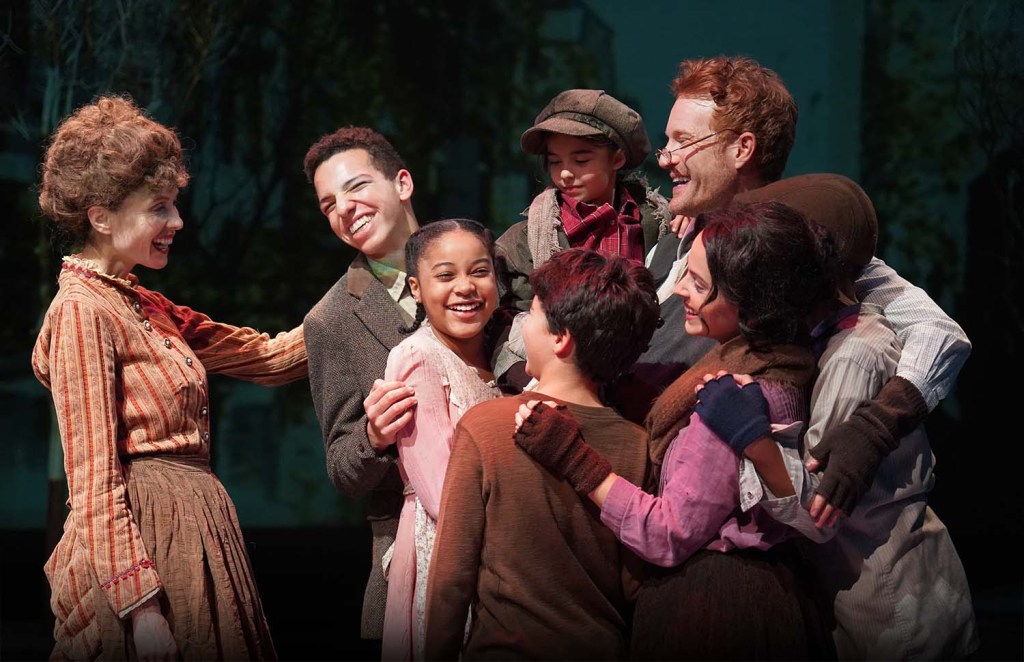
The Cratchits | Courtesy Photo

A Noise Within’s move to its present home in Pasadena was the excellent time and opportunity to mount this ambitious endeavor. Explains Rodriguez-Elliott, “The Masonic Temple didn’t have enough seats so it didn’t make much sense production-wise. With a finite number of days we can play it based on our schedule and the holiday, we wouldn’t have enough performances.  In this venue, we can give this adaptation a full run.”

It is a fortunate outcome for many of us who remember reading Charles Dickens’ memorable work of fiction growing up. That it is performed – with actual people on stage – gives this novella much greater extent and meaning.      

A Christmas Carol is the ultimate story of redemption and transformation ever written,” Elliott proclaims. “While we present the play every year, it is never stale because we always find something different to do. Even the performers who think they might want to take a break from it after having done it several times, come back to it because they realize it is a living, breathing fabric.”

Adds Rodriguez-Elliott, “I am seeing it fresh because I am in a different place from where I was a year ago. And as a director there’s always that feeling of ‘Gosh I’m not happy with this’. We have that opportunity to improve on it every year or make it better. And this is exactly what A Christmas Carol is all about – a tale of how even the most miserly curmudgeon on earth can change for the better.” 

“As scary as some children might think of Marley, and the Ghosts of Christmas Past, Present and Future, they are there out of love,” Elliott expounds. “They are all benevolent ghosts who want to help Scrooge. This is the attraction of A Christmas Carol; it is why people come to see it. We all want a chance at redemption.”

At the end of A Christmas Carol, Scrooge is overwhelmed with joy at the chance to redeem himself and is grateful for having returned to Christmas Day. He rushes out into the streets to share his newfound spirit. And from that day on, he celebrates the season by giving to the poor and treating others with generosity, kindness, and warmth.

How impressively mesmerizing it must be to behold this final scene as it unfolds before us! Maybe for longer than a few lingering moments, we wouldn’t equate Christmas with doorbuster specials. When Elliott pronounces that “live theatre is here to stay – it’s life changing,” this must be what he means. 

December College Search Guide

Originally published on 3 December 2015 in the Pasadena Independent, Arcadia Weekly, Monrovia Weekly, and Sierra Madre Weekly

The road to college

Cool and brisk weather, with wispy clouds scattered on clear blue skies, usually characterize December in California. Children are eagerly anticipating the Christmas season and winter break.  As we head towards the end of the year, some students are finishing up on the first semester, grateful that they are halfway through this school year.

FRESHMAN

What a relief it must be for your 9th grader – he or she has survived the first semester of high school. While your children’s thoughts may be all about Christmas vacation, this would be a good time to evaluate their progress. Remind them that while first semester grades don’t show on the final transcript, these are barometers of their academic strengths and weaknesses. Encourage them to use the winter break to plan how to improve where needed and how to build on their successes going into the second semester.

SOPHOMORE

If your children are taking AP courses they should also have taken the AP and SAT II exams.  They should take the time to meet with their college counselors for guidance on how to improve their test scores, if necessary. Now is the time to look at their interests to determine what college course they might be suited for. Based on their aptitude and grades, they will have to start planning on their course options for 11th grade. They can also start looking at which colleges offer the course they might want to pursue.

JUNIOR

This is an all-important year for your 11th grader and it is one of the busiest of their high school career. Your children should be able to successfully balance their academic and extra-curricular responsibilities. They should have already taken rigorous course loads, participated in campus activities and moved into positions of leadership in whatever extra-curricular endeavor they chose.

Your children should start preparing for the ACT or SAT exams either by taking practice tests online or by taking a prep course. By this time, college counselors have met with you and your children and given you an overview of the college application process. They should already have been to at least one College Fair and have met with a few admissions officers.

It might also be an opportune time to visit some colleges, at least the ones in California, before the spring break when you might consider going to out-of-town universities. If you haven’t thought about college visits, now is the time to put it on your calendar. I cannot emphasize enough how important it is for your children to see the campus for themselves. There is nothing more unfortunate than for them to matriculate to a college only to be miserable after the first few months. Adjusting to life away from one’s parents and the reality of college life is bad enough, finding out they are in the wrong school is just an added worry.

SENIOR

While kids all around are excited about the Christmas holidays – thinking about what movies they want to watch, and where to spend their time during their winter vacation – your high school senior is sweating over his or her personal essay or feverishly writing all the supplemental essays colleges are requiring when they submit their college application.  

This is a crucial time for every senior. He or she needs as much encouragement as elbow room to get their college applications ready for sending. Your children should be in constant communication with the school counselor to ensure that all transcripts, teacher recommendations and supplemental material are sent to all the colleges to which they are applying.  hey should be on top of application deadlines for all the schools to which they plan to apply.    

If your 12th grader has received an acceptance letter from his or her first choice – whether through Early Action (EA) or Early Decision (ED), then he or she must be ecstatic. An ED means your child is legally bound to matriculate to that university, and his or her college search is over. Whew!  If your child was accepted to a school through EA, he or she can either accept that offer or still go on to apply to other schools.

Accepting an EA offer relieves your children of pressure so they can enjoy the Christmas holidays but it doesn’t give them leverage if they are qualified for scholarships. The best scenario is to apply to and get accepted to several colleges so your children can pick and choose where they get the best financial offer or scholarship.

If your children are fortunate enough to have heard from their school, and have been offered admission, it would be thoughtful of them not to brag about their acceptance. Some of his or her classmates may have applied to the same school and are hoping for admission. The university to which your child was accepted might be his or her classmate’s first choice. It would be very hurtful to then boast that he or she has been accepted but is not planning on attending that college.

On the other hand, if your children have been deferred on the EA or ED round, there are some things they can do to enhance their chances during the regular round. They can write a strong letter of interest and intent – all colleges and universities are concerned about their yield. If they are assured that your child will matriculate if accepted, they will look at him or her in a more favorable light (that is, if your child fits the profile they are looking for). They can send any updates on any significant changes since they sent their application – a letter from a counselor about their first semester work or a letter from a senior teacher. They can also send in their first semester grades, especially if they have received some As in the meantime.   

Provide encouragement to your children if they have been deferred – the school isn’t rejecting them, they have just been put in the pool for the regular round. Remember that these admission officers have thousands of applications to read. They wouldn’t want to go through your children’s application again if they weren’t interested in the first place: they would have just outright rejected them.        

Your children should research all available scholarships, and start completing the FAFSA.

Some useful websites are: Affordable Colleges Online (http://www.affordablecollegesonline.org/graduating-debt-free); CollegeXpress (www.collegexpress.com); Fastweb (www.fastweb.com); Free Application for Federal Student Aid (www.fafsa.ed.gov); National Merit Scholarship Corporation (www.nationalmerit.org);  Scholarships.com (www.scholarships.com); Scholarships360 (www.scholarships360.org); Student Aid on the Web (www.studentaid.ed.gov).

The Life and Times of Y.C. Hong Focus of Exhibit at The Huntington

Originally published on 18 December 2015 in the Pasadena Independent, Arcadia Weekly, Monrovia Weekly, and Sierra Madre Weekly

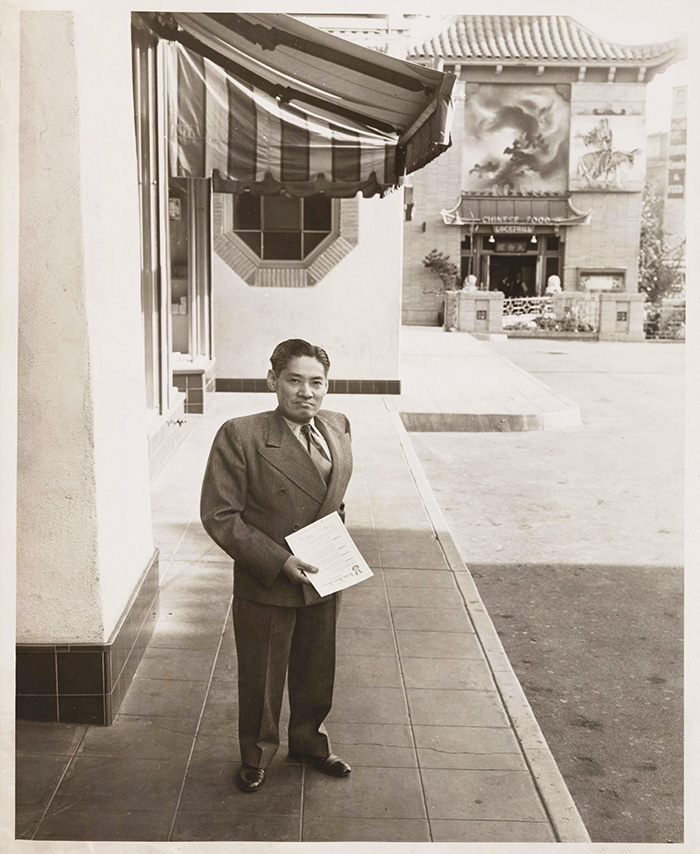
You Chung (Y.C.) Hong | Photo courtesy of The Huntington

The United States is one big melting pot – a land of immigrants who come from far-flung corners of the world. It’s almost inconceivable, therefore, that there was a time when Americans were openly hostile to certain foreign nationals who wanted to come into this country. And yet, this was the reality that You Chung (Y.C.) Hong, foremost Chinese-American immigration lawyer, encountered during the early years of the 20th century. 

A practicing immigration lawyer from 1927 to 1977, Y.C. worked relentlessly on behalf of Chinese settlers and, in the span of his career, helped over 7,000 enter the country legally. He was one of the Asian experts invited to take part in President Harry Truman’s commission to study and reform the U.S. Immigration system.

Y.C.’s history and life’s work is the subject of a show currently going on the Huntington Library, Art Collections and Botanical Gardens. Li Wei Yang, Curator of Western American History, says, “We were compelled to mount an exhibition because it was the first time the Huntington has received a collection about the life of a major Chinese-American figure in L.A. We felt it was important to let the community know, especially in San Marino and the San Gabriel Valley, that we are serious about the preservation of Chinese-American history. We want to show that we care about this community and that we encourage future collections of this kind.”   

To make the exhibition more accessible to a greater number of visitors, the Huntington presented it in bilingual form – translation panels are available to Chinese speakers. Six topical sections divide the 77 items on display – from a broad overview of why and how the Chinese came into the country to the last section showing the establishment of a family-friendly Chinatown in L.A.  

As the exhibit reveals, Y.C. was born in San Francisco in 1898 to Chinese-American parents who originated from Southern China. His early childhood was marked by two significant events – his father died at an early age leaving his mom to raise two boys on her own. And he was accidentally dropped by a relative who was taking care of him. The resulting spinal damage limited his full height to reach only four feet and five inches tall.    

In spite of his early misfortunes, Y.C. had a normal childhood. He graduated from Berkeley High School in 1915, then traveled around the country for a while, and worked as a bookkeeper at a Chinese restaurant in Boston. 

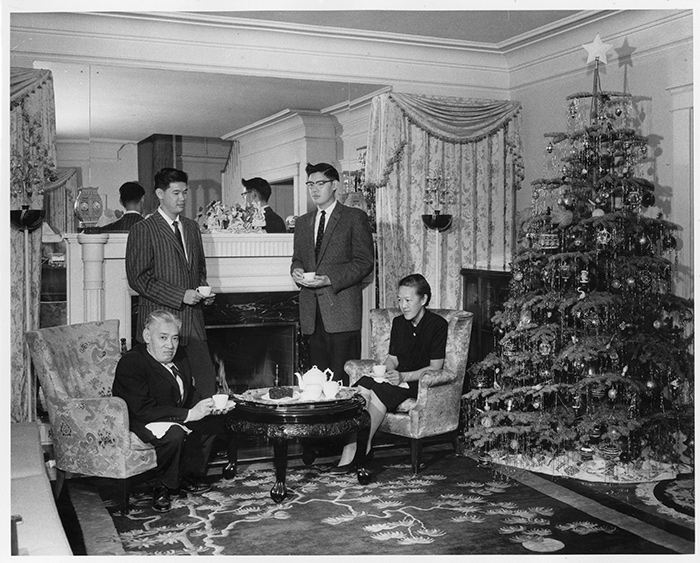
Y. C. Hong with his wife and sons | Photo courtesy of The Huntington

In 1918, Y.C. came to L.A. and was employed as Chinese translator for the Bureau of Immigration while attending night school. He passed the California Bar Exams in 1923, a remarkable feat as he was still a year away from receiving his Bachelor’s degree from USC. He was one of the first Chinese-Americans to be licensed to practice law; he graduated in 1924 and earned his Master’s degree in 1925 at USC. His 74-page Master’s thesis analyzed how the extension and administration of the Chinese Exclusion Act deviated from the original decree, making Chinese-Americans second-class citizens in their own country. In 1927, Y.C. became an immigration lawyer.

Y.C. grew up during the period when Chinese laborers were considered persona non grata. The Chinese Exclusion Act, which was in effect from 1882 to 1943, prohibited Chinese laborers from entering the country. Chinese miners who were in California during the Gold Rush were singled out, and had to pay $4 each month for the right to engage in mining. This tax practically legalized discrimination.

The Chinese Exclusion Act made it essential for every Chinese traveler to carry a passport when they came into the U.S. China’s Qing government issued passports to all merchants, missionaries, students, and all returning residents.

Beginning in 1909, all Chinese with legal status in the U.S. were issued Photo Certificates of Identity – a requirement which only applied to the Chinese, until 1928. This residence certificate became their proof of their legal right to be here – if stopped by the police, they had to produce such ID or they could be arrested or deported. It was eventually replaced by the Alien Registration Receipt Card, informally known as the “green card.”

As rules became ever more stringent, making it extremely difficult for Chinese immigrants to file the necessary paperwork, much less navigate the complex process, lawyers became requisite. Successful entry into the U.S. depended on their ability to recall precise details of family history during long hours of interrogation. While immigration officers used this deterrent, it didn’t stop the Chinese from coming as they adapted to the technique. Y.C. provided his clients with a list of commonly asked questions (which numbered in the hundreds), to which they constructed all the answers. They then used this “cheat sheet” to pass the test – they had found a way to outsmart the authorities. 

On March 28, 1931,Y.C. married Mabel Chin Qong, another Chinese-American whom he met during a Student Exchange in San Francisco in 1928. Mabel was one of the first Chinese-Americans to graduate from the University of Oregon. Their marriage produced two boys – Nowland and Roger.

In L.A. there was an old Chinatown which was a haven for gambling and prostitution. When it was razed in the 1930s to make way for Union Station, a group of Chinese entrepreneurs purchased land to build a new Chinatown on Broadway. It was designed and erected to appeal to families, and a place not just for the Chinese, but for everyone who wanted to learn about this Asian culture. It was the first planned Chinatown in the United States. Y.C. commissioned three buildings where he moved his law offices.

During World War II the Chinese became American allies as they joined the fight against a common enemy – Japan. Mabel helped the American Women’s Volunteer Services raise funds for and run the Chinese canteen, located in Chinatown, providing meal services and entertainment to servicemen in L.A. Approximately 1,500 military personnel patronized the canteen every month. Y.C.’s and Mabel’s war relief efforts in Chinatown were a huge success that a military ambulance airplane was named “Los Angeles Chinese” in recognition of their contributions.

A very astute man, Y.C. recognized the value of political connections sympathetic to the Chinese. He befriended politicians and contributed to their campaigns; he worked the system. 

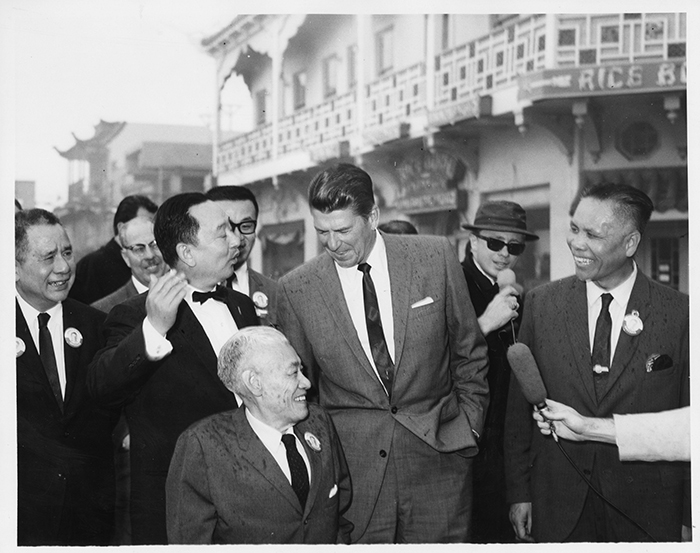
Y.C. Hong with Ronald Reagan, then governor of California | Photo courtesy of The Huntington

The Hong family papers document that in 1947 Senator Philip Hart introduced S747, which was merged with a bill proposed by Representative Emanuel Celler to form the basis of the Immigration and Nationality Act of 1965. This Act served as the foundation for the current immigration system, which abolished the National Origins Formula and emphasized job skills and family reunification.

Executive Order 10392, issued by President Truman on September 4, 1952 established the President’s Commission on Immigration and Naturalization. Y.C. was one of the experts invited to give their opinions. The Commission’s report “Whom Shall We Welcome” urged reform of the then-current immigration system. 

Y.C.’s and Mabel’s two sons went on to lead distinguished lives. Their older son, Nowland C. Hong, graduated from Pomona College in 1956 with a Bachelor of Arts degree. And, like his father before him, he matriculated at USC’s School of Law, earning his juris doctor degree in 1960. In 1961, he passed the California Bar Examinations and was appointed deputy city attorney of Los Angeles by City Attorney Roger Arnebergh. He served as chief general counsel for the L.A. Board of Harbor Commissions. He was also a founding member and two-term president of the Southern California Chinese Lawyers Association. He served as grand president of the Chinese American Citizens Alliance (of which his late father was an active member). He lives in Pasadena.

Roger S. Hong, their younger son, graduated with a Bachelor’s degree in Architecture from USC in 1965, and a Master’s degree in City and Regional Planning in 1968. He was certified as a licensed architect in many states, including California. Some of his notable projects include the expansion of the California Exposition and State Fair (Sacramento), Thomas and Mack Center (Las Vegas), Kunlun Hotel (Beijing) and Chieh Shou Sports Park (Taipei). He cofounded Arechaederra Hong Treiman Architects in the late 1970s. After his retirement in the early 1960s, he devoted himself to preserving his family’s history. Between 2000 and 2006, he donated the Hong family papers to the Huntington; he died of cancer in 2006.

Y.C. practiced immigration law from 1927 until his death on November 8, 1977. For 50 years the Chinese came to him for help and he responded with grace. He advocated for his people to gain acceptance into society and achieve economic stability. Any one of his countrymen who had lived through the exclusion era knew his name.

Circumstances beyond Y.C.’s control made him physically small and seemingly insignificant. But his unforgettable life and many accomplishments prove him to be extraordinary writ large.