Apache News at Arcadia High School Sets Journalistic Standards

Originally published on 16 March 2017 in the Pasadena Independent, Arcadia Weekly, and Monrovia Weekly

Monday through Friday, from 11:03 am to 12:02 pm, finds 20 of Arcadia High School’s (AHS) brightest broadcast journalists and technicians producing the week’s 15-minute Apache News (APN) show. 

This Advanced Video Production class runs its weekly meetings pretty much how television stations conduct theirs. Ryan Foran, Public Information Officer for the Arcadia Unified School District, who was a broadcast news reporter in the past, has high praises for this class.  

Foran says, “If you walk into KABC anytime today during their production meeting, it would look exactly like this – the news team will be talking about ideas, reporters will be pitching stories to the news director. When these kids go to college this is what they’ll see.”

“It’s a popular course and is difficult to get into,” according to Frank Nunez, who teaches the class. “Once the posting goes up, students have to attend an informational meeting to learn about the course prerequisites. There’s an application process, which includes an interview, and two teacher letters of recommendation are required. They have to have finished beginning and intermediate courses to be eligible for this capstone course, which they can take in junior and senior year. It is UC-credited and is one of the few Pathways in AHS.”        

It takes at least ten hours to create Apache News, which AHS airs every Friday during fourth period. Everyone in Nunez’s class contributes in some capacity and each is graded based on attendance, participation, and content. It’s a very time-consuming and intense course as seniors Andre Salcido, Simone Chu, and Will Atkinson can attest to.

Salcido, who writes documentaries and edits political news for APN, says, “There’s a required   daily class attendance – fourth period – and we also have to be enrolled in the after-school class that meets twice a week. We cover Saturday sports events on top of that, so we’re putting in a minimum of ten hours per week.” 

“But everyone likes this class because of the resources available to us; we know it prepares us for college,” Salcido adds. “The experiences I’ve gained have put me further along than the average student going into this field. While I had initially thought of taking film studies, I developed an interest in documentaries and last year I completed a multi-part project about the California drought. It was something which had never been done before – my documentary group used HD cameras and travelled to the Central Valley for weeks interviewing people, gathering case studies from area residents. It became a finalist in the Arcadia Film Festival and we were even invited to the Water Symposium ‘Save the Water’ where we showed our film and spoke about our experience.”

“This year I’m working solo on a documentary about mental health and have been talking with students with mental illness. At one point we got an invitation to interview the Director of Health Services for California. So there we were on a plane and I thought ‘I couldn’t believe the school is paying for us to fly to Sacramento for this class – we are in one of the best courses in the country!,” enthuses Salcido.        

Meanwhile, Chu, APN’s Breaking News and Political News expert charged with studio scriptwriting and editing, is an accomplished journalist herself.  She is currently editor of AHS’s newspaper and is a student columnist for the L.A. Times’s ‘High School Insider’. 

One of Chu’s recent segments for APN took her all the way to Oroville to cover the dam and ensuing spillway damage during the heavy rains in the state. She says, “I called up people in the area and I dialed into a press conference with the town”.

As political specialist, Chu was busy during the 2016 presidential elections. She discloses, “Before the elections I was running around the campus getting student opinions. We also held a mock election and compared our results with the rest of the nation. More recently, when Sean Spicer (White House press secretary and communications director for President Trump) banned certain media outlets from attending a press briefing, I was able to get a comment from New York Times Washington bureau reporter, Eric Lichtblau, for a story I was writing.”               

Handling two of the most exciting news assignments will keep Chu on her toes and in the thick of things. “Journalism has been my aspiration since elementary school,” she claims. “That’s why I pursued newspaper writing and when I had the chance to try out for APN, I took it. It’s intense but it’s a fun kind of intense. And the best part is that everyone is passionate about what they do; it’s quite refreshing to be working alongside people who give their best to put on a show very week.”

Atkinson is APN’s sports producer, tech manager and gag creator. While he is mostly behind the camera, he has reported for a few stories, is APN’s sports announcer and soccer commentator.  He creates the intro gags for the show and even acts in them.    
  

“I was recruited for this class and couldn’t be happier for agreeing to do it; this program taught me to work well with others,” Atkinson pronounces.  “We put in countless hours not because we’re getting paid but because we love doing it. And it has its flattering moments as I discovered when we were shooting the middle school play ‘A Monster Ate my Homework’. I was setting up the systems when a bunch of 8th graders asked, ‘Are you Will from APN?’ My tech director, Justin, told me they had been talking about my great hair for a while.” So much for preferring to being anonymous and a behind-the-scenes guy.    

According to Nunez, Atkinson is responsible for creating a relationship between APN and AHS’s sports teams and coaches. One of the reasons APN has been more visible lately is its expanded sports coverage and live streaming that started this year. It is a point of pride for Dr. Brent Forsee, AHS principal.

“I was with a bunch of friends one day watching an AHS game on my phone when they said ‘Hey, let’s watch that; how do you get that on TV?’. So we hooked it up and we all watched the livestream on TV. They were very impressed with the camera work and the play-by-play. It was all done very professionally,” tells Forsee.  

Ryan credits this degree of professionalism to Nunez, who has an extensive background in film technology and TV production. Before teaching Advanced Video Production at AHS full time this year, he had been travelling for ESPN’s sports broadcasts, flying the SkyCam for football games on cable television. He has won three Emmy Awards for his work. 

“It’s Mr. Nunez’s real-world experiences in livestreaming you see now on Fox Sports that’s allowing our students to get the high level of training in putting on a live sports event – using multi-camera sets on shoots,” Ryan declares.

While Nunez taught in college, he didn’t really set out to teach full time. He reveals, “I come from a live sports background; it’s something that I really enjoy. I was on the fence about taking this job because I didn’t know if this was quite the right time – I expected a much longer career in film and video. Bill Citrin, the previous teacher, roped me into teaching part time and it evolved into a full-time job. But it’s nice to get the chance to bring in that element of sports production, which I really miss, into this environment. I love the high energy games we go to.”      

“There’s quite an old history to this program. I was at an alumni event and had a conversation with the previous instructor, who told me that this began in 1986 as a sort of industrial tech class,” Nunez relates. “They built the very first camera they used for it – a toilet paper roll was utilized for the lens. Then it took off in 1997-1998 with Bill Citrin, who expanded the course to what it is today.”

An AHS alumnus himself, Nunez attended from 1998 to 2002 and was in Citrin’s class. He states, “I can say first-hand that I took this course and then when I went to UC Santa Cruz I didn’t touch a camera for two years until I started a news broadcast in college. I pretty much created that show based on this program and it’s still running there today. I got so much more experience here than in film school. I was so prepared; I had a leg up once I got to project management – shooting a film, pre-production work, etc. – all of which I had done here on a weekly basis.”

Nunez has big plans for the course, including creating a new weekly show, adding more sports themes, increasing content. He says, “We don’t call it a class; we’re professionals. I have very high expectations and I keep raising the bar lest we become complacent. We won’t rest on our laurels.” They have, in fact, begun work on a late-night comedy-style bonus show, the first episode of which they hope to air in early April.

When Forsee pronounces, “I’ve been extremely impressed with these students’ commitment to journalism. I could put us against professionals in the industry as far as what they’re practicing and learning,” it is a testament to the school’s confidence in the integrity of Apache News and the team that produces it.                                 
No Boundaries in Art and Talent at PUSD

Originally published on 9 March 2017 in the Pasadena Independent, Arcadia Weekly, and Monrovia Weekly

There is no shortage of artistic talent among Pasadena students as the upcoming 12th annual ‘No Boundaries’ will once again prove.

Scheduled to open on Friday, March 10, which coincides with ArtNight Pasadena, and running through March19, at The Shops on Lake Avenue, this art exhibition provides a platform for young artists in the Pasadena Unified School District (PUSD) to showcase their two- and three-dimensional art. Presented free to the public, gallery hours are Monday to Friday, from 3 to 6 pm; Saturday and Sunday from 1 to 4 pm. 

The exhibition is also a host site during ArtNight Pasadena on Friday, March 10. ‘No Boundaries 12’ is housed in a commercial space on 345 S. Lake Avenue lent for the occasion by Merlone Geier Partners as a giveback to the community. It will be a shuttle stop during the citywide free evening of art, music, and entertainment when Pasadena’s most prominent arts and cultural institutions open their doors.

ArtNight Pasadena, sponsored by the City of Pasadena Arts & Culture Commission and the Division of Cultural Affairs, is an ongoing partnership between the city and local cultural institutions. Twice each year, many of the city’s non-profit arts and cultural establishments open on a Friday night to provide a variety of art, culture, and music to the public free of charge.           

According to Jennifer Olson, District Arts Education Coordinator for PUSD, the first ‘No Boundaries’ was started by a former Pasadena high school teacher, Alex Schultz, and the former PUSD District Arts Coordinator, Marshall Ayers. It has always been a group effort involving Arts teachers, community arts partners, parents, and volunteers.

Olson relates, “The first year it was just middle and high school student work and it was all put up in one night in the wind tunnel at Art Center. The next year the District Arts Office decided to include every school, and the structure was set that informs how we still do it today. There is an arts representative designated at each school who selects between 12 and 32 artwork per school, depending on the size of the school and whether it is an elementary, middle or high school.”

All 26 PUSD schools submit their highest quality work which are organized visually (2D, 3D, video), rather than thematically. The exhibit is a monumental undertaking given the number of students and schools involved. 

“It is a gargantuan effort!,” Olson agrees wholeheartedly. “We started accepting delivery of artwork February 2, and the exhibition doesn’t open until March 10. So there are several weeks of registrar work – entering all the student information and statements – mounting all the artworks, and then of course building out the space, curating the art pieces, hanging the show, marketing, and event planning.” 

Continues Olson, “For many years we have had a district arts team/community arts team, and this is a major endeavour undertaken by that group. We also work with the Pasadena Educational Foundation to help us find volunteers to help with all aspects.”

“‘No Boundaries’ is a true community effort,” proclaims Olson.“We work side-by-side with our community arts partners, teachers, and parents to make this exhibition happen. By that, I mean if you walk in on any given day during installation, these folks are the people painting the pedestals, nailing up the student statements, and installing the promotional posters.”

Rochelle Branch, manager of the Cultural Affairs Division of the Pasadena Planning and Development, created ‘Bridging Boundaries’ in 2007 as an offshoot of ‘No Boundaries’ to expand access and highlight the collaboration between the City of Pasadena, and PUSD’s Arts Education. She says, “‘Bridging Boundaries’ references the connection between the city and PUSD, but also the geographic location of what we call the Student Art Wall which is near City Hall bridge.”

“Arts Commissioners and a member of the community attend the installation of the PUSD’s ‘No Boundaries’ exhibition and select artworks based on high artistic quality and merit,” Branch explains. “They provide a small tag that says ‘Arts & Culture Commission selection awardee for Bridging Boundaries Exhibition’. Everyone who goes to ‘No Boundaries’ will see the selected art.”

“When ‘No Boundaries’ ends on March 19, the selected pieces are taken to a professional framer and mounted in two installments at ‘Bridging Boundaries’ exhibition hall outside City Hall Council Chambers,” adds Branch. “The city contracts with Pasadena-based artist, Denise Seider, to curate ‘No Boundaries’ and ‘Bridging Boundaries’. For about five months, each student group will have its artwork up for public viewing.”

“Students get back their artwork professionally framed and get city-wide acknowledgement of the quality of their piece. They get to come with their families and friends and see their creation outside of City Hall,” Branch concludes.
          

Olson shares that sentiment when she declares, “The greatest joy of this project is seeing students come in with their family members, bursting with pride when they find their artwork and they see that it is professionally displayed like a ‘real artist’”.

This joint collaboration – among the City, PUSD, and Pasadena’s arts and cultural organizations – celebrates, showcases, and shares students’ artistic talents with the entire community. But more than public recognition, these young talented students’ self-satisfaction in their accomplishments may be the greatest reward of all.             

Near-Peer Mentoring for College Applicants

Originally published on 23 February 2017 in the Pasadena Independent, Arcadia Weekly, and Monrovia Weekly

A year ago, Emma Li was a 17-year-old high school senior at Arcadia High School, eagerly yet nervously waiting to hear from the colleges and universities to which she had applied. Today she is a freshman at Cornell University and a near-peer mentor to teenagers who are going through this same mind-numbingly complicated process called college applications.

Arcadia, where Li spent her childhood, is one of the San Gabriel Valley’s most sought after  districts because of its excellent schools. Indeed she was very fortunate to have attended Arcadia High School whose graduates are admitted to very selective universities – the class of 2016 had students who were accepted into every Ivy League university in the country. However, it also has a large enrollment. 

According Ryan Foran, Public Information Officer for the Arcadia Unified School District, there are 9.5 counselors at the high school. While every student from 9th through 12th grade is assigned a counselor, it is also a stretch for all 3,500 students to get face-to-face time with their counselor on a regular basis.  

Li says, “I actually started meeting with my counselor during freshman year because I needed assistance on applying to summer programs, which required a letter of recommendation to apply for. If I hadn’t wanted to attend these programs, I probably would have met with my counselor much later on. However, there are only two counselors assigned to each class and there were approximately 850 students in mine.”

“When we were seniors, we were assigned a counselor who would write the recommendations for our college applications, and that counselor might not have been the one designated to our class year,” Li adds. “I was lucky enough to have requested that my counselor for all four years write my counselor recommendation; I know that this wasn’t the case for many of my peers.”          

Still, Li felt it had been an impersonal experience for her. She explains, “There has to be an active effort on the students’ part to meet with their counselor or they will just get lost in the crowd. If I didn’t proactively seek it out, I wouldn’t get any time with the counselors. As it was, I didn’t see or speak with mine that often.”

“Most of my college application experience was on my own,” expounds Li. “My counselor gave me a few recommendations when I had my interview with her; she told me to look at some more schools. On a few occasions, my teachers suggested universities that might be a good fit; another helped narrow my choices after I received acceptance letters. Older students also helped with my essay.”

A first generation Asian-American whose parents are immigrants from China, Li didn’t get much guidance from them. She states, “My parents have only been here for two decades and didn’t have any experience in U.S. college application. So I was pretty much on my own. I did a lot of research and applied to 15 schools – five UCs and ten private universities – but I only visited a handful of them.”   

Li was accepted to UC Berkeley, Williams and Cornell. She didn’t visit Cornell but decided to matriculate there based on a friend’s recommendation. She says, “I think that being in college is  overwhelming for almost all of the people I met. Before coming here, I had expected to be intellectually challenged, to meet people who’ve done incredible things, to join clubs and organizations that would allow me to pursue the interests I had in high school or to explore new passions. In that respect, Cornell lived up to what I had anticipated, but at the same time, so could any other college that I had applied to. The way I see it, my expectations were about college itself than about this school in particular. I don’t think visiting Cornell would have altered what I hoped to experience, although I would have been able to picture myself walking to class or eating in the dining halls.”

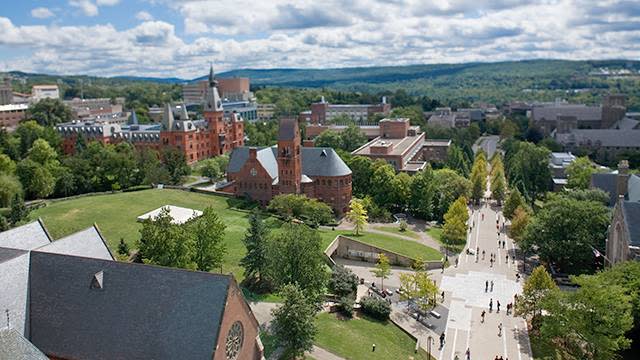
Cornell University | Image taken from Cornell University’s website

From Cornell’s Facebook page, Li learned about a company called CollegeVine (CV), which helps families navigate the path to the best schools. She applied to one of the jobs and internships it was offering for Cornell students and was accepted.

Asked why she decided to become a CV mentor, Li answers, “It’s probably a mix of two reasons. Firstly, I was a tutor for many years and I enjoyed doing it; but there aren’t too many similar programs in college. Secondly, when I was in high school, a lot of the help I got with my essays came from older students who were attending the schools to which I was applying.”

“There are many college prep companies in Arcadia to help students through the process, but I find that they are primarily staffed with older people,” adds Li. “What’s really appealing for CollegeVine clients is that the counselors helping them are in their age group. In that sense,  CollegeVine is more effective because the consultants recently applied to college, know what it’s like and share a common experience of the pressure of applying.”

Li went through intensive training – on completing the common application, writing a compelling essay, interviewing techniques – to become a CV mentor. She got her first client, an international student, in September last year. 

Because the academic system in other countries isn’t the same as in the U.S., Li’s first job required her to do a lot of paperwork and research. She spent three hours a week working – one-and-a-half hours doing research and the other one-and-a-half hours video chatting with her client. She checked her student’s essay for grammatical errors and organized it, while ensuring it still had her client’s voice.   

“My client applied to seven U.S. schools and a few in her home country,” relates Li. “She concentrated on colleges with rolling admissions so she sent her first application early on and was accepted to her first choice school in mid-November. I was very excited for her! On top of that, she got a half-ride scholarship which her parents didn’t think they would qualify for.”

College counselors in private schools discourage their students from hiring independent consultants to help them through the application process. By necessity, though, those who are in large, public schools who can’t see their counselor regularly have to seek additional assistance.

As Li emphasizes, “I definitely think that getting outside help will make students more successful, just because they can have the personalized attention they don’t receive in school.  Independent counselors like me can better assess students’ strengths and weaknesses to find the best way to present them to college admissions officers.”

“It also benefits students to have someone who can recommend ways to handle less-than-ideal scenarios,” Li says further. “As a counselor, I provide an alternative point of view if they’re deferred, waitlisted, or rejected. Having gone through this process recently, I can honestly tell my clients not to make senior year more stressful than it already is. While it might be the culmination of everything they’ve worked for 12 years, it all comes together in the end.”

College application is a rite-of-passage for most teenagers in this country. And as Li could personally attest to, it is at once nerve-wracking and thrilling. Now, as a counselor, the most rewarding aspect of her job is being able to relive its best moments.                            

‘King Lear’ and ‘Man of La Mancha’ Share Similar Worlds at A Noise Within

Originally published on 14 February 2017 in the Pasadena Independent, Arcadia Weekly, and Monrovia Weekly

Resuming its 25th Anniversary celebration, ‘Beyond our Wildest Dreams’, A Noise Within puts on a production of William Shakespeare’s King Lear which will run in repertory with Man of La Mancha later in the spring. Geoff Elliott and Julia Rodriguez-Elliott, co-producing and artistic directors of ANW, have conceived these two shows to be seen on the same day, allowing them to fully speak to each other. 

Both shows share the same leading man (Geoff Elliott), the same director (Julia Rodriguez-Elliott) and the same scenic elements, enabling a quick turnover between matinee and an evening performance so the two productions can play on the same stage.  

Of the opportunity to perform both Lear and Cervantes/Don Quixote, Elliott pronounces, “I feel I know Lear. He is stripped of everything, and must face his worst demons to find tenderness and uncompromising love in a very violent world. Lear spends so much of the play terrified of losing his mind. Anyone who goes through a similar self-investigation can’t help questioning his sanity as so much of the world that we live in seems insane.”

Continues Elliott, “In his way, Cervantes/Don Quixote is Lear’s doppelganger. As he assumes Quixote’s persona, Cervantes gains the courage and the strength needed to face the uncertain future of the Inquisition. He, along with his fellow prisoners and, ultimately, the audience are transformed.”  


King Lear | Image taken from A Noise Within’s website

Says Rodriguez-Elliott, “In Lear, this personal journey of a family dealing with an ailing patriarch has global implications. The breakdown of a nation runs concurrent with Lear’s mental decline. At the beginning of the play, we see a man at the zenith of his power, a modern day dictator who is feared and has never heard the word NO. The world we enter is a violent, callous one. At the end, we see a man transformed.”

The world of La Mancha is as violent and callous as it is ripe and crying out for transformation. “Though many often associate Man of La Mancha with elaborate set pieces and fanciful costumes, its earliest stagings were sparse, encompassing the spirit of a rag-tag band of prisoners putting on a play with found objects,” explains Rodriguez-Elliott. “I wanted to return to those roots. Based on real-world prisoners, the conditions we’ve created for Cervantes and his fellow inmates are recognizable and terrifying.”

Audiences will likewise be transported to these worlds, in large part, because of the actors’ excellent portrayal of the characters they will inhabit for the next two hours. However, stage plays are a collaboration among many – actors and directors; as well as designers, which include costume, lighting, and set – and their success depends on how seamlessly these collaborators work together to create one magnificent piece.  

That Lear and La Mancha also share artistic team members – Fred Kinney (scenic), Angela Balogh Calin (costume), and Ken Booth (lighting) – makes for an exciting experience for the audience and for everyone involved in both productions as well.

Booth, ANW’s resident lighting designer, who has worked on over 40 productions for ANW since 1998 says, “I’m thrilled to be a part of it; this kind of challenge doesn’t happen a lot in small theatres. For Lear I am using a palette of warm and cold lighting, often in combination.  You don’t really see the source of light but it’s there being filtered through some unknown artificial source. Shifting the temperature of the lighting within a scene helps to punctuate or accent a moment. Highlighting one particular character helps create dramatic conflict within that character.”

“Lighting defines and redefines the performance space; it can influence the mood for the play and the audience. It enhances the atmosphere for the actors who are on stage to share their art and emotions with their audience,” Booth adds.

Man of La Mancha | Image taken from A Noise Within’s website

“Both Lear and La Mancha deal with a man with delusions of grandeur. The conflicts in both come not from without but from within the characters – their inner dilemmas of importance and immortality that affect them. To connect both stories, I will create lighting that seems omnipotent in certain scenes and confining for others. Beyond the giant set wall the plays share, you only see shafts of light that emanate from behind a window or door whenever it is opened. The wall is the horizon – there doesn’t seem to be an outside world – and for the most part the lighting of the wall is the same: a cool or bluish wash, beams of warm light seeping down; and a filtered break-up catching parts of it.”

Angela Balogh Calin, resident costume designer for ANW, has worked with Booth since 1998. She says she hasn’t done many shows when Booth didn’t light. “We go back a long time,” she declares. 

“Both Lear and La Mancha are going to have modern setting so costume-wise, I will give them a modern approach,” Calin discloses. “The clothes will be something the audience will be able to identify with; they will be easily recognizable. Lear will be eclectic, with 1950s flair.”

Lear and La Mancha will only be Fred Kinney’s second and third shows with ANW. An independent scenic designer, he was contracted for both shows last spring and immediately did his research. 

“I think Shakespeare’s work is better heard not read; so I watched a couple of film versions of Lear before I started conceptualizing the scenery,” Kinney reveals. “For La Mancha, I listened to the music and then watched the film. Then I came up with a concept that could work for both but different enough. They are unified in theme but the design will have enough variety to service the individual parts of the shows – the things that are unique to each production. I will have a base layer to which I can add elements to make the scenery distinctive to each.”

ANW provides a unique environment in which artists work together across decades. They are comfortable experimenting, trying new things; impressing as much as supporting each other show after show. These artistic relationships inform each of this repertory theatre company’s many exceptional productions for 25 years.

Booth expresses says it best when he says, “I want our audiences to remember what an otherworldly universe we created within our theatre for our interpretation of King Lear and, hopefully, they get a satisfying feeling of bittersweet closure. This is what I find exciting – the collaboration in putting on a production – to take a blank stage and create a beautiful picture that is like a painting come to life using the limited tools at our disposal.”

Pasadena Master Chorale Fosters Young Musical Talents

Originally published on 17 January 2017 in the Pasadena Independent, Arcadia Weekly, and Monrovia Weekly

Jeffrey Bernstein, Artistic and Executive Director of the Pasadena Master Chorale (PMC), has always been into music and music-making. He started playing the piano when he was eight years old; when he was 13 he sang Beethoven’s Ninth Symphony in a choir. 

It isn’t surprising, therefore, that Bernstein’s interest in music grew through the years. He  relates, “Like many people, I came to choral music in school. For me it was in college, at Harvard. That’s a natural place to have terrific experiences of community. In a way I realized I wanted to give that experience to people who weren’t going to leave in four years. I wanted to see what it was like to deepen that sense of community and to be embedded in the broader Pasadena community.”

In 2009 Bernstein founded the Pasadena Master Chorale which he imbued with his own personal stamp to distinguish it from other choral groups. He explains, “For one, we’re auditioned and it’s a pretty rigorous process. We take, on average, less than half the people who audition for us. We also re-audition the group every year so singers have to demonstrate they’re continuing in keeping up. I believe the higher the quality of music-making, the greater the sense of community.”

Bernstein continues, “The other thing that sets us apart, and which I’m very proud of, is our pricing model. Our concerts are offered on a ‘listen first then give’ basis; we sell tickets for zero dollars. We want people to attend our concert then offer a gift to us as they are moved and able.  We started this concept two years ago and our attendance and revenue have since gone up.”                              

“There are obviously people who can’t give very much, and I’m very proud of the fact that our concerts are so accessible to everyone. And there are people who give very generously because they recognize the value of what we do,” Bernstein opines.

Knowing that children are exposed to singing in a choir at a young age – whether it’s through a church or at school – Bernstein established an education program to foster middle and high school students’ love of music.

Expounds Bernstein, “Since we started we have always been involved with young people singing with us. It’s at the heart of what we’re trying to do – to create opportunities for young people who love choir music to learn about it and perform it. The program has grown tremendously and we currently have three offerings.” 

Image of Pasadena Master Chorale taken from South Pasadena News

According to Bernstein, their program for student singers is open to all Pasadena middle schoolers with a teacher recommendation. They rehearse with PMC’s associate conductor, Lauren Buckley Schaer, and perform a couple of pieces at the beginning of two of their concerts – Handel’s ‘Messiah’ and the Brahms concert. 

With a teacher recommendation, high school students who want to get a deeper experience with choral music can join PMC as apprentice singers. Says Bernstein, “They rehearse with us every Monday night as full members and they sing all the pieces the PMC does, including the ‘Requiem’ which we sing in German. This is a much smaller group of students because it is a big demand on their time and requires more familiarity with choral singing.”

Bernstein adds, “This year, we are again holding a program we began last year called ‘Listening to the Future’. Through an application process, we select composers from local private and public schools. We team them up with a composer mentor who meets with them almost weekly starting in November through June. They write music for us and we perform their work. PMC’s final program of the year is entirely composed by high school students. June last year was the first time we put on this program and it was a huge success!”

“We had four composers last year; this year we have six and they’re already writing. During the spring they’ll come to our rehearsal every now and then to hear us sing their composition. It’s thrilling! It’s hard to tell who’s more excited – the students or the singers. It’s great to work with living composers, but to work with someone so young …. This is a rare opportunity for  young composers to have a group play their composition, sing it and take it seriously. It’s almost unheard of. That’s a program I’m very, very proud of,” Bernstein proclaims.                                                         

“I’m a big champion of young people and music-making,” Bernstein expands. “I want our organization to serve the youth at as many different levels of development as possible. For this young composers program, we’re looking for students who are willing to roll up their sleeves and do the work. They must have had music training – maybe sang in a choir or played in an orchestra or band – and have a teacher recommendation. But we’re not going to judge their potential as creative people; instead we’re here to foster their talent and let them run with it. 

Last year we came up with four completely diverse sets of music. It was beautiful!  We don’t change what composers create, we don’t want to get in the way. We want to encourage creativity and we sing what they write for us.”

Image taken from The Hollywood Times

‘Listening to the Future’ commences right after Labor Day, when PMC publicizes the program and accepts applications. At the end of October, PMC selects the composers who start working with mentors in November. Both mentor and student develop a schedule for what pieces need to be written and when. Each composer will write at least one arrangement of a folk song which should be finished by February and one original composition which they will write from February to April.

Bernstein says of this program, “Composing is a form of communication. Student composers are communicating with the singers and singers are communicating with the audience.  We emphasize that the score has to be neat and without errors. Composers have to take into consideration if the words are easy to read, if the harmony is understandable. 

It’s a very interesting process for these young students to experience. They spend months alone in a room in front of their computer or with a piece of staff paper writing their composition.  Their faces light up when they hear a roomful of 60 people transform that music off the page.  It’s utterly amazing when that happens!”

Pasadena Master Chorale holds five concerts a year. Its 2016-2017 season began on December 11 when the group sang Handel’s ‘Messiah’ at First Congregational Church in Pasadena. On January 15, PMC performed Beethoven’s Ninth Symphony at the Oratani Theatre in Downtown L.A.  Brahms Unbound follows on April 22 and 23 at the Altadena Community Church. On June 10 and 11, PMC will be back at the Altadena Community Church to sing two pieces: Heinrich Schutz’s ‘Musikalische Exequien’ and Gabriel Faure’s ‘Requiem’. The season ends on June 25 at the Neighborhood Unitarian Church in Pasadena with a ‘Listening to the Future’ concert.

Financial support for PMC comes from the L.A. County Arts Commission, Pasadena Community Foundation, Pasadena Showcase House for the Arts, the City of Pasadena, and through various fund raising efforts.                 

While PMC has come far since Bernstein founded it, there are more things he wants to accomplish. He wants to one day be able to purchase a building to house their education program, for students to come in five days a week after school, with a staff of people who can provide training – from individual voice lessons to music theory – and who will encourage students to have their own choral group with leadership.

“It’s limitless what you can do and realize what difference you can make in one kid’s life … not just with choral music, but for them to have a place to belong,” Bernstein states wistfully.         

Table Tennis Demonstration Energizes Morning Assembly

Originally published on 26 January 2017 in the Pasadena Independent, Arcadia Weekly, and Monrovia Weekly

Morning assembly at Clairbourn School, a pre-kindergarten to eighth grade independent school in San Gabriel, was more animated than usual this Tuesday morning when students and parents arrived in the multi-purpose building (MPB). That’s because they were getting a special demonstration on table tennis after all the announcements are over.

Table tennis originated in Victorian England as a ‘parlor game’ when lawn tennis players moved the game indoors during the winter. It got the name ‘ping-pong’ at the end of the 1800s when the English firm J. Jacques and Son started manufacturing high-end equipment for the sport and trademarked the brand. It was later trademarked in the U.S. by board game company, Parker Brothers.

On April 24, 1927 the English Table Tennis Association was created with a membership of 19 leagues; it has since grown to its present 300 members, with approximately 75,000 registered players.  In the 1988 games in Seoul, South Korea, table tennis became an Olympic Games sport for the first time.   

While it had seen widespread popularity in the western world, it was China which took table tennis to new heights when Communist Chairman Mao Zedong declared it as the country’s national sport. Today, a reported 10 million Chinese play competitive ping-pong regularly and 300 million who play it occasionally. It won the gold in all four table tennis events at the 2016 Summer Olympics; it has taken home 28 of 32 gold medals since the game was introduced as an Olympic sport.     

Recognizing that Clairbourn has a large Asian population, Dr. Robert Nafie, headmaster, decided to acknowledge Chinese pride in their excellence in this sport and share it with the school community as well. Through Clairbourn parent, Harry Tsao, he found the California Table Tennis Club, an organization established four years ago by Gao Jun, a world champion who went to the Olympics five times in her career and currently an Olympic trainer. In its location at 2727 Stingle Avenue in Rosemead, it holds classes every Saturday and Sunday, as well as private lessons, for its 60-80 students aged five to 86 – some coming in for competitive training while others simply looking for a sport to enjoy.           

The team from the California Table Tennis Club – Gao Jun; coach Candy Tang; international table tennis player, Ryan Wu; club managers, Kevin Yu, and Lydia Zu – came on campus and set up their table for this morning’s assembly.  Jun, acting as facilitator, invited students to play against the coaches to show the different positions, strokes, and moves. 

There wasn’t a shortage of volunteers as several students raised their hands. First up was 5th  grader, Kelly Tsao, who demonstrated the ‘forehand’ when she played against Coach Ryan.  Eighth grader and Student Body president, Nick Polen, showed how the ‘backhand’ is played.

Clairbourn School’s Randall Hall | Photo take from Clairbourn School’s website

Sixth grader, Piper Kibbe, who followed, was clearly new to this game but Coach Gao took her hand to demonstrate how the paddle should be held to play table tennis properly. Kibbe quickly picked it up and had great fun using the ‘forehand’ and ‘backhand’ strokes. Second grader, Jason Qi, was a good sport and got the hang of it too.

To invigorate the game with faster strokes Jun called upon 4th grader, Madeline King, who lived up to the challenge with some fancy footwork and the more advanced ‘loop’ and ‘chop’ strokes.  She clearly isn’t a stranger to this game.

Mac Cole, 8th grader, wasn’t to be bested – he showed some very quick moves. But it was when 2nd grader, Atticus Williams, went up to the table that all the students fully erupted to life. With all the kids chanting “At-ti-cus! At-ti-cus! At-ti-cus!”, he demonstrated that while he wasn’t as adept at the game as the students who preceded him, he undoubtedly possessed an unmatched confidence at playing. Not to be outdone by his students, PE coach, Luke Ball, performed admirably.  

When the facilitator asked for a parent volunteer Li Feng came forward and showed everyone how graceful this game looks when played by someone who knows it well. She held her paddle in ‘penhold’ position, she had her eyes firmly peeled on the ball, she was fast and fluid, and she knew exactly when to crush her opponent.  

To end the demonstration, the table tennis coaches and Clairbourn’s Coach Luke played Doubles to everyone’s delight. A great time was had by all. With an obvious spring in their walk, parents left to go to work, run errands, or stretch at the gym. Students and teachers headed to their morning classes unmistakably energized.

Nafie has once more found another interesting experience for students that may not necessarily relate to their learning. But as he says, “I want to make sure the school is alive for the kids; that it’s not all drudgery.” Mission accomplished.           

A Noise Within’s ‘A Christmas Carol’ is a Glorious Production

Originally published on 8 December 2016 in the Pasadena Independent, Arcadia Weekly, Monrovia Weekly, and Sierra Madre Weekly

The joyful observance of the holiday season isn’t complete without annual traditions one remembers with nostalgia. At A Noise Within (ANW), the classical repertory theatre company in Pasadena, it means a restaging of Charles Dickens’ A Christmas Carol. 

Celebrating its  25th anniversary and its fifth production of this time-honored tale, ANW will have 16 performances of A Christmas Carol starting Friday, December 2 and closing Friday, December 23, 2016. Producing Artistic Directors Geoff Elliott (who adapted the play from the novella) and Julia Rodriguez-Elliott co-direct this masterpiece about the redemptive power of love.       

Much like ANW’s ardent followers, the company’s resident artists look forward to this year-end event with anticipation. “Remounting our acclaimed presentation of Charles Dickens’ A Christmas Carol allows families to once again take a supremely theatrical journey, and celebrate the transformative power of forgiveness during the holidays,” says Elliott. She adds, “Ebenezer Scrooge’s rebirth from miserly curmudgeon to the epitome of love and generosity affirms our faith in the potent goodness of humanity during this beloved time of year.”   

“The beauty of going back to these great works is that you have a history with it – because they are in your muscle memory, you have the opportunity to discover new things,” explains Rodriguez-Elliott. “You don’t have the same pressure of having to create something for the first time; it’s very lived in.”

“For me there’s a unique aspect every year  – I can see something from a different perspective because I’m a year older,” Rodriguez-Elliott continues. “There are elements of a particular play that have altered because of where we are personally and where we are as a country. It takes on a different meaning for everyone, depending on where one is in life at that time.”

But wherever one finds himself in life, when the entire ensemble belts out Ego Plum’s majestic song ‘Glorious’ at the close, one will understand why it was undeniably worth the wait and coming back for. ANW’s A Christmas Carol is like aged wine – its flavor gets deeper and richer with each year. One could never have too much of it.               

One thing that will change annually is the casting of the Cratchit children. As Rodriguez-Elliott relates, “Last year, resident artist Freddy Douglas’s son, Eli, was too young but we knew at some point he would be right for Tiny Tim. He has a little sister who is in the wings getting ready for her turn. She knows all the songs and sings them in my ear during rehearsals.”

Ashlyn Woo, an eighth grader in Suzanne Middle School, plays Belinda Cratchit this year. She has previously attended the Fine Arts Academy of Dance and Summer with Shakespeare to prepare her for stage acting. While she has been in other shows, including the Nutcracker, this is her first professional performance in an ANW production. 

Enthuses Woo, “I found out I have been picked to play Belinda and be a part of the ensemble on a Friday after school. I read A Christmas Carol in seventh grade and now I’m a character in a production of it! How amazing is that!”

“To be in the show, I’ve had to do my homework in the car and sometimes during rehearsals,” Woo confides. “But it’s so worth it.”   

The Cratchits | Image taken from A Noise Within’s website

Another young actor debuting on A Christmas Carol as a Cratchit child is Samuel Genghis Christian. A sixth grader at Blair Middle School in Pasadena, he also trained at Summer with Shakespeare and Youth Conservatory at ANW.

Christian reveals, “I knew I wanted to perform on stage when I saw A Christmas Carol for the first time two years ago. It was one of the most exciting experiences of my life besides watching Harry Potter and the 2015 Super Bowl!”

“It was easy for me to get into the role once rehearsals started because I had seen the production before; I knew what it was going to be like,” adds Christian. “It’s such a wonderful show and I invited all my classmates and teachers to see it. My English class is coming to a student matinee.”

Of his time on the set of A Christmas Carol, Christian exclaims, “Everybody has been super nice to me and I feel really at home. It’s fantastalicious!”  Being in the company of talented ANW performers must produce such an incredible feeling if the experience moves one to invent words.

For Freddy Douglas, who is once more narrating, this year’s A Christmas Carol has greater significance as he shares the stage for the first time with his son, Eli Stuart. According to Douglas, Stuart hadn’t really shown an interest in acting until last year.

Says Douglas, “Eli saw A Christmas Carol last year and started singing ‘Glorious’, the final musical number on the show. Then seeing Apollo Dukakis in The Imaginary Invalid  caught his imagination and he agreed to have a go at Tiny Tim.”

Stuart is seven years old and attends second grade at Ivanhoe in Silverlake. Douglas states, “His teacher is working with us, helping him juggle the demands of school with that of the production.  He does extra reading on two show days.”

Douglas refrains from giving unsolicited advice to his young aspiring thespians. He discloses, “I just tell them to enjoy it and don’t bump into the furniture. However, this morning his four-year-old sister sang ‘The Charwoman Song’ about 50 times so he gets pointers from her.”

According to Stuart, “Working with my dad is a thrill; it feels special. I saw him on this show last year and I wanted to be on stage with him.” On the other hand, it was Douglas who was concerned. He confesses, “I was wondering if I might get very emotional after this song but so far I’ve managed to hold it together.”   

Sentiments like these are one of the reasons why ANW puts on A Christmas Carol every year.  As Rodriguez-Elliott points out, “It takes on a different meaning depending on where one is in life at that time.” 

Altadena Library Programs Reflect Multi-Ethnic Community

Originally published on 24 November 2016 in the Pasadena Independent, Arcadia Weekly, Monrovia Weekly, and Sierra Madre Weekly

On the second Saturday of every month (at least from October through June), the Altadena Library turns into a hopping and noisy place – descriptions few people would associate with the word library. And that’s by design.

A brainchild of Mindy Kittay, Director of the Altadena Library District, Second Saturday began about a year and a half ago. She explains, “I felt we needed to do something to bring the community into the library for reasons besides checking out a book. We want to provide opportunities for people to create, imagine, and be motivated to learn, grow, and enjoy music, dancing, food, and drink.”

“From 6:30 to 8:30 pm every month, Second Saturday features a band to provide music people can dance to while they eat, drink, mingle and talk,” continues Kittay. “In October we partnered with ‘Next Door’, an online social network for communities. Altadena ‘Next Door’ reaches 4,000 members and they wanted to celebrate in a meet-and-greet where they can see face-to-face the people they’ve been talking to online. So we invited them to our community center for that purpose. About 50 or 60 ‘Next Door’ people came that Saturday then they headed upstairs to eat, drink, listen to music, and dance.”

Image taken from the Altadena Library website

Kittay makes it a point to present a diverse offering. This month, Second Saturday (which will be held on a first Saturday, December 3, because the Christmas Tree Lane lighting is scheduled for December 10) will feature Young Dempsey. Band members Drewin Young, Josh Jones, Matt Lake and Marc Doten will play music from the 50s to 80s to evoke hot-rodded nostalgic doo wop and country sound.  

This month’s Second Saturday event will coincide with the Open Studios Tour weekend which will kick-off with a reception on Friday, December 2 from 6 to 9 pm. The library will be open on Saturday, December 3, from 10 am to 6 pm and on Sunday, December 4, from 11 am to 5 pm.

“The library hasn’t opened on a Sunday in several years but it will be this weekend for Open Studios. It’s where their tours will start, for people to pick up the brochures, maps, and information for the self-guided tour to 23 locations hosting a total of 53 artists,” Kittay says.

Unlike a typical gallery show, the Open Studios Tour provides an intimate view into the artist’s life and studio; it shows where and how ideas are conceived and developed. Visitors get a glimpse of the creative process, which makes for an individualized experience.                          

From January through June, Second Saturday concerts will showcase multi-cultural musical performers: Todd Washington Trio (blues, folk, rock, soul and gospel); Louis Van Taylor Quintet (jazz); DeRumba (Spanish guitar to the beat of the gypsy rumba); Splish Splash Band (folk ‘n blues);  Michael Haggins Band  (funk and smooth jazz); and The Satisfaction Band (dance music Top 40, Latin rock, R&B, cumbias, and oldies).

A project Kittay is currently working on is called Community Conversations. She describes, “Using the Harwood Process, we will reach out to every corner of Altadena between now and mid-March, and have a series of fifteen conversations. We want to represent everyone in the community regardless of race, religion, financial standing, or sexual orientation. We want to ask them their aspirations for themselves and the community; their challenges; and how they felt they can help with those challenges.”

“We will compile our findings and create a report which we will present to the Altadena Chamber of Commerce, Town Council, Board of Supervisors, churches, schools, and service  organizations including the Rotary Club,” Kittay says further. “From this process we expect three specific things. First: connections – we will learn about organizations, people and opportunities, and who needs what so we can effectively connect people. Second: partnerships – this will help eliminate duplication of effort. We can partner with someone to provide what we need instead of us reinventing the wheel to fill that requirement. Third: a plan – our strategic plan expires in 2017. We’ll use the information we gather to help us decide how we can better serve our community.”

Image taken from Altadena Library website

Kittay came on board in November of 2014 to lead a staff of 32, and run the main library, which occupies a 10,000 sq. ft. mid-century building on East Mariposa Street, and a branch library, a 1,500 sq. ft. structure on Ventura and Lincoln in west Altadena. She was responsible for the many changes the main library has undergone since. Without spending a dime, she supervised moving around shelves and area partitions to create spaces for specific functions and users. She got rid of books which no one has checked out in years and reorganized the physical area to make it easier for people to locate what they’re looking for.

And there’s much to find. The Altadena Library has over 80,000 items for people to borrow including books, magazines, CDs, DVDs, books on CDs and video games. It has ebooks and eaudiobooks that can be checked out and downloaded from home.

There are 20 laptops and 12 chromebooks available for patrons to checkout for the full day at the main library (but cannot leave the premises). The branch library has three laptops and three chromebooks. Both library sites have 1G WiFi.

Users have access to computers, printers, scanners, and copiers (color and B&W), 3D printers and Virtual Reality equipment by appointment. The libraries have online programs to help with homework and job skills as well as research. Librarians can help with questions and research needs. All the services at both libraries are free except for photocopying, faxing, and printing.  

A community room is available to the public for use as a small meeting or collaboration space.  There is a water conservation garden for people to enjoy on site as well.

According to Kittay, Altadena has about 55,000 residents and has also seen several changes since the Altadena Library opened its doors in 1967. Its population used to be 30 percent African Americans and 10 percent Latinos, the number has reversed to 30 percent Latinos and 10 percent African Americans.

It is Kittay’s job to make sure the library adapts to the shifting needs of the community. But she is undoubtedly up to the task. After all, she gained an excellent experience at her previous job as the Finance Director at Any Think Libraries in Colorado. During the five years she worked there, it went from what the Denver Post decried ‘the worst library in the state’ to winning an IMLS (Institute of Museum and Library Services) Library of the Year award, the highest honor it can achieve. “We reinvented what a library could be,” she declares. 

In the two years since taking the helm at the Altadena Library, Kittay has redefined its functions.  She has created a library that is responsive to the needs of the community – “outward-facing,” she says.

With Kittay steering the wheel at the Altadena Library District, it will assuredly head in the direction where it had never gone before.                                                                                      

Farmscaping Takes Root

Originally published on 3 November 2016 in the Pasadena Independent, Arcadia Weekly, Monrovia Weekly, and Sierra Madre Weekly

Farmscape, which started out as a small company offering backyard vegetable growing service to Pasadena residents, is slowly spreading the urban farming concept to large businesses whose names most people recognize. 

This evolution has been an organic process which began when a handful of young college students collaborated on what seemed like an ambitious project.  

When Dan Allen was 21 years old, one of his old high school pals was writing an analysis paper for Pomona College about environmental challenges to the biosphere. It just happens that this friend is also a day trader, has made a great deal of money, and would like to do something about it.  

Relates Allen, “He wanted to identify the problem and solve it which, looking back, is a naïve and noble objective at once. But we were 20, maybe 21 years old so that made sense at the time; we were young idealists and optimists who wanted to make the world a better place. I moved from where I was then staying in D.C. out to California, and together with two other childhood buddies from Iowa, we turned a school paper into a business plan and created Farmscape in 2009.”         

Seven years later, Farmscape has a staff of 30 and operates from an office in Eagle Rock that has an outdoor space for growing produce. It maintains urban farms for 30 public and private schools, several restaurants, and a multitude of residential clients in the Los Angeles area. It also has branched out to Northern California which caters to a mostly corporate clientele that counts the San Francisco 49ers ball club, the Giants stadium, and Oracle as customers. And Allen is all of 31 years old.

Says Allen, “Our clients enjoyed the vegetable garden experience with their kids; our subsequent expansion into schools, therefore, was an organic growth. The most satisfying aspect of this business endeavor is the experiential part. It’s working with partners or clients who are inspired by the garden in some way.  Our educational program instills in young children a love of the outdoors and nature. I make it a point to hire people who have backgrounds and skills specific to the project they’re working on. Farmscape’s horticulturist, Melissa Gutierrez, has a great speaking and teaching style. She’s able to build rapport with young kindergartners and get them to taste what they’re growing in the al fresco classrooms.” 

Farmscape teachers hold workshops at 30 L.A. area schools including Clairbourn, an independent pre-K to eighth grade institution in San Gabriel; Valentine Elementary in the San Marino Unified District; and Oak Knoll Kinderhouse Montessori in Pasadena.

Continues Allen, “Then some restaurateurs heard about Farmscape and reached out to us. One them is Chef Niki Nakayama, who used to live in San Gabriel, but has since moved closer to her restaurant, n/naka, in Culver City. She grows the vegetables she uses on her upscale Japanese tasting menus in her backyard garden. Another client is Providence, Chef Michael Cimarusti’s innovative seafood restaurant  in Melrose. 

The Jonathan Club in downtown L.A. is also a client. It has a 5th floor rooftop garden from which the chef and sous chef harvest their vegetables every morning. Farmscape also has raised beds at the Los Angeles County Museum of Art (LACMA) which provide extraordinary seasonal fare for its Ray’s and Stark Bar.”          

“It’s great to work with varied clients because they’re the ones pushing us on to different approaches to growing produce,” claims Allen. With homes and schools, our farmers emphasize that ‘it tastes amazing’ – they don’t lecture on the health benefits. But it’s the restaurants who push us on flavors – they want great tasting produce than what they might otherwise have access to.”                

Now the Los Angeles office is extending its reach to include multi-housing projects and Allen works with several developers in the area to include vegetable garden amenities in their buildings. Farmscape currently maintains a vegetable garden at the Abbot Lofts (in Abbot Kinney) in Venice. The company’s garden is also on display for clients to enjoy at the Traina Developers office in Northridge.    

A most inspired move proved to be opening a Farmscape branch in Oakland, California in February 2014. Lara Hermanson, who declares she’s the company’s second hire, heads that division which currently has eight employees. She is responsible for generating all new business  for Northern California and beyond. Once she lands a project, she brings it back to the office and the install team takes over. From there, the maintenance crew takes care of the garden’s weekly maintenance.      

Hermanson says it was her idea to expand, “I pushed to open in Northern California because I thought it made good financial sense and would lead to more interesting work. There’s a real energy and commitment to innovation; people here like having cool stuff. This has proven true for us – we have more leeway to do better, more creative projects. While L.A. is committed to healthy eating and living, the conversation here is further along. People are past vegetable gardens, they’re into improved water systems, they’re ready to live completely off the grid. It’s easier to close deals here because I don’t have to sell the concept.”

“Most of our Oakland business is corporate,” Hermanson reveals. “Our largest client is Levi Stadium where the San Francisco 49ers play. It has a 4,500 sq. ft. rooftop farm from which the kitchen harvests the produce that’s divided among its various restaurants.”

While she has accomplished quite a lot in the short time she’s been in the Northern California office, Hermanson has her sights on some big names in the area. “I use Apple and Google all day so it would be really awesome if they can be Farmscape clients,” she says.

That wish isn’t too farfetched. As Allen has said, Farmscape’s growth has been very organic. It has taken root and, in time, it will spread far and wide.                                  

The Huntington Offers Outstanding Dining to Match its World-Class Reputation

Originally published on 17 November 2016 in the Pasadena Independent, Arcadia Weekly, Monrovia Weekly, and Sierra Madre Weekly

Laura Skandera-Trombley took over as president of The Huntington Library, Art Collections, and Botanical Gardens, in San Marino, in July of last year and put into motion several initiatives almost as soon as she walked in her office. One of her first undertakings was to ensure that visitors’ dining experience at The Huntington matches its reputation as a world-class institution.

Eight months ago, Skandera-Trombley led a committee composed of Huntington staff, overseers and trustees on what she describes as a “food quest”. They reviewed proposals and interviewed 14 prospective catering operators who will work with them to usher in a new era in destination dining at The Huntington.  

On October 5, The Huntington announced that it has contracted with Bon Appetit Management Company based in Palo Alto. As part of this partnership, The Huntington and Bon Appetit have invited Border Grill cofounders, Mary Sue Milliken and Sue Feniger, and Blue Window co-owner, Kajsa Alger, to launch several new dining concepts on its historic grounds.               

It is a perfect partnership according to Skandera-Trombley, “The introduction of world-class dining at The Huntington is a natural extension of who and what we are. We are home to a 6,5000-volume historic cookbook collection, including the first known printed cookbook – dating to 1475. Specially prepared good food beautifully matches our commitment to authenticity, quality and culture. And, for that reason, we couldn’t be more excited to have Susan, Mary Sue, and Kajsa joining us at this time.”

Says Skandera-Trombly on their choice of Bon Appetit, “Standout features of the Bon Appetit proposal included their commitment to quality, taste, and sustainability. We consider sustainability to be of key importance at The Huntington – whether we are considering how to lower our water use, narrow our carbon footprint, or determine what types of seafood we serve.” 

Bon Appetit CEO and co-founder Fedele Bauccio, who has been recognized for his work in sustainability before it became a household word, says, “I am thrilled to bring our focus on sustainability and fresh, seasonally driven food to The Huntington.”       

Feniger, who also cofounded Blue Window with Alger, enthuses, “In the heart of the San Gabriel Valley, surrounded by breathtaking botanical gardens, art collections, and renowned library holdings, and serving flavorful foods that reflect Southern California’s growing multi-cultural population, we hope to transform The Huntington into a place that inspires all the senses!”

The Celebration Garden | Image taken from The Huntington’s website

The celebrated chefs are offering their signature fares befitting the various destinations at The Huntington. The main café, newly renamed 1919 for the year The Huntington was founded, features different dining concepts to please visitors. The Border Grill taqueria, a smaller version of Feniger’s and Milliken’s Border Grill restaurants, serves the chefs’ signature modern Mexican cuisine like tacos on handmade corn tortillas with organic rice and beans, quesadillas, ceviche, and seasonal aguas frescas. At The Bar, Alger creates freshly made sushi – rolls, nigiri, and bowls; or small plates of global fare for pairing with beer, wine, and sake – or whimsical craft cocktails inspired by the setting.    

Alger and Feniger are offering at the Chinese Garden’s Freshwater Dumpling and Noodle House authentic dumplings, noodles, and rice dishes drawn from China, Nepal and Mongolia. The chefs will take their food inspiration as the surrounding garden changes with the season.

“The Huntington has always been this little oasis within the city, a place where you can come and feel tranquil among the chaos,” proclaims Alger. “We’re thrilled to be at the center of the Chinese Garden and to offer the simple dishes and flavors that I grew up with, spanning the regions of China.”

At the casual Patio Grill, adjacent to The Huntington’s Shakespeare Garden and American art galleries, weekend visitors can savor Feniger’s and Milliken’s global-meets-local flavors. The rotating seasonal menus will highlight the rich culinary heritage from the various communities in Los Angeles like griddled Cubano sandwiches; grilled corn with smoky aioli and cheese; a roasted yam, quinoa, and kale salad; and seasonal aguas frescas.

A tour of The Huntington wouldn’t be complete without stopping at the Rose Garden Tea Room.  Currently under renovation, it will reopen on November 16 to once again be the venue for an elegant and memorable experience, inspired by the English tradition of afternoon tea with a distinctive California twist. Visitors can indulge on crumpets and scones, delicate finger sandwiches, caviar-topped blinis, and decadent desserts with their choice of herbal and Fair Trade teas or sparkling wine.       

“At a time when cuisine has become key to every type of cultural experience – from museum-going to concert-watching – we believe it’s critically important to have dining here reflect the high quality that is The Huntington standard,” declares Skandera-Trombley. “Food is no longer incidental – it is part of our culture. And, according to some, it is everything. We want wonderful, memorable food to be part of the greater Huntington experience. 

With the most respected names in food creation and catering all working together, Skandera-Trombley’s wish to make people think of The Huntington as a food destination in an incomparable setting is now a triumphant reality.