Originally published on 13 December 2017 in the Pasadena Independent, Arcadia Weekly, and Monrovia Weekly
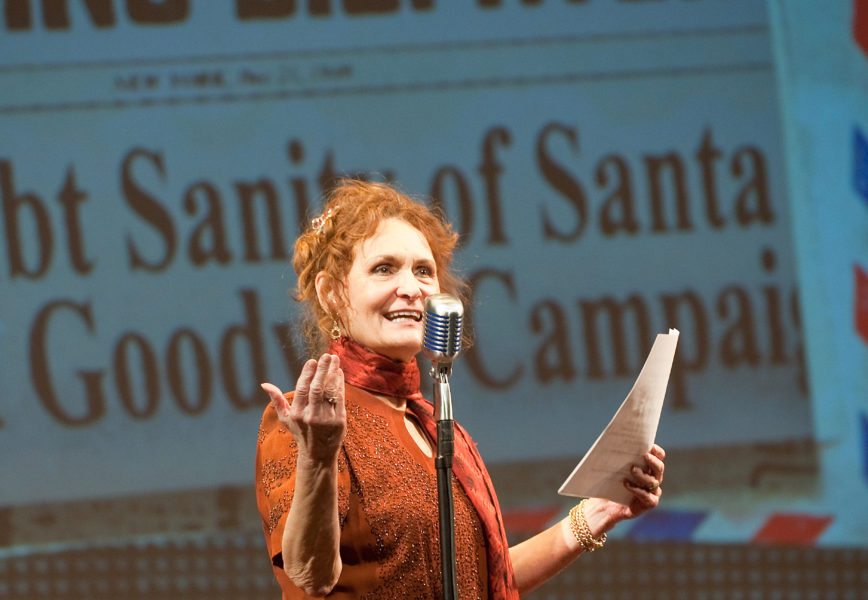
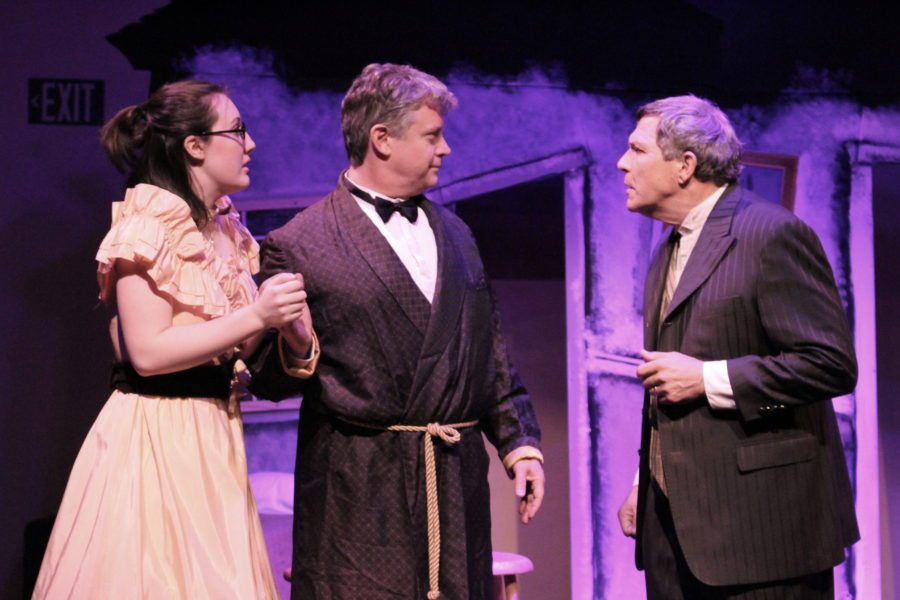
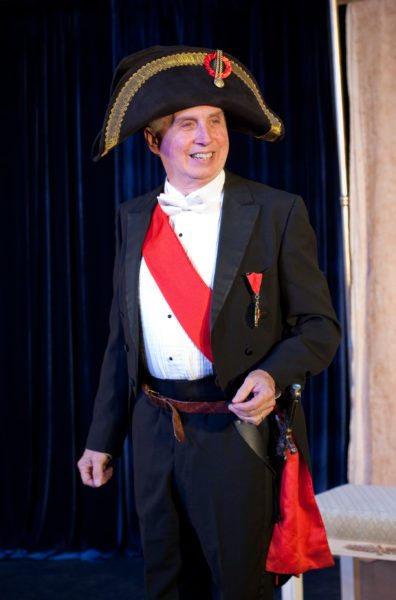
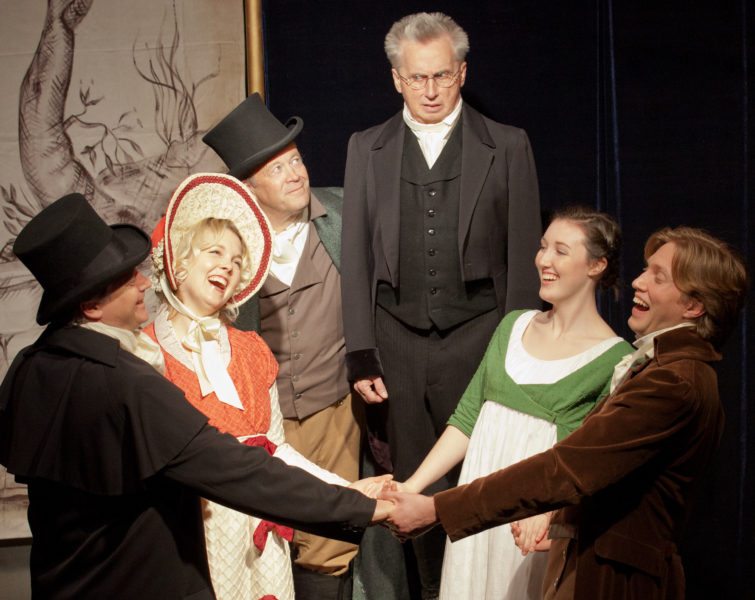
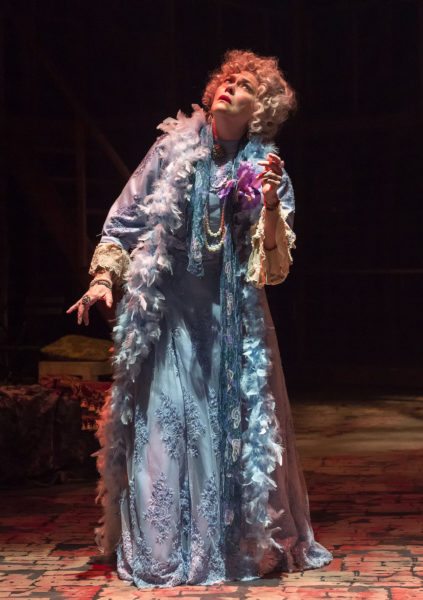
Cast of “Miracle on 34th Street” | Photo by Nick Agro / Pasadena Playhouse
The Pasadena Playhouse, the State Theatre of California, presents a limited engagement of 14 performances of ‘Miracle on 34th Street’ from December 14 to 23, 2017. Originally a radio play, it is celebrating its 70th anniversary on stage, fittingly, at the Playhouse which is marking its centennial year.
Directed by Cameron Watson, who helmed the recent revival of Tennessee Williams’s ‘Cat on a Hot Tin Roof’, it stars Peri Gilpin (Roz Doyle on NBC’s ‘Frasier’), Beth Grant (Beverly Janoszewski on Hulu’s ‘The Mindy Project’), and award-winning film, television, and stage actor Alfred Molina (‘Raiders of the Lost Ark’) as Kris Kringle.
‘Miracle on 34th Street’ is a staple on TV during the holidays. Most of us know the story of Kris Kringle, who substitutes as a department store Santa Claus and claims to be the real thing. He goes all the way to the Supreme Court to prove his sanity and his assertion.
“What is much less known is that this story was very popular as a radio play, when all of America used their ears and their imaginations to completely realize the story,” discloses Danny Feldman, Pasadena Playhouse’s Producing Artistic Director. “And now in 2017, seventy years later, the eyes of our audience get to watch what went into producing the performance live, which its original listeners never got to see.”
“I’m happy to report that the story in the radio play and movie are very similar,” informs Grant. “What’s going to be fun for us is that we will be presenting it as though we are actually doing a radio play with sponsors, commercials, a foley artist, and a narrator. I can’t wait! I’ve always thought it must have been such an imaginative process for people who were only listening to it.”
Grant plays the role of the mother of the little boy whom Santa sends to Gimbel’s to get the fire engine which Macy’s doesn’t have. She enthuses, “I’m very thrilled and honored to play the role that Thelma Ritter made famous in what was her first feature film. That has always been my favorite sequence and Thelma Ritter is one of my heroes.”
Besides that part, Grant will be playing others. She pronounces, “When Cameron told me I would be playing several different roles I got so excited! I love doing character work and disappear in my character, and to do so many in one night would be a fun challenge.”
Beth Grant | Photo by Nick Agro / Pasadena Playhouse
“This isn’t the first time that Watson is directing Grant and she is quite ecstatic to be reunited with the director. “I said ‘yes’ as soon as Cameron asked – I will always work for him anytime, as long as I’m available. He is the most collaborative director I know. He is gentle, kind, and loving but at the same time he’s tough. He’ll keep after you if he sees something that needs to come out,” Grant states.
“Cameron is crafting a ‘framing’ for the radio play, adding his artistic genius to create the reality of being in a live performance,” adds Grant. “He is also using unexpected casting in the various roles – we have some great surprises!”
On learning who her costars were going to be, Grant declares, “I am so thrilled to be working with Peri; she and I have been friends for years, through Cameron. I saw them act together at The Pasadena Playhouse in ‘As Bees in Honey Drown’ by Douglas Carter Beane. She is such a lovely person, with a terrific sense of humor. All that, and beautiful too! And Alfred Molina as Santa? Say no more!”
It’s refreshing to hear that admiration for fellow performers coming from an actor as seasoned as Grant. She has been in several celebrated and honored films in the last few years that you’d think she has a knack for picking the right project to attach herself to.
Known as Hollywood’s lucky charm, Grant has co-starred in three Academy Award-winning Best Pictures: ‘The Artist’, ‘No Country for Old Men’, and ‘Rain Man’. She has twice received the Screen Actors Guild Ensemble Award for ‘Little Miss Sunshine’ and ‘No Country for Old Men’. She also voiced the Academy Award-winning Best Animated Feature, ‘Rango’.
Grant says of her previous successes, “I have been very lucky to have been in so many great films but I have not picked them so much as they have picked me. I try to say ‘yes’ to any great role, no matter the size or even the character, as long as I understand the character’s role in the story and I believe that the story needs to be told. I love to be challenged, to find the goodness in a ‘bad guy’. I love a story with a heart, to make a statement as long as it’s entertaining in the process.”
“From reading the scripts and knowing the filmmakers, I can tell which ones would do well with audiences and academy members. I did believe that Barry Levinson’s ‘Rain Man’ and the Coen Brothers’ ‘No Country for Old Men’ would go all the way,” continues Grant.
“I was pleasantly surprised that ‘The Artist’ was so commercially well-received. I loved it so much but because it was a black-and-white, silent film with subtitles, French stars, and French director, I thought it would just play the art houses. I was so proud and thrilled that it was appreciated on such a grand scale.
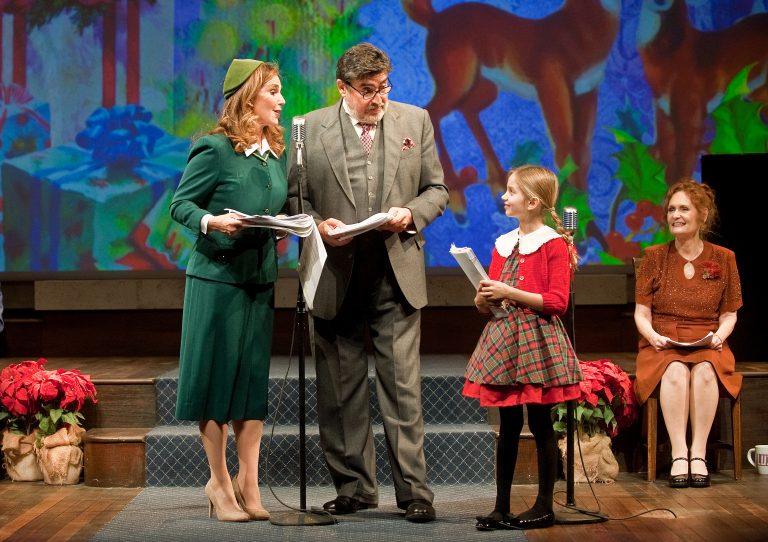
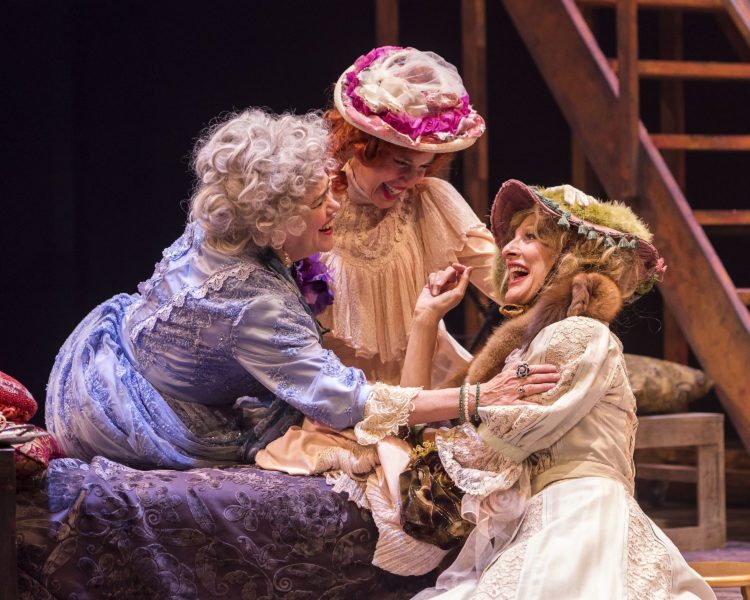
Peri Gilpin, Alfred Molina, Cecilia Witt, and Beth Grant | Photo by Nick Agro / Pasadena Playhouse
I’ve been right a few times, wrong a few times; liked movies that didn’t do well. But, always, I go back to the work and have that optimistic anticipation for what’s next,” Grant says further.
This seasonal production is a first for Grant, “I have never done a Christmas show and I’m thrilled because I love Christmas more than any other time of the year. I’ve always felt renewed during the holidays and I promise you that every single year something magical happens in my life! I am still a child at heart, especially during the holidays. I love everything about the season!”
‘Miracle on 34th Street’ is showing at the Pasadena Playhouse, another first for Grant. She declares, “I’ve been to see quite a few shows at the beautiful Playhouse but have never worked here before and I’m very honored! And did you know it’s also their 100th anniversary!
I love TV and movies, but there is nothing like this experience. When you are on the stage, creating a character, telling a story to a live audience, something truly spiritual happens. We are all one on this journey together. I feel so close to the audience; and each one has his own personality!”
Grant concludes, “I hope everyone who sees ‘Miracle on 34th Street’ has a swell time, feel happy, and encouraged about life after they get back home.”
‘Miracle on 34th Street’ makes even the most skeptical among us believe that wishes can come true. That is the true magic of Christmas. One can only imagine Grant contentedly sipping hot cocoa, joyful with the knowledge that she somehow helped bring the spirit and warmth of the season to one and all.
Originally published on 6 December 2017 in the Pasadena Independent, Arcadia Weekly, and Monrovia Weekly
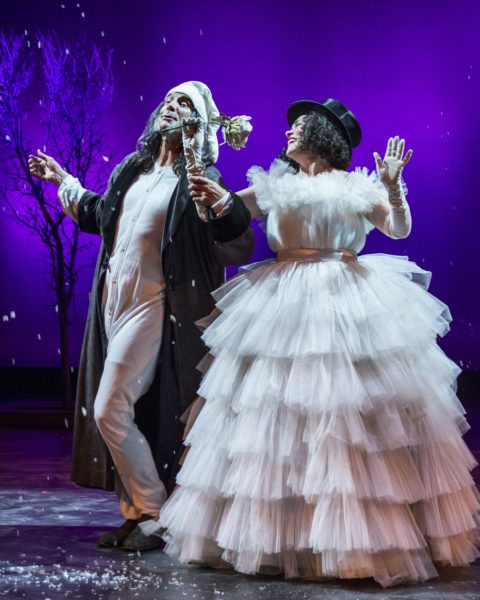
Geoff Elliott is Ebenezer Scrooge and Deborah Strang plays the Ghost of Christmas Past | Photo by Craig Schwartz/ A Noise Within
A Noise Within (ANW), the acclaimed repertory theatre company in Pasadena, presents Charles Dickens’s ‘A Christmas Carol’ for the sixth year. Onstage from December 1st to the 23rd, it remains, to this day, the embodiment of the true spirit of this season.
Adapted directly from the original novella by Geoff Elliott, ‘A Christmas Carol’ is directed by ANW’s Co-Producing Artistic Directors, Geoff Elliott and Julia Rodriguez-Elliott.
‘A Christmas Carol’ features mostly the same cast members as in previous years, including: Geoff Elliott as Scrooge; Rafael Goldstein as his nephew, Fred; Deborah Strang as the Ghost of Christmas Past; and Frederick Stuart as the narrator. Seven-year-old newcomer, Ryan Dizon plays the youngest of the Cratchit children, Tiny Tim.
“I’ve watched the movie and I saw ‘A Christmas Carol’ here two years ago and I enjoyed it a lot. I can’t remember much about Tiny Tim but I’m really excited to be playing him,” Dizon says with a big smile.
Dizon is not a stranger to acting. According to his mom, Corinne Chooey, he started modeling for commercials as a baby and expanded to print work. Lately, he appeared in the film ‘Dr. Strange’ and just finished work on the television show ‘Jane, the Virgin’.
This artistic interest runs in the Dizon-Chooey family. Both his parents and two older brothers, Ethan and Zachary, are in the entertainment business. He and his siblings all attended ANW’s ‘Summer with Shakespeare Workshop’ as well as the Saturday acting class.
“In the Summer with Shakespeare workshop I learned four different types of plays – comedy, romance, history, and tragedy,” Dizon informs proudly. “Comedy always has a good ending. In tragedy everybody gets a bad ending. Romance play is where the good guys have a good ending and bad guys get a bad ending. And history play is about England.”
Ryan Dizon is this year’s Tiny Tim | Courtesy Photo
“This is my first stage play,” continues Dizon. “Rehearsals began on November 14 and the show opened on December 1st. I didn’t really have a lot of lines to memorize so it’s easy. Everyone is nice – they all treat me like a child. Because Tiny Tim can’t walk, I am being carried a lot on the show. The entire experience is so much fun that I would like to be on other ANW productions.”
“Besides acting, there’s some singing on this show – I start the first lines of the Tiny Tim song, and I sing in another number; I’m also part of the ensemble,” Dizon states, grinning. “My favorite portion is the end where Scrooge turns into a kind man and where we all sing ‘Glorious’.”
“Christmas is my favorite holiday because it is when we spend time with our family. Last year all my cousins came over to my house and we had a grand time,” Dizon volunteers without prodding, which touches his mom immensely.
“We have a large family on both sides; Ryan has a lot of cousins. It’s a big occasion in our house – we have a Christmas tree, we gather as a clan, we open presents. Since we have two different cultures, Filipino and Chinese, we blend the two together. It’s an especially big holiday for my husband because he’s Filipino; I think Filipinos start celebrating it in September. On Christmas eve our table is filled with food – mostly desserts,” Chooey laughingly discloses.
Acting is embedded in Dizon’s genes. Chooey reveals, “My grandparents were movie stars from Hong Kong and my aunts are dancers. My cousins are also actors, dancers, musicians, and producers. So, for me, getting my children involved in it was simply a natural consequence.
However, my husband and I don’t make them do it; we let them pursue it only if they want to. Ryan’s older brother, Ethan, who is 15 years old, revels being on screen. He was in the summer movie ‘Spiderman: Homecoming’ and also appears on some TV shows. Zachary is nine years old and was in the TV series ‘Henry Danger’ in 2014. He chose to quit acting and we were fine with his decision. But after a year he asked, ‘When’s my next audition’. And Ryan, here, seems to like it enormously.”
For his audition as Tiny Tim, Dizon met with Elliott. He recounts, “I walked into the rehearsal room and he asked me to pretend there was a window and there were a lot of toys to play with. Then he asked me to walk with a limp. And the last thing was for me to sing; I sang ‘Happy Birthday’ because that’s the only one I know the words to.”
Dizon adds, “To prepare for this role my mom downloaded some vocal warm-ups and the songs in ‘A Christmas Carol’ on my Kindle. That helped me memorize the songs and prepare me to become Tiny Tim. I can’t wait for my whole family to come and watch the show.”
“Christmas is a big, happy occasion for the Chooey and Dizon clan. We’re very excited that Ryan is part of this cherished family play. I hope everyone who comes to see it leaves the theatre with the spirit of kindness and bigheartedness the show inspires,” Chooey says.
That sentiment is echoed by Rodriguez-Elliott, “Ebenezer Scrooge’s rebirth from miserly curmudgeon to the essence of love and generosity affirms our faith in the potent goodness of humanity during this beloved time of year.”
Elliott adds, “‘A Christmas Carol’ is the epitome of Christmas entertainment which encompasses warm moments, beautiful score, memorable scenes, and great performances. Half a generation of children have grown up on it and families continue to make it our most popular production of the year. Students studying Dickens come to see his story leap off the page onto our stage.”
For all these reasons, being Tiny Tim in ‘A Christmas Carol’ this year is of deep significance to this second-grader. Indeed, it is one Christmas carol Ryan Dizon shall remember the words to and sing in years to come.
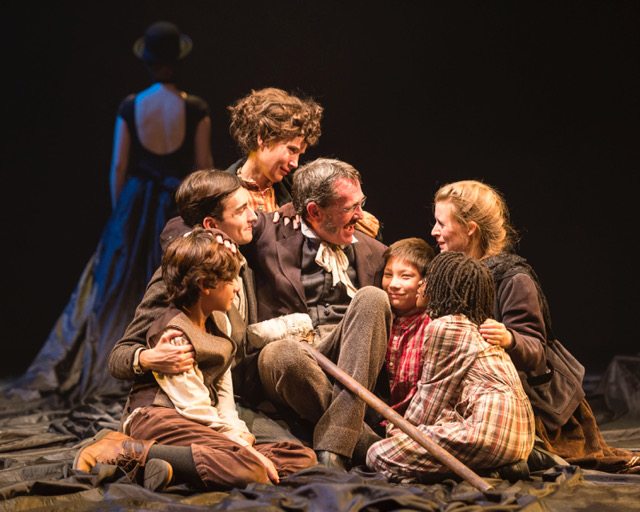
Scrooge with the Cratchits | Photo by Craig Schwartz/ A Noise Within
Originally published on 28 November 2017 in the Pasadena Independent, Arcadia Weekly, and Monrovia Weekly
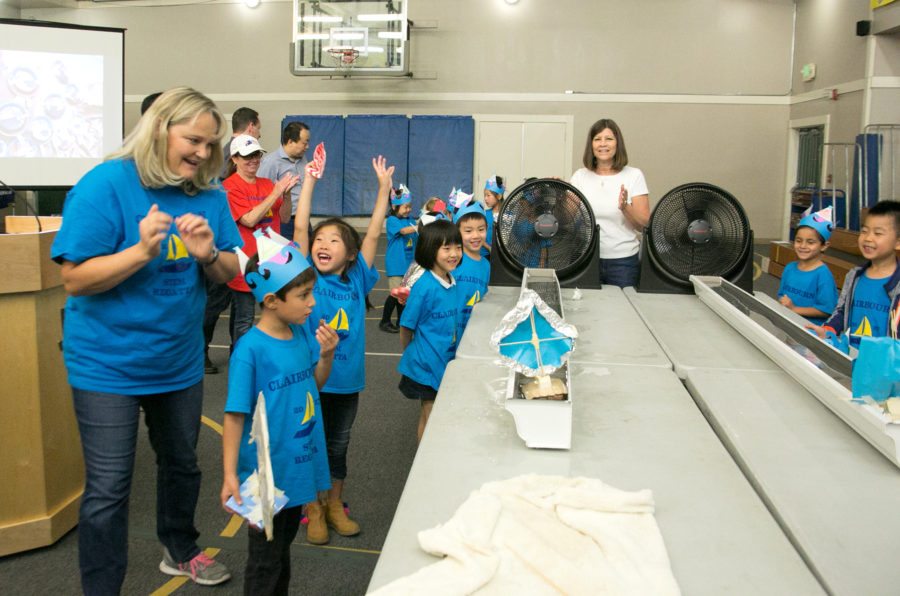
Pre-K students (left to right) explore buoyancy to prepare for their STEM Regatta project | Courtesy Photo
One evening this past October, little students were all gathered impatiently around a rain gutter filled with water, eager to sail their “boats” down the river. This was going to be so much fun!
That they’re three-, four-, and five-year-old pre-school and kindergarten students at Clairbourn School, an independent junior pre-K to eighth grade school in San Gabriel, learning STEM was why this regatta was such a big deal.
What was totally out of character, though, was how even the parents couldn’t take their hands off the boats. They were just as enthusiastic to test the product they built with their children.
This was the culmination of a ten-day, three-part STEM Regatta project that began with the teacher reading ‘The Raft’, by Jim La Marche, a story about a little boy who spends the summer with his grandma in her cabin. The classes also read ‘The Three Billy Goats Gruff’, about a family of goats that wants to avoid the troll and cross a river.
After listening to the stories, students were challenged to design and build a miniature boat, or raft, capable of carrying three billy goats (represented by three small, but heavy metal washers) to avoid a dangerous troll. Their boat/raft should not exceed five inches wide, and had to be able to float.
The first part – raft/boat component – took five days to complete. Day one was reading the story. The second day was spent researching with Nearpod presentation and time for questions. On day three students tested their materials and charted their findings. Using their selected materials, they planned and designed their raft on the fourth day. Day five was spent building their designs. On day six they tested their designs, made improvements and retested.
The second part – the sail component – was done in three days. The class read books about the wind on the seventh day. They spent the eighth day listening to a Nearpod presentation to learn about sails. On day nine students investigated sail materials, sizes, and shapes with demonstrations and charted their results.
The third part – the finale event – was the STEM regatta. On Thursday, October 5, 2017, all three grades, made up of two pre-kindergarten classes and one kindergarten class, and their parents came to Clairbourn for the crucial finish.
The evening’s activity consisted of extensive display boards and a Nearpod presentation from kindergarten teacher, Kris Shoemake, to show parents their children’s learning process over the previous nine days.
And then it was time for families to build the sails, followed immediately by wind-powered boat/raft races by grade level.
Karen Paciorek, Lower School Director, says the STEM regatta was the collaborative brainchild of the pre-school, kindergarten teachers and herself. She relates, “We’ve been wanting to do a cross-grade activity that highlights the things they do all the time in their classrooms with ‘Project Work’. They brainstormed, agreed on an idea and decided on a title. It was a collaborative effort for the teachers, which is a model for what we want students to emulate.
The idea for the regatta came organically. Kris Shoemake came across an article about students testing boats. Since we know that kids love playing with water, we thought that would be a fun way for kids to learn the concepts of floating and sinking. Instead of us showing pictures, we’d take it a step further by having a hands-on activity integrating what they do in the upper grade engineering design challenge.
We wanted for them to show their learning by picking what materials would work for them. We also wanted this project to demonstrate to parents the progression of ability through the grades – expectations at JPK (junior pre-kindergarten), PK (pre-kindergarten), and at K (kindergarten) – so they have a true picture of what we look at as developmentally appropriate.
Teachers use the academic language with the kids so even the youngest students know this is a science project. We’re not expecting them to master the concepts or terms, but to be familiar with them. They will be hearing the words as they go through the grades.”
Parents helped their children during the STEM Regatta finale. Pictured (left to right) are Kaitlyn Nava, Mackenzie Bates,, Stephanie Furukawa, Zoe Nava, and Jason Nava |Courtesy Photo
Adds Dr. Amy Patzlaff, Assistant head of School, “It wasn’t merely a reinforcement of the concept of buoyancy. Teachers talked about the scientific methods: collecting, charting, and interpreting data. As the students worked and tested a variety of materials, they had a chart that showed which boat sank and which floated so they could refer to the data later. And it was simple – it was pre-school level – but they could see on the chart which material worked and didn’t.
They then repeated it when they were talking about sails – which materials held against the wind? Did the shape matter? The students tested the sails using a zip line and a fan; they sat and watched as they tried different things. They had access to that data as well when they had to replicate the activity on the night of the regatta. They built their sails with their parents and tested their final product. They employed scientific methods – how to use the data; how to problem-solve; how to use previous history to scaffold what’s going to happen next; how to use the product for the next round.
Each grade level had a different take on building the boat, which was all done in the classroom, with the teacher assisting. During the night of the regatta, the parents helped in the culmination of the activity which was building the sail and testing it.
To make it age appropriate, it wasn’t a win-lose situation; they just wanted to see if it worked or if it didn’t, and why. We used water-filled rain gutter rivers with a fan at the end. They set their boat in the rain gutter and if the boat got stuck, they righted it. Watching the parents test their product was highly entertaining! But it was all a friendly event, everyone cheered for one another, happy to see each other succeed.”
According to Paciorek, even during the ten-day period that the kids were working on it, they would practice what they learned at school. Her granddaughter, who is four-years-old and is in the pre-K class, tested some toys for buoyancy in their bathtub.
“This is fairly representative,” explains Dr. Patzlaff. “When I was having breakfast with some of the parents later that week many parents commented on their kids wanting a fan to test the zip line of some of the sail types, in addition to the ones provided in class. Another child wanted to get more materials to test in their bathtub at home; one was going to do a race in their pool. So they wanted to continue the exploration and testing on their own. It continued to engage them which is a great testament to the fun embedded in the project.”
Paciorek says the regatta was a major collaborative event and they plan to do one every year. In the meantime, each grade has its own classroom STEM projects. In kindergarten they have about four or five smaller STEM-related work. One is an apple-picking activity where kids help a farmer get his apples from the trees to the barn. Students have to design the transportation to get this accomplished using the same scientific methods.
In first grade they do a pumpkin drop and students have to brainstorm ideas in groups and design a container that protects the pumpkin. They test which materials kept the pumpkin from breaking. They also have one activity where they build a nest to hold the eggs.
“We started a heavy emphasis on STEM once the NGSS (Next Generation Science Standards), the nationally adopted science standards, came into play around 2012,” states Dr. Patzlaff. “There has been so much conversation about 21st century skills and about not knowing what jobs are going to look like. And because we don’t know what jobs are going to look like the most important pieces we can give students are how to problem-solve, how to think, how to communicate clearly, how to have resilience and grit, how to persevere when something doesn’t go right, collaborating – all the soft skills – in addition to being able to write.
One thing that STEM projects give is real-world possibilities for how to apply those skills in a nice, tight package. When they design the sail for the boat, for instance, they have to problem solve, they have to work together, they have to communicate with their partner, they have to be able to document their results. For little kids documentation is different – we take a picture of it and we put them on the wall. For older kids, they would be written documentation of some sort, depending on the age. It gives them opportunities to apply the skills in ways that are highly engaging and meaningful to them so they’ll want to persist in it.
Having STEM in our curriculum not only improved math skills and scores among our students, it has also helped primarily in the understanding of concepts. We want kids to not rely on memorization of formula because if they memorize it incorrectly they will never get the right answer. If all they know is the formula, they’re only plugging in numbers; they aren’t checking it to see if that makes sense because they don’t have a way to do that.”
Paciorek adds, “Through this program they’re learning to explain what they’re doing and why they’re doing it. That gives them that foundational understanding to gain higher performance in math, even at the kindergarten level.”
“I think parents now are looking for things that are measurable,” Dr. Patzlaff posits. “It’s hard to test for creativity and that’s one of my biggest challenges. Frankly, the things that are easily measured like the Kumon math worksheets – my kids could do 100 additional problems in 45 seconds – don’t really mean much. What are you going to do with that? Being able to blend the measurable outcomes with the applicable results is an interesting thing for me. The things that I value are the problem-solving, the communication, the ability to work together with others, the ethics – most of those things are hard to measure.
The components that are within STEM – the problem-solving, the engineering, the applicability of all the new skills – they’re all important competencies to add on but how do you apply them? I like the elements of STEM that help give context to student learning. It gives more meaning to the concept so it sticks and makes them want to explore further.”
Kindergarten teacher, Kris Shoemake, and Lower School Director, Karen Paciorek, help students race their sailboats during the STEM Regatta finale | Courtesy Photo
Concurs Paciorek, “They don’t really see it as learning, it’s just something fun and interesting for them. Another thing that’s vital that we discuss with parents is that high schools and colleges are looking for balanced students. When we have standardized testing appointments with individual parents we’re educating them, one family at a time, on the importance of being well-rounded. We explain that these tests only measure Language arts and math; they don’t measure sense of humor, leadership skills, musical ability – all those things that are key in making well-rounded people.
The high schools love our students, they add so much to the schools they go to and this is where they get that foundation. We want families to understand that. It’s not just about math or science; it’s learning how to apply the academics, how to think, how to be creative.”
According to headmaster, Dr. Robert Nafie, Clairbourn’s overall teaching philosophy mirrored that of other English-based schools, which focused on a classical liberal arts education. However, as times changed the school shifted its emphasis to keep up with prevailing conditions.
“The world has gotten smaller and the population is much more diverse,” begins Dr. Nafie. “Our students are global citizens, they come from different backgrounds and culture. As such, the language becomes a little less precise, less critical even. Today’s universal language is mathematics and the hard sciences are the currency to become successful.
The big question for schools now is ‘Do we prepare our students for their future or for our past?’ We’re more comfortable preparing them for our past because we were educated that way, we know it. But the truth is we have to look into that murky, cloudy, and foggy future.
That said, from Clairbourn’s standpoint, we have always done a good deal of STEM. We’ve had a lower school science lab for at least 25 years where teachers have all workbook activities, and experiment materials, and tools organized for them in the cupboards.”
“We are in an educational and biotech corridor,” Dr. Nafie points out. “This particular area of Los Angeles is very rich in science and technology. Starting on the west side, with UCLA, USC, Pepperdine; in Pasadena we have Caltech and JPL. We have all these hospitals – Huntington Memorial, Arcadia Methodist, City of Hope. These institutions are, really, right along the mountains going all the way east to the Claremont Colleges.
Our feeling is that there should be an ongoing conversation between Clairbourn and the community. Several years ago we started something called Project STAR (Science, Technology Activities, and Research) and invited our Caltech dads for input on how we can focus on engineering and science. As a result of that, we held science fairs with Caltech and JPL engineers as judges, and we had a guest speaker. In recent years, we have embraced STEM as a philosophy. We established an Entrepreneurial Fair where there are Makers’ Spaces for students to create something creative using STEM.
For Clairbourn, the reality is that we are in the midst of a very large Asian population. Our families are from Arcadia, Pasadena, San Gabriel, San Marino, and Temple City. And what they’re looking for is a school that has a strong emphasis on STEM. At the end of the day we are a corporation masquerading as a school. If we don’t provide what people want, we’ll be out of business.
We have to ensure that children in the youngest grades have this kind of educational experiences. We teach STEM early and we use the spiral curriculum – we introduce a subject and come around to it again. For instance, we teach fractions in second grade, hit it hard in fourth, reinforce it in sixth, etc. For STEM we introduce it through activities like the regatta but that won’t be the last they will hear about it.”
Ultimately, what matters is what children make of their education. As Dr. Patzlaff says, “More than anything, I want to send out into the world students who could think and problem-solve. That’s what’s needed right now because there are so many vexing problems and the solutions aren’t that obvious. Because if they were, we would’ve already solved them.”
These three-year-olds are our best hope for a brighter future. That’s why Clairbourn is teaching and training its youngest students to identify challenges and resolve them using the lessons they learned in class. And if they have to get their hands in the water in order to do that, then it would be worth the trouble. Or the fun.
Originally published on 27 November 2017 in the Pasadena Independent, Arcadia Weekly, and Monrovia Weekly
A scene from 2017’s “Government Inspector” with cast members (left to right) Aiden Rees, James Calvert, and Paul Perri | Photo by Lance Davis / Parson’s Nose Theater
Mary Chalon Davis and Lance Davis, who founded Parson’s Nose Theater (PNT) in 2000, are feeling quite content these days. After 17 years as a gypsy theater company they have finally found a permanent home in Pasadena.
Their 2017-2018 season debuted last month at the beautiful ivy-covered Parson’s Nose Abbey on 95 North Marengo Avenue with Lance’s adaptation of Nikolai Gogol’s ‘The Government Inspector’.
For two weekends in December – 9 and 10; 16 and 17 – PNT will present a Readers’ Theater Series of Charles Dickens’s ‘A Christmas Carol’. Actors, dressed in the attire of the era will read this beloved annual production as it was meant to be staged.
Lance explains their rationale for establishing PNT, “People say live theater is dead. Why would they want to see a play when they have television at home? But the idea of returning to the live art form where the actors and audience are both present and no one is looking at screens is what theater is about. You’re interacting with the literary art form for the most part so you have to listen to the words and the ideas.
During World War II, in London, in spite of all the bombings going on, theaters were full because people wanted to go out and be with others. That sense of socialization and community is what we’re trying to bring back. While our plays are only 90 minutes long we take a break so people can get up to talk with each other, have a cup of coffee or a glass of wine, and chat.”
PNT’s productions are designed to be introductions to the classics. Students are a big audience so they deliberately addressed the most common complaint students voiced.
“We eliminated all the things that students said they don’t like about theater, one of which is that Shakespeare plays are too long,” Lance says. “So I distilled them to 90 minutes. The idea is to keep them short but complete – the language, the characters, the plot, and the spirit of the play are intact.
One of the students who watched our production of ‘Twelfth Night’ told us she went to see it at a theater Festival. About an hour and 30 minutes into it, she just said, ‘Excuse me, I saw this before and I know it can be done more quickly’”.
“But there was a reason why these classics are too long,” Mary interjects. “At the time they were written people didn’t have much to do for entertainment. We re-introduced these for the modern audience so they can enjoy the very same plays that adults, before our time, knew.”
That students actually enjoy these classic plays was revealed recently. Lance recounts, “We had a group of eighth graders from Pasadena High School and during the intermission they were all conversing with each other while their parents were checking their cell phones.”
Lance Davis starred in “A Middle Class Nobleman”, a PNT 2013 production | Photo by Peter Zuehlke / Parson’s Nose Theater
PNT’s productions are comedy classics because Lance is particularly gifted in the art form. Expounds Mary, “Lance came from the Guthrie Theater Minneapolis which informed his choices; it’s his orientation. But also because comedy makes people laugh; it lifts their spirits in a way.”
Lance adds, “Besides that, we want to recognize that these classics, like the plays Moliere wrote in the 1660s, were the basis for some of modern plays. For instance, Moliere wrote about this miser who thought of nothing else but money. This character engendered Scrooge. Then came Jack Benny and his obsession with money; and then much later on there was Burnseneezer Scrooge in the animated show ‘The Simpsons’. All these modern day comic characters came from the works of early playwrights.
Our most recent play ‘The Government Inspector’ is about a clerk who comes into town whom people thought is the expected inspector who’s to expose all the evil deeds that the mayor is doing. o all these local officials are going around bribing him and he eagerly accepts them so he’s just as corrupt as they are. All this time the town officials thought they’re safe because they’ve bought off the inspector, until one day the real inspector arrives.”
“My Character in the play is the mayor’s wife and she see meets this man whom she thinks is the government inspector,” Mary relates. “She plays matchmaker between him and her daughter, and he proposes marriage. So Mary thinks this is going to change their life – they’ll leave this crummy place and move to St. Petersburg; all their dreams have come true. She snubs the townspeople then she finds out he’s not the real inspector so all her hopes come crashing down.”
“This is something we still see today,” expounds Mary. “So people who watch this show realize we have a link with these characters. Classics have universal themes and audiences connect with them. And because they’re funny they become more accessible and disarming.”
Lance interjects, “We laugh at them and then we realize, ‘Oh, that’s me!’ Through these plays, we see human nature. There are ideas that seem so foreign to us like, in one of Moliere’s plays, how the dowry is very important. We think it’s funny and say no one does it anymore but we still do, only in a different way. Today when one’s daughter is dating someone, parents think ‘who is he?’; ‘what are his parents like?’; ‘what are his prospects?’”
How they came up with their theater company’s name is a story in itself as Lance laughingly relates. “First of all Parson’s Nose was the only name my wife and I agreed on. It’s a quote from ‘Romeo and Juliet’ where Mercutio talks about Queen Mab’s speech that dreams reflect one’s passion and desires – she tickles a sleeping parson’s nose with a tithe-pigs tail and he dreams of a large donation. And we’re always dreaming about grants. It’s very far-fetched.
On the other hand, when I was growing up, in Philadelphia, a parson’s nose was the tail-end of the chicken. So if you look at our logo it’s either a sleeping parson or the tail-end of a chicken. In that sense that’s a metaphor for us – while we do the classics, we don’t take ourselves seriously.”
“This company has been around for 30 years,” Mary stresses. The individuals we work with – the actors, the designers, including us – are trained people who went to Julliard, Yale, and other drama schools with 30 years of experience and have worked all over the country. Many of us are from New York and ended up moving to California in our mid-adulthood and raised families.
We bring a lot of skills to the work; we’re not amateurs. People who come to our show are watching something that’s well done. We don’t spend a lot of money on our sets but we focus on the art of acting and storytelling. That’s key for us. It’s like ‘theatre unplugged’. These actors, several of whom are from Pasadena, are here because they love acting.”
We started PNT 17 years ago and our first production was ‘Twelfth Night’ then ‘The Miser’ which we did at Interact. The Geffen Playhouse came over and loved what we did and asked us to do their Saturday shows which toured for schools. While we didn’t envision ourselves doing that, we thought it was a nice opportunity. We produced all the hour-long shows and we were able to hire a company of actors to do the tours for six years.
From there we came up to the Pasadena Playhouse where we produced family-oriented performances that brought families to the Playhouse. All these shows that we were producing for the Geffen and the Playhouse were all under their name but we were thankful because they gave us a foundation. This went on for about nine years until the Playhouse scrapped this component of their programming when they downsized.
PNT’s 2016 show, “The School for Wives”, featured (left to right) James Calvert, Marisa Chandler, John Harnagel, Lance Davis, Aiden Rees, and Matt Franta | Courtesy Photo
In 2008 we realized we had been working all these years but no one knew who we were. So we decided that this was the time to reinvent ourselves – we had to get the name Parson’s Nose out there.
The first production we did under our own name was at Pacific Asia Museum. We were then at Lineage Center for the Performing Arts where we stayed for seven years. It’s a dance company on Fair Oaks, south of Green Street, and they rented out their space. We were their tenant for five years. We were briefly in South Pasadena where we did the ‘Under the Tent’ series. Then the recession hit big time. So we stopped making full productions and we did readings instead.
We were in New York for a while and readings of new plays are common there. It’s not as common here where readings are usually table readings for movie scripts. We started to do readings and people were fascinated – actors make the characters on the page come to life. So we began doing that; of course it’s also a less costly production.
When the economy improved over time, we started putting full productions back in. We were doing this at Lineage but as we were renting only the performance space, we had to find other places for our requirements – costumes were stored in one location; props were at a different space; rehearsing was done at yet a different site. We became experts at being a gypsy theatre company – arriving in a van, setting up props, and stuff.”
Lance adds, “We began to look for a space in earnest which took longer than we thought. We looked at all kinds of spaces. We now know Pasadena inside out – if you say Discount Tires, we know where that is. When, after three years of searching, our realtor discovered this place, he declared, ‘this is Parson’s Nose’.
And, to us, finding the Abbey is such a gift. It’s a place where we can hang lights and have a set that can stay up all the time. For the first time we can argue with each other and just storm out the door. We don’t have to pick up and fold our chairs before leaving.
The city was very happy to have us occupy this space; they’ve been very supportive. And we are ecstatic to be here. Now our challenge is to tell people where we are, how to get here, and how to make it a destination for people.
This year we were part of ArtNight Pasadena and a lot of people came in to see us. We did 20-minute readings of radio plays people grew up with, like Flash Gordon.”
Following the 2017 fall full production of ‘The Government Inspector’ and Charles Dicken’s ‘A Christmas Carol’, PNT will present a full production of Moliere’s ‘Too Learned Ladies’, then a Readers’ Theater Series of ‘An Irish Celebration’ with select Irish poems, stories, and songs in the winter. The 2017-2018 season will close in May with a full production of William Shakespeare’s ‘Clearly Classic: Twelfth Night’.
Plans for more productions for schools and an outreach for seniors are underway, as well as plays multi-generational families can enjoy.
Parsons Nose Theater is a hidden gem in Pasadena, as one of its board directors noted. However, with its founders’ achievements in staging timeless classics for students and families and plans to extend its reach to an even wider audience, it is on track towards getting recognized. This hidden gem will be found at last.
Originally published on 13 November 2017 in the Pasadena Independent, Arcadia Weekly, and Monrovia Weekly
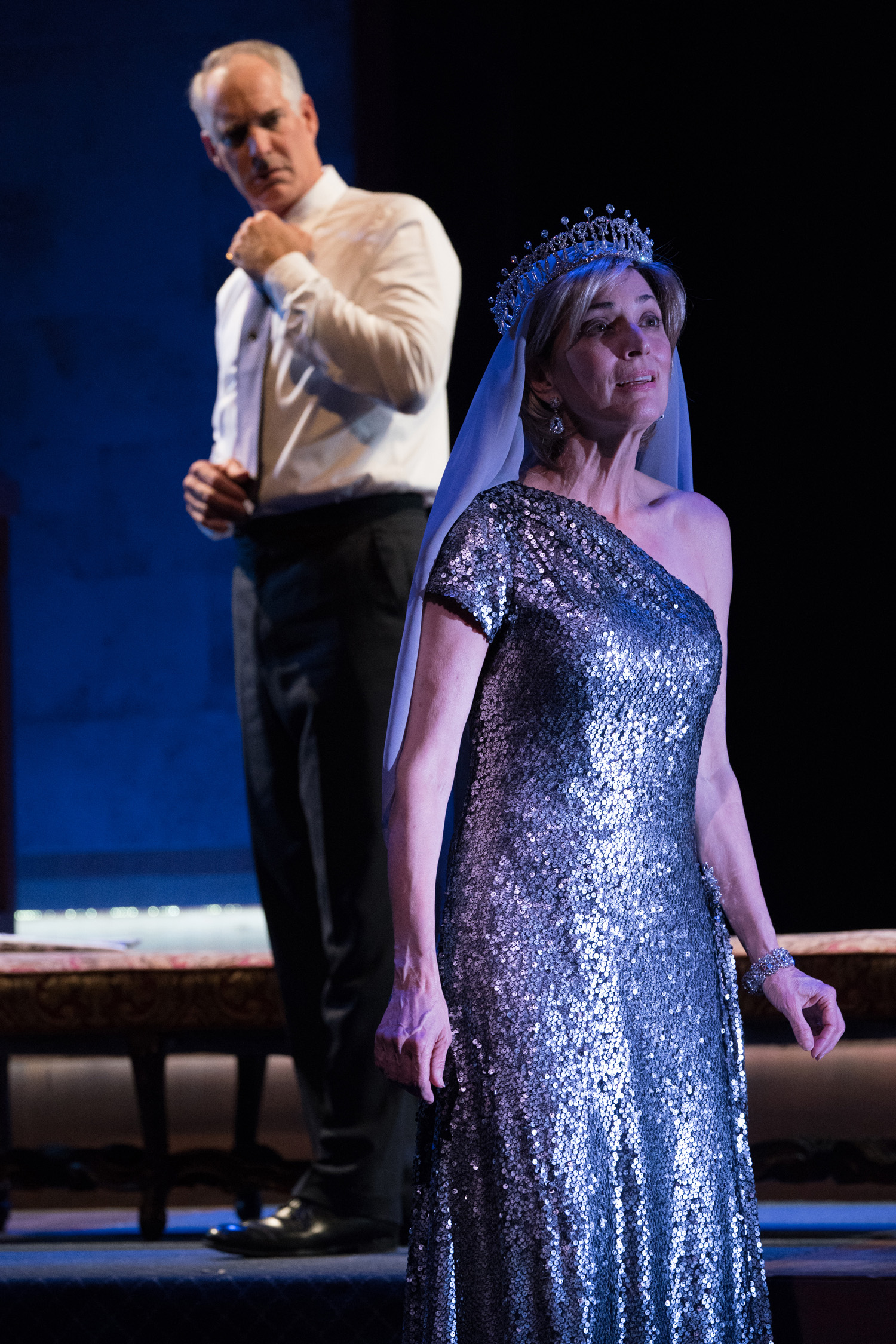
Jim Abele as King Charles III | Photo by Jenny Graham / Pasadena Playhouse
If we were to determine how we feel about our neighbors across The Pond by the popularity of shows on PBS and the BBC, we could confidently conclude that Americans are enamored with all things British.
Their class structure for one, which is vastly different from ours, is a source of endless curiosity. Our fascination with the English aristocracy made a phenomenal success of ‘Downton Abbey’ set at the turn of the 20th century depicting the intersecting lives of the Crawleys and those who served them. Never mind that breaching the class system at that time wasn’t slightly plausible; we wanted to believe the Crawleys had an innate goodness.
More recently, the lives of English monarchs, past and present, are being serialized in ‘Victoria’ and ‘The Crown’. These programs will chronicle two widely admired queens’ reign through the decades, for our extended viewing pleasure. We just couldn’t get enough of the Royals.
And now the British monarchy or, more accurately, ascension to the throne is the focus of a future history play that’s on stage at the Pasadena Playhouse from November 8 to December 3, 2017. Written by Mike Bartlett, ‘King Charles III’ was the winner of the 2015 Olivier Award for Best New play and is the second production in the Playhouse’s 2017-2018 season. It also marks the play’s Southern California premiere.
‘King Charles III’ is directed by Michael Michetti, who is also helming two other Pasadena productions – ‘Mrs. Warren’s Profession’ at A Noise Within, and ‘A Streetcar Named Desire’ in February at The Theatre @ Boston Court, where he is Co-Artistic Director.
According to Michetti he saw the Broadway performance, which was essentially a remount of the British production with the original cast, two years ago and absolutely loved it. When the Pasadena Playhouse’s Producing Artistic Director, Danny Feldman, selected the play and asked Michetti to direct, he jumped at the chance.
Says Michetti, “While this staging is not going to be the same as what was done in London’s West End nor the one I saw on Broadway in New York, we are not intentionally trying to change it. I thought it was a wonderful production and it was beautifully done. But any time you mount a show you take into consideration all the conditions, including where it’s being produced, what the space is like, who the actors are, and what adjustments need to be made.
Because this is being produced in Southern California, at the Pasadena Playhouse, there were some concerns to address in pre-production. Among them is that the needs of the Playhouse space are very different from that of the Broadway’s.
The Pasadena Playhouse is such a beautiful and historic theater but the challenge was that the stage was too high. Very early on, we brought in a scenic designer to work on the creative space. He fashioned an area that steps down from the stage level to bring the action closer to the audience. This means members of the audience are in the midst of the action, giving the production a real immediacy that’s supported by the style of the play.”
“It’s written in the style of Shakespeare,” Michetti expounds. “And like in a Shakespearean play, there are times when actors break the fourth wall in a soliloquy and speak to the audience. We made sure this connection was maintained. This takes advantage of the stage we have created, allowing for an intimate relationship with the audience. What adds to its intimacy is that the play involves the Royal family whom we know so well.
Jim Abele and Nike Doukas, as the family ghost | Photo by Jenny Graham / Pasadena Playhouse
The English royals are people we only see and hear on television interviews. They’re very protective of their image; they don’t let us into their thoughts so we’re not privy to what they’re thinking. Bartlett very cleverly allows us behind closed doors to listen in on conversations that might be happening. That’s extremely powerful.”
According to Michetti contemporary plays in the fashion of Shakespeare are pretty novel. While Bartlett uses a number of Shakespearean styles and inventions like blank verse, ‘King Charles III’ is told with modern characters and in present-day English as well. This makes it easier for the audience to understand.
As befits a play about the royal family, ‘King Charles III’ revolves around people American audiences are very familiar with – Camilla, William, Catherine, Harry – and a few fictional characters Bartlett conjured, including a new love interest for Harry, and a family ghost.
Over the past few years, with the marriage of William to Catherine, who is a commoner, there has been a resurgence in our enthrallment with the Windsors. This young couple has certainly made the royals feel more accessible. That ‘King Charles III’ is arriving on the Southern California stage on the 20th anniversary of Diana’s death has only increased our excitement.
“Our most common recollection of Prince Charles was during the Diana years, when he didn’t quite cut a sympathetic figure,” posits Michetti. “There was a great deal of negative backlash after Charles’s and Diana’s fairy tale marriage crumbled. But Charles and Camilla have since successfully built a healthy relationship with the British public. Many Americans may not be aware of it, but he has regained a good image. While Diana is still beloved in England, the prince, of late, has become more respected.
These days we see a great deal of the Duke and Duchess of Cambridge, William and Catherine, who are very popular with the media and they know how to use the press to better advantage. It is a power they have over the monarchy and the play touches on that.
Because ‘King Charles III’ is about real people my mandate is for actors in the role of Charles, Camilla, William, Catherine, and Harry to avoid playing them as they have been represented in the media. We made a very deliberate effort to make sure they are not delivering impersonations but emulating qualities of them.”
Dylan Saunders as Harry and Sarah Hollis as Harry’s love interest| Photo by Jenny Graham / Pasadena Playhouse
“The play is structured like a political thriller and it gives nothing away,” Michetti discloses. “It begins at the funeral of Queen Elizabeth II. Charles has become king and he faces challenges which have personal and political impacts as he deals with the transition to the monarchy. The play is surprisingly funny in its portrayal of the characters and the wit with which they tackle their problems. It’s exceptionally smartly written.
When I saw it on Broadway two years ago I was dazzled at how well-crafted it was but it didn’t feel relevant to American audiences. But a lot has happened since. Concerns including the dangers of limiting freedom of the press, the difficulty of political transitions, conflicts between branches of government, and the potential for constitutional crisis are all issues on our headline news every day. I hope that while the circumstances and characters are different audiences will be able to see ourselves, and the current situations in America, reflected in this play.”
‘King Charles III’ has all the elements of ‘must-see TV’ except it’s performed live in front of us. It is replete with captivating personalities we merely glimpse in magazines at the supermarket checkout – a king facing a political emergency as soon as he begins his reign, a prince dating a young woman who has an embarrassing past, a lady coming back as a ghost to haunt the palace.
This production is one that Anglophiles will most assuredly relish. Eager as we are to see how the royals resolve this predicament in the end so are we reluctant to end our enjoyment in watching them keep their wry humor through it all. That they speak in iambic pentameter with their posh accent only adds to our delectation. ‘King Charles III’ is decadently brilliant!
Originally published on 6 November 2017 in the Pasadena Independent, Arcadia Weekly, and Monrovia Weekly
Duarte High School students took the pledge to stand up against bullying. Courtesy Photo
Bullying is a common occurrence in schools and the numbers prove it; one study revealed that as many as 49 percent of children in grades 4-12 have been bullied at least once during the past month.
School administrators and teachers have been looking for ways to solve this prevalent problem. For years several different methods to stop bullying have been utilized, including zero tolerance and expulsion which have since been deemed ineffective.
Several schools in the San Gabriel Valley are grabbing this bull by the horns, so to speak, through active and ongoing conversations with students and parents about bullying. One independent school in Arcadia went a step further by including a social curriculum to create acceptable standards of behavior on campus.
States Mucerino, “PBIS has been quite popular in Orange County where I came from before it made its way to Los Angeles in the last five to six years. I brought it to my last district when I came to Los Angeles prior to landing in Duarte, and it has grown by leaps and bounds. It’s a school-wide behavior management system with social emotional learning embedded into the program. The key is to teach behavior expectations and balance corrective actions with positive supports and interventions designed to restore a positive relationship.
However, because we utilize restorative practice doesn’t mean we tolerate bad behavior. In fact, it’s the opposite. Students are held more accountable; they are made to realize that bad behavior changes the relationships with teachers and fellow students. The old punishment of suspending them seems almost like a reward because they’re getting a day off. In PBIS we address that destructive behavior – we call in the students involved and the teachers then we discuss ways to restore the fractured relationship. When necessary we resolve the issue by using more sophisticated exercises including bringing in facilitators and families to rebuild relationships.”
“This is consistent with our transformation to K-8 because students stay here for the duration of their studies before transitioning to high school,” Mucerino discloses. “In the research literature, K-8s have a lower incidence of bullying. And the reason is obvious – kids coming into a middle school from a variety of elementary schools at adolescence are more vulnerable. It’s in middle school that kids act out; they feel liberated from all the restrictions in the elementary school.
Our transition to K-8 is an educational design model to create a safer learning environment, to build in conditions for kids to become successful based on student-adult relationships. This is where PBIS comes in; it is a program that the entire school owns – from kindergarten all the way to high school.”
Students at Northview 8th Grade Village implemented creative ways to build a school culture founded on inclusion, acceptance, and kindness. Courtesy Photo
PBIS is ubiquitous on all DUSD campuses: all classrooms have some motto or sign that emphasizes good behavior. Teachers are now a presence during passing period when most bullying – from slight comments to bumping into someone – occurs. There’s active supervision; an adult is present every 20 feet to give students fewer opportunities for bullying.
As Mucerino says, “The point is prevention; we don’t want to catch kids. To balance corrective measures with positive action, DUSD uses a token economy to acknowledge good conduct. Each time a student demonstrates good behavior – like a random act of kindness – he or she gets rewarded with a token. They accumulate these tokens until they have enough to purchase something at the student store, which is very popular; even high-schoolers love this idea.”
Every school at DUSD has a PBIS coordinator who reports to the principal and they work together with the Director of Student Services to address discipline issues as they arise. Schools have to come up with creative ways to address chronically bad behavior, according to Mucerino. While suspension and expulsion are still used for the most egregious behaviors, they are last-resort options, when mediation and less drastic solutions have been exhausted.
Mucerino expounds that there is a direct relation between behavior and academics. “Students who are not successful tend to be the ones who are also having behavior issues because school isn’t a happy place for them. My expectation is that because of improving behavior and deepening relationships, the academics will follow. Student-teacher relationships have the highest effect on student growth.”
“What I expect is the culture of our school district to shift from a zero-tolerance punitive approach to one that considers the whole child and recognizes the responsibility for social and emotional learning,” pronounces Mucerino. “Bad behavior is disruptive to learning and we don’t want to put everything on parents; we accept our role in teaching proper behavior and helping children succeed. I see DUSD on the forefront of providing a nurturing culture and a model for all schools. We want our schools to provide a safe haven for kids, like family.”
At DUSD an entire community of administrators, teachers, parents, and students come together to help each child succeed. It is a culture and environment where everyone is seen and heard – where bullying can never take hold. It is where students can only flourish and thrive.
Originally published on 31 October 2017 in the Pasadena Independent, Arcadia Weekly, and Monrovia Weekly
Judith Scott as Kitty Warren and Adam Faison as Frank Gardner. Photo by Craig Schwartz
George Bernard Shaw’s seminal play ‘Mrs. Warren’s Profession’ is currently playing at A Noise Within (ANW) until November 17, 2017. Directed by Michael Michetti, Co-Artistic Director of The Theatre @ Boston Court, it stars Judith Scott, known for her role as Claudia Crane on the current FX series ‘Snowfall’, in the titular role of Kitty Warren.
Written in 1893, ‘Mrs. Warren’s Profession’ was one of Shaw’s earliest plays which was published in a series called ‘Plays Pleasant and Unpleasant’ in 1898. It was widely branded as being immoral not so much because it dealt with prostitution but because the woman in the center of the scandal did not show remorse for her choice of career.
Michetti says of ‘Mrs. Warren’s Profession’, “It is shockingly modern. It’s a play that examines Kitty Warren’s choices from different perspectives and without judgment. Shaw was brazen to put the plight of women front and center in his art; it’s a choice none of his contemporaries made. It’s a protofeminist play before the terminology was even commonplace.”
“When Shaw wrote ‘Mrs. Warren’s Profession’ in 1893 he exposed women’s dilemma at that time and the double standard that society imposed,” Scott pronounces. “Prostitution was highly regulated and prostitutes were punished while the men who availed of their services got away with it.
This is a woman who has prostituted herself unabashedly and has remained unashamed for having done that. It is a powerful portrayal of women and the tremendous sacrifices they make to raise their children and give them opportunities in life.”
Scott got her acting training at Webster University, alma mater of acclaimed actress Marsha Mason, in Webster Groves, Missouri. She says, “It was at one time an all-girls school but it was coed by the time I attended it. I was there for three years; I left after the third year and moved to Paris. My friends used to call me the Wandering Jude.”
“A month after I got back in the States, in 1983, I went walking with my mother in downtown Chicago. I went into The Second City Theater to use the bathroom and after I came out I heard some people laughing. I entered the room and saw people improvising. When I rejoined my mother outside I told her, ‘that’s what I want to do’. That sealed my fate, I went to the bathroom and decided I want to be an improviser,” relates Scott.
“Actually, I grew up improvising; that’s how I made my mother laugh,” Scott hastens to confess. “So I have always been an improviser but when I saw what they were doing I knew I wanted to do that. I was there in the fall and by the spring I was one of 300 touring performers with The Second City Theater Company. I did that for six years.
My mother was an amateur actress, my grandmother watched soap operas and was kind of a drama queen. The path was already laid out for me all my life and I just took up the calling. But I didn’t really make it a serious career until I was in my 40s.”
ANW Resident Artist Erika Soto as Vivien Warren and Adam Faison as Frank Gardner. Photo by Craig Schwartz / A Noise Within
“Having studied all the classics in college, I’m familiar with Shaw’s work,” explains Scott. “’Mrs. Warren’s Profession’ is a very intellectual play; Shaw is a very word-heavy writer but there’s a tremendous amount of emotion and feeling in his work. That was what struck me – how much feeling was in his writing; it is replete with polemic discussion, there’s so much passion in it.
It is a powerful piece and playing the role of this strong and willful character was life-changing for me. I related to Kitty Warren on a deeply personal level. The play has resonated with me because of what I know and where I come from; my ancestral history has certain parallels with her experience.
This role is not traditionally played by a woman of color and it has made a difference for me. It was a vehicle that changed my life – not only in my understanding of me as Judith, my mother’s child, but as a woman of color who comes from a long line of women of color before me who sacrificed a great deal to have the privileges that I now enjoy but take for granted.”
Adds Scott, “This is the first Shaw I performed ever and is also my first at ANW. It has been both challenging and illuminating. It helped me understand that I come with a certain history and perspective that I have learned to respect and honor more than I ever did before; Shaw gave me my identity.
By relating to the character it simply means that I have taken her seriously and deeply; I see Kitty through her eyes. I don’t live in my skin color but I use it when it’s necessary to make a statement – in this role I have to fight diligently and ferociously. In Shaw’s work that revelation is more so.”
While Shaw wrote ‘Mrs. Warren’s Profession’ towards the end of the 19th century to expose the prevailing culture, women in the early 21st century are still fighting against double standards of behavior and inequality in the workplace.
Would that Shaw’s depiction of a woman being decidedly unapologetic for making her own fortune and shedding the inhibitions that society unfairly imposed serve as an exhortation for all women of this generation to fearlessly pursue their dream and resolutely determine their own destiny. May equity and parity be achieved long before the end of this century.
Originally published on 24 October 2017 in the Pasadena Independent, Arcadia Weekly, and Monrovia Weekly
The Long Room at Trinity College is one of the most beautiful libraries in the world.
Summer this year took me back to Europe, my favorite travel destination. I journeyed to Scotland for the third time on British Airways via Heathrow International in London, which is one of the busiest and most crowded airports in the world.
To avoid having to go through Heathrow again coming back, I decided to visit Ireland for a few days before heading home. From Edinburgh, I took an Aer Lingus flight and was in Dublin in an hour.
I have actually stepped foot on Dublin before now; four years ago I made a stop here for a few hours enroute to Switzerland. While enjoying a breakfast of a cup of hot coffee and pastry at the airport lounge, I glimpsed lush green foliage outside through the rain. It was absolutely picturesque and I resolved to come back one day to see more of the city. And this past August I did.
The name ‘Ireland’ is a derivation of the ancient Irish word ‘Eire’ meaning western. According to legend, the Irish believe their country is in the west, the last land before the vast Atlantic Ocean.
It is divided into the northern and southern parts.
Northern Ireland is one of four countries that make up the United Kingdom (the others are England, Scotland, and Wales). Its capital is Belfast and its currency is the British Pound Sterling.
The southern part is the Republic of Ireland, with Dublin as its capital and the Euro as its currency; this is the Ireland I visited. Dublin (Black Pool), Ireland’s most important city, has been the capital and its major cultural and economic center since the early Middle Ages.
I was going to be here for only three nights so I limited my exploration of this land of leprechauns and shamrocks to Dublin. As in all my travels, I tend to see castles, cathedrals, and universities. And the capital has all three in close proximity to each other.
Being an education writer, I was very much interested in seeing for myself Trinity College, the University of Dublin, on College Green. It is the oldest university in Ireland and one of the oldest in Europe. I really wanted to learn as much as I could about the school so I joined a tour being given by a pleasant English graduate student.
Founded by Queen Elizabeth I in 1592 as ‘The College of the Holy and Undivided Trinity near Dublin’, its mission was to ‘promote civility, learning, and Protestant piety among the youth of Ireland’.
Due to some confusion in the Latin phrase used in the foundation document, the terms ‘University of Dublin’ and ‘Trinity College’ became synonymous. The explanation is that the University of Dublin consists of only one college: Trinity.
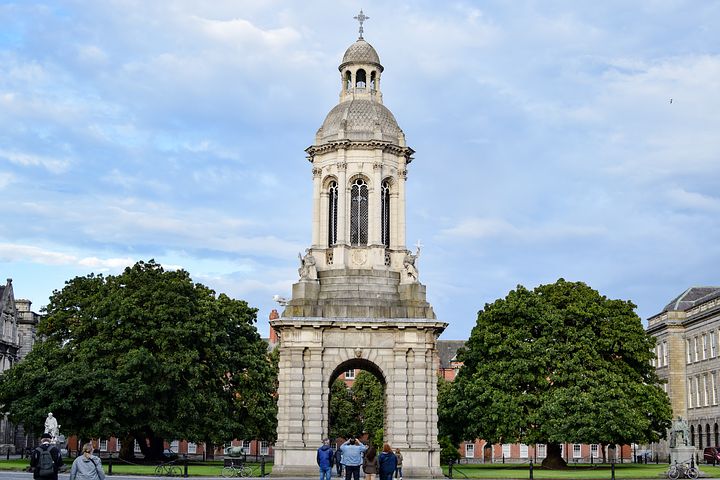
The Campanile welcomes students and visitors to Trinity College.
A majestic Campanile welcomes students and visitors to its beautiful campus. Flanking the Campanile’s rear are two Oregon maple trees, which were reportedly planted before 1850 from original seeds that were presumably taken back from the New World.
A life-size statue in marble of George Salmon, provost of Trinity College from 1888 to 1904, occupies a prominent space close to the Campanile. His 14 years as provost are described as ‘the golden years’ of Trinity.
According to our learned guide, Salmon is also known as the champion of women, a dubious honor since he apparently opposed the admission of women into the university having pronounced ‘Women would enter the college over my dead body’.
It is ironic that while it was founded by a woman, Trinity College was one of the last in the British Isles to admit women students. It was only in 1892 when 10,000 Irish women signed a petition to give women the same benefits and rights as have been conferred to men that the school finally gave in to pressure. Ireland’s 7th and 8th presidents, and its only two female presidents, Mary Robinson and Mary McAleese, were both Trinity alumnae. Today women constitute 58% of the student body.
Some of the most well-regarded luminaries in the world are graduates of Trinity College: Jonathan Swift, known as the author of Gulliver’s Travels, who later moved to London and got involved in English politics and then was appointed Dean of Saint Patrick’s Cathedral; Samuel Beckett, the acclaimed Pulitzer Prize-winning playwright of ‘Waiting for Godot’ and one of the most influential writers of the 20th century; Edmund Burke, who is best remembered as an early supporter of the American Revolution; to mention just three.
But there’s one name that ought to ring a bell to Californians – that of George Berkeley. He was a philosopher and later became Bishop of Cloyne. His many accomplishments are commemorated at Trinity College with a Berkeley Library and in California with an eponymous city – home of the University of California, Berkeley which has a Sather Tower that’s known as the Campanile. (At this juncture our tour guide noted that it is pronounced Bark-ley, but became Berk-ley in the United States. He also mentioned that, coincidentally, he is here pursuing his doctorate on George Berkeley’s life.)
My main goal in visiting Trinity College was to see the Old Library Building. It houses the Long Room, which may be the most gorgeous and most photographed library in the word, and the Book of Kells.
Called the Long Room because it is the longest single-room library in Europe, at 65 meters in length, it contains over 200,000 of some of the oldest volumes in the library. It is an amazing sight to behold! It is a working library and because the books there are rare, trained staff process requests from readers. Books are then brought to a specific area and care taken so their bindings are not stressed.
However, as in everything nowadays, technology will soon replace actual books being taken out and read – they are currently being scanned for online access. But that just ruins the whole experience, doesn’t it? There is nothing more thrilling for a bibliophile like me, than to hold one in my hands, smell the old leather, turn the fragile pages, and peruse the words written hundreds of years before my time.
The Book of Kells, also known as the Book of Columba, is an illuminated manuscript done in the Insular style. Containing the four Gospels of the New Testament, it is a masterpiece of Western calligraphy and an exemplar of insular illumination. It is regarded as Ireland’s greatest treasure.
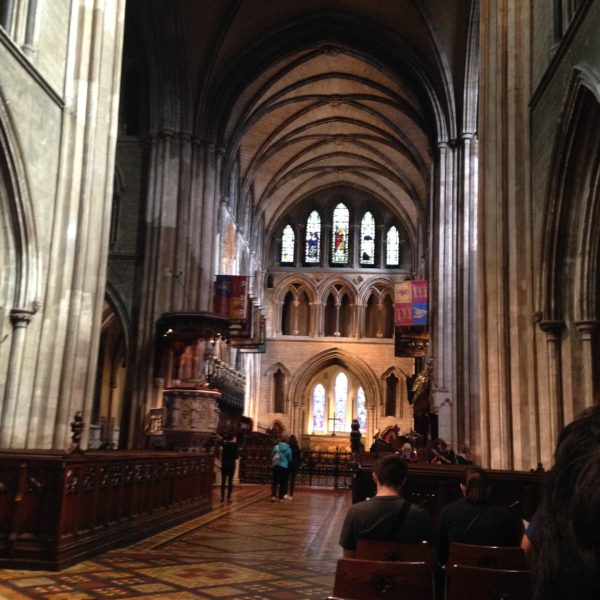
Saint Patrick’s Cathedral’s nave looks like the long part of the cross and the choir, the top part.
A tour of Dublin would never be complete without a visit to Saint Patrick’s Cathedral, the patron saint of Ireland. Built by Luke, Archbishop of Dublin, between 1220-1259, on the site of an ancient well which was reported to have been used by Saint Patrick himself, the cathedral was made from local limestone and stone imported from Bristol.
Constructed like a cruciform, Saint Patrick’s Cathedral’s nave resembles the long part of the cross; the Choir, the top of the cross; and the transepts, the arms of the cross. Its design is thought to be based on Old Sarum Cathedral, near Salisbury, England.
Having visited the Cathedral of St. Patrick, the magnificent landmark Neo-Gothic-style Roman Catholic church on Fifth Avenue in New York City, I thought the Dublin cathedral appeared like a humbler version.
Saint Patrick’s Cathedral in Dublin is still a place of worship today. However, it is also very much a tourist stop, with kiosks selling all manner of souvenir spread throughout the nave. Standing near the apse, I found it difficult to think of Christian values when commercialism was on full display a few feet away.
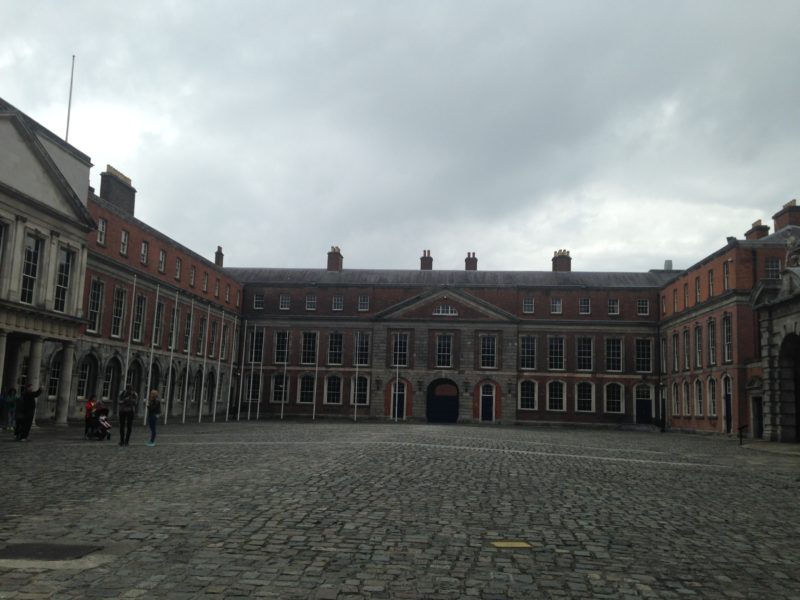
The next place I went to was Dublin Castle on the city center off Dame Street. Built in 1204 on the orders of King John of England on a spot previously settled by the Vikings, it features a typical Norman courtyard design. It has a central square and is bounded on all sides by tall defensive walls and protected at each corner by a circular tower.
Dublin Castle’s center square.
My tour consisted of visiting the state apartments and exhibitions. Saint Patrick’s Hall is the grandest room of the state apartments – it has one of the most important decorative interiors in Ireland. Its most striking feature is a painted ceiling by Vincenzo Valdre. Composed of three panels, it depicts the coronation of King George III, Saint Patrick introducing Christianity to Ireland, and King Henry II receiving the submission of the Irish chieftains. The room is used to this day for presidential inaugurations.
Other rooms worth seeing are: the throne room; the state drawing room; the dining room; and the Wedgwood room.
The most architectural space of the state apartments is the state corridor based on the early 18th century corridor of Edward Lovett Pearce in the former Parliament House on College Green. It showcases a marching procession of top-lit vaults and arches.
While it is an historic tourist attraction, Dublin Castle is a working Irish government building. It is used for state dinners, the most recent one being for Queen Elizabeth when she visited Ireland in 2011. It also hosts conferences.
Next on my walking tour was Dublin City Hall, located on Dame Street, next to Dublin Castle and five minutes away from Trinity College. Constructed between 1769 and 1779 by Thomas Cooley, a young architect from London, the City Hall was originally intended to be the Royal Exchange.
An impressive example of Georgian architecture, for which Dublin is world-renowned, the City Hall has a central entrance hall or rotunda, with a large dome supported by twelve columns. A floor mosaic showing the city arms and motto and marble statues of prominent Irish men grace the rotunda. Today it is used for corporate events and functions.
Not having much time left to enjoy other attractions, I opted to see the rest of the city from the comfort of a city tour bus. Our tour guide was Kiernan, a Dubliner, who gave the most insightful commentary about each stop. I will mention a few places I found personally notable.
Kiernan pointed out that it is almost inconceivable that such a small island could produce so many exceptional scholars and writers, especially when Ireland is perceived as a geographical backwater on the farthest edge of Europe. The Irish pride in their intellectuals is celebrated in the Dublin Writers Museum on Parnell Square North. This restored 18th century building is domicile to letters, books, and other memorabilia of Ireland’s greatest writers – George Bernard Shaw, William Butler Yeats, Samuel Beckett, Oscar Wilde, James Joyce, and Brendan Behan.
Dublin may very well be the only two-Cathedral city anywhere. Saint Patrick’s is the National Cathedral for the Church of Ireland community; and the First Church Cathedral – the original Cathedral of Norse – is the cathedral for the diocese of Dublin and Glendalough, and the seat of the bishop.
Mansion House on Dawson Street has been the official residence of the Lord Mayor of Dublin since 1715. The Round Room to the left of the main building is where the Irish Parliament met in 1919.
The Ha’penny Bridge crosses the River Liffey.
One of Dublin’s most famous attractions is the Guinness Storehouse. Tourists come here to see the site where Arthur Guinness started brewing the drink that bears his name. The highlight of one’s visit is the Gravity Bar where one can see the entire city while imbibing a complimentary pint.
The Irish are also famous for their whiskies. They claim that whiskey was first distilled in Ireland (having just visited Scotland, where, the Scots assert, whisky originated, I found this rather amusing. That they cannot agree on the matter is further reflected in the way they spell the word. The Scottish spelling is whisky while the Irish spell it whiskey). Whiskey is the English translation for the Scottish Gaelic uisge or Irish Gaelic uisce, meaning ‘water of life’.
Celtic Whiskey on 27 Dawson Street does not discriminate; it boasts the most comprehensive range of the drink with Irish, Scotch, and whiskies from around the world. It is staffed with afionadoes who can tell buyers everything they want to know about whiskey.
Teeling Whiskey Distillery on Newmarket Square is the only operational distillery in Dublin. Here visitors can watch the traditional Irish whiskey process.
Jameson Distillery, Bow Street, Smithfield Village offers upbeat and informative tours by personal guides who take visitors from grain to glass. Guided tours, whiskey masterclasses, and premium tasting are available. The tour ends at the gift shop where buyers can purchase a personalized bottle or a memento of their visit.
Grafton Street is Dublin’s premier shopping area. It is also a social and cultural district where buskers and entertainers can be found at all hours of the day.
Ireland’s widest and most famous street is O’Connell St which has been the setting of pivotal events in its history. It is lined with statues commemorating Irish heroes including Daniel O’Connell and Jim Larkin, the central figure in Dublin’s lockout. Here is also where one can find the spire of Dublin, a pin-like monument over 120 meters high.
Convention Centre, Dublin is striking in its modernity.
Dublin is a city of many contrasts. The classic and stately Custom House stands not too far from the carbon neutral-constructed Convention Centre, Dublin, utterly striking in its modernity. The Ha’penny, the iconic iron pedestrian bridge crosses The River Liffey on Aston Quay, while a mile away in the Docklands area there’s the cable-stayed Samuel Beckett Bridge, a stunning masterpiece of structural engineering. Pubs which characterize old stereotypes of Irish culture are mainstays even as ubiquitous stores the likes of Abercrombie & Fitch, Gucci, H&M, and Louis Vuitton flourish, evidence of a cosmopolitan city.
Through it all, you can see that Ireland is a welcoming country. Dubliners are gregarious by nature and are quick to talk to strangers about their infamous weather (it rains at the drop of a hat and stops just as abruptly as it starts). They are happy to give you directions when you’re getting lost (they conjecture their early street designers were probably affected by Guinness fumes). They go about their daily life with an ease reflective of their country’s unspoiled beauty.
Everywhere you go, you observe young people with backpacks slung on their shoulder and earbuds attached to their iPhones walking alongside their older briefcase-carrying counterparts looking down on their smartphones, ready to begin their day. Today’s Dublin feels contemporary and vibrant – it is a city at once in touch with its historic past and set to embark on a promising future.
Originally published on 20 October 2017 in the Pasadena Independent, Arcadia Weekly, and Monrovia Weekly
Marc Alongi, Director of Sequoyah High School in Pasadena, couldn’t be more excited to usher in the new school year. After completing a highly successful first year of establishment, he is ready for the challenge of surpassing what they have achieved.
Enthuses Alongi, “We had a really great year! We didn’t know how it was going to go because we hadn’t done it before. It was all new to us – creating an entire curriculum, hiring faculty for it, adding more grade levels. The question for us was ‘how do we maintain the culture’.
Proof of how successful we were became clear on the last day of the school year. The students were all thrilled to be coming back. We held an afternoon meeting and showed a slide presentation of the past year’s activities. They were all proud of what they have accomplished.
Our students built a fun, curious, and inquisitive culture. It’s hard to do when you’re a teenager and forming really powerful relationships – cliques can develop very easily, it could become exclusive. But they have done a very good job of acknowledging and including each other. It’s a place where everybody is seen and welcomed.
They said they got a lot out of the classes; they loved the student/teacher relationship – being able to have inside jokes and share the things that were funny in class. It’s a sign of a pleasant class experience when teachers and students have a good rapport.
I told them to take a moment to realize that they’re part of Sequoyah’s history as the founding students of the high school. While the new students coming in will still be founding students, they have this particular experience – the very first day, the very first year, and many other major firsts.”
A concern Alongi remembers one student expressing was that it wouldn’t be the same with newcomers arriving this school year. He says, “They were worried that the special composition as they know it will change. There was a real sentimentality there and we discussed that. Even though we’re growing – we’re doubling in size with new students coming in ninth, tenth, and eleventh grade – we can preserve the culture.”
Starting the year off with an all-school camping trip at Pumice Flat campground in the Inyo National Forest | Courtesy Photo
Sequoyah HS joins an elite collection of secondary schools in Pasadena. It offers a rigorous curriculum as all the other high schools but what’s different is the pedagogy. Elucidates Alongi, “We take it to another level beyond lectures in class. We emphasize application of concepts; we want students to articulate and demonstrate what and why it matters; why it’s relevant.
They demonstrate mastery of a subject through exhibitions, which we have twice a year – in January and June. While there are still tests and quizzes, the grand assessment is a project that requires them to creatively use the factual knowledge and skills they gained in the classroom. They have to be able to coherently communicate this with an audience of their parents and other students who didn’t take the class. It’s hard to do and we want to make sure that was presented and valued and celebrated. They came up with excellent exhibits and they also completed an innovation program in their first year.”
Alongi is referring to an integral component in Sequoyah High School’s curriculum – the four-year Social Innovation Program (SIP) designed to develop students’ empathy and desire to be thoughtful, effective collaborators and change-makers.
“The idea behind that is for students to be familiar with social or environmental issues,” says Alongi. “And rather than having a discrete class in tenth or eleventh grade about civics, or economics, or specifically about local policy issues, we want students of our four-year program to become familiar with how communities work – whether that’s the school, Pasadena, L.A., or whatever concentric circle they have.”
“This past year for our ninth and tenth graders we decided to look at the L.A. River because it has a number of issues that are related to it,” continues Alongi. “It has been a very important focus for L.A. and Mayor Eric Garcetti has put together a long-term plan to make the city more sustainable and more just socially and environmentally.”
According to Alongi, the L.A. River presented students with three big areas which they discussed in their group topics.
The first big area was the water quality’s impact on the environment. Students did experiments on different metrics of water, PH level, and turbidity; they tested for traces of metals on murky water. This was exciting for this group because they were able to use what they learned in chemistry class and they were able to relate this to what happened in Flint, Michigan.
A second topic was biodiversity in the watershed. This team examined Devil’s Gate Dam at the Hahamongna watershed near JPL. The dam was created to prevent flooding in the Arroyo which covers the Rose Bowl, the Aquatic Center, and several houses.
“The dam has filled up with sediment, volume has been displaced so it’s less effective and it can be breached,” explains Alongi. “While the easiest solution might be to remove the sediment, other factors have to be taken into account. Over the decades it has become a habitat for wild animals, including an endangered bird. Removing millions of cubic feet of sediment rocks and sand means that there will potentially be 400 truck trips per day for five years once they start the sediment removal.
Our students made a documentary film about it to engage people in the issue so they could be more involved in the decisions being made. They also created a board game using a two-scale model of the dam simulating what would happen if more water goes into the dam. The game gives players courses of action and shows that the choices they make have consequences. They took this board game to several senior centers and a handful of schools. They videotaped the experience of playing the game with older people and students. They even composed original music to go with it. I was very impressed with them,” Alongi beams.
A third topic was housing. The students found out that there was a lot of development going on around the L.A. River. They decided to apply it to the local level and they discovered that Pasadena, in particular, has a shortage of affordable housing. They realized the role of economics behind it – more inventory means less expensive housing.
Students explored the dynamics between tenants and landlords, and examined tenants’ rights. A lot of conflicts can arise from lack of information, so they went door-to-door, talked with a lot of people to find out what they know and don’t know. They ended up producing an 18-page report outlining how to build better tenant-landlord relationships.
Alongi states, “Working on this issue complements the curriculum very well. Questions from humanities come to life when you’re talking to people about being a renter. Economic, political, and social concepts are raised in tenancy issues.
Students aren’t necessarily coming up with a solution, they are learning from complexity and they’re learning how to be creative. The other thing that we emphasize is what’s called design thinking – using design to solve a problem – which has become very trendy in schools.
The simple idea behind it is to do a lot of research, use ethnological scales, talk to people, observe people’s behavior. After collecting all this information, start the brainstorming process. Come up with not one, or two, or five ideas; come up with 50 ideas for what could be strategies to improve some of the issues you identify.
Once you narrow it down to what you feel is the best idea, start to prototype. Create a model or a simulation that you think could be interesting to people, then take it back and get feedback from them. The responses you get are the basis for helping you innovate; you’ll probably get a lot of critical feedback, but maybe something you came up with sticks with people.”
Girls’ volleyball wrapping up a game in the fall | Courtesy Photo
According to RJ Sakai, Director of Social Innovation, this year instead of using the L.A. River as starting point, students will be focusing on a diversity of Backyard Issues beginning in November.
Sakai states, “As they did last year, ninth and tenth graders will work in groups of ten with one faculty facilitator. In the upcoming weeks, faculty members will choose umbrella topics and, with the students who self-elect into their groups, will narrow it down to a specific issue through their research and ideation. They haven’t yet decided on topics but I imagine they might include homelessness, incarceration, transportation, arts & culture, access to green space among other things.
Ninth and tenth graders are spending the first two months of school in a SIP orientation in their Stewardship Committees, which center on topics that help build the Sequoyah community: morning meeting committee; diversity committee; sustainable campus committee, etc. As part of their research and inspiration phases, these committees have spoken with people at KPCC, Grand Performances, and Mia Lehrer + Associates (landscape architects), respectively.”
Eleventh graders are working on an Independent Impact Project. Sakai reports that they have written essential questions to guide their research inquiry for the rest of the fall semester.
Some of the questions they are looking to answer include: How might alternative produce distribution procedures increase exposure and access to healthy food options in underserved L.A. communities?; What could be done to change the disposal methods of medications to make it safe for our environment?; and What physiological effects do microplastics have on living organisms and how do they damage ecosystems?
“In the spring students will begin to prototype ways to intervene in these issues and make a difference. All of our students follow a process of ethnographic research (interviews, field work), synthesis (concept mapping, note taking), ideating (blue sky imaging, sketching), and prototyping (making things),” explains Sakai.
Alongi adds, “Through all their SIP projects what our students learned is that making policy decisions is a balancing act. There are stakeholders who are impacted differently by these issues and there are controversies embedded in them. So that’s part of the learning process – recognizing there aren’t easy solutions. Innovation is simply creative problem-solving, helping bring a constellation of people together around a potential outcome that could be a win, win, win. Maybe we arrive at a solution that isn’t perfect, but is better.
A student team tours the Bowtie Parcel at Glassell Park as part of their work with SIP | Courtesy Photo
The kids are really enjoying this process of problem-solving – that it takes time, constant iteration, and a lot of good research. And it’s also a cycle: sometimes you end up going back to do more research because you realize you’re on the wrong path. It combines hands-on action with thoughtful research and interviewing people, and doing the science or the math.
It’s quite satisfying to see students learn in the real world. Unlike doing a unit in class, the real world is messy. They have to learn how to ask really good questions, figure out who they’re going to talk to, find out what websites to use for their research. The teacher’s role becomes more of a coach to help students wade through all the information.”
Each group is mentored by a faculty member with proficiency on the topic being investigated. Math teacher, Ronnie Bryan, worked with the students who looked into the Hahamongna watershed issue. He helped them calculate volume and scale to complete their project. He has a bachelor’s degree in Brain and Cognitive Science from MIT and a PhD in Computation and Neural Systems from Caltech.
Humanities/English teacher, Ian Chang, who mentored the housing team, was a language arts teacher at Sequoyah before transitioning to the high school where he developed the Humanities curriculum. He has an MFA in Fiction Writing from the Iowa Writers’ Workshop and a BA in English Literature from Swarthmore College.
Laura Haney, science teacher, coached the water quality group. She received her bachelor’s degree in Astrophysics and Math from Barnard College of Columbia University, and her PhD in Astronomy and Astrophysics at UCLA.
Director of Social Innovation, RJ Sakai, graduated with a Cultural Anthropology and Graphic Design degree. He has an MFA in Media Design Practice from Art Center College of Design. His work has led to immersions in Uganda, Cuba, small town Massachusetts, East Harlem, and Los Angeles.
Alongi states with pride, “We have very accomplished and impressive teachers with content expertise who really care about learning. They know how to get inside the minds of different students, and understand what motivates them, how they think, and how to help them become really curious, to do the math deeply, to perform good quality work, and to go above and beyond.”
Nigh its 60 years of founding, Sequoyah School stands by its dictum to impart active citizenship, advocacy for social justice, and environmental stewardship to its youngest students. Today, with the establishment of the high school, it carries on that promise to prepare a mindful, young generation to navigate ambiguity, embrace change, and positively impact global society. That resolve came through clearly during its very first year.
With Alongi leading the way, Sequoyah High School will undoubtedly graduate students who magnificently epitomize the legacy that sets the school apart from all others.
A tale of men’s greed and the common people’s fight against it, ‘The Madwoman of Chaillot’ addresses ecological and environmental concerns – issues that affect us to this day. It is also quite significant that it has a woman as the instigator of the battle, a role usually reserved for men, when it was written at a time when having female leads in theatre was not as commonplace.
Deborah Strang, resident artist at ANW, plays the title madwoman. She says, “Clearly Giraudoux loved women; he had a fondness for the female mind and ability. There was one other play he wrote called ‘Ondine’ that I saw a while back which also featured a female protagonist. Oddly, it was also directed by Stephanie Shroyer.”
“I am very excited to be playing the ‘Madwoman of Chaillot’. First and foremost because it’s by Giraudoux, who’s an incredible French playwright and I have never done one before. So it got me particularly intrigued,” says Strang.
“Valency’s translation and adaptation recreates the spirit of the piece,” continues Strang. “It is almost Shakespearean in its rhythm and use of language, the repetition of sounds, vowels, and consonants. It’s very beautiful just to speak it – it’s poetry, almost.”
“It’s an extremely thrilling role for an actor – on every page of the script the madwoman is speaking nonstop. It’s an enormous challenge to carry almost all of the text in the play for two hours. It’s stimulating for my old brain to try to take it all in and comprehend,” Strang states self-deprecatingly.
“That it is being directed by Stephanie, whom I adore, makes it especially fun for me,” adds Strang. “This is the second time I’m working with her; the previous one I did with her was ‘You Never Can Tell’ which we had on stage a couple of years ago.
The way Stephanie puts things together is quite magical. She is a choreographer so she approaches her plays from a dancer’s mind; she directs the actors’ movements in a way that’s electrifying for the audience to watch. It’s exhilarating for actors because it’s like learning to dance; in the movement we discover new ways to explore the text.”
Deborah Strang (left) as Aurelia, The Madwoman of Chaillot; Jill Hill (center) as Therese, Mme. Gabrielle, The Madwoman of St. Sulspice, and Susan Angelo (right) as Paulette, The Madwoman of Passy | Photo by Craig Schwartz / A Noise Within
In ‘The Madwoman of Chaillot’, Strang co-stars with two other female resident artists whom she has known for a long time – Susan Angelo as Mme. Constance and Jill Hill as Mme. Gabrielle – and Veralyn Jones, who plays Mme. Josephine.
“Susan, Jill, and I haven’t been in the same play for some time. So it’s wonderful to work with two of my favorite actresses,” Strang says further. “The fourth madwoman, Veralyn, who is now my new best friend is someone I’ve heard of but have never worked with before. And she’s fantastic! To have four strong women on stage at the same time playing against one another is a rare treat.”
“Classical plays, in general, have more dominant male roles,” Strang points out. “And while ‘Madwoman of Chaillot’ has more men in it, they are the bad guys. Giraudoux may not have set out to create a feminist play so much as to show the underdog winning.”
Written in 1943, ‘The Madwoman of Chaillot’ follows three businessmen in Paris conspiring to destroy the city in order to unearth oil, which a prospector’s sense of smell located in the neighborhood.
However, Countess Aurelia, ‘The Madwoman of Chaillot’, hears about their plot. With an outwardly eccentric behavior but possessing a much common sense, she enlists the help of her fellow outcasts: the ragpicker, the street singer, the sewer man, the flower girl, the sergeant, and various other oddballs and dreamers. She invites them all to a tea party, reminiscent of Alice in Wonderland’s, then sends the greedy businessmen into a bottomless pit that opens out of her cellar.
“It’s a play that is extremely relevant in today’s world,” declares Strang. “When the audience hears certain lines like ‘What would you rather have in your backyard, an almond tree or an oil well?’ or ‘Why would you want a park for children?’, they all identify with the situation. This was true in Giraudoux’s time as it is now.”
“Yet in the end, the audience will have a very good time – it’s wonderful entertainment. They’re going to laugh, maybe think a bit,” Strang says. Then she adds wistfully, “Ideally it will change the world, we’ll be more generous and loving to one another.”